• Skip to main content
  • Skip to primary sidebar
  • About
    • About Art Class Curator
    • Contact
    • Speaking
    • Media & Press
    • Programs for Schools
  • Blog
  • Podcast
  • Shop
  • Join
  • Member Login

Art Class Curator

Hands-on and Minds-curious Art Learning

  • Art & Artists
  • Art Connection Activities
  • Art Teacher Tips
  • Elements & Principles
  • Downloads & Resources
Home
  • About
    • About Art Class Curator
    • Contact
    • Speaking
    • Media & Press
    • Programs for Schools
  • Blog
    • Art & Artists
    • Elements & Principles
    • Art Connection Activities
    • Art Teacher Tips
    • Downloads & Resources
  • Book
  • Podcast
  • Shop
  • Join
  • Member Login

All Posts from Art Curator for Kids

November 26, 2016 Leave a Comment

Ten Intriguing Ancient Artworks from Around the World

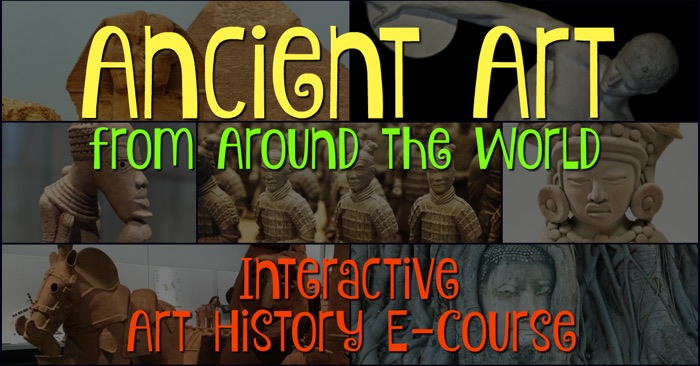
For more information about Ancient Art, check out the eCourse: Ancient Art Around the World eCourse. It is available with your membership to the Curated Connections Library. The students currently enrolled in the course have given me some great feedback!

For more information on the course and to register, click here.
Ancient Art Course FB with Text

Get the Full Lesson!

This Lesson is in The Curated Connections Library!

Find the full lesson from this post along with hundreds of other art teaching resources and trainings in the Curated Connections Library. Click here for more information about how to join or enter your email below for a free SPARKworks lesson from the membership!

Join the List

Get the Full Lesson!

This Lesson is in The Curated Connections Library!

Find the full lesson from this post along with hundreds of other art teaching resources and trainings in the Curated Connections Library. Click here for more information about how to join or enter your email below for a free SPARKworks lesson from the membership!

I thought I’d share with you some of the works of art that you’ll learn about by taking the course.

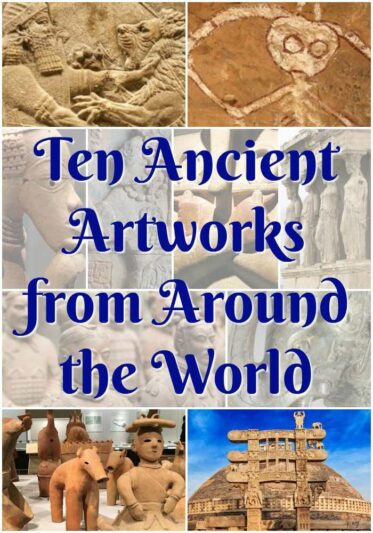
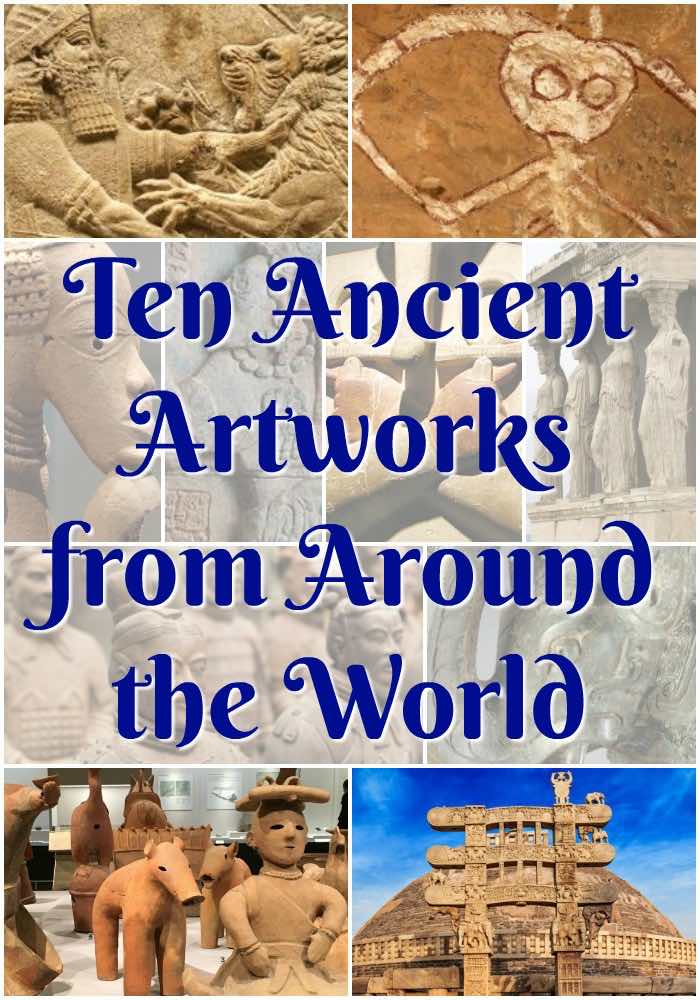
Ten Artworks from Ancient Art Around the World
ten-ancient-artworks-from-around-the-world-the-art-curator-for-kids

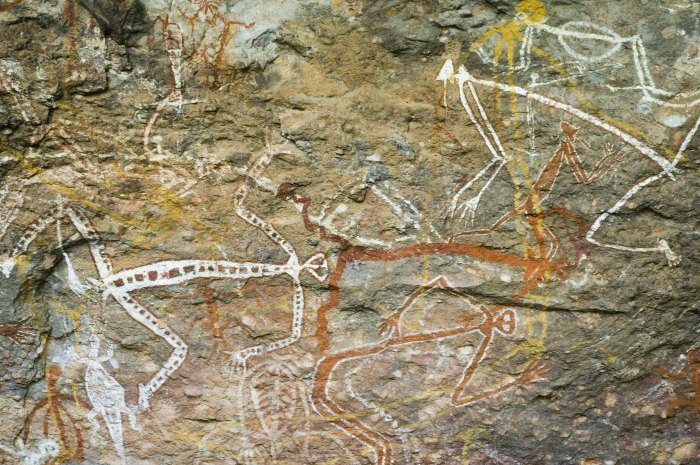
1. Mimih Spirits from Australian Aborigines

Imagine what these little spirits do and better understand the Aboriginal Dreamtime belief system.
austrailian-rock-art-mimih-adobe-stock

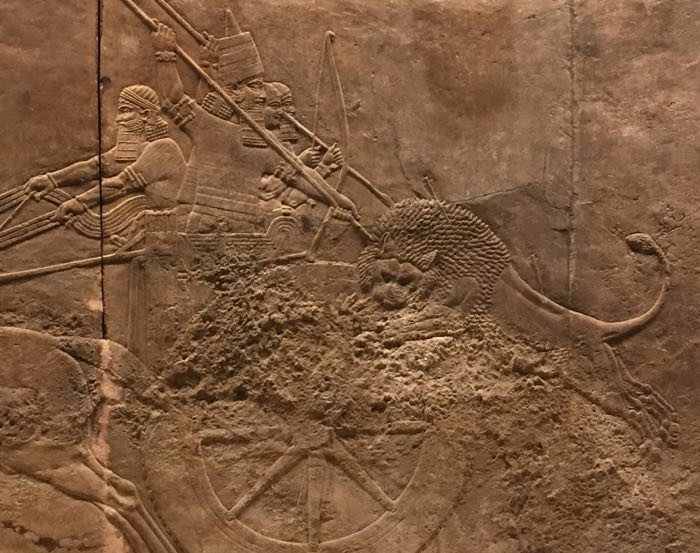
2. Ashurnasirpal II Hunting Lions

Learn how the artists of Mesopotamia used animals to show the power of the king.
Ashurbanipal Hunting Lions3

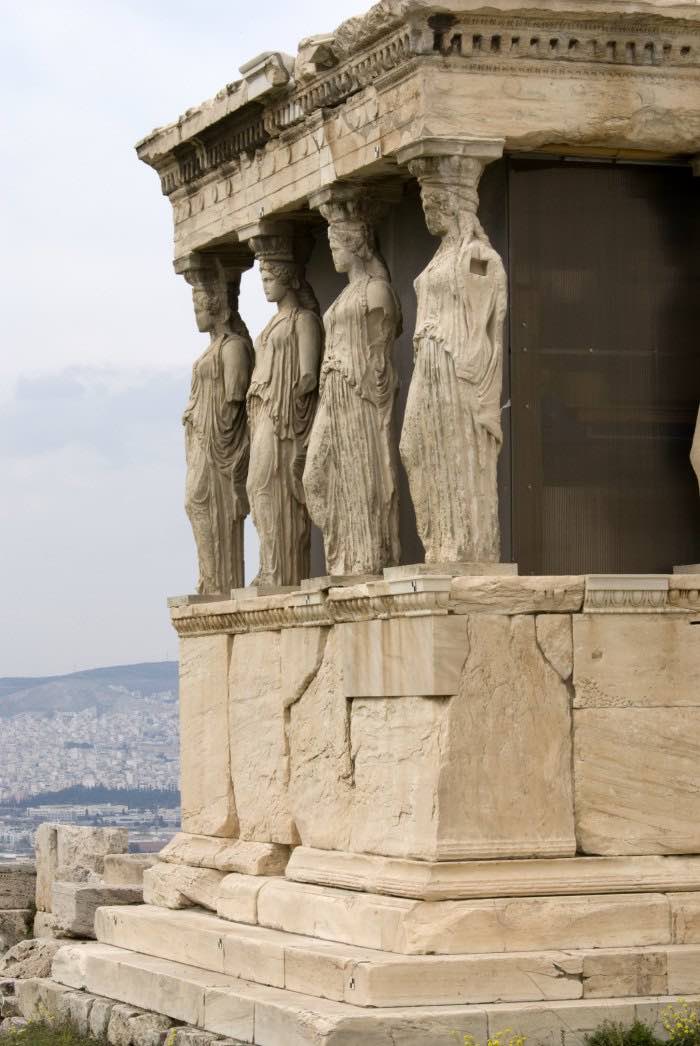
3. The Caryatid Porch of the Erechtheion, Athens

Write a poem that considers how democracy is seen through the art of Ancient Greece.
caryatids2

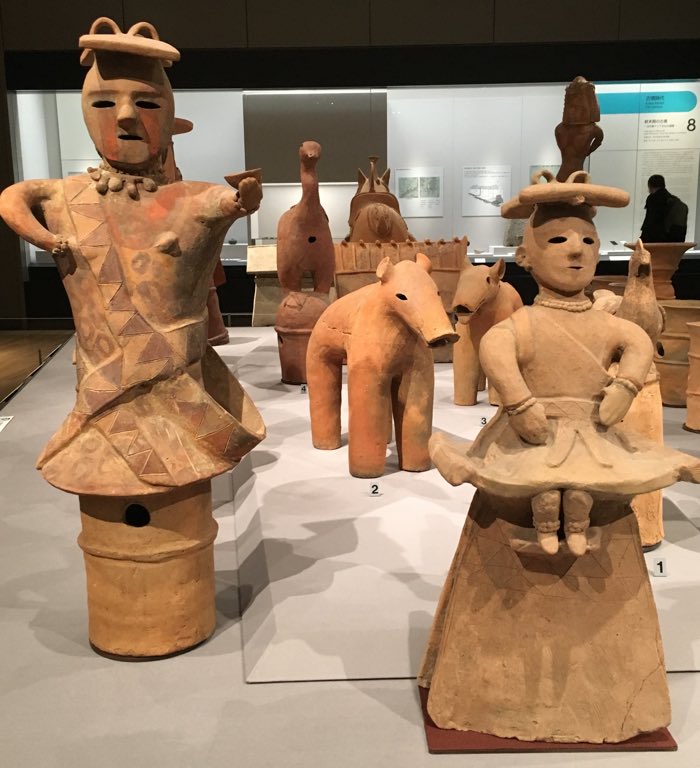
4. Kofun Haniwa

Discover the function and style of these ancient Japanese sculptures through interactive learning activities.
haniwa-kofun-japan-3

5. Nok Sculpture

Explore the conventions of these ancient and mysterious Africa sculptures.
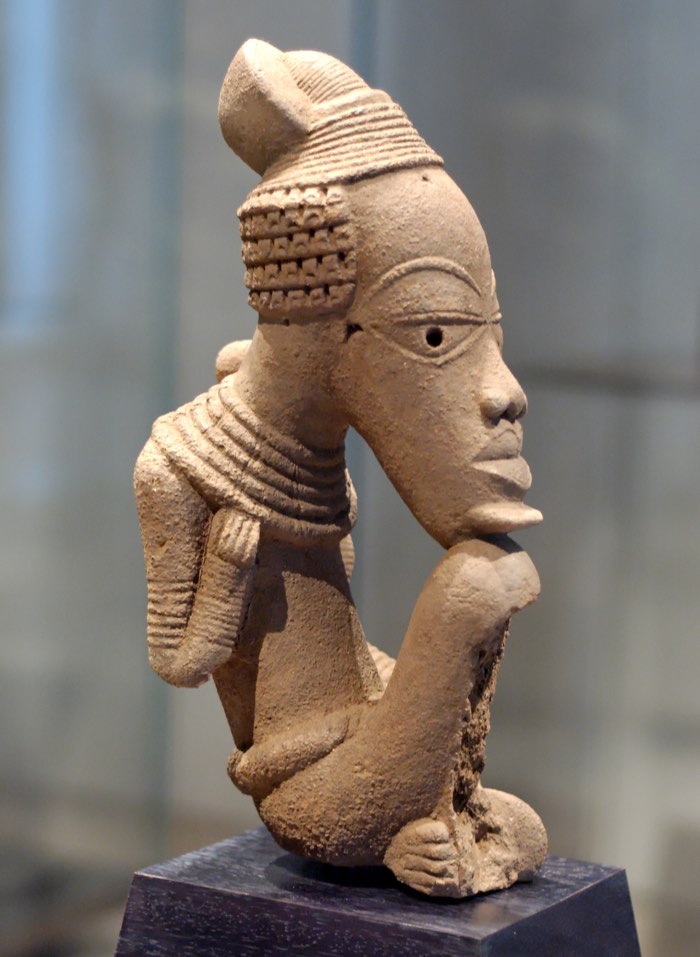
noksculpturelouvre

6. Chinese Bronze Vessel

Search for the zoomorphic designs and then design your own squished animal based on a common stylized design.
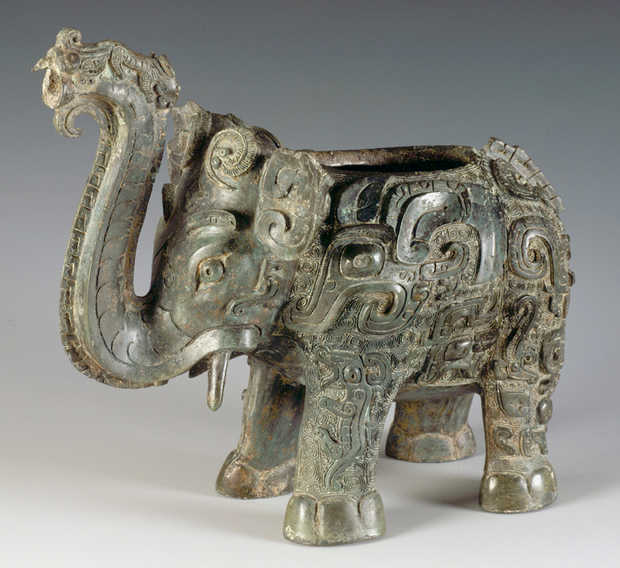
Courtesy of Hunan Provincial Museum This bronze, elephant-shaped Zun vessell dates back to the 12th or 11th century BCE.

7. The Great Stupa at Sanchi

Find out whose remains are buried here and discover the symbols found in the elaborate relief sculptures.
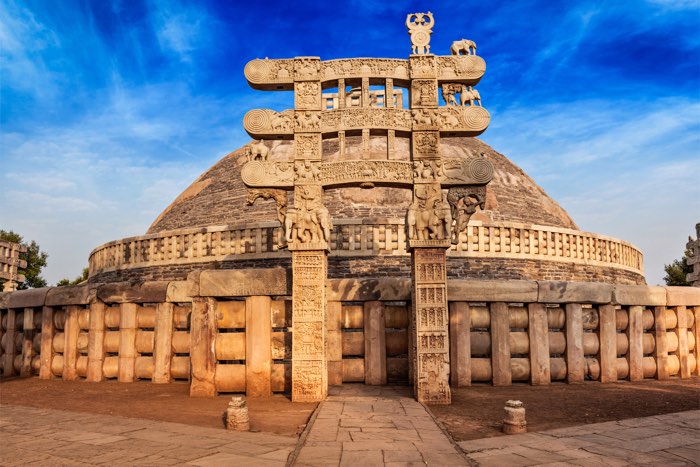
Great Stupa. Sanchi, Madhya Pradesh, India

8. Sensuret I

Analyze a primary source poem about Sensuret I to discover how Ancient Egyptians viewed the afterlife.
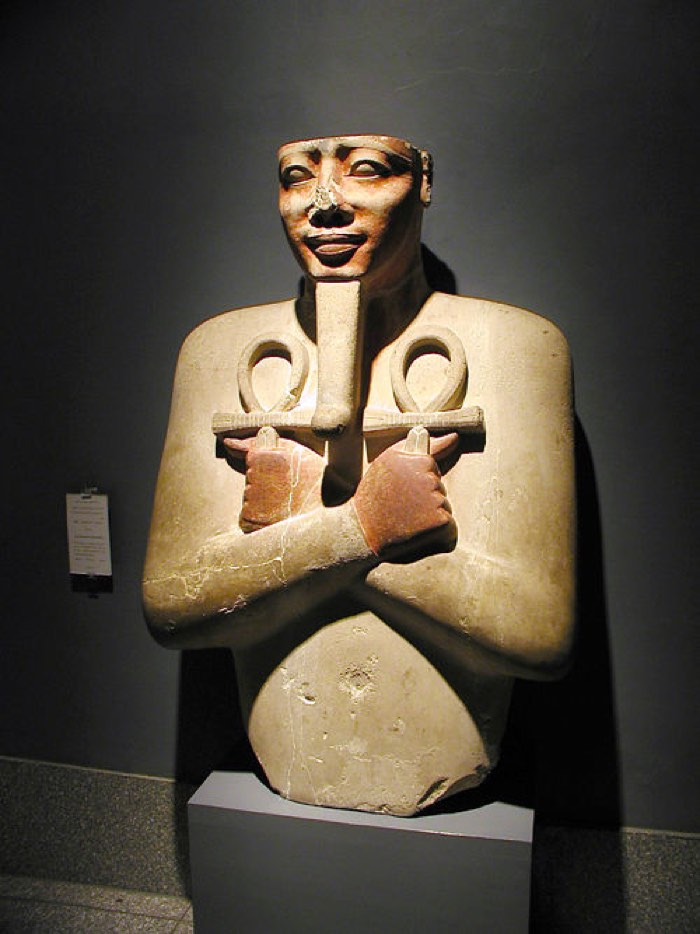
egypt-senusret-i

9. Emperor Qin’s Terracotta Army

Ponder the unfathomable size of emperor Qin’s tomb.
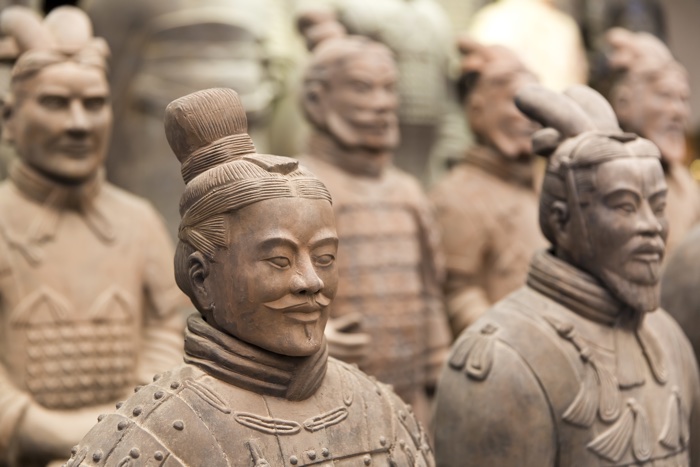
Chinese terracotta army - Xian

10. Mayan Relief Sculpture

Narrate the story from this Mayan relief sculpture to better understand the vast Mayan civilization.
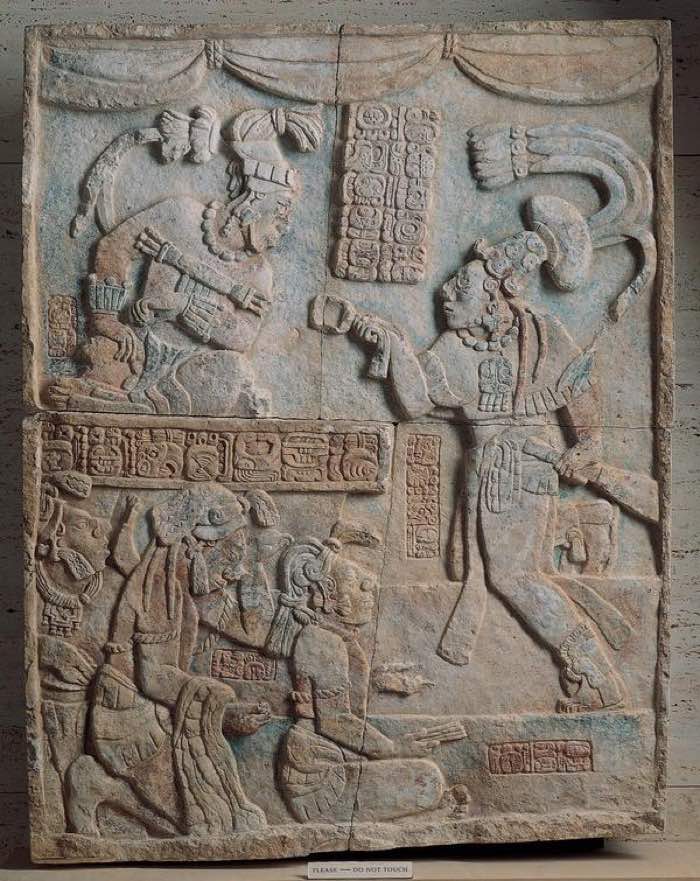
CH1971.07SS

Spend quality time with all of these artworks and more by enrolling in Ancient Art Around the World. As a bonus, you also get lifetime access to the Prehistoric Mini-Course.

Both courses are available through the membership!
How to Study Art History Bundle

This bundle includes all of my favorite resources for art history—interactive activities, in-depth lessons, useful worksheets, trainings and more!
Buy Now

Filed Under: Art and Artists


November 22, 2016 Leave a Comment

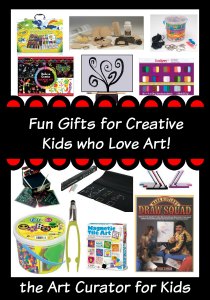
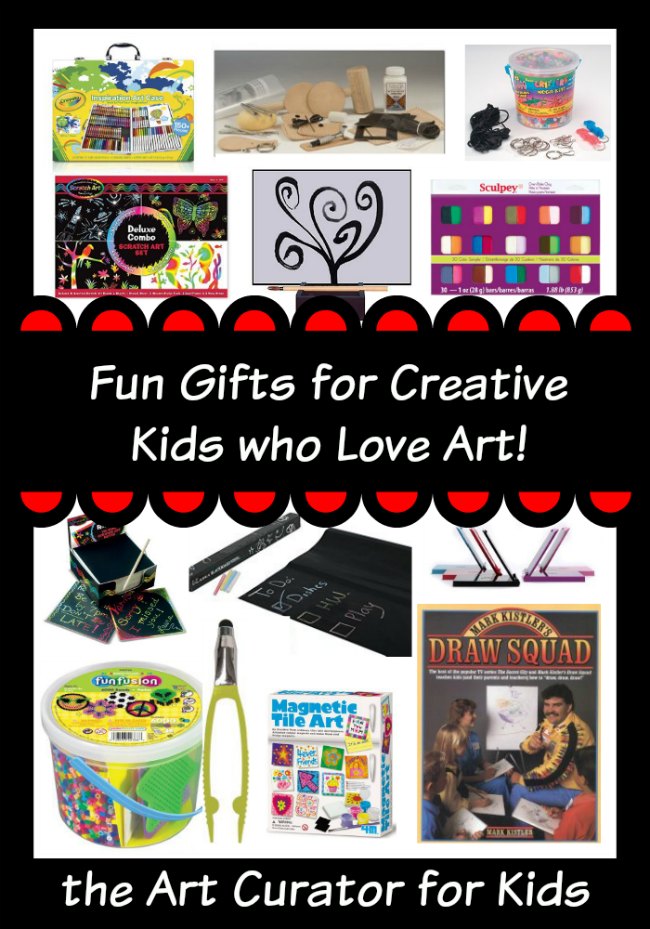
Brilliant Gifts for your Artsy Kid

gifts for artsy kids

Looking for the perfect gifts for artsy kid? Look no further. For this list, I was specifically thinking of gifts for artsy kid, middle schoolers, tweens, and upper elementary artsy kids, ages 8-13. For gifts for artsy teens, check out these two posts: Quality Art Supplies for Teens who Love Art and Manga and Art Gifts for Teens.

gifts for artsy kid

To come up with this list of artsy gifts for kids, I channeled me as a 10 year old. I wish I had a picture scanned of me so you could see my bright red jeans and looney tunes shirt, my red glasses covering half my face, and my big and tall ball of hair-sprayed bangs. You can imagine. It was glorious. These are the things I loved or would have loved.

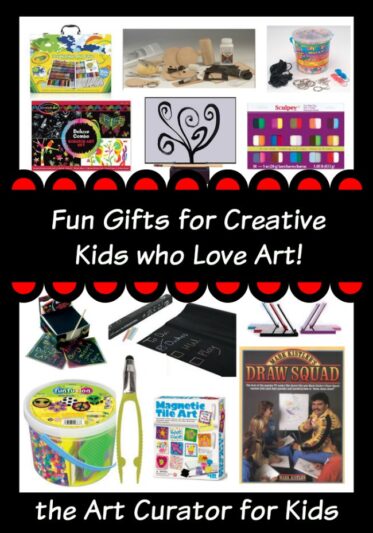
Fun Artsy Gifts for Kid:

  • Magnetic Tile Art – Make your own magnet! Ceramic tiles with paint and magnet backings. I would have LOVED this as a middle schooler.
  • Melissa & Doug Deluxe Combo Scratch Art Set – Scratch art is so fun! I did it with my 3rd-5th graders as a teacher although we made our own scratch paper with crayon and tempera paint. I probably wouldn’t give this to anyone younger than maybe 8 or they’ll soar through all the paper in about 5 minutes. (Here’s a stocking stuffer version! Melissa & Doug Rainbow Mini Scratch Art Notes)
  • Tandy Leather Factory Basic Leather Craft Set – I said before that I am basically making these gift guides for me when I was young. When I was in maybe the 5th grade, someone from the Tandy leather company came to my school and taught us some leather craft stuff. I somehow ended up with some leather crafting supplies, and I have such fond memories of playing with the leather kit at home and making designs in the leather and making stuff. This one is purely on here for me, but if you have a little mini-me (always making stuff, always drawing, always tinkering) in your house, they would love this. I can’t wait until my daughter is old enough for this. She is definitely a mini-me. She is over at her art table gluing beads to stuff as I type. Thanks for listening to me ramble down memory lane. I’m tempted just to buy this for myself.
  • Perler Beads 6,000 Count Bucket – Another thing I LOVED when I was little. I don’t think my mom ever let me do the ironing part. I just did the designs and then dumped it out and did more. You can also get some tweezers to go with it. (They also make a “BIGGIE” version for the little kids.)
  • Kassa Chalkboard Contact Paper with Chalk – I would’ve put this up on my wall next to my tiger beat posters and written “I love Jonathan Taylor Thomas on it.”
  • Original Buddha Board – I had one of these when I was young, and it was so fun! And bonus, you can practice the brushstrokes in the Chinese brush painting we learned about last month. 🙂 (Here’s a stocking stuffer version! Mini Buddha Board – Red)
  • Mark Kistler’s Draw Squad – I can’t believe this is still in print! I lived for this book. I probably should look for stuff not popular in 1988, but whatever. I’m having fun remembering my childhood today. 🙂
  • Crayola Inspiration Art Case – I love the idea of art kits like this, but I’m usually not impressed with the quality of the materials. I was happy to see that Crayola makes one. We can trust Crayola quality! It’s of course cheaper to just buy the stuff separately, but I think a kid would like having these all in a kit they can easily take from room to room or to Grandma’s house.
  • Plastic Pony Bead Mega Critters Bucket – I like this suggest things that are a little more open-ended, but I can’t deny that my 10yo self would have loved making these bead keychains!
  • Sculpey III Polymer Clay, Multicolor – Sculpey is SO FUN. You make little colorful sculptures (or just white and paint them) and bake them in the oven. I remember making a hot dog with a bun that I just loved. I kept it for a long time.

Check our my other gift guides from Art Class Curator! Follow me on Facebook or sign up to receive posts by e-mail to not miss a thing!

This post on gifts for artsy kid was originally published on December 4, 2014.

More Gifts for Artsy Kid:

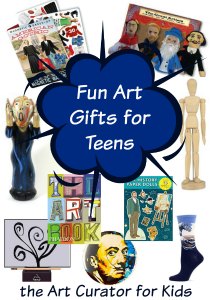
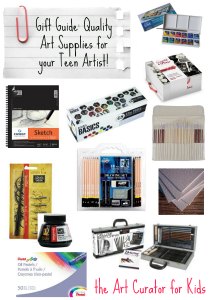
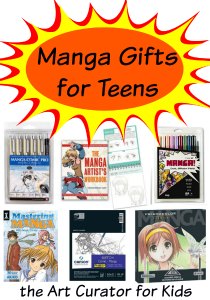
the Art Curator for Kids - Fun Art Gifts for Teens who Love Art-300, art gifts for kids    the Art Curator for Kids - Art Gift Guide - Quality Art Supplies for Teens who Love Art - Holiday Art Gift Guide, art gifts for kids     the Art Curator for Kids - Manga Gifts for Teens. art gifts for kids
If you like this post, you may also like:

the Art Curator for Kids - Manga Gifts for Teens-300the Art Curator for Kids - Fun Art Gifts for Teens who Love Art-300the Art Curator for Kids - Fun Gifts for Creative Kids who Love Art, Ages 8-13, Art Gifts for Middle Schoolers, Art Gifts for Tweens, Art Gifts for Elementary-300The Best Gift Ideas for Art Teachers - Don't forget your art teacher this year!eBay Guide - The Art Curator for Kids - One-of-a-kind Gifts for the Art Lover in your Lifethe Art Curator for Kids - Art Gift Guide - Quality Art Supplies for Teens who Love Art - Holiday Art Gift Guide-300
 

Filed Under: Art Gift Guide


November 14, 2016 Leave a Comment

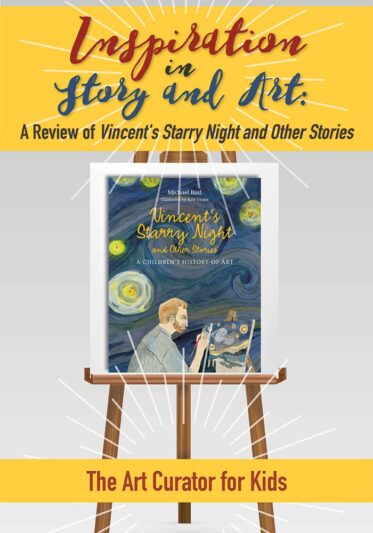
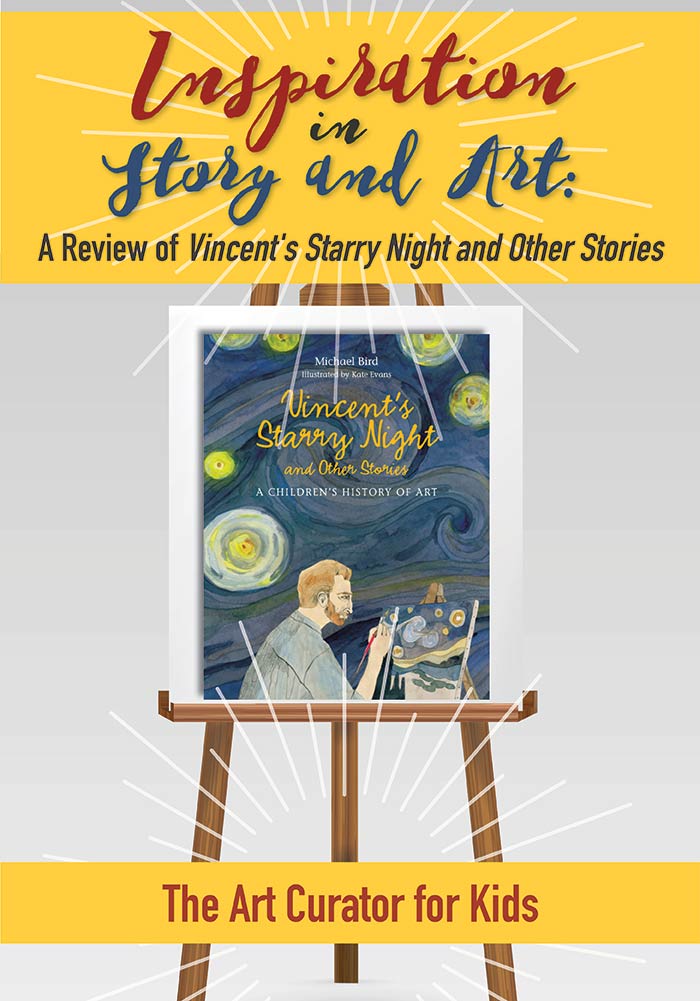
Inspiration in Story and Art: A Review of “Vincent’s Starry Night and Other Stories”

“Welcome to the Art Show!”

“Welcome to the Other Art Show!”

“Welcome to the Other Other Art Show!”

So state the signs on three walls of our townhome, most of which are covered with our five-year-old daughter’s artwork. The “every wall is an art gallery” decorating scheme is not for everyone: it’s cluttered and colorful, occasionally weird. But in a small house, especially, concessions must be made for kid-friendly space, and lines blur between living and playing and learning. And we draw, paint, and/or make something just about every day, including more ephemeral creations in Play-doh, blocks, and, occasionally, pantry items.

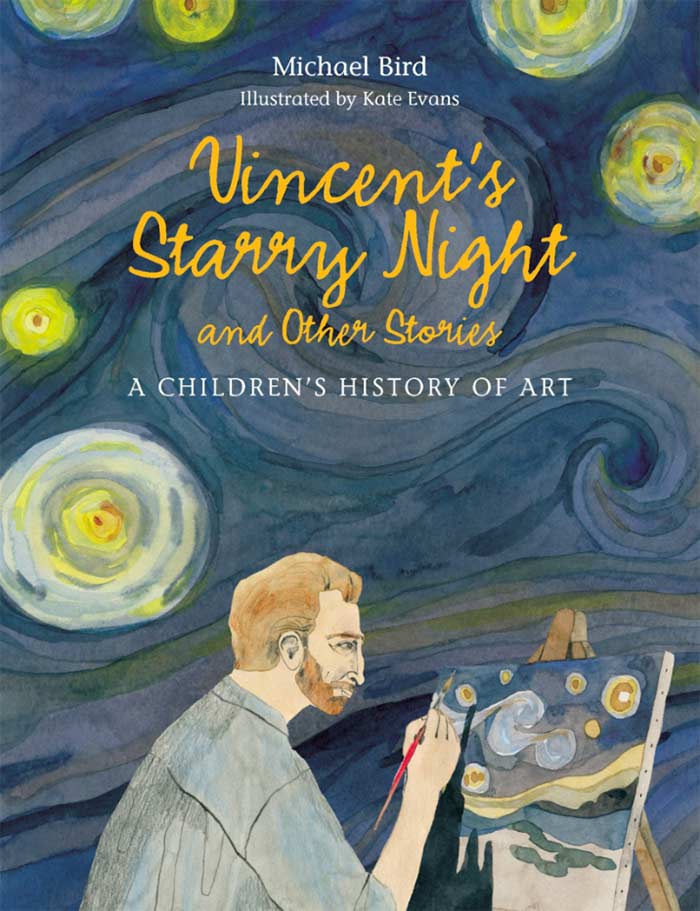
Yesterday, powdered cinnamon played a central role in our art-making (it smelled like autumn – bonus!) The inspiration was an early entry in the recently published book Vincent’s Starry Night and Other Stories: A Children’s History of Art, written by Michael Bird and illustrated by Kate Evans. At home or in the classroom, the book beautifully brings together story and art.

Please note, this post includes Amazon affiliate links. As an Amazon Associate I earn from qualifying purchases.

vincents-starry-night-and-other-stories-main-image

This book is great intersection of passions for us, because if there is one category that outpaces art-making in our house, it’s stories – and this book combines both. (Overlapping categories…ah, a theme we know well, says a countertop currently housing a Lego building, a stone-polishing project, a drying button bowl, and pita bread in progress.) The book offers short stories about artworks, artists, and eras that are great for combining art and story.

Vincent’s Starry Night and Other Stories takes a narrative approach to a world art survey, prehistoric past to present. Sixty-eight short chapters comprise this dense world art tour (heavy on the Europeans, it must be noted, but including more than a half-dozen Asian, Latin American, Middle Eastern, and African artists and cultural traditions). Perspectives and approaches change with each entry, making each a surprise in approach and content. Integrating literacy and art, each entry brings to life artists and their art with personal stories set in broader historical and cultural contexts. I was surprised to learn something new with every entry! The stories skew toward middle- to older-elementary school-aged children (the book listings state that it’s for ages 8-14) but my kindergartner kept up and enjoyed looking for artists she knew. Learning through story about artists and their inspirations also prompted her own explorations.

Vincent's Starry Night and Other Stories: A Children's History of Art, written by Michael Bird and illustrated by Kate Evans; Lawrence King Publishing, 2016
Vincent’s Starry Night and Other Stories: A Children’s History of Art, written by Michael Bird and illustrated by Kate Evans; Lawrence King Publishing, 2016

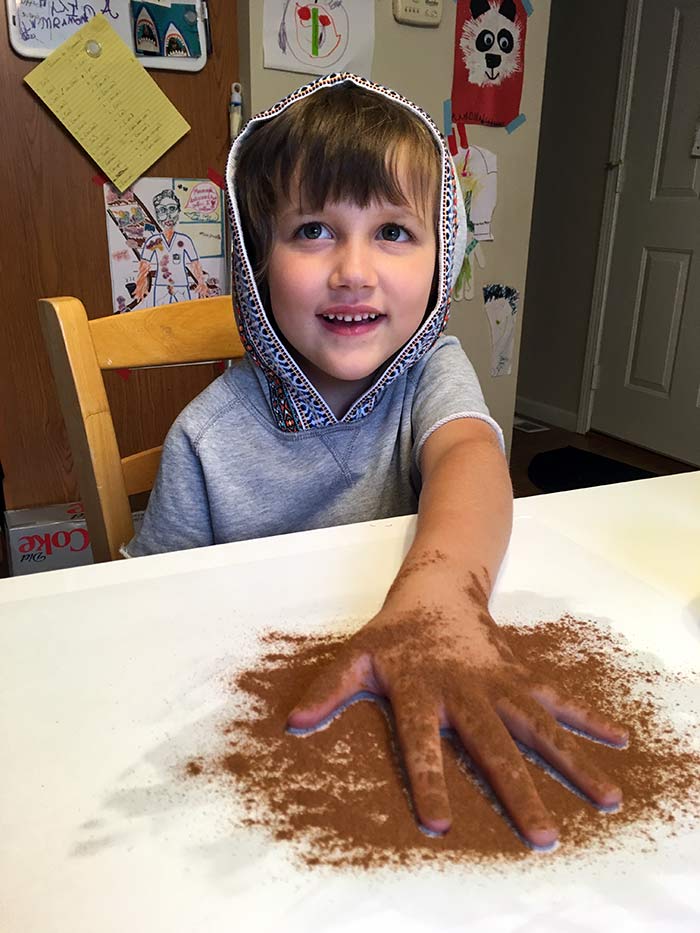
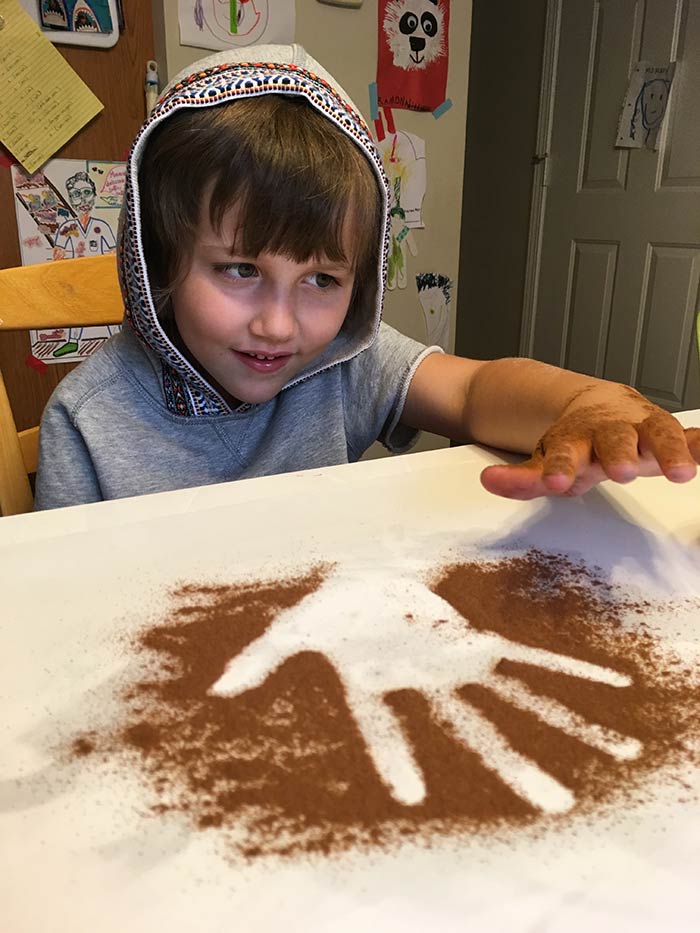
In the second chapter of the book, we read that women and children took part in making early cave art, as determined by the size of painted handprints in Chauvet Cave, France (dated to 32,000-30,000 BCE). Prehistoric people painted their palms to create traditional prints, and made reverse outlines by mixing dirt in their mouths and spit-blowing it over their hands. We decided to try our hands – literally – at making similar outlines. We brainstormed ideas for materials – powdered tempera color, whole wheat flour, sugar (my daughter’s favorite) – and settled on cinnamon as our “paint.” The shaker on the spice container would dispense it nicely. But how to get the cinnamon to stick to the cardboard so we could see the results? Vegetable oil! We couldn’t find a cave, more’s the pity, and my partner was not in favor of applying spices to the walls, so we used thin packaging cardboard as our canvas (white on one side and kraft-paper brown on the other).

r-with-cinnamon-on-hand

r-lifting-hand-from-cinnamon

It was fun to experiment, to discuss whether and what we would consider putting in our mouths to blow against our hands to create the reverse print, as did our cave art ancestors of thirty thousand years ago. My kid was still sure she would use sugar for such a technique.

Given her age, my daughter was drawn less to overviews about eras and places (the Parthenon in Athens is a lovely page, though, and she did enjoy the map of Paris because she recognized numerous landmarks). But the book is both reference and storybook, describing methodologies and history inside of character-driven short narratives. We both enjoyed a story about a Yoruba girl whose skilled metalsmith father is making a bronze head sculpture of a king. I learned about casting methods, and my daughter cheered on Abebi, a girl who wanted to become an apprentice, like her brothers, in a male-dominated art.

As a former media and communication professor, I was happy to see a nod to Eadweard Muybridge, who created the zoetrope (or “zoopraxiscope” as he called it) – an introduction to film aa art. My daughter immediately understood that Muybridge’s “A Horse in Motion” was like her GoldieBlox “Movie Machine.” Connections like these are moments that I live for – not because I’m trying to raise a future Jeopardy! contestant, but because I’m thrilled about the opportunities in creative STEAM (science, technology, engineering, art, medicine) thinking for hands-on learning.

The informative stories in this book do so in narrative form, requiring attention to contextual information. For the intended audience, this is a welcome strategy – a different format than many contemporary art history books intended for children, which tend to organize information into fact blurbs. The stories and illustrations in Vincent’s Starry Night require attention to detail, to making guesses and asking questions about time period, society, personalities, the role of artists and artisans in sharing culture, mediums, etc.

Not all of the stories are happy ones; Jacques-Louis David’s paintings during the time of the French revolution were a bit too grim to read aloud just yet, as was the following entry about Goya’s work in documenting war scenes. We discussed the challenges that women have faced as artists when reading the chapters on painter Berthe Morisot and sculptor Camille Claudel. Several stories left my daughter and I feeling cut off, with less resolution to understanding than is usually comfortable in stories for children. But that’s okay, too – there is conversation to be had about understanding stories in their historical context. We also talked about point of view in stories and in art, because the narrative voice changes in these stories.

I would love to know how long it took illustrator Kate Evans to produce her lovely watercolors this book. Her understated colors and textures give the stories a through-thread even as narrative voices, geography, time periods, and cultural contexts change, weaving a sense of connection through this broad survey.

The last chapter, about Ai Weiwei’s sunflower seeds, provided a wonderful opportunity to talk with my daughter about the eternal question “What is art?” and to explore more about processes of making art. (How many people does it take to paint tens of millions of tiny porcelain sunflower seeds? Oh, around 1,600! People in the small Chinese city of Jingdezhen who helped in any of the nearly 30 steps required to create the small seed sculptures will not soon forget the experience!) We decided to try to create a few sunflower seeds of our own with a quick-dry sculpting medium. Making the simple shape was more difficult than I anticipated – Ai Weiwei’s team used molds for the porcelain – but we made a half-dozen seeds and tried decorating them with black markers, watercolor pencil, and tempera paint. So many entry points into one work, with one story.

r-decorating-seeds

sunflower-seeds-in-hand

To quote Ai Weiwei, “Art is a tool to set up new questions…” And this book sets up familiar and new questions in accessible ways.

I always jump at new books about art and artists when I spot them in our local library, and Vincent’s Starry Night and Other Stories takes its place among beautiful books from the past few years that we’ve renewed again and again:

  • Dorothea’s Eyes, written by Barb Rosenstock and illustrated by Gerard DuBois
  • Balloons over Broadway: The True Story of the Puppeteer of Macy’s Parade by Melissa Sweet
  • Matisse’s Garden, written by Samantha Friedman and illustrated by Christina Amodea, with artwork by Henri Matisse (I also like Jeanette Winter’s Henri’s Scissors)
  • Cloth Lullaby: The Woven Life of Louise Bourgeois, written by Amy Novesky and illustrated by Isabelle Arsenault
  • A Splash of Red: The Life and Art of Horace Pippin, written by Jen Bryant and illustrated by Melissa Sweet
  • Jake Makes a World: Jacob Lawrence, a Young Artist in Harlem, written by Sharifa Rhodes-Pitts and illustrated by Christopher Myers
  • Kid Artists: True Tales of Childhood from Creative Legends, written by David Stabler and illustrated by Doogie Horner
  • Me, Frida, written by by Amy Novesky and illustrated by David Diaz (the paperback edition was published last year)
  • A World of Your Own by Laura Carlin

Rachel Lapp Whitt is a designer and editor currently in Illinois who works with clients of all sizes, from small businesses to national health care companies, bloggers to bed-and-breakfasts, nature centers to recording artists. She previously worked as a journalist and in public relations, and taught college-level Communication and Media courses emphasizing multicultural and feminist studies. Her great love is her daughter, and then coffee, children’s books about artists and women making history, street art, outsider art, design and art blogs, cooking shows, and a refill on that coffee. 

Filed Under: Art Connection Activities


November 5, 2016 9 Comments

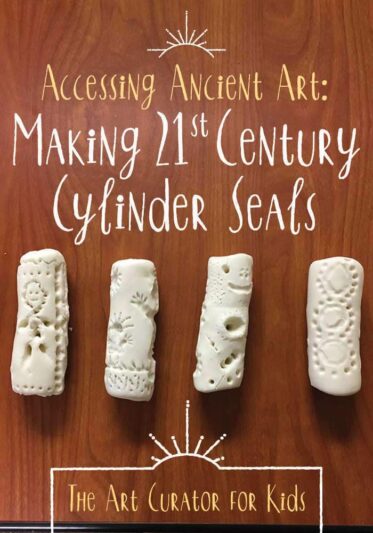
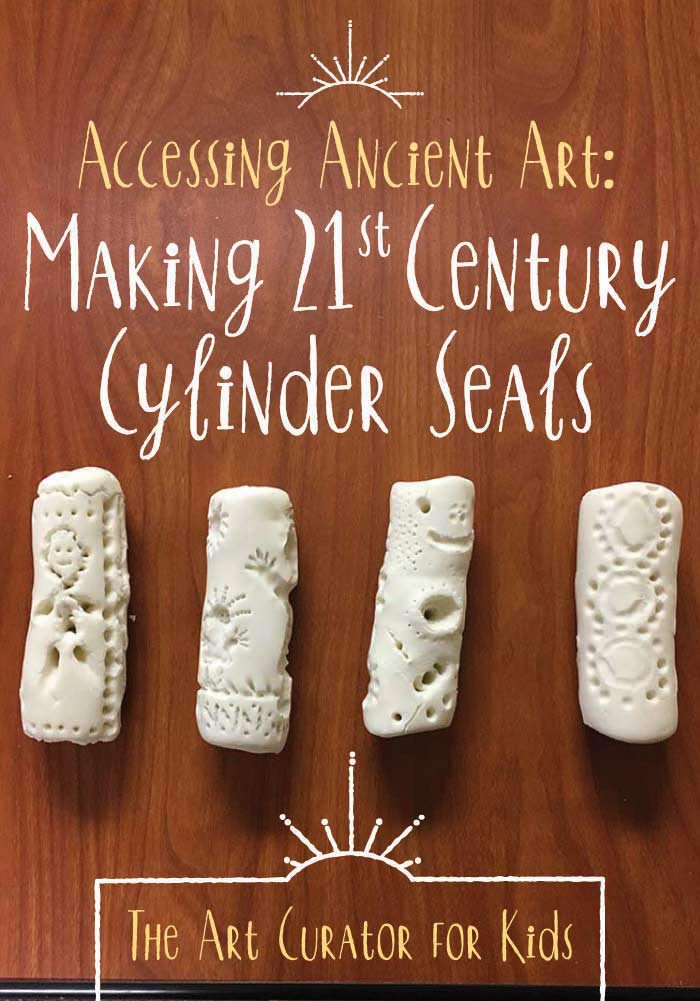
Accessing Ancient Art: Making 21st Century Cylinder Seals

My ninth graders are studying the art of Ancient Sumer. I love teaching about ancient art of Mesopotamia – see my 5-Minute Art History Series: Sumerian Art of Mesopotamia video blog post and in The Art of Ancient Sumer, in The Curated Connections Library.

Get the Full Lesson!

This Lesson is in The Curated Connections Library!

Find the full lesson from this post along with hundreds of other art teaching resources and trainings in the Curated Connections Library. Click here for more information about how to join or enter your email below for a free SPARKworks lesson from the membership!

Join the List

Get the Full Lesson!

This Lesson is in The Curated Connections Library!

Find the full lesson from this post along with hundreds of other art teaching resources and trainings in the Curated Connections Library. Click here for more information about how to join or enter your email below for a free SPARKworks lesson from the membership!

accessing-ancient-art-making-21st-century-cylinder-seals

There are lots of entry points for this time period – cuneiform (one of the earliest written languages!), architecture (ziggurat temples!), astronomy (early constellation maps!), the wheel (the WHEEL!). The Sumerians invented for themselves a wide variety of things, from irrigation systems to sandals to sailboats. We know about this partly because they also created one of the first written languages – an incredible shift in history in the region and beyond.

Jemdet Nasr period cuneiform tablet, Mesopotamia (probably from Uruk), ca. 3100–2900 B.C.

Cylinder seals

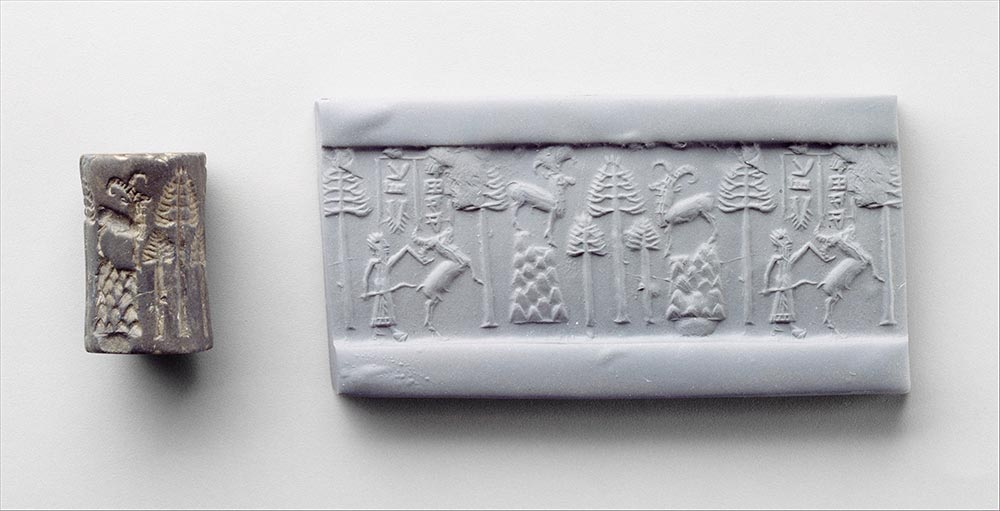
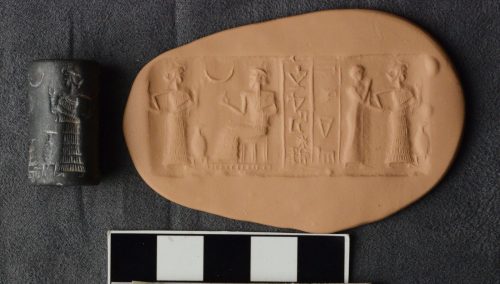
Sumerians also created the cylinder seal by combining wheel technology with a picture story to create a uniquely artistic and useful “signature.” These could be used by merchants, builders, artisans, account keepers, and in governance. First developed sometime around 3500 BCE, the cylinders were made out of stone, glass, or clay, and featured a design carved into the side. The design might be figures, a scene of some sort, or have cuneiform markings. We have a glimpse into what was considered important to society at the time in pictographs and text. The cylinder could be rolled over wet clay to make an impression. Unlike stamps developed earlier, cylinder seals could cover a larger area.

Akkadian period Cylinder Seal, Mesopotamia, ca. 2350–2150 B.C.
Sumerian cylinder seal, Presentation before a god, 2112-2004 B.C.E.

The cylinder seals were used as signatures to mark tablets, building bricks, or other property. A hole through the middle of the cylinder made it wearable as jewelry or an amulet.

Making a cylinder seal

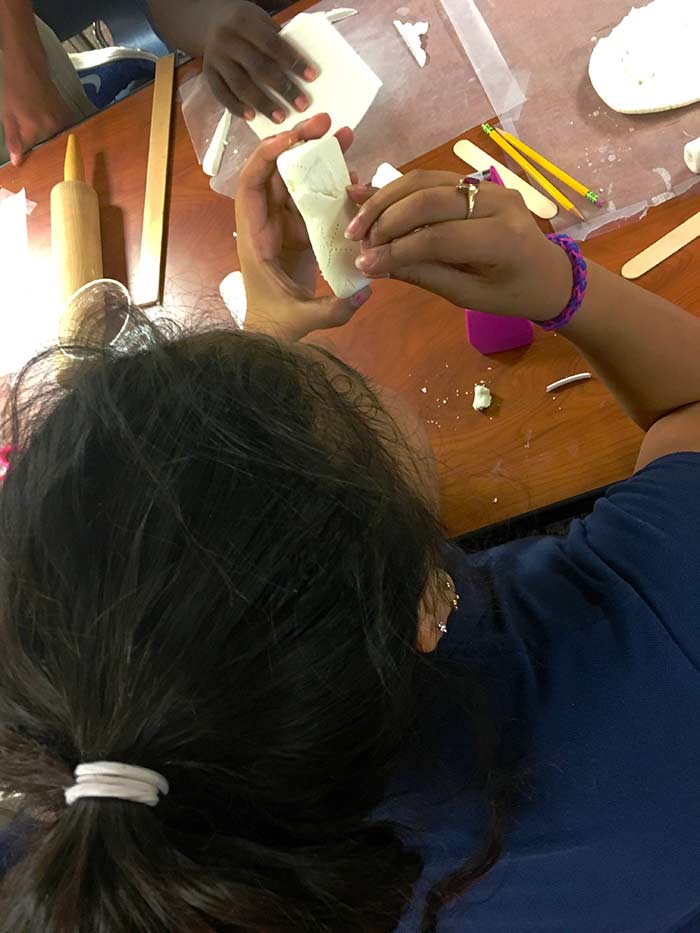
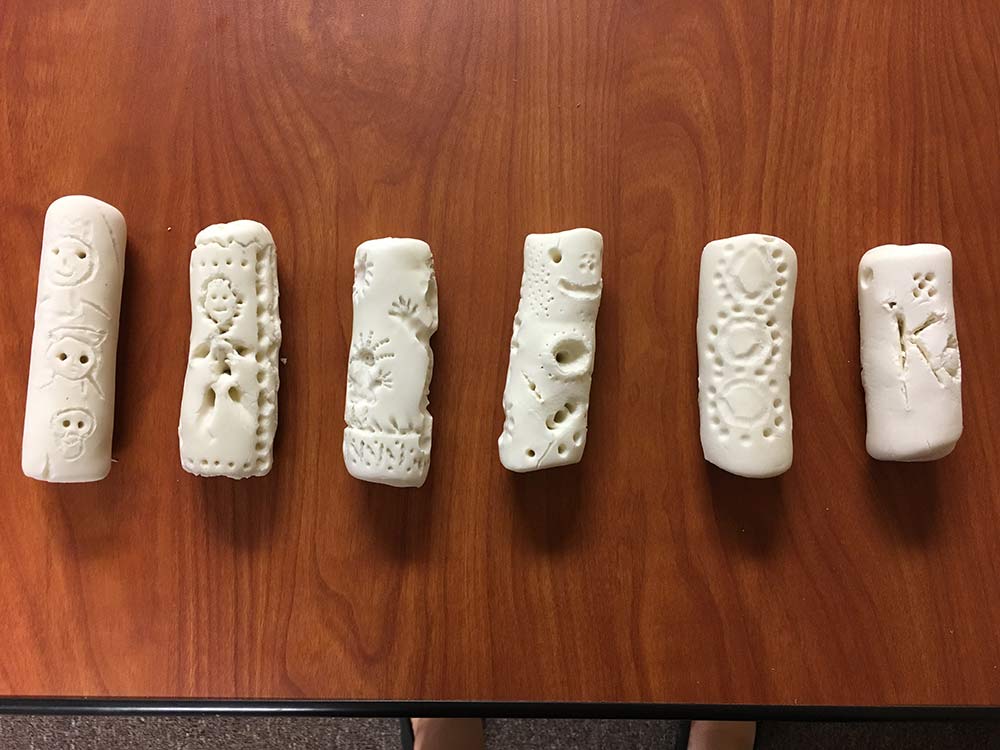
As I’ve said before, knowing and experiencing how artworks were made helps you have a better connection with and understanding of them. My ninth-graders made their own cylinder seals by using air-dry clay. We used Sculptit, which comes out the container in cylinders – very handy! – then tried pencils, thumb tacks, the end of brushes, basically anything we could find, to carve into it.

student-carving-cylinder-seal

We let the cylinders dry, and then rolled them out on to slabs of clay.

student-cylinder-seal-show-roll

After this we may paint them, because a lot of the relief sculptures from ancient art are painted – though the paint has faded from the examples we have – and I want students to see the difference.

student-made-cylinder-seals

Questions to ask students as part of this process:

  • What can we learn by making and trying out cylinder seals?
  • What are different situations – in different jobs, government functions, etc., – that Sumerians might have used cylinder seals?
  • What materials do you think made for the best cylinder seals, in terms of ease in carving, ease in printing, and durability? (STEAM question!)
  • How are cylinder seals an example of form and function?
  • What kind of markings, pictograph, or other type of visual signature would you create to represent yourself?
  • What are modern examples of symbols that we use to identify ourselves – in marks we make, jewelry we wear, screen names and avatars, etc.?

Filed Under: Art and Artists


October 20, 2016 7 Comments

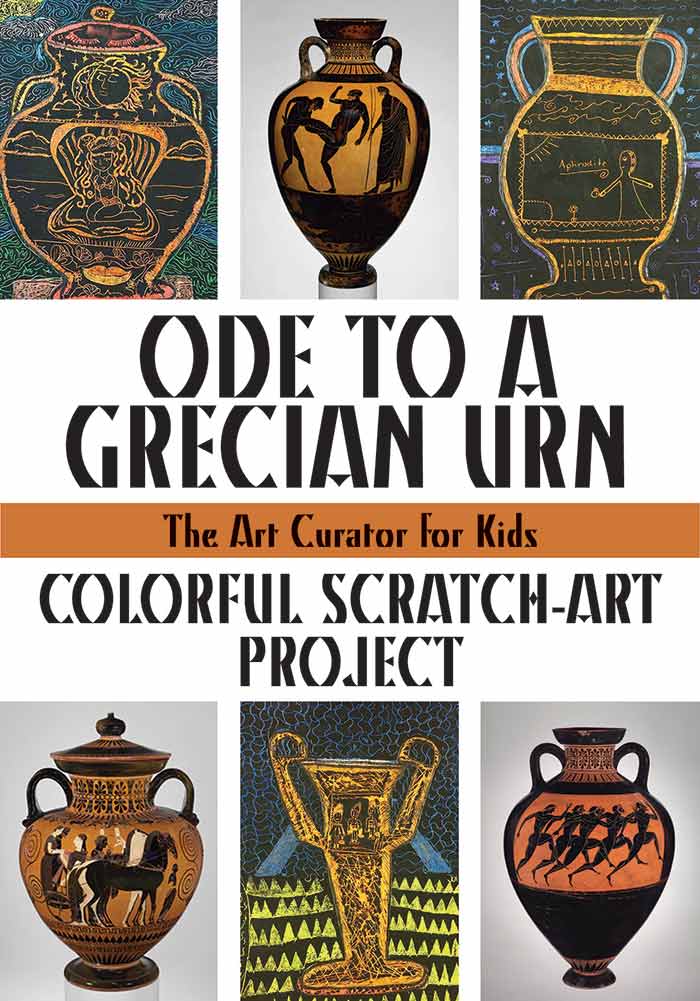
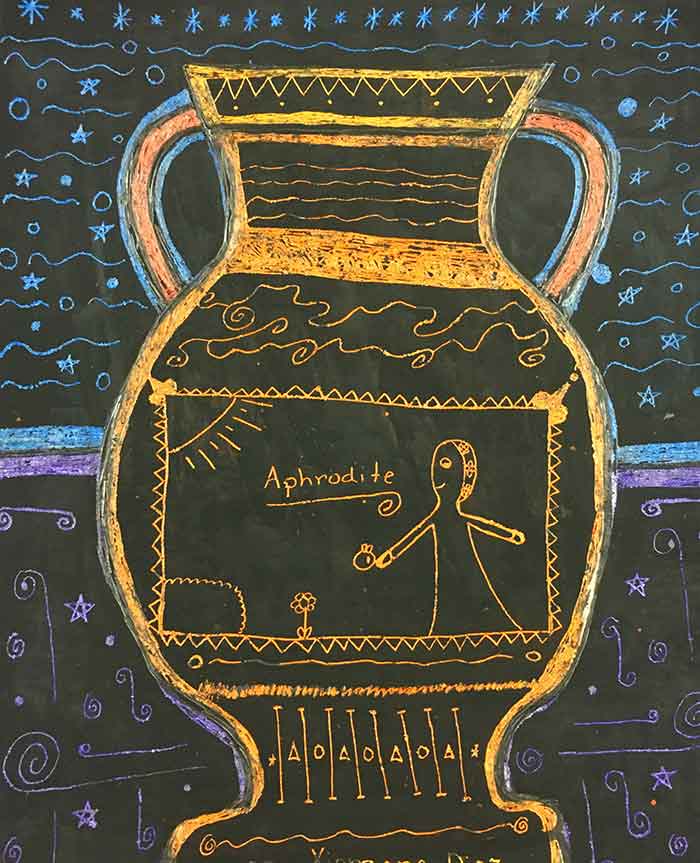
Ode to a Grecian Urn: Colorful Scratch-Art Project

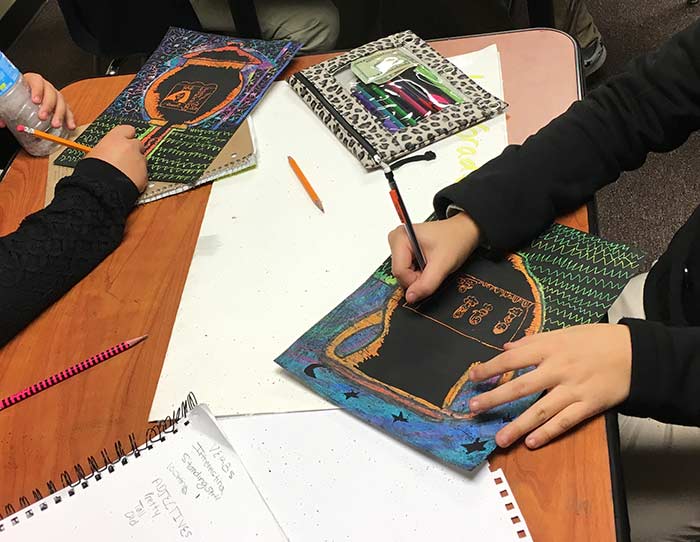
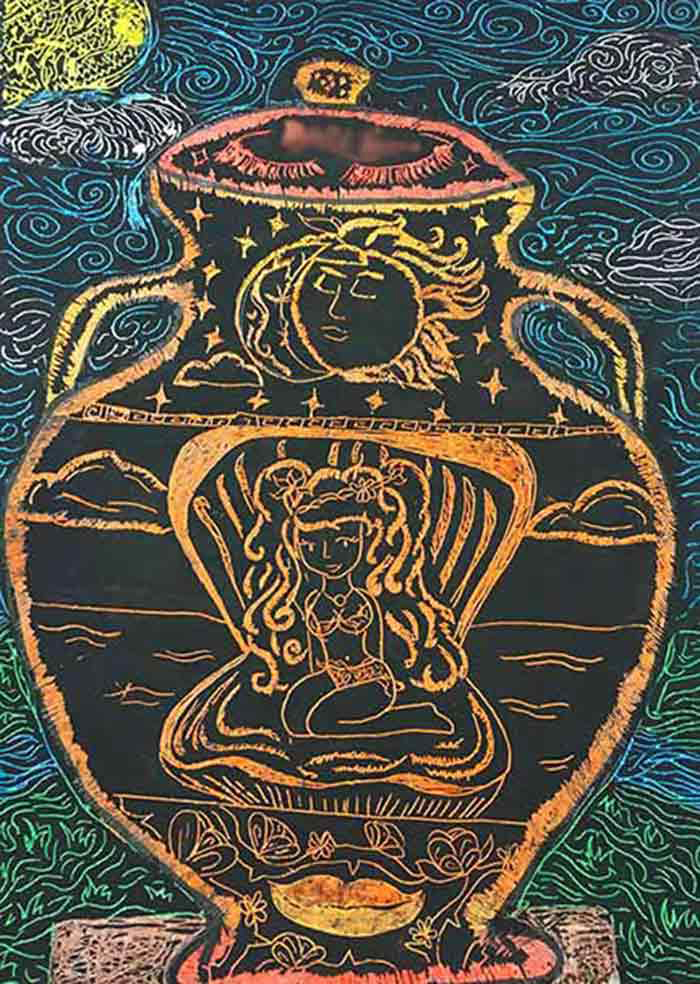
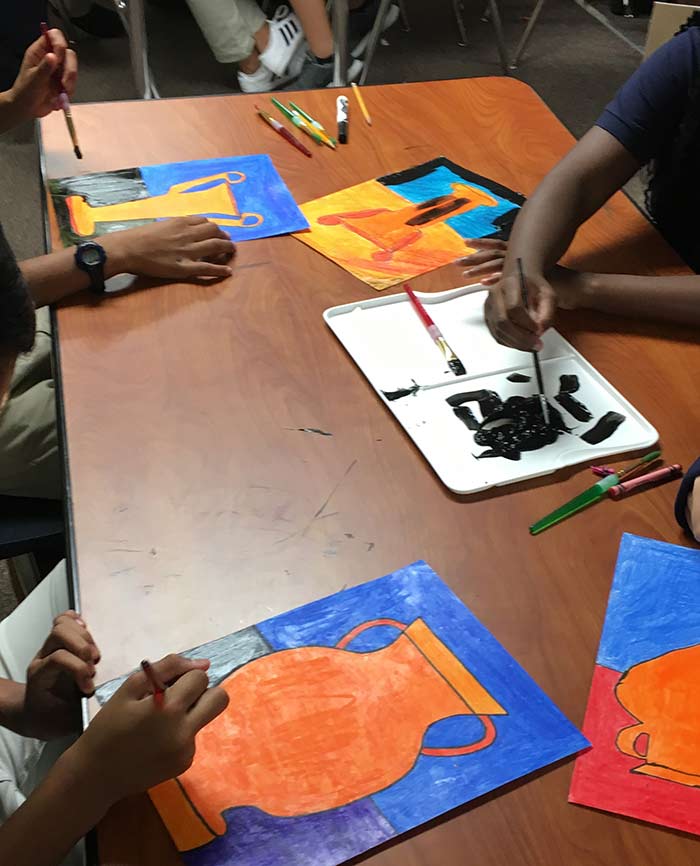
I teach at a classical school, and my sixth graders are studying Ancient Greece. I planned a multi-step project – within the context of a larger lesson on Greek art from this time period – to create Greek amphora scratch-art.

ode-to-a-grecian-urn-colorful-scratch-art-project-main

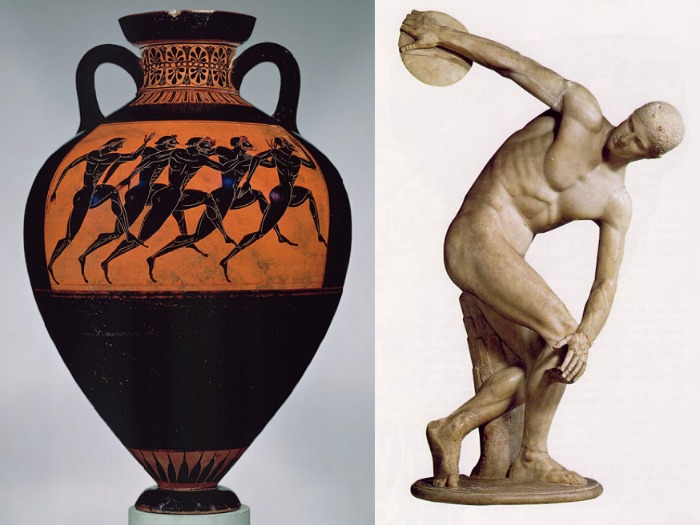
We first did a general lesson on Greece where we learned about their architecture and sculpture. I showed them a picture of a Greek amphora painted with a scene of Olympians running, then one of the sculpture “The Discobolus of Myron” (the Discus Thrower). I asked my students to think about the life of Ancient Greece. What did they think the culture valued, by looking at those examples? They saw the focus on the body and athletics, and emphasis of the individual.

discobolus-and-olympic-amphora
(Left) Attic Black-figure Panathenaic neck amphora, c. 530 BCE, by the Euphiletos Painter; (Right) Myron, Roman copy of Greek original, Discus Thrower (Discobolus)

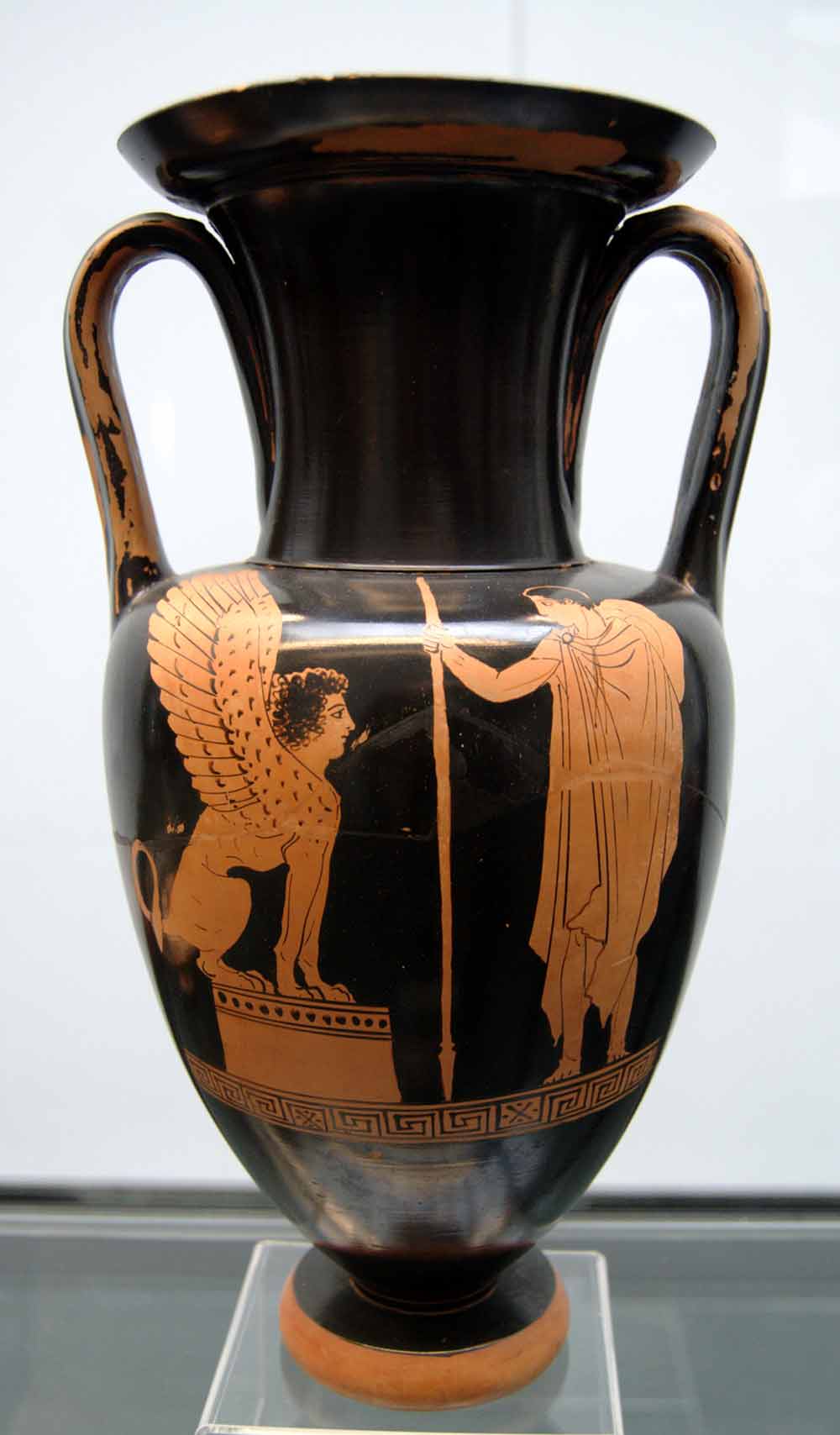
Then we talked about Greek urns or vases – often made to store and carry food and water, and also wine, or used for decorative purposes. Amphorae, one type of urn or vase, were made in shapes that are very recognizable, with looping handles under the neck of the vase that widens in the middle.

Oedipus and the sphinx, Nolan amphora by the Achilles Painter, circa 440/430 BC.

Most amphoras and other Greek vase types and shapes were ceramic. The decorations on the sides of amphoras and other vases from this period tell us a lot about the culture and values of that time period. And they were often beautiful – poet John Keats wrote an amphora in “Ode to a Grecian Urn” (1918), with the famous final stanzas:

“Beauty is truth, truth beauty,—that is all / Ye know on earth, and all ye need to know.”

When I do my art history lessons I always have the students do a warm-up activity when they come into the classroom. One day, I had the students choose and illustrate a scene or story from Greek mythology that they knew. (If my students had not come with that knowledge, I would’ve given them a list of Greek gods and goddesses or read a book with them.) They had to pick a god or goddess and write a little bit about them and share the story from their drawing.

Then I showed my students this video that shows the steps of how amphoras were made, from working with the clay to shaping it and then painting on the designs.

Step by step scratch-off

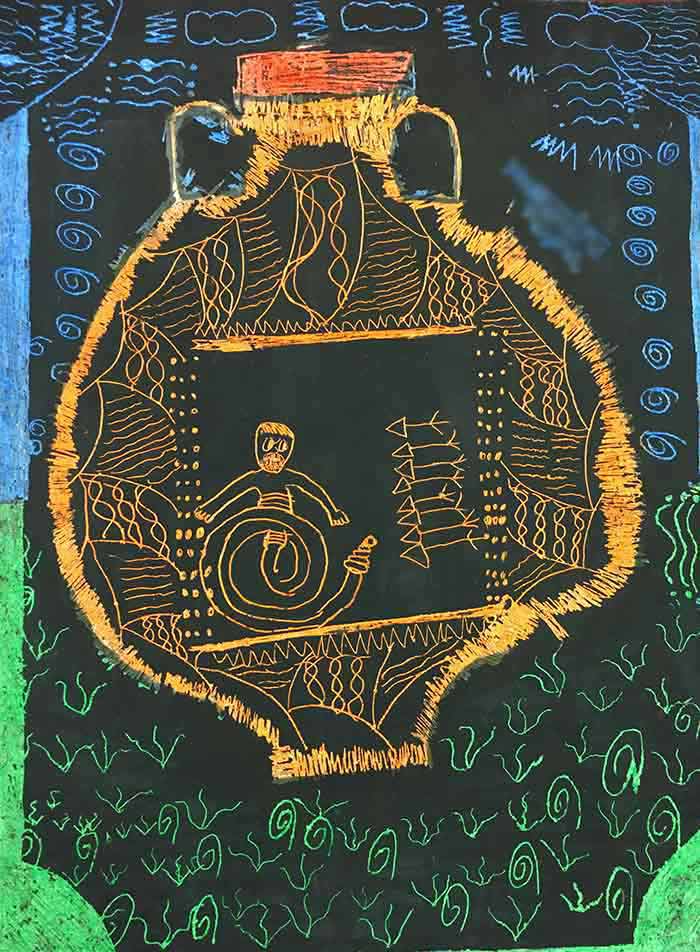
Our scratch-art project didn’t involve clay, but there were multiple steps that the students needed to follow to get to the finished product. As you can see, the end result of a scratch-off project looks something like black-figure or red-figure glazing processes – techniques used in successive periods in Ancient Greece as artists refined their processes for decorating the urns.

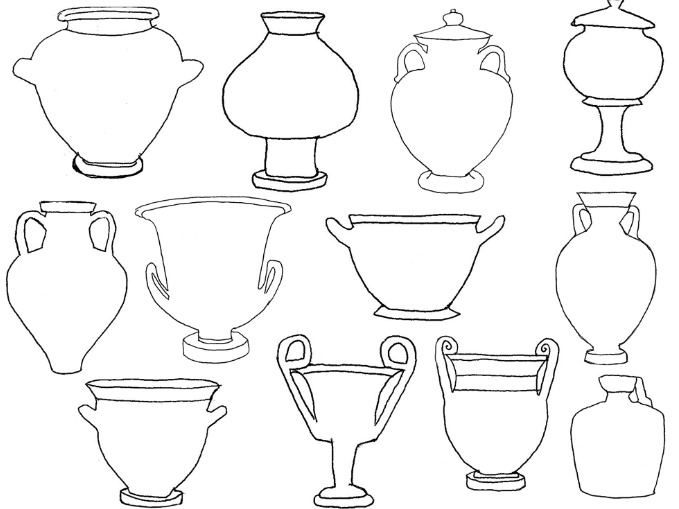
greek-vase-shapes

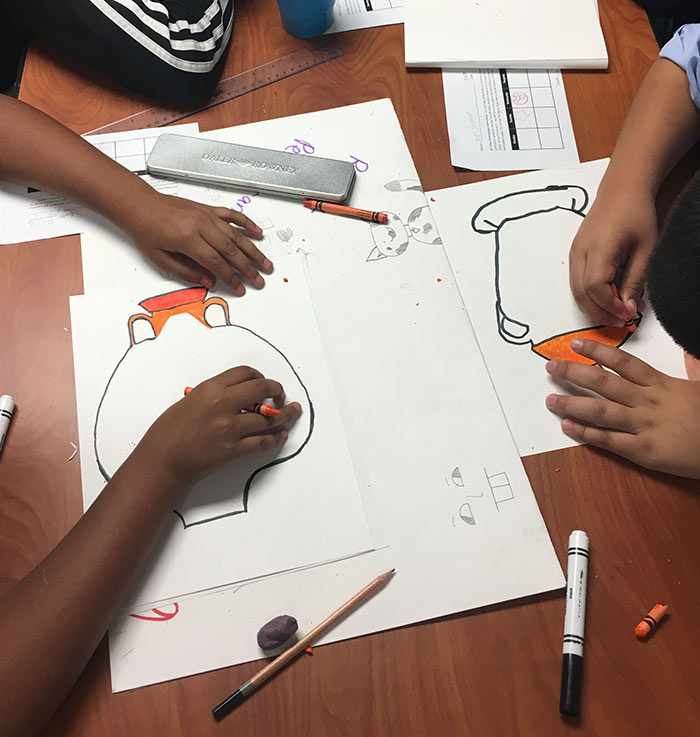
I had drawn a number of different vase shapes, which I projected onto the wall and had the students draw their favorite (or their version of it) with a black marker on a piece of 9”x12” piece of card stock. The students drew in the horizon line, and then colored inside the lines of the urns with several different colors of orange that I gave them. They colored the background with contrasting colors like blue and green.

They had to press super-hard with the crayons to get a smooth, thick layer of color, or the next step wouldn’t work. This took several days of class time! (If they finished coloring before the end of the class, they could continue to work on their drawing of the god or goddess for their vase; there was a good amount of sketching time to be prepared for next steps.)

trace-and-color-base

After they were done coloring the first layer, the students painted over the whole page with a mixture of black tempera paint mixed with a few drops of dish soap – I learned about this trick on an art teacher’s online group. (The dish soap makes it easier to scratch off the paint.) This step can be kind of alarming to students – covering up all that color with black paint – but the reveal is worth it.

coloring-base

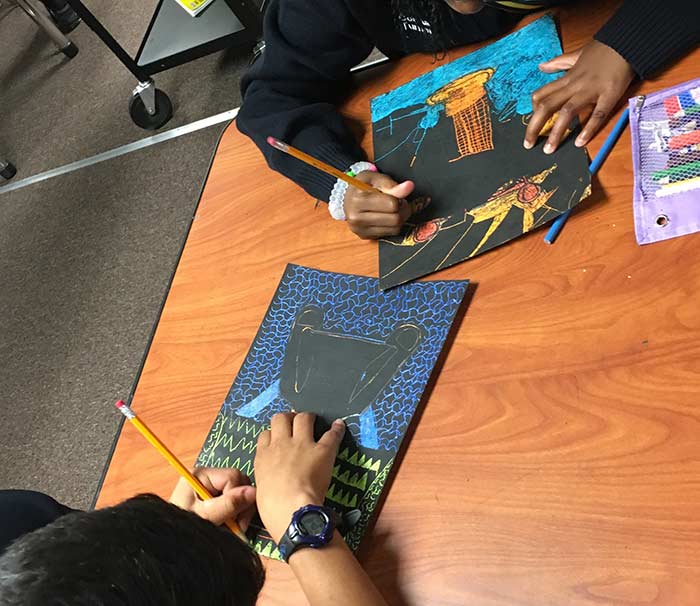
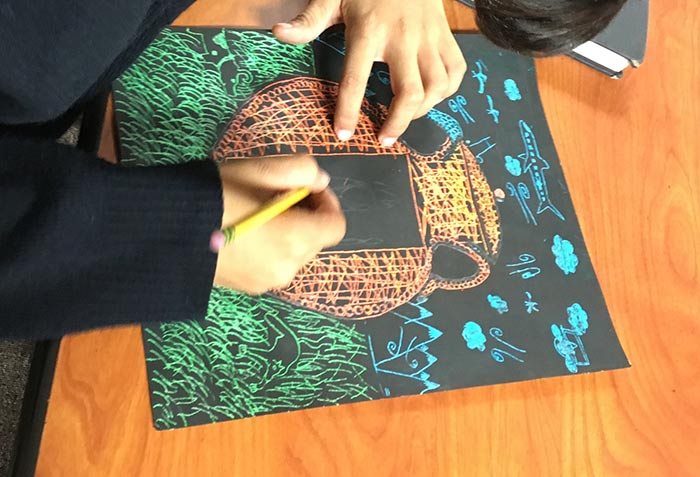
When the paint dried, we started scratching in the background, the area outside of the outline of the vase. Wooden scratching sticks with a pointed tip work well, of course, to reveal the color underneath the paint. But I couldn’t find these, so we used whatever we could find – you could use toothpicks, a fork, a pencil, anything that is sharp enough to make a mark but won’t tear the paper. (If you use a pencil, be aware that it can show up on the background, so using a colored pencil is a good option.)

scratching-black-3

On the first day of scratching through the black paint, the students worked on the background: the sky and the ground beneath the amphora. One of my brilliant students realized that you could hold the paper up to a light to see where the vase was located. Then I had them scratch off the border around the amphora, as well as the handles and the lid.

scratching-at-edges-2

The project looked really good at this point – the colors were really shining through.

Once they knew where the edges were, I had the students draw a square or rectangle on the widest part of the vase. In this space, they reproduced the illustration they had made previously of their god or goddess story.

scratching-black

This step can be a challenge. One of my students was nervous about being able to transfer her sketch, so I helped her with a technique that I will incorporate into the project the next time I do it. I will have the students make their preliminary sketch the same size as it will be on the finished urn they scratch. Then they will use a pencil to cover the back side of the sketch. Then they can place their drawing on to the square or rectangle on their scratch-art page and retrace the lines. The graphite will show up on the black tempera – a shiny guideline to scratch through to transfer their illustration. It worked really well.

finished-amphora-5
finished-amphora

After they transferred their illustrations on to the scratch art vase, the students finished the space above and below. They decorated the foot and the neck of the urn with patterns and shapes.

finished-amphora3
finished-amphora-1

Classical Sculpture, Ancient Greek, & Ancient Rome Lesson Bundle

In these lessons, students will learn about the art of Ancient Greece & Ancient Rome. Plus, get a complete Classical Sculpture lesson with an interactive activity to empower students to figure out the conventions on their own!

Buy Now

Filed Under: Art and Artists


October 8, 2016 Leave a Comment

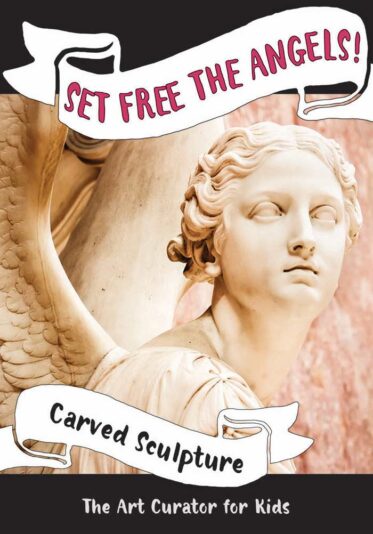
Set Free the Angels: How Carved Sculptures Are Made

When we look at artwork, we can appreciate what we see at face value, even if we don’t know the story behind it or about the artist. We enter the artist’s world by what they’ve chosen to show us, creating a relationship to the artwork in how we respond to it (or don’t).

A great way to begin to connect more deeply with art is to learn how artworks were made. This brings not only a better appreciation of the tools, skills, time, and choices involved, but also a sensory element into our understanding. Here we will look at carved sculpture and think about the relationship between the artist and how they make their art. 

Set Free the Angels: How Carved Sculptures Are Made

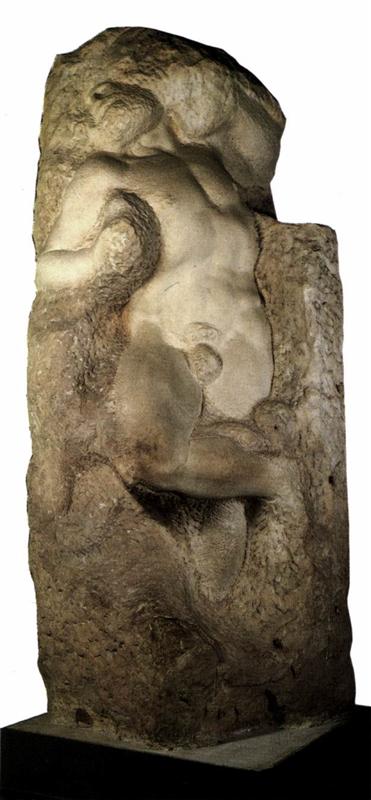
Take a look at this Renaissance artwork by Michelangelo, who said that he carved a sculpture to “free” its subject. Focus your looking on the textures of the sculpture. What differences do you see, and how do you think Michelangelo achieved these contrasting textures? Imagine you are Michelangelo carving this sculpture: where would you start?

Michaelangelo, The Awakening Slave (Design for Julius II Tomb), 1536

Facing off with a block of stone  

After spending time looking at the artwork, answer this question: What challenges do you think an artist faced when carving a figure out of a block of stone?

For some fun, write an “I am” character poem from the perspective of the man emerging in this sculpture. Use the following prompts to begin your poem, describing your feelings, actions, frustrations, discoveries:

  • I am…
  • I see…
  • I hear…
  • I feel…
  • I wonder…
  • I want…
  • I am…

Art Appreciation Worksheet Bundle

This art worksheets bundle from the Art Class Curator includes 25 ready-to-use art worksheets for use with individual works of art. The worksheets for art in this document are designed to work with lots of different types of artworks, so you can just pick an artwork, print a worksheet, and start the activity. Each has instructions at the top and plenty of space to do the activity.

Buy Now

Carving: One of four primary sculpture techniques

There are four primary categories of sculpture: casting, carving, modeling, and assemblage. Each process has its own set of techniques and challenges.

The sculpture above is a carved sculpture. Artists begin with a block of material such as wood or stone and carve and chip material away using a variety of tools such as hammers and chisels. This is called a subtractive process: the artist starts with a certain amount of material and removes it to create the desired form.

Here’s a video from the Science Channel showing some of the processes and tools used in carving marble sculpture.

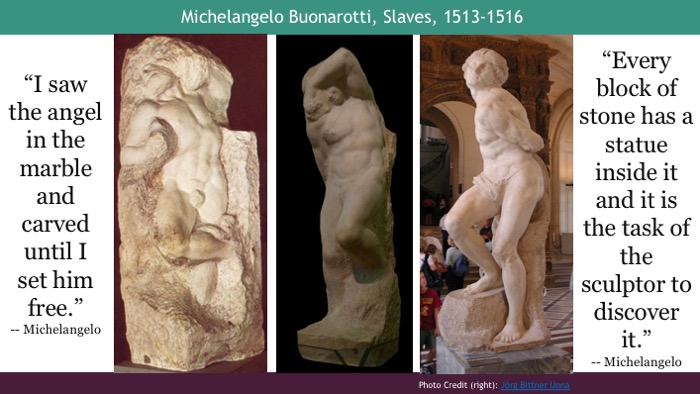
Michelangelo’s Slaves

I like to use Michelangelo’s slave sculptures to teach about this concept because they show where the artist started and where the artist finished. It’s pretty amazing to think about how the smooth and perfect marble sculptures from Classical and Renaissance art were once just rough stone.

Michelangelo believed that the sculpture was already inside the block of stone, so he chose his stone carefully. It was his job to release the form from the stone.

michelangeloslaves

Think about these questions:

  • What challenges does an artist face when carving from a block of stone?
  • Do you think Michelangelo intended to leave the slave sculptures unfinished or do you think they are only works in progress?
  • How is emotion and feeling conveyed when you see only partial faces? How else is emotion or feeling conveyed?

These sculptures were originally created to be a part of the tomb of Pope Julius II which was to have at least 40 sculptures as a part of it. Due to finances and other reasons, the plans for the tomb changed several times. Michelangelo was pulled away to work on the Sistine Chapel, and these sculptures were eventually abandoned. There is disagreement among scholars as to whether or not the artist intended these to be left unfinished or not.

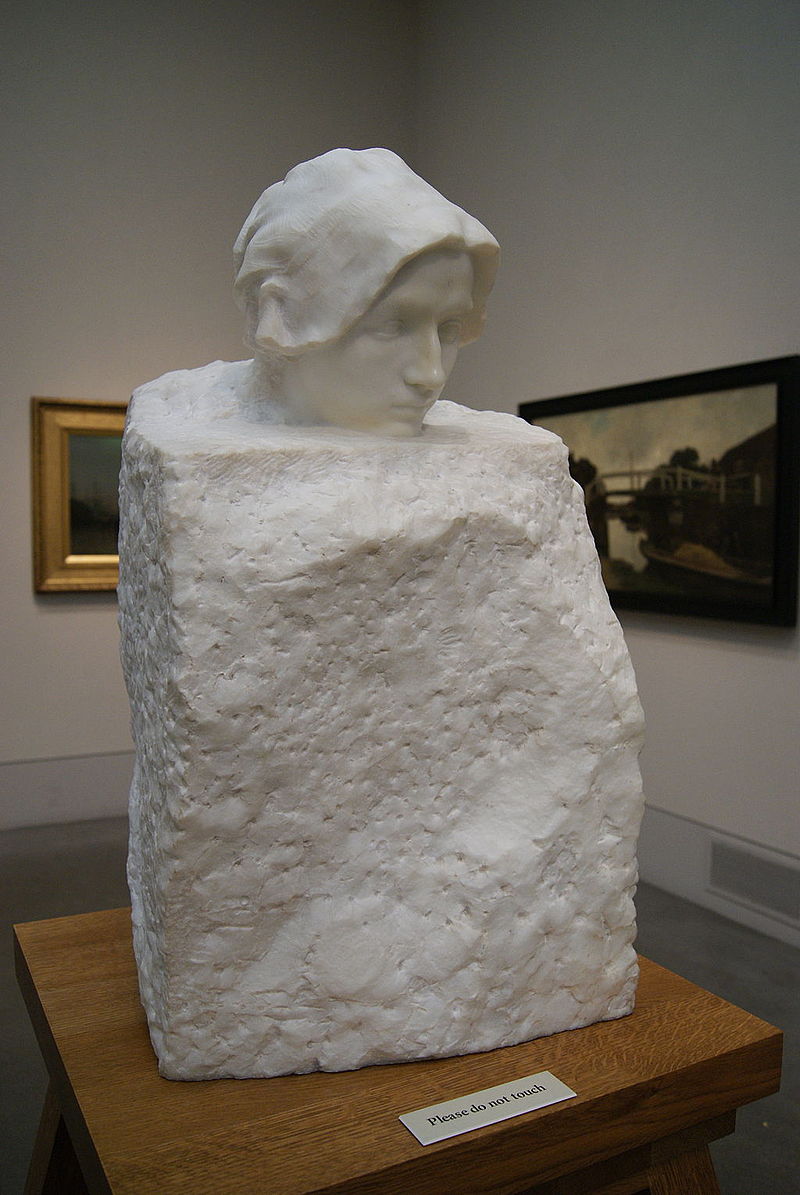
Another artwork I turn to when teaching about sculpture is Rodin’s Thought Emerging from Matter from about 1895. Rodin was sculpting his student (and love interest) Camille Claudel when he decided to top work on it and leave it as it is.

  • Why do you think he chose to leave it as it was?
  • What do think Camille’s expression conveys? 

This sculpture could be an interesting one to use with my Twitter Perspective activity. In 140 characters or less, what thoughts would Camille send out into the Twittersphere? What hash tags would she use?

Art Appreciation Worksheet Bundle

This art worksheets bundle from the Art Class Curator includes 25 ready-to-use art worksheets for use with individual works of art. The worksheets for art in this document are designed to work with lots of different types of artworks, so you can just pick an artwork, print a worksheet, and start the activity. Each has instructions at the top and plenty of space to do the activity.

Buy Now
auguste_rodin_thought_1901
Auguste Rodin, Thought Emerging From Matter, 1895

Because sculpture is most often 3-dimensional, photographs don’t always do justice to size, textures, changes in different light. Another area to discuss: what is different about seeing a photograph of a 3-dimensional sculpture versus seeing it in “real” 3-D glory?

Classical Sculpture, Ancient Greek, & Ancient Rome Lesson Bundle

In these lessons, students will learn about the art of Ancient Greece & Ancient Rome. Plus, get a complete Classical Sculpture lesson with an interactive activity to empower students to figure out the conventions on their own!

Buy Now

Get the Full Lesson!

This Lesson is in The Curated Connections Library!

Find the full lesson from this post along with hundreds of other art teaching resources and trainings in the Curated Connections Library. Click here for more information about how to join or enter your email below for a free SPARKworks lesson from the membership!

Join the List

Get the Full Lesson!

This Lesson is in The Curated Connections Library!

Find the full lesson from this post along with hundreds of other art teaching resources and trainings in the Curated Connections Library. Click here for more information about how to join or enter your email below for a free SPARKworks lesson from the membership!

Filed Under: Art and Artists
Tagged With: michelangelo, rodin


September 23, 2016 2 Comments

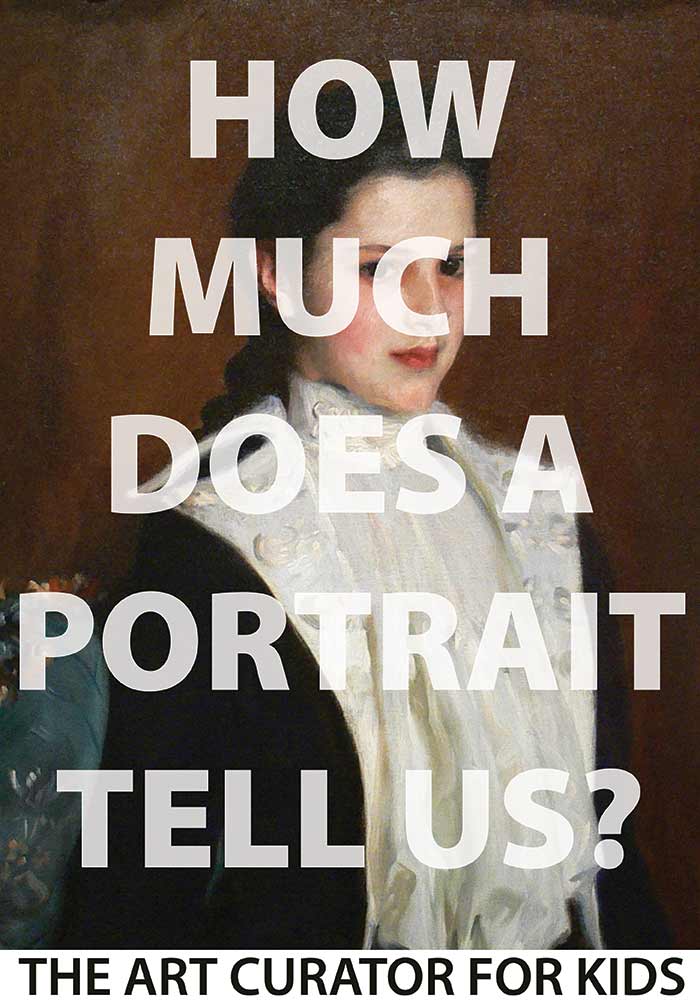
How Much Does a Portrait Tell Us?

As you may know, I started teaching in the classroom again (art instruction to grades 6-9). Overall, it is going very well. It is so so great to see the aha moments in person again! It’s been a while since I was in the classroom because I spent the past 5 years teaching online. While I love both “spaces,” I couldn’t see my students’ faces when I taught online, and it’s so much fun to see someone’s eyes light up when an idea clicks!

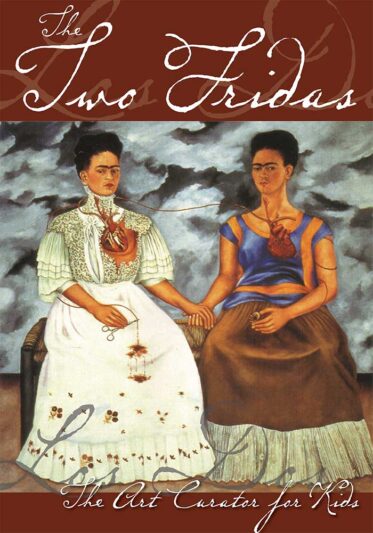
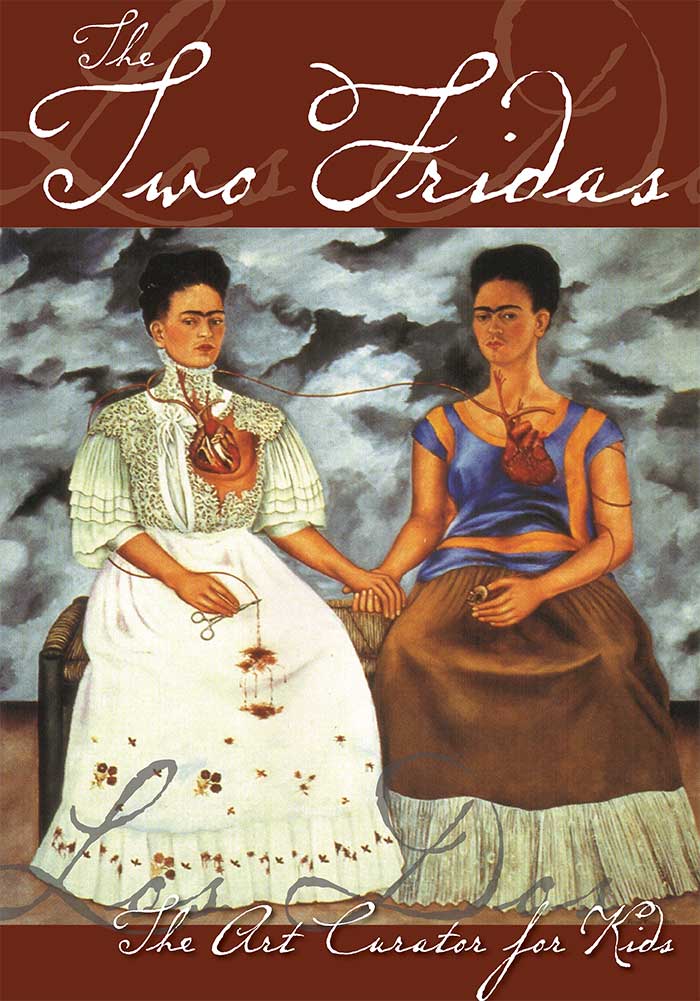
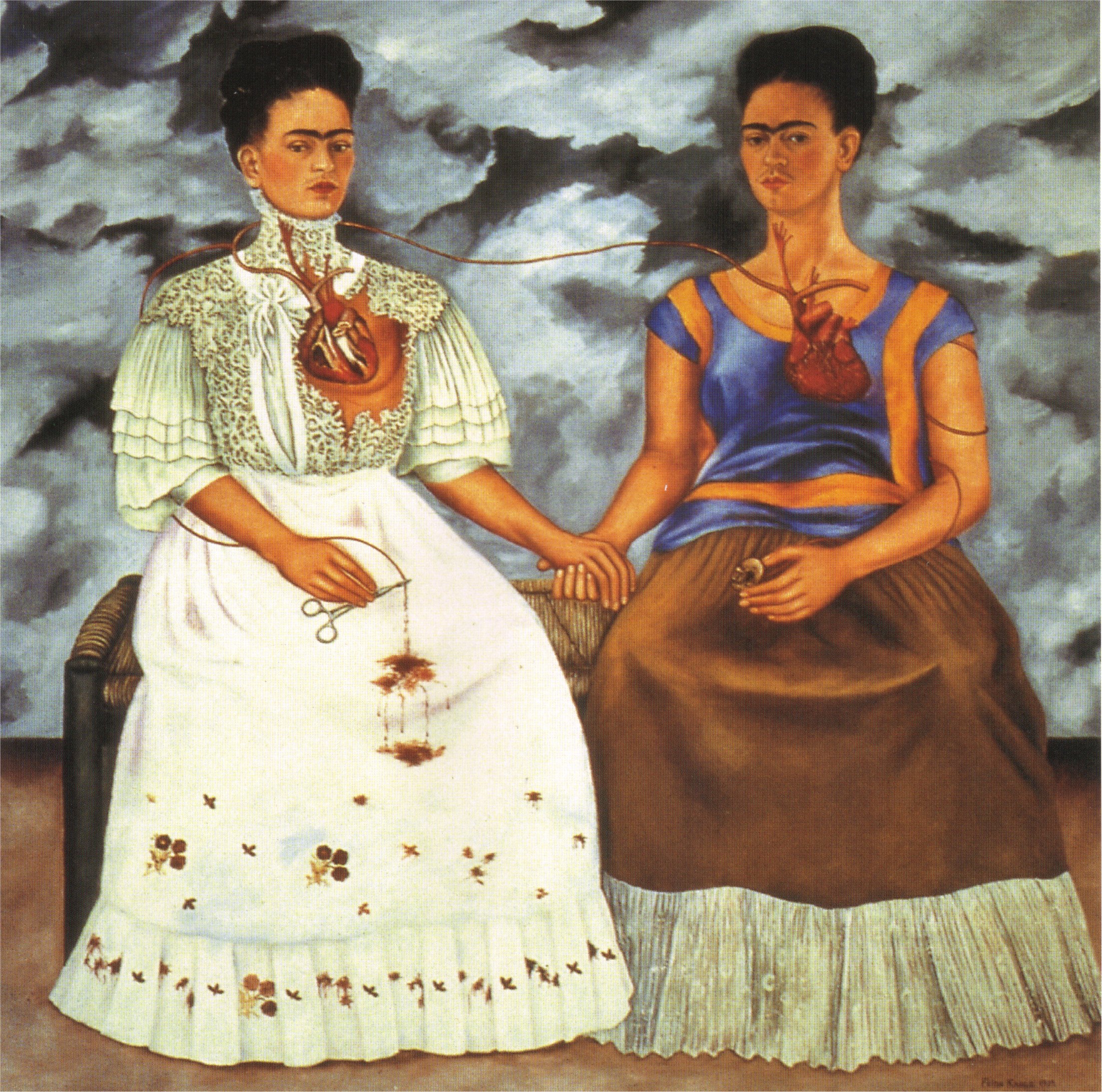
To start the year with my middle school students, I opened a discussion of The Two Fridas. The kids ate that up! They loved the painting and coming up with ideas. We actually spent nearly an entire class period on that painting. You can learn a lot about Frida from that artwork, but what happens when you see a portrait without so many clues to start from?

How Much Does Art Tell Us main image 700x1000

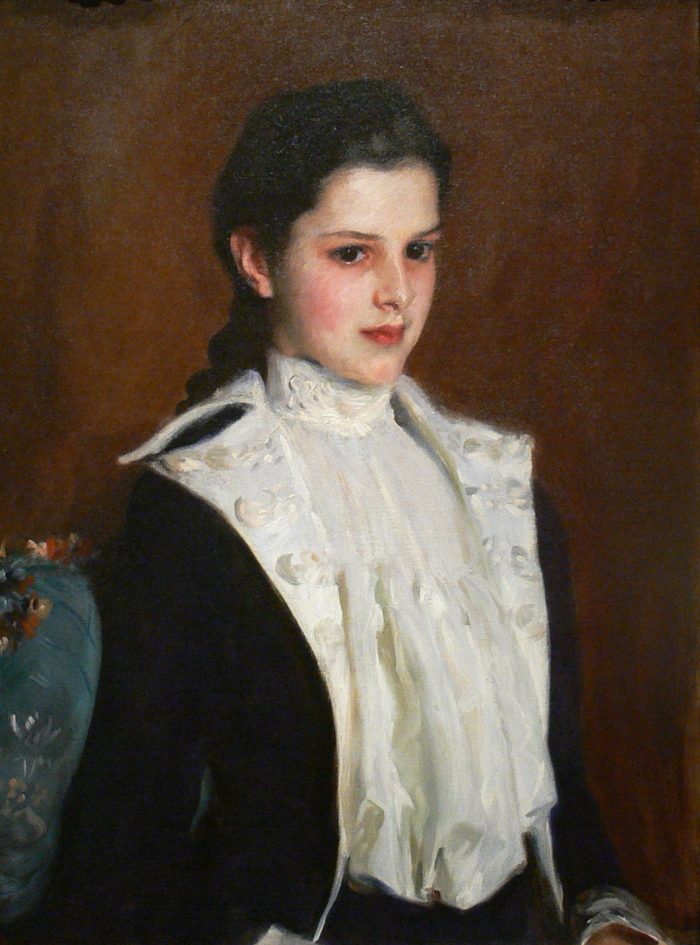
Enter Alice Vanderbilt Shepard by John Singer Sargent.

John_Singer_Sargent_Alice_Vanderbilt_Shepard_Amon_Carter_Museum John Singer Sargent, Alice Vanderbilt Shephard, 1888

My students are starting the year with a self-portrait project, and one day as a warm-up, we looked at this painting together. My question to them was: “What can you tell about this girl based on what you see in the portrait?” It’s amazing what you can discover with some close looking.

We talked about how she’s young, wealthy, and very pretty, but she also looks sick and uncomfortable. Her pale skin, redness of her eyes and cheeks, and watery eyes give that sense that something is wrong. We discussed her posture and practiced sitting like her. It’s awkward and painful to sit like she is.

The students noticed that she almost looks forced to sit there against her will, and that the slightest hint of a smile on her face shows us those mixed emotions.

Alice Vanderbilt Shepard injured her back when she was younger when she climbed and then fell from tree in spite of her father’s opposition, so he punished her by not calling the doctor (eek!). She also spent much of her youth sick and bedridden.

It’s so cool that we can detect so many clues to her life just by looking at a portrait that we might normally walk by at a museum.

Leading students in looking closely at portraits helps them connect to the real person: when they lived, how they lived, where they lived, what social status they held, even their health and their temperament. This activity, which can be applied to portraits and photographs from anywhere in the world, encourages not only paying attention to detail but making larger connections – global thinking, in a portrait!

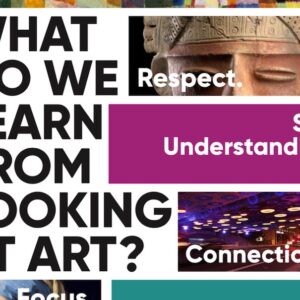
Free Poster

What Do Kids Learn from Looking at Art Poster

Our students learn so much from looking at art. Use this poster in your classroom to remind them of all the skills they’re growing!

Download

Free Poster

What Do Kids Learn from Looking at Art Poster

Our students learn so much from looking at art. Use this poster in your classroom to remind them of all the skills they’re growing!

Filed Under: Art Connection Activities
Tagged With: john singer sargent


September 21, 2016 3 Comments

The Two Fridas – Art Discussion Lesson

The Two Fridas main image 700x1000

During the first week of school, three teachers and administrators at my new school told me, “All of the middle school hated art and music last year. All of them.” And, they didn’t just hate it, they LOATHED it. Let me tell you, that gave me a great confidence boost to start the new school year. Yikes.

I think the students hated it for a variety of reasons – from it being treated like a core class at the school (you can FAIL ART?!) to a lack of resources for the former teacher (no projector, no sink, tiny art prints, no real classroom). I had to come in with a strong plan to change these students’ minds from Day One!

In addition to all of the procedure practice and syllabus blah blah blah, we’re going to start talking and thinking about art!

The Two Fridas main image 700x1000

We started with The Two Fridas by Frida Kahlo. On one side of the paper, I had them write two observations about the first Frida and on the other half of the paper, they wrote two observations about the second Frida. After going over (and practicing) behavior expectations and procedures for group work and for discussions, I led a full class discussion on this artwork. They ate this painting up, and we ended up spending most of a class period dissecting it!

Free Worksheet!

The Two Fridas – Art Discussion Lesson

The Two Fridas, like much of the work of Frida Kahlo, is a great painting on which to practice your students’ art interpretation skills through a classroom discussion.

Download

Free Worksheet!

The Two Fridas – Art Discussion Lesson

The Two Fridas, like much of the work of Frida Kahlo, is a great painting on which to practice your students’ art interpretation skills through a classroom discussion.

The Two Fridas, like much of the work of Frida Kahlo, is a great painting on which to practice your art interpretation skills. Her paintings are so personal, so real, and so cool. I don’t want you to read anything below until you have clicked the link and looked at the painting on your own (the same goes for your high schooler). Go through these discussion questions and think about it first. Promise?

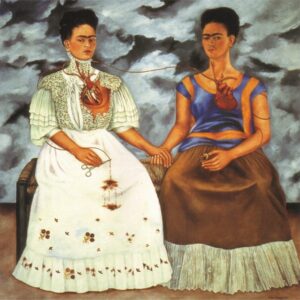
The Two Fridas, Frida Kahlo, 1939

Questions to ask:

  • What’s going on in this painting? What do you see that makes you say that?
  • Who are these women? What is their relationship?
  • How are they dressed? Why are they dressed that way?
  • How are the two women the same? How are they different?
  • What is different about the two hearts? What do you think that means?
  • What is she holding (look at the close-up shots in this link, scrolling down the page)? Why is she holding that? Why is she using that tool?
  • What do the blood, veins, and heart symbolize?
  • What emotions are present in this artwork? What do you see that makes you say that?
  • How does her use of color contribute to the feeling of the painting?
  • What do you think this artist is trying to say here … What is the meaning or message?

I’m hesitant to give you any information about this because your ideas are just as important as the “real meaning.” But I’ll share a bit to whet your appetite. Did you keep your promise and look/think first? I’m trusting you. Okay, this painting shows two elements of the artist and her mixed ancestry. One side displays her father’s German-Jewish descent, and the other side illustrates her mother’s Mexican roots.

The real story shows her tumultuous relationship with the famous Mexican muralist, Diego Rivera. This link has a great roll-over activity showing key elements of the painting and highlights some of the elements of her relationship with Diego.

frida-kahlo-dialogue

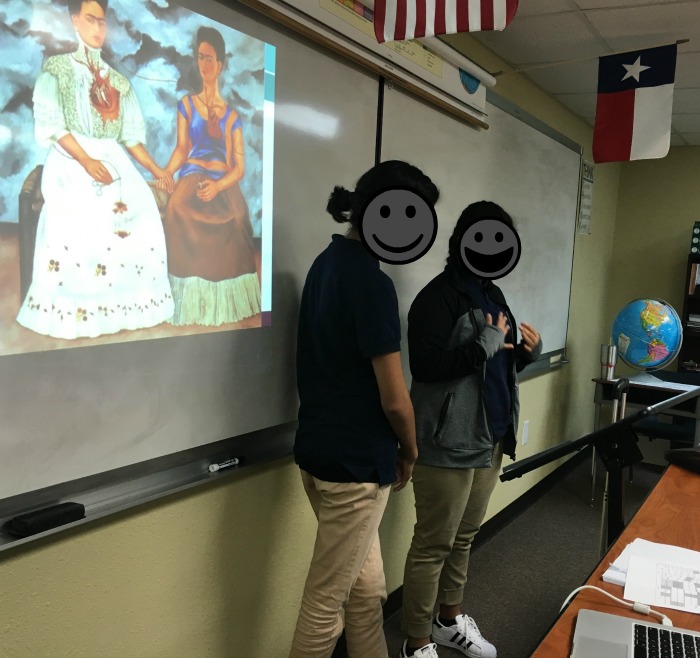
After the discussion, I had some of the students in their groups (3 at a table) come up with a few lines of imagined dialogue between the two Fridas. I really enjoyed having the students act out their lines of dialogue. Overall, this was such a fun lesson for both me and my new students.

Mentioned on the Art Class Curator Podcast…

Subscribe in Your Favorite Podcast Listening App

Filed Under: Art and Artists
Tagged With: best of art class curator, frida kahlo


September 18, 2016 Leave a Comment

Puzzles About Art: The Chimpanzee Painter

I am totally obsessed with teaching art and aesthetics. I use aesthetics puzzles such as the one below to address this fun and engaging philosophical questions in the classroom.

The Art Curator for Kids - Aesthetics Puzzles about Art - The Chimpanzee Painter


Please note, this post includes Amazon affiliate links. As an Amazon Associate I earn from qualifying purchases.

One of my favorite books that I used to use when I taught college art appreciation was called Puzzles About Art: An Aesthetics Casebook (no longer in print I think). The book has lots of small aesthetics case studies with philosophical discussions about art. It really gets you thinking!

Aesthetics Lesson Bundle

What is art? Get your students in the mindset to THINK in art class and lead fun art discussions with this lesson bundle!

Buy Now

What is aesthetics?

Aesthetics is the philosophy of art. Every time you say “My kid could have done that!” in a museum, you are engaging in an aesthetics discussion worthy of the great philosophers. Examples of “aesthetic questions” include “What is art?” “What is an artist?” “Why is that art and that not?” “Why did that artwork sell for $4 million?” “Does art have to be beautiful to be considered art?” “Can something be art if it was not made by an artist?” “Are a child’s drawings art?”

The Chimpanzee Painter

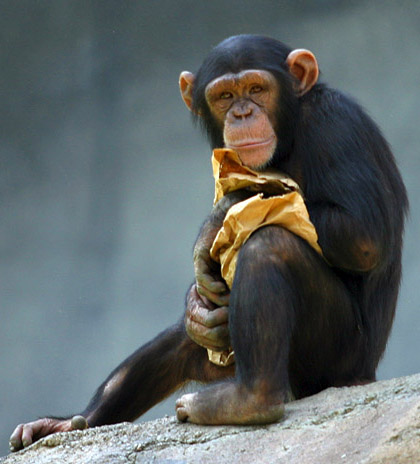
chimpanzee at los angeles zoo photo credit Aaron Logan
Photo Credit: Aaron Logan

Recommended Age: Upper Middle and High School

Source:
This activity is adapted from Battin, M.P., Fisher, J., Moore, R., and Silvers, A. (1989). Puzzles about art: An aesthetics casebook. New York: St. Martin’s Press which is no longer in print. I make no claim to the content; I just think it is an awesome resource!

 The Situation:
“Betsy the Chimpanzee in the Baltimore Zoo is given some paints and some paper; with them, she creates various products, some of which might be called paintings. Even if Betsy’s works are not masterpieces, they are undeniably interesting and appealing in their own way. Selected pieces of Betsy’s paintings are displayed for a month at the Field Museum of Natural History in Chicago then at the Chicago Art Institute. In both exhibitions, Betsy’s works are greatly admired by the viewing public.” — Puzzles about Art

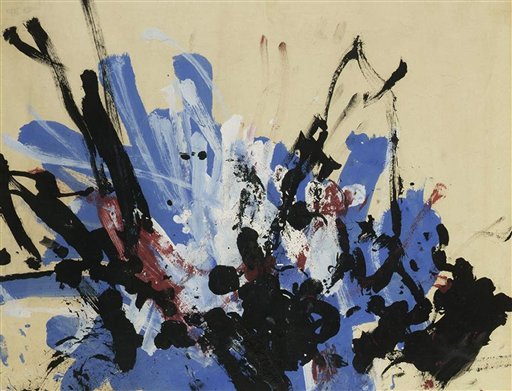
Aesthetics Puzzles Chimpanzee painting_congo_painting.jpg
Painting by a Chimpanzee named Congo

 The Aesthetic Question:

  • Is Betsy’s work art?  Why or why not? Explain.
  • Does the decision to put it in a museum change its “art” status? Why or why not?
  • If it is art, who is the artist? The chimpanzee? The museum? The zoo staff who had the original idea? Explain.

Commentary:
This is a great question with no real answer. It calls to mind questions of intent. Can a chimpanzee intend to make art or is he or she just playing with the supplies? Is art about the final product, or is it about the idea? If it is about the idea, wouldn’t that make the artist the zoo worker?


I just found out you can buy prints of Chimpanzee art here at the Humane Society website! So cool. Proceeds from that sale go to support chimpanzee sanctuaries. This is not an affiliate link. It’s just neat.

What do you think? Is it art? Why are why not? Answer in the comments!

Mentioned on the Art Class Curator Podcast…

Subscribe in Your Favorite Podcast Listening App

This post was originally published in May 2014.

Filed Under: Art and Artists, Downloads and Resources
Tagged With: best of art class curator


August 21, 2016 Leave a Comment

Ancient Art from Around the World Online Course


Join the Prehistoric Art Mini-Course in the Curated Connections Library! It’s been so fun learning alongside many of you. This course was a precursor to a bigger course, Ancient Art from Around the World!

Ancient Art History Course - Pin - 700x1000px

In the course, we will cover Ancient Art from the Near East, Egypt, Greece, Rome, Africa, Asia, and the Americas.

Join us for the Ancient Art Around the World class to get access to the following features:

  • Lifetime access to both the Ancient Art course and the Prehistoric Art mini-course
  • Two, manageable 30-45m lessons per week
  • Private Class Facebook Group for Discussions (optional)
  • Printable Workbook Pages for All Activities
  • Videos, projects, discussions, quizzes, and more!
  • Bonus activities for extra learning!
  • Form letters to school administrators to help potentially cover the cost or get PD credit for teachers
  • Certificate of completion

If you want to see what my classes are like, you can check out the Prehistoric Art Mini-Course in the Curated Connections Library.

Get the Full Lesson!

This Lesson is in The Curated Connections Library!

Find the full lesson from this post along with hundreds of other art teaching resources and trainings in the Curated Connections Library. Click here for more information about how to join or enter your email below for a free SPARKworks lesson from the membership!

Join the List

Get the Full Lesson!

This Lesson is in The Curated Connections Library!

Find the full lesson from this post along with hundreds of other art teaching resources and trainings in the Curated Connections Library. Click here for more information about how to join or enter your email below for a free SPARKworks lesson from the membership!

Filed Under: Art Teacher Tips, Downloads and Resources


  • Previous Page
  • Page 1
  • Interim pages omitted …
  • Page 18
  • Page 19
  • Page 20
  • Page 21
  • Page 22
  • Interim pages omitted …
  • Page 38
  • Next Page

Primary Sidebar

Hi! I’m Cindy Ingram, the creator of Art Class Curator and The Curated Connections Library

I’m on a mission to revolutionize education with the power of life-changing art connections. Art is not “extra”. Art is essential. We are empowering teachers to bridge the gap between art making and art connection, kindling a passion for art that will transform generations.

More About Me

Free Worksheets!

-Free Bundle of Art Appreciation Worksheets-

In this free bundle of art worksheets, you receive six ready-to-use art worksheets with looking activities designed to work with almost any work of art.

Download

Free Worksheets!

-Free Bundle of Art Appreciation Worksheets-

In this free bundle of art worksheets, you receive six ready-to-use art worksheets with looking activities designed to work with almost any work of art.

Enrollment in Curated Connections Library is currently open. Click here to join. Join our list to get more information and to get a free lesson from the vault! If you are purchasing for a school or school district, head over here for more information.

Check Out What’s New In The Shop

Experience Art: Engaging Art Criticism Discussions and Activities for Teachers and Students of All Ages
Call to Art: An Un-Conference for Art Educators
Curated Connections Library Membership
Perspectives High School Curriculum

More Products

Have You Listened to the Latest Podcast Episode?

Falling for Naudline Pierre’s Evocative Art: A Conversation with Madalyn (Part 2)

More Episodes

Testimonials

I like how this program, unlike other art class resource membership programs, feels authentic. It's like art matters more here, and not fancy flash-in-the-pan trendiness. The goal of Art Class Curator seemed to be helping kids develop a lifelong love and art appreciation versus "Hey, look. I painted this fish."
Erin A.
Your questions are helping me to delve into much deeper learning, and my students are getting better at discussion-and then, making connections in their own work. Art Class Curator is awesome!
Denise W.
Interestingly, my lower performing classes really get engaged in these [lessons] and come away with some profound thoughts!
Melissa G.
I had the most amazing 6th grade class today. They were jumping out of their seats with hands raised just to respond and give input. It was as if I was waving candy in front of them! They saw more and more and the ideas and interpretations unfolded. So cool!!! This is what makes teaching art so wonderful – thank you!!
Caroline G.
I just wanted to thank you for the invaluable resource you have through Art Class Curator. Not only do you have thought provoking activities and discussion prompts, but it saves me so much time in preparing things for myself! I feel like I’ve only scratched the surface with your site.
Maryjane F.

Get Art Inspiration To Your Inbox!

Enter your email address to get regular art inspiration to your inbox
plus a BUNDLE OF 6 FREE WORKSHEETS!
We hate SPAM and promise to keep your email address safe.
Download

Free Worksheets!

*Free Bundle of Art Appreciation Worksheets*

In this free bundle of art worksheets, you receive six ready-to-use art worksheets with looking activities designed to work with almost any work of art.

Copyright © 2026 Ignite Art, LLC DBA Art Class Curator •  All rights reserved  •  Privacy Policy  •  Terms of Service  •  Site Design by Emily White Designs