• Skip to main content
  • Skip to primary sidebar
  • About
    • About Art Class Curator
    • Contact
    • Speaking
    • Media & Press
    • Programs for Schools
  • Blog
  • Podcast
  • Shop
  • Join
  • Member Login

Art Class Curator

Hands-on and Minds-curious Art Learning

  • Art & Artists
  • Art Connection Activities
  • Art Teacher Tips
  • Elements & Principles
  • Downloads & Resources
Home
  • About
    • About Art Class Curator
    • Contact
    • Speaking
    • Media & Press
    • Programs for Schools
  • Blog
    • Art & Artists
    • Elements & Principles
    • Art Connection Activities
    • Art Teacher Tips
    • Downloads & Resources
  • Book
  • Podcast
  • Shop
  • Join
  • Member Login

All Posts from Art Curator for Kids

June 28, 2021 2 Comments

Reclaim Your Classroom: Take Back Your Teaching Spark with Intention, Joy, and Purpose

Inside: An invitation to a free email series empowering art teachers and educators to reclaim your classroom with actionable tools and powerful reflections starting July 26th.
This year, it felt like teachers went from heroes to zeroes.

Parents got a taste for how difficult teaching can be. Admins watched as teachers scrambled to make their last minute plans a reality. Students realized how much they missed being with us and learning from us. Teachers were celebrated for their innovation and quick action.

But then, the tides turned. Parents became inpatient. Admins didn’t ask for our input. Students lost their manners and motivation.

We made it through all of this. We have new reasons to hope, but after all the stress and trauma, we have to ask: What did we learn?

This year was a wake up call, but have we listened? Have we even woken up?

Part of making next year different is believing that it can be different.
Saying yes to the things that matter.
Saying no to the things that don’t.
Shifting our mindset to know that everyone is doing their best, and that includes us.

It’s time to let go of all the negativity and brokenness we endured this year.

This summer, we’re recharging and rethinking how and why we teach. We’re empowering ourselves.
Reclaim Your Classroom: Free Email Program starting July 26th

Reclaim Your Classroom: Take Back Your Teaching Spark with Intention, Joy, and Purpose is a free email program for art teachers and educators. We’re using actionable tools and thoughtful reflection to make the most of our teaching lives. This free program includes:

  • Email Series starting July 26th
  • Short Videos
  • Powerful Prompts
  • Straight to Your Inbox
  • Community Content Discussions in Art Class Curator Collective Facebook Group

See you there!
Filed Under: Art Teacher Tips


How the Blood, Sweat, and Tears Mindset Poisons Teachers’ Self-Care

Teachers’ Self-Care

Like I said in last week’s episode, this summer, we’re focusing on getting a good feel for what teachers have gone through this year. What struggles you’ve had, and we want to acknowledge you for the work you’ve done and empathize with you for how hard that was. We also want to celebrate, but right now doesn’t feel like the right headspace for that. So this week I want to encourage you to take stock of the year.

In a survey we did, many shared that this year was a wake-up call, but they weren’t sure what they were waking up to. I think a lot of teachers are waking up to the fact that teaching has become toxic, that teaching has become too much to handle. They are expecting too much out of teachers, they are not respecting the work that we’re doing, and they are not giving us the support that we need. This year, I heard story after story about districts giving webinars on self-care, telling teachers, “Don’t forget self-care,”

And this summer, taking stock is a great way for teachers to practice self-care. 

Subscribe in Your Favorite Podcast Listening App

3:01​ – Ways toxicity in public education took its toll

9:46 – A history of lack of support for teachers boiling over

14:40 – Reflecting on your wake-up call from this year

19:53 – Positives that came out of the pandemic for educators this year

23:14 – How to make next school year different

  • 82 Questions About Art
  • artclasscurator.com/takeback
  • Episode 31: “Classroom management as an Act of Self-Care”
  • Episode 29: “Mindset and Management with Anna Nichols”
  • Episode 4: “Smart Classroom Management with Michael Linsin”
  • Be a Podcast Guest: Submit a Voice Memo of Your Art Story (Scroll to the bottom of the page to submit your story.)


Cindy Ingram: Hello and welcome to The Art Class Curator Podcast. I am Cindy Ingram, your host and the founder of Art Class Curator, and The Curated Connections Library. We’re here to talk about teaching art with purpose and inspiration from the daily delights of creativity to the messy mishaps that come with being a teacher. Whether you’re driving home from school or cleaning up your classroom for the 15th time today, take a second, take a deep breath, relax those shoulders, and let’s get started.

Hi everybody, it’s Cindy Ingram from Art Class Curator. I am happy to be back with you for another episode of The Art Class Curator Podcast. Today, what we’re going to be talking about is something I’m really passionate about, something I can get maybe a little emotional about, so we’ll see how that goes. But I also don’t really have an outline for today. Often, I will come with an outline or a general idea of the flow. But today, as I was trying to plan what I was going to say, I realized that this was one of those topics that I think I just need to click record, start talking, and see what happens. That’s what we’re going to do today. Hopefully, it makes sense. Hopefully, that works for you.

Like I said in last week’s episode, this summer, we’re really focused on really getting a good feel for what you guys have gone through this year, the struggles that you’ve had, and acknowledge you for the work that you did, and empathize with you for how hard it was. We also want to celebrate that you made it through. But it’s also at a point where I don’t know that anyone is really in the right headspace for celebration at this point, that how you feel right now is exhausted and just weary, and celebrating something that was so hard, that you didn’t get enough support in just doesn’t feel right. So we do want to celebrate, we made it through and we want to get to that place but I just don’t know that we’re there yet.

We sent an email recently to our email list—if you’re not on the email list, go to artclasscurator.com and click just about anywhere, you’ll find a place to enter your email—and we’ve gotten some really beautiful responses to it. I’m going to talk a little bit about the email, then go into what I really wanted to talk about. We’ve been doing interviews of art teachers as you heard the first one last week. We did a survey talking about what we learned this year, what we are looking forward to for next year, what we learned from this year. We scoured all the Facebook groups looking for what are you all talking about. We really spent a lot of time trying to make sure we really understand where you’re at.

One of the responses that we got was someone that said that teaching has become toxic. It really hit us hard and it resonated too because all of the teachers that I know, this year, barely made it through. We thought about, “What is toxic? What does that really mean?” So I looked it up and it’s poisonous or very harmful or unpleasant in a pervasive or insidious way. It’s true, we are seeing teachers leaving the classroom in droves, early retirement, just people who quit and don’t even have another job lined up. They just could not take it anymore. We’re seeing teachers feel unsupported and unappreciated. It’s just insidious through the whole system.

It’s so sad because at the beginning of the pandemic, we saw that teachers were heroes. When the pandemic hit and everybody switched to online learning, there was this feeling of we’re all in this together. They were innovative, they were learning new technology, and they were trying new ideas. Everybody was praising the teachers for everything they were doing to keep their students engaged. As soon as the new school year started, that changed. I won’t tell you who said this but someone told me that they heard from a high up administrator that they were worried about teachers eating bonbons all day, that’s why they had to go to the school. They had to go to the school to do their online teaching because they didn’t trust the teachers were going to do their work, then they weren’t going to teach the kids.

I was infuriated because you saw, in the beginning of the pandemic, how hard the teachers were working. They were doing it from home. They were doing it with their kids at home with them. They were doing it with their spouses at home with them. They just pulled it together and did amazing things. Then a few months down the line, that changed. We saw plans for going back to school that didn’t keep the teacher’s safety in mind. All of that stuff. I don’t get worked up too easily. I don’t get mad, occasionally, I do. You all heard it a few weeks ago in the episode I did about the Van Gogh Exhibit but the thing that gets me worked up the most is injustice, unfairness, and people not respecting professionals, people taking advantage. That really upsets me, so I lived so angry for a pretty long time.

There was a lot of good in the pandemic and we talk about that in the interview next week that I’m doing with another teacher, Stacey Sternberg, who is on the podcast next week. We talk about the gift that we were given of the time to reflect on our lives when everything shut down. There were good things in it, but as far as teachers go, it was an uphill, uphill battle.

In talking about this with teachers from all over—someone in one of the survey responses said, “Through blood, sweat, and tears, we made it through this year.”—I started to think that is horrifying when you think about it. When you hear the terms blood, sweat, and tears, it feels like it’s something you should be proud of. You worked hard, you suffered through, you did it, you had perseverance, you made it, and you look back and you’re like, “Wow, I did that.” But really, you bled through it, you cried through it, you sweated through it. To get to that moment of pride, to get to that moment of looking back and realizing what you’ve done, you had to bleed and cry.

I think that is a little messed up, to be honest, because we live in this world where the hard way is considered the best way. This Puritan work ethic, this work ethic that was taught to us so that we would be good factory workers like, “You work hard. You make a living. You support your family. You should be grateful you have a job,” I feel like that’s really messed up. I am a recovering over worker. My whole life has been spent working way too hard. When I was a high school student, I studied all night, I was obsessed with my class rank, I had a part-time job, I was in AP classes, and all of that, worked through college. Every job I had after college until just like three years ago, two years ago, I worked two jobs. It was like I would work a full-time job during the day and I would teach community college at night; or I would teach during the day, teach community college at night; or I would work during the day and I start my business Art Class Curator at night.

I always had two jobs and I worked, and I worked, and I worked, and I worked, and I worked, and I worked. I don’t know how I did it and people were like, “How do you do that?” I’m like, “I don’t know. I just can do it.” Just in the last few years, I realized, “What am I hiding from with all that work? Why am I so proud of that, that I can’t rest, that I can’t sit and relax, that I can’t sit still?” Because we’re in a culture that values hard work. We’re not valuing smart work. We’re not valuing efficiency. We’re valuing hours put in, money spent. We’re valuing bodily fluids, blood, sweat, and tears being shed over your personal joy, your peace, your quality of life. I think that really has come to a head with teaching this year because teachers are in one of the professions where teachers are taken advantage of. To be honest, we are. They don’t give us enough resources. They don’t give us enough time to plan, to do all the work we need to do. We’re given too many students, too many classes, not enough time, not enough money, not enough support, not enough help, none of that.

That was the case before the pandemic. That was the case when I was in the classroom, you go, go, go, go, you don’t stop, then you work at night, and you work over the weekend. When you have to take a day off, you have to work to prepare for that. You still have to do the work for that day. It’s like you can’t catch a break. When the pandemic hit, we’re in a profession where everybody is already worked to the bone. You’re already spent. You’re already at a breaking point. Then now, here you are, you have to add in online teaching at the same time as your regular teaching, or you’re adding in teaching outside the entire time, or you’re adding a cart which adds a whole slew of problems, or you’re adding in masks and not being able to share materials, having to clean all the materials. I’m sorry if this is actually triggering you because you’ve lived this and now it’s over, and now you’re like, “Oh, I don’t know how much or what worth it is,” but we were already at a breaking point, and this year just sent it over the edge.

I’m tearing up talking about that because I think about how I felt as a teacher. I left the classroom in 2018. When I was in the classroom, it was so exhausting. I would leave, I would go to the gas station, I would get soda and hot Cheetos, and I would eat them—or Takis—on the way home and it just took everything out of me. It’s already hard enough and now, we had this happen. We did the survey, talked to a lot of teachers and one of the teachers said—and I thought it was brilliant—it said, “This year was a wake-up call. But I don’t know to what?” What are we waking up to?

What I think it is for teachers is a lot of teachers are waking up to the fact that teaching has become toxic, that teaching has become too much to handle. They are expecting too much out of teachers, they are not respecting the work that we’re doing, and they are not giving us the support that we need. This year, I heard story after story about districts giving webinars on self-care, telling teachers, “Don’t forget self-care,” and it became a joke online on all the Facebook groups, and stuff because it’s like, “How am I supposed to self-care when I am just worked down to the bone?”

Self-care is not taking a bath, getting a manicure. On the surface, I think self-care has a really bad name because self-care goes so much deeper than just taking a bath, end of a hard day. Self-care is figuring out what made that a hard day and “What can I do tomorrow to make the day a little bit easier? What can I do tomorrow to make myself feel good so I’m not run ragged by the end of the day where I have to bury myself in blankets and binge watch TV, binge eat, and all of those things? How do I prevent getting to that place of desperation in the first place?”

That’s one thing I want to challenge you to consider as you are starting your summer or as you are a few weeks into your summer, is to think about and really reflect on your year. Take a good stock of your emotions from the year. Think about what brought you joy. Think about what stressed you out. Think about what worked and what didn’t. What did you learn this year and what was your own personal wake-up call from this year? Maybe, you learned that when times get tough and when you get stressed out, you lose your creativity or you lose your desire to create art. Maybe, one element of self-care for you this summer is to reconnect with that creative side of yourself. Maybe what you realized is that when you get really stressed out, you stop eating and fueling your body in ways that make you feel good. Maybe, your self-care task this summer is to make a plan for how to prevent that in the future.

I know that is a really big problem for me. My busiest time of the year is in August when a lot of new teachers are going back to school. That’s when we’re really supporting teachers the most and I find that sometimes, I just flat out forget to eat, then it’ll be 3:00 PM and I’ll have the biggest headache in the world, then that’s made me feel terrible and that’s going to cause me to retreat into my cocoon of blankets or my bathtub and just suffer that night. This year, I am making a plan of how I’m going to feed myself in August. I’m going to lay it out, write it all out.

Really think about “Where were those sticking places in your life?” and instead of self-carrying the symptoms of how bad you feel after, self care as an act of prevention. I did another episode in the past of Classroom Management as an Act of Self-Care. It might have been that this year, you had a really hard time with classroom management. I heard that a lot, especially just with lack of motivation from students and all of that, that maybe your self-care preparation for the year is to come up with some new procedures and routines, and read up on some classroom management, so that when you start the school year, you try some new things, create a plan for how it went last year.

We have a couple episodes, there are three episodes that I can think of off the top of my head, one is with Anna Nichols and one is with Michael Linsin, then the other one is the one I mentioned of Classroom Management as an Act of Self-Care. Check those out. I’ll put links in the show notes.

I want to view self-care as something bigger, something greater, something that truly does impact your overall feeling of peace, wellness, and joy. For example, for me, I know that I am much happier, more at peace, more calm when I start the day with a standard routine. I will wake up and I’ll have a cup of coffee, then I exercise or I’ll take a walk, then I meditate. When I do those things in that order, it makes my day so much better. Think about where you can fit in those things that you know work for you. It’ll probably be something totally different but that is really important.

Another thing that you might be thinking about is that you didn’t receive enough support or resources from your administration. Also, we saw a lot of issues with art being viewed as subpar to your core classes. That has always happened, obviously. But this year, it became extra prevalent because with online learning, remote learning, I know some schools just didn’t even have art for those kids or it was optional, so the teacher was just spinning their wheels doing nothing. I saw on Facebook, a teacher said that they taught 20 minutes of a class with no one there, that all the kids were there with their cameras off. She ended the lesson and they all stayed. She was teaching in an empty room. I think we need to think about how to advocate for ourselves, advocate for art, education in general, and ask for more support and more resources.

There were good things that came out of this year. For example, we saw an increase in districts willing to fund our programs for their campuses. We had an increase in district sales because there was extra money for COVID relief through the CARES Act and money was allocated in different ways because of COVID, and teachers felt more confident asking for resources. I don’t even remember who told me this in the past but it’s a good metaphor for teachers spending a lot of money out of their pocket. You think about a teacher who just wants a box of macaroni for a lesson—I doubt many of you are doing macaroni art—but maybe they’re doing a counting exercise or whatever it is. It’s just easier for the teacher to just go get a box of macaroni from the store or a pack of wood sticks or whatever you need, because if you ask, it’s going to take time, they might say no and in the end, it’s just easier to do it yourself, pay for it yourself. It was only two dollars. But then you think about, “Well, it’s $2 this week, it’s $5 next week, it’s $25 a week after.” Then soon, you’re spending all this money out of your own pocket.

I often just didn’t even bother to ask, so I think that teachers could be a little more vocal in what they want. I think that teachers will be surprised that there are resources, there is support if only we ask. I’m not saying your school is going to buy you a box of macaroni when you need one but that’s just the example that I always picture in my head. Don’t even get me started about how I think that’s all stemmed with the patriarchy. If you ever run into me at a conference or something, we can talk about the patriarchy and teachers but maybe, that’s a future episode. Yes, this episode has been negative, it’s just been hard, but there have been some really positive things that we have learned about teachers this year. In addition to their resiliency, their passion, and dedication, we learned that teachers can learn new tricks. They can pick up new technology easily. They can transfer that teaching to the computer and they can still make learning fun for their students.

We also really learned that our attitude and our energy affects our students. It affects our creativity and we cannot be creative when we’re exhausted. I think we also learned that our students need us. They need us to be there for them. We had a hard year, our students had a hard year too and we made it through. We’re looking to a new year. I really think that part of making next year different is believing that it can be different. It’s taking the time this summer to realize what we’ve been through. Recognize the trauma that it was and work through that trauma so that when we come back, we can be there for our kids, we can be there for our students, we can be there for ourselves too. That means doing things differently next year. It means saying no to things that don’t matter. It means speaking up for yourself when you feel like you need to, even if you feel like you shouldn’t or don’t want to or it’s scary too.

We know what it’s like to not speak up. We know what it’s like to just push through. We know what it’s like to have blood, sweat, and tears. We know we don’t want to do that again but we also learned that we can—I mean it’s cliche to say—but we can do hard things. We realize that we can but we don’t have to next year. Next year, we don’t have to do that again. It was our only choice this year. For a lot of people, that’s what you just pushed through, you did what you had to do. But now, let’s take some of that power back. Let’s take some of our joy back. Let’s take some of our life and our energy back. Let’s reconnect with our students. Let’s reconnect with our creativity. Let’s reconnect with art. Let’s reconnect with why we became teachers in the first place because we can’t do that again. You can’t do it again.

The way to make next year different is to believe that it can be different. It’s time to just reclaim our profession, detoxify our profession, and reconnect with why we’re here to begin with. That’s what we’re going to talk about this summer in Art Class Curator, in our emails, in our podcasts. This is the beginning of a series of conversations that I think we need to have to prepare for the new year. We are working on developing a program, a free email program to take back your teaching, to reclaim your year, take your joy back, take your energy back, and take your power back. To do that, we are going to do a little bit of reflection, we are going to do some brainstorming, then we are going to work on a manifesto of sorts to take back our teaching and start the year with purpose, start the year with intention, and really take what we’ve learned last year. We take what we learned in our years up till this last year, then we create our new normal, our new teaching. It is going to be a mix of what you’ve done in the past, what you learned this year, and what you learned you don’t want anymore. That’s what we’re going to work on.

If you’re in our email list, then you’re great, you’re in the right place. If you are not on our email list, you can head over to sign up for this new program that we’re going to do—this new program is going to start on July 26th—to sign up for this new program, you can go to artclasscurator.com/takeback. Again, that program will start on July 26th but all of our emails this summer, our podcast episodes, we’re going to be talking about this a lot, so stay tuned for that. All of these episodes won’t be so negative or depressing. I really needed to say the things that I was feeling about this topic.

Thank you so much for listening. I am looking forward to talking with you more this summer. Our next episode, we have another teacher interview where we talked to Stacey Sternberg. She had a ton of amazing things to say about how she did a lot of art connections with her students this year. Looking forward to sharing her story with you. Thank you so much for listening. I will see you again next time. Bye.

If your art appreciation classes were anything like mine, they happened in dark rooms with endless slides and boring lectures. Art in the dark. But art appreciation doesn’t have to turn into nap time for your students. Start connecting your students to art with powerful class discussions. It can be intimidating to start talking about art with students, so teachers always want to know what they should say. The real question is what you should ask. You can get 82 questions to ask about almost any work of art for free on the Art Class Curator Blog. The free download includes the list of questions plus cards that you can cut out and laminate to use, again and again. These versatile questions can be used in everything from bell ringers to group activities to critiques. Just go to artclasscurator.com/questions to get your free copy today. 

Thank you so much for listening to The Art Class Curator Podcast. If you like what you hear, please subscribe and give us an honest rating on iTunes to help other teachers find us, and hear these amazing art conversations and art teacher insights. Be sure to tune in next week for more art inspiration and curated conversations.

Free Resource!

82 Questions About Art

82 questions you can use to start and extend conversations about works of art with your classroom. Free download includes a list plus individual question cards perfect for laminating!

Download

Free Resource!

82 Questions About Art

82 questions you can use to start and extend conversations about works of art with your classroom. Free download includes a list plus individual question cards perfect for laminating!

Subscribe and Review in iTunes

Have you subscribed to the podcast? I don’t want you to miss an episode and we have a lot of good topics and guests coming up! Click here to subscribe on iTunes!

If you are feeling extra kind, I would LOVE it if you left us a review on iTunes too! These reviews help others find the podcast and I truly love reading your feedback. You can click here to review and select “Write a Review” and let me know what you love best about the podcast!

View in iTunes

Filed Under: Podcast


Teaching Art in a Treacherous Year: Interview with Teacher Mary Greim-Gallo

Teaching Art in a Treacherous Year: Interview with Teacher Mary Greim-Gallo

For this summer, I really want to focus on art teachers and what they went through in the last year teaching through the pandemic. Every teacher has a different story to tell about what they faced, and I want to talk about one of the hardest years in memory for teachers and celebrate getting through it.

Looking forward to the new school year, what have teachers learned from this experience that’ll change the way they teach moving forward? Let’s take back the joy of reconnecting with art and reclaim our power as teachers and individuals by first reflecting on what we’ve gone through and the lessons learned. So in this episode, I start off by welcoming my first guest in a series of teacher interviews: Mary Greim-Gallo, a K-5 elementary art teacher in Rhode Island.

Subscribe in Your Favorite Podcast Listening App

4:33​ – Mary’s art teaching philosophy and the classroom environment this past year

11:44 – Particular artwork lessons that connected really well with Mary’s students

14:20 – Regional art and having to carefully choose what to teach students

21:08 – What changes Mary plans to incorporate for future years

28:28 – Why Mary feels a little unnerved about planning the upcoming school year

31:56 – Going forward with a focus on social-emotional learning and diversity

37:45 – The artists that changed Mary’s life

  • 82 Questions About Art
  • artclasscurator.com/takeback
  • Episode 31: “Classroom management as an Act of Self-Care”
  • Episode 29: “Mindset and Management with Anna Nichols”
  • Episode 4: “Smart Classroom Management with Michael Linsin”
  • Be a Podcast Guest: Submit a Voice Memo of Your Art Story (Scroll to the bottom of the page to submit your story.)


Cindy Ingram: Hello and welcome to The Art Class Curator Podcast. I am Cindy Ingram, your host and the founder of Art Class Curator, and The Curated Connections Library. We’re here to talk about teaching art with purpose and inspiration from the daily delights of creativity to the messy mishaps that come with being a teacher. Whether you’re driving home from school or cleaning up your classroom for the 15th time today, take a second, take a deep breath, relax those shoulders, and let’s get started.

Hi everybody, it’s Cindy Ingram from Art Class Curator. I am happy to be back with you for another episode of The Art Class Curator Podcast. Today, what we’re going to be talking about is something I’m really passionate about, something I can get maybe a little emotional about, so we’ll see how that goes. But I also don’t really have an outline for today. Often, I will come with an outline or a general idea of the flow. But today, as I was trying to plan what I was going to say, I realized that this was one of those topics that I think I just need to click record, start talking, and see what happens. That’s what we’re going to do today. Hopefully, it makes sense. Hopefully, that works for you.

Like I said in last week’s episode, this summer, we’re really focused on really getting a good feel for what you guys have gone through this year, the struggles that you’ve had, and acknowledge you for the work that you did, and empathize with you for how hard it was. We also want to celebrate that you made it through. But it’s also at a point where I don’t know that anyone is really in the right headspace for celebration at this point, that how you feel right now is exhausted and just weary, and celebrating something that was so hard, that you didn’t get enough support in just doesn’t feel right. So we do want to celebrate, we made it through and we want to get to that place but I just don’t know that we’re there yet.

We sent an email recently to our email list—if you’re not on the email list, go to artclasscurator.com and click just about anywhere, you’ll find a place to enter your email—and we’ve gotten some really beautiful responses to it. I’m going to talk a little bit about the email, then go into what I really wanted to talk about. We’ve been doing interviews of art teachers as you heard the first one last week. We did a survey talking about what we learned this year, what we are looking forward to for next year, what we learned from this year. We scoured all the Facebook groups looking for what are you all talking about. We really spent a lot of time trying to make sure we really understand where you’re at.

One of the responses that we got was someone that said that teaching has become toxic. It really hit us hard and it resonated too because all of the teachers that I know, this year, barely made it through. We thought about, “What is toxic? What does that really mean?” So I looked it up and it’s poisonous or very harmful or unpleasant in a pervasive or insidious way. It’s true, we are seeing teachers leaving the classroom in droves, early retirement, just people who quit and don’t even have another job lined up. They just could not take it anymore. We’re seeing teachers feel unsupported and unappreciated. It’s just insidious through the whole system.

It’s so sad because at the beginning of the pandemic, we saw that teachers were heroes. When the pandemic hit and everybody switched to online learning, there was this feeling of we’re all in this together. They were innovative, they were learning new technology, and they were trying new ideas. Everybody was praising the teachers for everything they were doing to keep their students engaged. As soon as the new school year started, that changed. I won’t tell you who said this but someone told me that they heard from a high up administrator that they were worried about teachers eating bonbons all day, that’s why they had to go to the school. They had to go to the school to do their online teaching because they didn’t trust the teachers were going to do their work, then they weren’t going to teach the kids.

I was infuriated because you saw, in the beginning of the pandemic, how hard the teachers were working. They were doing it from home. They were doing it with their kids at home with them. They were doing it with their spouses at home with them. They just pulled it together and did amazing things. Then a few months down the line, that changed. We saw plans for going back to school that didn’t keep the teacher’s safety in mind. All of that stuff. I don’t get worked up too easily. I don’t get mad, occasionally, I do. You all heard it a few weeks ago in the episode I did about the Van Gogh Exhibit but the thing that gets me worked up the most is injustice, unfairness, and people not respecting professionals, people taking advantage. That really upsets me, so I lived so angry for a pretty long time.

There was a lot of good in the pandemic and we talk about that in the interview next week that I’m doing with another teacher, Stacey Sternberg, who is on the podcast next week. We talk about the gift that we were given of the time to reflect on our lives when everything shut down. There were good things in it, but as far as teachers go, it was an uphill, uphill battle.

In talking about this with teachers from all over—someone in one of the survey responses said, “Through blood, sweat, and tears, we made it through this year.”—I started to think that is horrifying when you think about it. When you hear the terms blood, sweat, and tears, it feels like it’s something you should be proud of. You worked hard, you suffered through, you did it, you had perseverance, you made it, and you look back and you’re like, “Wow, I did that.” But really, you bled through it, you cried through it, you sweated through it. To get to that moment of pride, to get to that moment of looking back and realizing what you’ve done, you had to bleed and cry.

I think that is a little messed up, to be honest, because we live in this world where the hard way is considered the best way. This Puritan work ethic, this work ethic that was taught to us so that we would be good factory workers like, “You work hard. You make a living. You support your family. You should be grateful you have a job,” I feel like that’s really messed up. I am a recovering over worker. My whole life has been spent working way too hard. When I was a high school student, I studied all night, I was obsessed with my class rank, I had a part-time job, I was in AP classes, and all of that, worked through college. Every job I had after college until just like three years ago, two years ago, I worked two jobs. It was like I would work a full-time job during the day and I would teach community college at night; or I would teach during the day, teach community college at night; or I would work during the day and I start my business Art Class Curator at night.

I always had two jobs and I worked, and I worked, and I worked, and I worked, and I worked, and I worked. I don’t know how I did it and people were like, “How do you do that?” I’m like, “I don’t know. I just can do it.” Just in the last few years, I realized, “What am I hiding from with all that work? Why am I so proud of that, that I can’t rest, that I can’t sit and relax, that I can’t sit still?” Because we’re in a culture that values hard work. We’re not valuing smart work. We’re not valuing efficiency. We’re valuing hours put in, money spent. We’re valuing bodily fluids, blood, sweat, and tears being shed over your personal joy, your peace, your quality of life. I think that really has come to a head with teaching this year because teachers are in one of the professions where teachers are taken advantage of. To be honest, we are. They don’t give us enough resources. They don’t give us enough time to plan, to do all the work we need to do. We’re given too many students, too many classes, not enough time, not enough money, not enough support, not enough help, none of that.

That was the case before the pandemic. That was the case when I was in the classroom, you go, go, go, go, you don’t stop, then you work at night, and you work over the weekend. When you have to take a day off, you have to work to prepare for that. You still have to do the work for that day. It’s like you can’t catch a break. When the pandemic hit, we’re in a profession where everybody is already worked to the bone. You’re already spent. You’re already at a breaking point. Then now, here you are, you have to add in online teaching at the same time as your regular teaching, or you’re adding in teaching outside the entire time, or you’re adding a cart which adds a whole slew of problems, or you’re adding in masks and not being able to share materials, having to clean all the materials. I’m sorry if this is actually triggering you because you’ve lived this and now it’s over, and now you’re like, “Oh, I don’t know how much or what worth it is,” but we were already at a breaking point, and this year just sent it over the edge.

I’m tearing up talking about that because I think about how I felt as a teacher. I left the classroom in 2018. When I was in the classroom, it was so exhausting. I would leave, I would go to the gas station, I would get soda and hot Cheetos, and I would eat them—or Takis—on the way home and it just took everything out of me. It’s already hard enough and now, we had this happen. We did the survey, talked to a lot of teachers and one of the teachers said—and I thought it was brilliant—it said, “This year was a wake-up call. But I don’t know to what?” What are we waking up to?

What I think it is for teachers is a lot of teachers are waking up to the fact that teaching has become toxic, that teaching has become too much to handle. They are expecting too much out of teachers, they are not respecting the work that we’re doing, and they are not giving us the support that we need. This year, I heard story after story about districts giving webinars on self-care, telling teachers, “Don’t forget self-care,” and it became a joke online on all the Facebook groups, and stuff because it’s like, “How am I supposed to self-care when I am just worked down to the bone?”

Self-care is not taking a bath, getting a manicure. On the surface, I think self-care has a really bad name because self-care goes so much deeper than just taking a bath, end of a hard day. Self-care is figuring out what made that a hard day and “What can I do tomorrow to make the day a little bit easier? What can I do tomorrow to make myself feel good so I’m not run ragged by the end of the day where I have to bury myself in blankets and binge watch TV, binge eat, and all of those things? How do I prevent getting to that place of desperation in the first place?”

That’s one thing I want to challenge you to consider as you are starting your summer or as you are a few weeks into your summer, is to think about and really reflect on your year. Take a good stock of your emotions from the year. Think about what brought you joy. Think about what stressed you out. Think about what worked and what didn’t. What did you learn this year and what was your own personal wake-up call from this year? Maybe, you learned that when times get tough and when you get stressed out, you lose your creativity or you lose your desire to create art. Maybe, one element of self-care for you this summer is to reconnect with that creative side of yourself. Maybe what you realized is that when you get really stressed out, you stop eating and fueling your body in ways that make you feel good. Maybe, your self-care task this summer is to make a plan for how to prevent that in the future.

I know that is a really big problem for me. My busiest time of the year is in August when a lot of new teachers are going back to school. That’s when we’re really supporting teachers the most and I find that sometimes, I just flat out forget to eat, then it’ll be 3:00 PM and I’ll have the biggest headache in the world, then that’s made me feel terrible and that’s going to cause me to retreat into my cocoon of blankets or my bathtub and just suffer that night. This year, I am making a plan of how I’m going to feed myself in August. I’m going to lay it out, write it all out.

Really think about “Where were those sticking places in your life?” and instead of self-carrying the symptoms of how bad you feel after, self care as an act of prevention. I did another episode in the past of Classroom Management as an Act of Self-Care. It might have been that this year, you had a really hard time with classroom management. I heard that a lot, especially just with lack of motivation from students and all of that, that maybe your self-care preparation for the year is to come up with some new procedures and routines, and read up on some classroom management, so that when you start the school year, you try some new things, create a plan for how it went last year.

We have a couple episodes, there are three episodes that I can think of off the top of my head, one is with Anna Nichols and one is with Michael Linsin, then the other one is the one I mentioned of Classroom Management as an Act of Self-Care. Check those out. I’ll put links in the show notes.

I want to view self-care as something bigger, something greater, something that truly does impact your overall feeling of peace, wellness, and joy. For example, for me, I know that I am much happier, more at peace, more calm when I start the day with a standard routine. I will wake up and I’ll have a cup of coffee, then I exercise or I’ll take a walk, then I meditate. When I do those things in that order, it makes my day so much better. Think about where you can fit in those things that you know work for you. It’ll probably be something totally different but that is really important.

Another thing that you might be thinking about is that you didn’t receive enough support or resources from your administration. Also, we saw a lot of issues with art being viewed as subpar to your core classes. That has always happened, obviously. But this year, it became extra prevalent because with online learning, remote learning, I know some schools just didn’t even have art for those kids or it was optional, so the teacher was just spinning their wheels doing nothing. I saw on Facebook, a teacher said that they taught 20 minutes of a class with no one there, that all the kids were there with their cameras off. She ended the lesson and they all stayed. She was teaching in an empty room. I think we need to think about how to advocate for ourselves, advocate for art, education in general, and ask for more support and more resources.

There were good things that came out of this year. For example, we saw an increase in districts willing to fund our programs for their campuses. We had an increase in district sales because there was extra money for COVID relief through the CARES Act and money was allocated in different ways because of COVID, and teachers felt more confident asking for resources. I don’t even remember who told me this in the past but it’s a good metaphor for teachers spending a lot of money out of their pocket. You think about a teacher who just wants a box of macaroni for a lesson—I doubt many of you are doing macaroni art—but maybe they’re doing a counting exercise or whatever it is. It’s just easier for the teacher to just go get a box of macaroni from the store or a pack of wood sticks or whatever you need, because if you ask, it’s going to take time, they might say no and in the end, it’s just easier to do it yourself, pay for it yourself. It was only two dollars. But then you think about, “Well, it’s $2 this week, it’s $5 next week, it’s $25 a week after.” Then soon, you’re spending all this money out of your own pocket.

I often just didn’t even bother to ask, so I think that teachers could be a little more vocal in what they want. I think that teachers will be surprised that there are resources, there is support if only we ask. I’m not saying your school is going to buy you a box of macaroni when you need one but that’s just the example that I always picture in my head. Don’t even get me started about how I think that’s all stemmed with the patriarchy. If you ever run into me at a conference or something, we can talk about the patriarchy and teachers but maybe, that’s a future episode. Yes, this episode has been negative, it’s just been hard, but there have been some really positive things that we have learned about teachers this year. In addition to their resiliency, their passion, and dedication, we learned that teachers can learn new tricks. They can pick up new technology easily. They can transfer that teaching to the computer and they can still make learning fun for their students.

We also really learned that our attitude and our energy affects our students. It affects our creativity and we cannot be creative when we’re exhausted. I think we also learned that our students need us. They need us to be there for them. We had a hard year, our students had a hard year too and we made it through. We’re looking to a new year. I really think that part of making next year different is believing that it can be different. It’s taking the time this summer to realize what we’ve been through. Recognize the trauma that it was and work through that trauma so that when we come back, we can be there for our kids, we can be there for our students, we can be there for ourselves too. That means doing things differently next year. It means saying no to things that don’t matter. It means speaking up for yourself when you feel like you need to, even if you feel like you shouldn’t or don’t want to or it’s scary too.

We know what it’s like to not speak up. We know what it’s like to just push through. We know what it’s like to have blood, sweat, and tears. We know we don’t want to do that again but we also learned that we can—I mean it’s cliche to say—but we can do hard things. We realize that we can but we don’t have to next year. Next year, we don’t have to do that again. It was our only choice this year. For a lot of people, that’s what you just pushed through, you did what you had to do. But now, let’s take some of that power back. Let’s take some of our joy back. Let’s take some of our life and our energy back. Let’s reconnect with our students. Let’s reconnect with our creativity. Let’s reconnect with art. Let’s reconnect with why we became teachers in the first place because we can’t do that again. You can’t do it again.

The way to make next year different is to believe that it can be different. It’s time to just reclaim our profession, detoxify our profession, and reconnect with why we’re here to begin with. That’s what we’re going to talk about this summer in Art Class Curator, in our emails, in our podcasts. This is the beginning of a series of conversations that I think we need to have to prepare for the new year. We are working on developing a program, a free email program to take back your teaching, to reclaim your year, take your joy back, take your energy back, and take your power back. To do that, we are going to do a little bit of reflection, we are going to do some brainstorming, then we are going to work on a manifesto of sorts to take back our teaching and start the year with purpose, start the year with intention, and really take what we’ve learned last year. We take what we learned in our years up till this last year, then we create our new normal, our new teaching. It is going to be a mix of what you’ve done in the past, what you learned this year, and what you learned you don’t want anymore. That’s what we’re going to work on.

If you’re in our email list, then you’re great, you’re in the right place. If you are not on our email list, you can head over to sign up for this new program that we’re going to do—this new program is going to start on July 26th—to sign up for this new program, you can go to artclasscurator.com/takeback. Again, that program will start on July 26th but all of our emails this summer, our podcast episodes, we’re going to be talking about this a lot, so stay tuned for that. All of these episodes won’t be so negative or depressing. I really needed to say the things that I was feeling about this topic.

Thank you so much for listening. I am looking forward to talking with you more this summer. Our next episode, we have another teacher interview where we talked to Stacey Sternberg. She had a ton of amazing things to say about how she did a lot of art connections with her students this year. Looking forward to sharing her story with you. Thank you so much for listening. I will see you again next time. Bye.

If your art appreciation classes were anything like mine, they happened in dark rooms with endless slides and boring lectures. Art in the dark. But art appreciation doesn’t have to turn into nap time for your students. Start connecting your students to art with powerful class discussions. It can be intimidating to start talking about art with students, so teachers always want to know what they should say. The real question is what you should ask. You can get 82 questions to ask about almost any work of art for free on the Art Class Curator Blog. The free download includes the list of questions plus cards that you can cut out and laminate to use, again and again. These versatile questions can be used in everything from bell ringers to group activities to critiques. Just go to artclasscurator.com/questions to get your free copy today. 

Thank you so much for listening to The Art Class Curator Podcast. If you like what you hear, please subscribe and give us an honest rating on iTunes to help other teachers find us, and hear these amazing art conversations and art teacher insights. Be sure to tune in next week for more art inspiration and curated conversations.

Free Resource!

82 Questions About Art

82 questions you can use to start and extend conversations about works of art with your classroom. Free download includes a list plus individual question cards perfect for laminating!

Download

Free Resource!

82 Questions About Art

82 questions you can use to start and extend conversations about works of art with your classroom. Free download includes a list plus individual question cards perfect for laminating!

Subscribe and Review in iTunes

Have you subscribed to the podcast? I don’t want you to miss an episode and we have a lot of good topics and guests coming up! Click here to subscribe on iTunes!

If you are feeling extra kind, I would LOVE it if you left us a review on iTunes too! These reviews help others find the podcast and I truly love reading your feedback. You can click here to review and select “Write a Review” and let me know what you love best about the podcast!

View in iTunes

Filed Under: Podcast


June 16, 2021 Leave a Comment

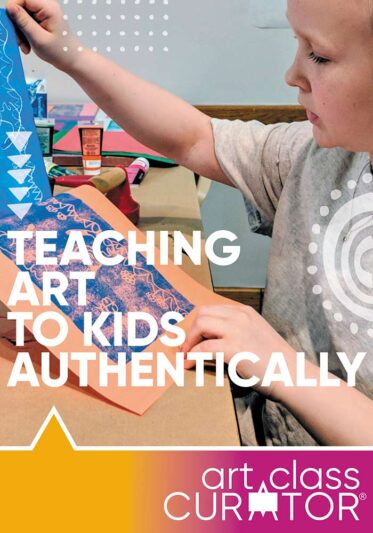
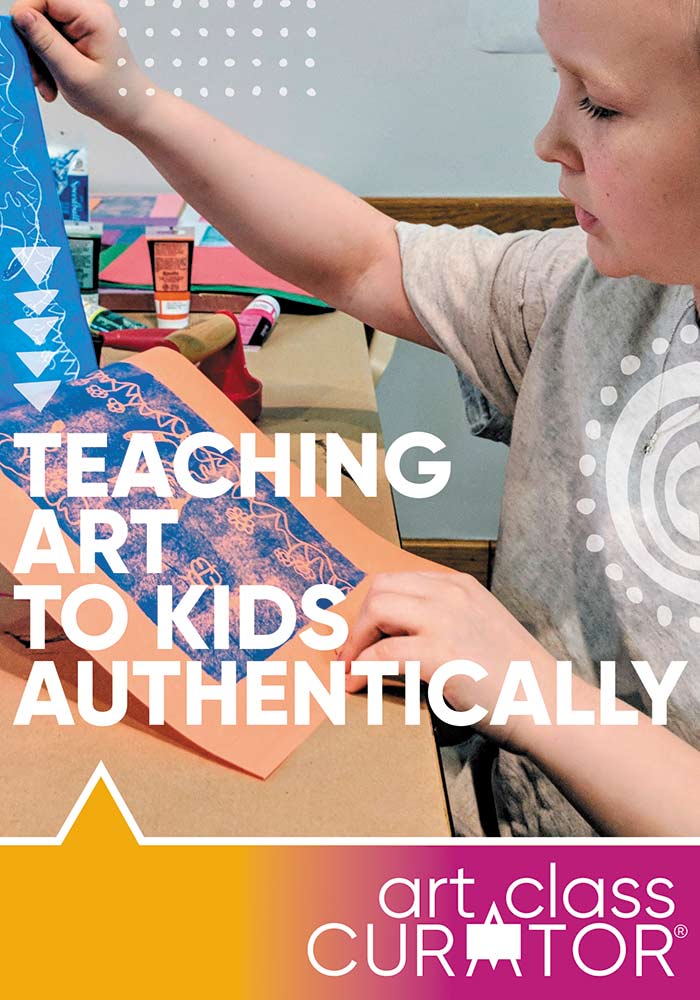
Teaching Art to Kids Authentically

Inside: Teaching art to kids authentically comes from connecting artworks to projects in a meaningful way that doesn’t rely on copycat crafts.

We’ve all seen it. Many of us have taught it. Art projects that are really just copycat crafts.

When parents walk into the art classroom on open house night, many are greeted with mosaics of student artworks that all look basically the same. Students, excited to show their parents their work, scan the rows of nearly identical projects, searching until they find their name—one of the only things that sets their work apart from the others.

Don’t get me wrong, there is value in copying the works and techniques of great artists. But there’s so much more to art. There’s so much more to creating. Teaching art to kids authentically is more than having them make their own version of Starry Night or the Mona Lisa.

True art connection happens when students interact with an artwork through discussions and activities that empower them to see the importance of art in their lives and the world. True art connection happens when we connect artworks to projects authentically, honing in on the idea that inspired the artist or a powerful technique that they used.

Teaching Art to Kids Authentically

This idea might sound good, but it can be difficult to pull off in practice—especially if you’ve never seen it done before. The trick is to focus on the connection. We want students to care about what they’re making, that way the experience stays with them long after their artwork has dried and curled around the edges. We do this by focusing on a specific aspect of the artwork:

  • The big idea, theme, or mood of the artwork
  • The function of the artwork
  • The content, subject matter, or story behind the artwork
  • The media or technique used by the artist
  • The elements or principles of art present in the work

Let’s take a lesson from the Curated Connections Library to show you how we can connect artworks and projects in a way that will inspire students instead of stifling their creativity.

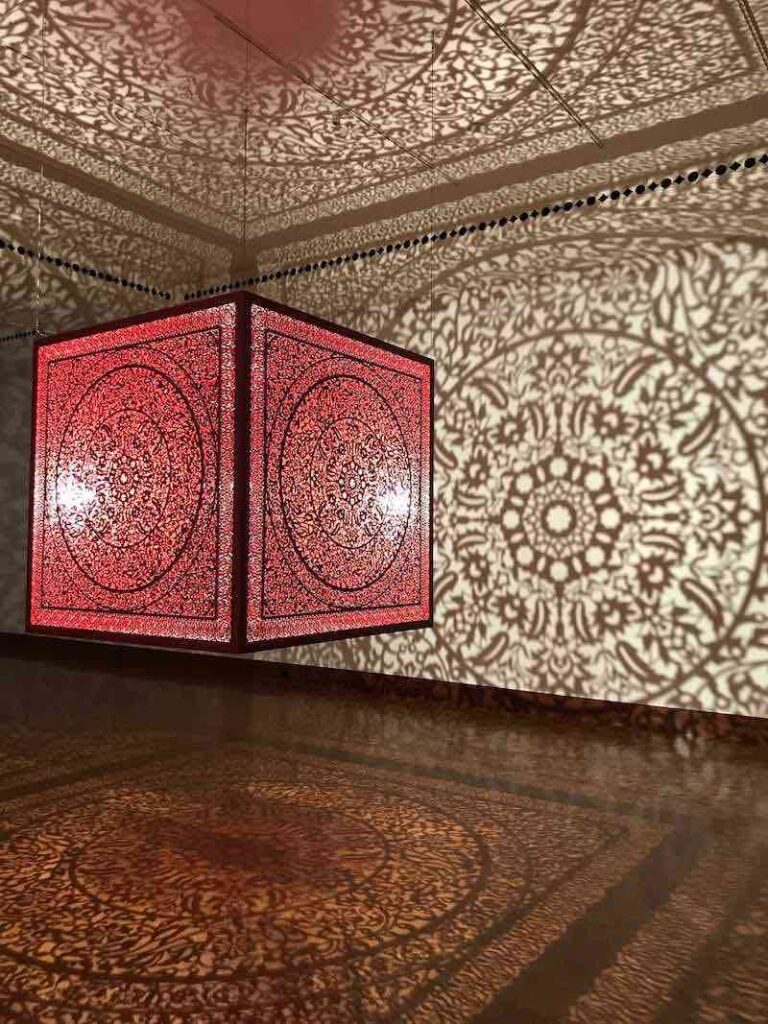
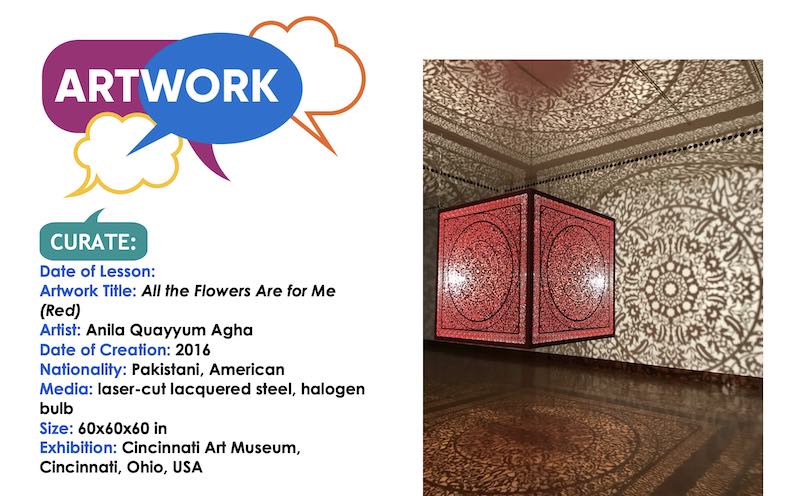
Anila Quayyum Agha, All the Flowers Are for Me (Red), 2016

As a woman in Pakistan, the artist was excluded from certain places. When she immigrated to the U.S., she sometimes felt like an outsider. These experiences inspired her to create sculptures that are meant to be welcoming and inviting. “That’s where this idea of ‘All the Flowers’ came from,” Agha said. “It’s the continuation of me exploring this concept of creating spiritual, yet safe spaces that do not say ‘no’ to anybody.”

The intricate geometric patterns in Agha’s work is a great technique to share with students as they learn new skills.

Get the Full Lesson!

This Lesson is in The Curated Connections Library!

Find the full lesson from this post along with hundreds of other art teaching resources and trainings in the Curated Connections Library. Click here for more information about how to join or enter your email below for a free SPARKworks lesson from the membership!

Join the List

Get the Full Lesson!

This Lesson is in The Curated Connections Library!

Find the full lesson from this post along with hundreds of other art teaching resources and trainings in the Curated Connections Library. Click here for more information about how to join or enter your email below for a free SPARKworks lesson from the membership!

Elementary students can fold and cut paper, mastering motor skills while they utilize radial design and geometric patterns. Each work will be unique. As students create their simple mandalas, they can hold them up to the light and discover the way bright light and dark shadows change the emotion of their work.

Middle school students can create their own intricate mandala or printmaking design, taking inspiration from Agha’s work to create art that represents spaces where they feel welcomed or excluded.

High school students can create a radial design or geometric tessellation on cardstock or construction paper. They can cut out shapes and patterns to make positive and negative spaces, then hang their creation in a window or in front of a light to cast their design throughout the room for an immersive experience. This invites students to consider how spaces are transformed by art.

A lesson inspired by this artwork is also perfect for cross-curricular and integrated assignments. You can collaborate with the math department or geometry teacher to make a large design to be displayed on school grounds.

Get a full lesson for Anila Quayyum Agha’s All the Flowers Are for Me (Red), including lesson plan, discussion questions, activities, and more in the Curated Connections Library.

When we assign an art project, we have two choices. We can tell students where every line and color go, or we can allow them to explore their lives through the lens of art. Both have educational value, but only one way will help them find their own meaning.

Filed Under: Art Connection Activities, Art Teacher Tips


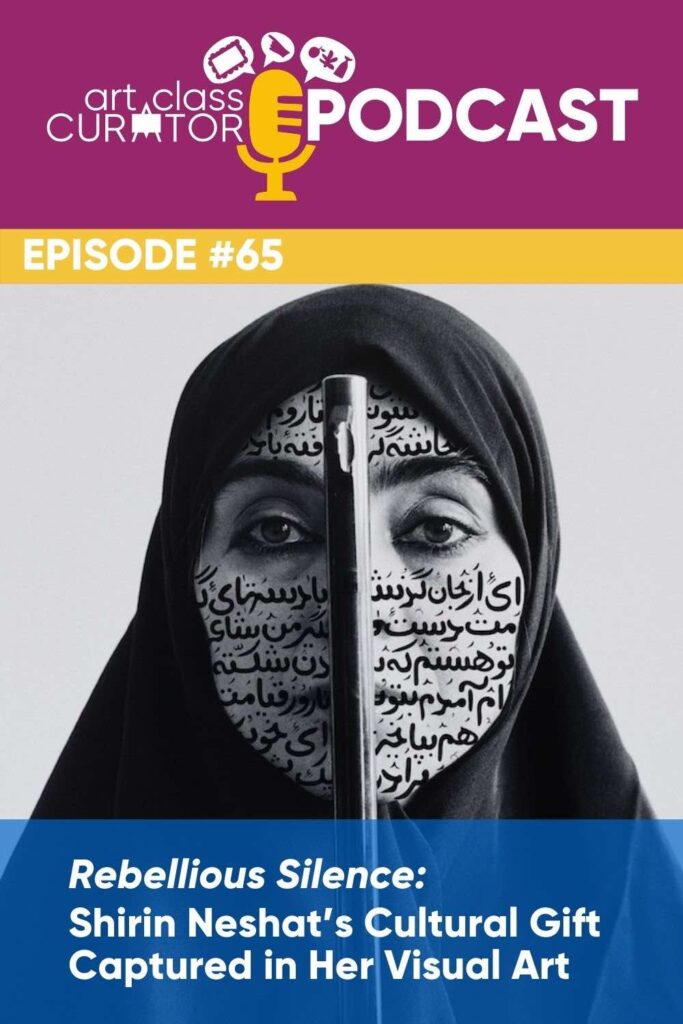
Rebellious Silence: Shirin Neshat’s Cultural Gift Captured in Her Visual Art

Rebellious Silence: Shirin Neshat’s Cultural Gift Captured in Her Visual Art

Today, I’m here with Jennifer Easterling who is another wonderful staff member of Art Class Curator. She writes lessons for our membership at Curated Connections Library and our curriculums. In this episode, she’s chosen Shirin Neshat’s Rebellious Silence for our conversation which she’s been enraptured with ever since she came across it when looking at an AP Art History class. Recently, this artwork came to Fort Worth, Texas and Jenn got to go see it!

Subscribe in Your Favorite Podcast Listening App

4:22​ – What the art piece looks like

9:23 – What surprised Cindy and Jenn about Neshat’s photographs

15:05 – The nuances of the photographs in person vs. online

21:51 – Opening eyes to Muslim women’s rights

26:13 – Discussing the symbolism of guns in Neshat’s artwork

31:34 – Getting lost in Neshat’s dramatic eyes

33:46 – What Neshat wants from us looking at her work

36:58 – Speculating about the meaning of the poem

44:10 – The artistic beauty of the Farsi language

47:48 – Going back home never being the same

52:10 – Watching Neshat’s video art

59:49 – Key personal connection for Jenn to take forward

1:04:38 – Insights from Jenn teaching this art in the classroom

  • Free Lesson Sample
  • Share Your Story to be a Podcast Guest
  • Untitled, 1996 by Shirin Neshat
  • “Illusions & Mirrors” trailer
  • Turbulent by Shirin Neshat
  • Rapture, 1999 by Shirin Neshat (excerpt)
  • Shirin Neshat: “I Will Greet the Sun Again” at The Modern Art Museum of Fort Worth
  • Art This Week-At The Modern-Shirin Neshat: I Will Greet the Sun Again
  • More Art by Shirin Neshat
  • Shirin Neshat Women of Allah Translations (PDF)
  • Art Appreciation Worksheet Bundle (for the I am character poem)
  • SPARK: 5 Art Criticism Steps for Inspired Art Connections and Conversations
  • https://members.artclasscurator.com/courses/shirin-neshat-rebellious-silence/ (for members)
  • I am character poem for members — https://members.artclasscurator.com/courses/art-worksheets-poetry/
  • Be a Podcast Guest: Submit a Voice Memo of Your Art Story (Scroll to the bottom of the page to submit your story.)

Cindy Ingram: Hello and welcome to The Art Class Curator Podcast. I am Cindy Ingram, your host and the founder of Art Class Curator, and The Curated Connections Library. We’re here to talk about teaching art with purpose and inspiration from the daily delights of creativity to the messy mishaps that come with being a teacher. Whether you’re driving home from school or cleaning up your classroom for the 15th time today, take a second, take a deep breath, relax those shoulders, and let’s get started.

Hello everybody, it’s Cindy Ingram from Art Class Curator. Before we get into our episode, I want to invite you to the Curated Connections Experience this summer. Join me and your fellow art teachers for our 2021 Summer Art Teacher Workshops. We have one virtual and one in person. You can learn exciting and engaging teaching strategies, spend quality time with art, spark your own personal art connections, and inspire your teaching. You’ll get to spend quality time with your peers and regain the power, and excitement of art education before heading into the new school year. You can go to artclasscurator.com/workshop2021 to learn more and we’ll see you there.

Hello everybody, this is Cindy Ingram from The Art Class Curator Podcast. I am back for another curated conversation—that’s what we’re going to call this type of episode. I am here with Jennifer Easterling who is another of the wonderful Art Class Curator staff. Jennifer works with all of our education and curriculum, writing lessons for our membership, The Curated Connections Library, and also, our curriculums. I am so excited to welcome you back to the podcast, Jennifer. Welcome.

Jennifer Easterling: Thank you. I’m glad to be here. 

Cindy Ingram: We had our first of these types of podcast episodes last month with Madalyn Gregory where we talked about Death and Life by Gustav Klimt. If you haven’t listened to that episode, I encourage you to go back. We did a two-parter for that where we talked about work of art. The impetus for this type of conversation is we pick a work of art, one that was meaningful to the person that I am interviewing, then we just talk about it. We don’t really have an outline going in. We’ve had a little bit of conversation about what we might want to talk about but we really haven’t outlined this.

The structure that we’re using for this conversation is called SPARK, which if you have been following Art Class Curator for a while, you know we had the SPARK Hybrid Learning Curriculum, but we have an art criticism model called SPARK. You can get a download for that at artclasscurator.com/spark. Basically, it is See, Perceive, Ask and Answer, Reflect, and Know. We’re going through each step in a loose way—we never really follow it fully, finish one step before moving to the other—but we’re really going to talk about what moves us about the artwork, what we know, what we think, what it teaches us about ourselves and about life, then we’ll also talk about how to teach this one in the classroom because the artwork that Jennifer has chosen today is in the membership and she has also used it in her classroom. Jennifer, can you share with us which artwork that you chose for this conversation?

Jennifer Easterling: Yes, definitely. I chose Shirin Neshat, Rebellious Silence. This artwork has just stuck with me ever since I came across it when I was looking at the Art History AP 250 for the AP class. They have to know 250 artworks to take that AP test and this one just really stuck with me. I was so excited to find out that this one, along with a whole bunch of others, were coming to Fort Worth so I could actually see it in person and live. After researching and studying, to get to go see it, it inspired me and made me think about art in whole new ways. Some of it, really thought provoking. 

Cindy Ingram: Yes. For those of you who are listening—obviously, you’re listening because it’s a podcast—but if you want to look at the artwork, we will put the artwork in the show notes. If you head over to artclasscurator.com/65, you will find the image there to look at. But let’s describe the image. For those of you driving, please don’t go look at it while you’re driving, wait until you’re not driving, but can you describe the artwork for the listeners?

Jennifer Easterling: In this artwork, you have a woman who is wrapped in dark cloth and it’s got a very light background. You see her stunning eyes, they’re just very piercing staring right back at you. They really looked into my soul whenever I started looking at this artwork. The more you look at it, the more you start to see. She actually has writing across her face. If you look closer, it’s Farsi. I, unfortunately, cannot read Farsi so I had to go look for some translations. It’s actually a poem written by a female poetry writer and the words translate to, “O, you martyr hold my hands with your hands cut from earthly means. Hold my hands, I am your poet, with an inflicted body, I’ve come to be with you and on the promised day, we shall rise again.”

The more you look at it, the more you start to see. She’s actually holding a rifle. She’s holding it straight up but it’s splitting her face vertically, so you’ve got the shadows contrasting from the light to the dark. You have all of these different imagery of all these things being blended together into this one image. The more you look, the more you see. That’s what I just found absolutely fascinating about it.

Cindy Ingram: Yeah, I agree. Especially the eyes in this one too, I cannot stop looking at her eyes. They are so big and haunting. I noticed that too. We both got to see this exhibit of Shirin Neshat at the Fort Worth Modern Art Museum and I noticed that– is this her?

Jennifer Easterling: Yes, she was the model for her photographs.

Cindy Ingram: So she’s in most of a lot of her early photographs and in some of her videos as well. Her eyes are just a very prominent feature. You talked about when you first discovered it and what your first reaction was to it. When you got to see it at the museum last week, what was your reaction when you entered that space? 

Jennifer Easterling: There was a lot of overwhelming feeling, just, “Wow, this is it.” I always get those feelings whenever I’ve written about something and looked at it on a computer screen or in a book for so long, then I finally get to go see it in person, it changes. It’s the experience with the museum, just being in a different space, but then all of the other artworks around it, you can see how they play off of each other. I knew that this one artwork, this one photograph was a part of an entire series. I didn’t realize how extensive that series was and how one series led into another, led into another, led into another. I couldn’t believe how it took up the entire three-fourths of the top level of the Fort Worth Modern. I just kept going and going, and there were more photographs.

Cindy Ingram: I love that about seeing a work for the first time that you know so well from the computer, from books, it’s always like seeing an old friend but also someone you’ve never met before at the same time, or I guess it’s just like we met first, you and I, on the computer. We didn’t meet until, I don’t know, two years after–

Jennifer Easterling: No, wait, we met at TAEA after. Because I attended one of your workshops and I came up and met you afterwards. 

Cindy Ingram: Did you? I don’t remember that. Okay, you weren’t Jennifer Easterling then to me, you weren’t like the person who worked for Art Class Curator, you were just somebody else, or had you already started working?

Jennifer Easterling: No. I hadn’t.

Cindy Ingram: All right. 

Jennifer Easterling: I was a member, then I came up to you afterwards and I was like, “Oh, I’m a member. I love you. Here’s my number, you should call me sometime.”

Cindy Ingram: That’s hilarious. I do not remember that at all but I also get very overwhelmed at events like that. I’m not surprised that I don’t remember but that’s funny. I can’t use that example, but someone else you meet in a group online or something, you meet them in person, you feel like you really know them but it’s also like you’re seeing their body language, then you’re seeing how they walk, and you’re seeing their expressions in a new way. It just gives you more information about that person. It feels that way with the work of art. It’s really fun.

Jennifer Easterling: Definitely. It changes the whole perspective of the artwork.

Cindy Ingram: The size.

Jennifer Easterling: Yeah, the size is definitely one that blows me away every time. They’re never the size that I have in my head.

Cindy Ingram: Yeah. I think what surprised me about this one and just the first few rooms of the exhibit was I think I never looked close enough to see that the writing wasn’t written on the person, then photographed. It was added to the photograph after. That was really surprising to me. It added a different layer of texture to it that I wasn’t really expecting. But now that I’m looking at it on the screen, I’m like, “Oh yeah, it’s definitely written on top.” But for some reason, I didn’t make that connection until I was there in person.

Jennifer Easterling: There’s a really cool photo that I came across whenever I was doing the research and it’s of her writing, like actually doing the writing and the drawings on the photographs after they’re printed. But what struck me is how big they are. I’m thinking it’s just an 8×10 photograph but they’re not. They’re huge and to see that perspective of her drawing on them—because you can see she’s painting and it’s much more than just writing on there, there’s more artistic thought to it—this one, it’s pretty straightforward across and of course, she doesn’t write across the eyes.

She leaves that blank so they really stand out but in some of her other works, the size changes according to the shadows and where they are on the body. Some of them she writes are really large. Another one she writes is really small. Other ones, she layers the writing and the text to create shadows, and form on top of the photographs. There’s definitely a lot more to it than just writing something on there which is really fascinating.

Cindy Ingram: Yeah. There was a room with photographs of people from Egypt and it had the writing over their faces. I think the exhibit was chronological, so this stuff was her early work at the beginning. This one we’re talking about, Rebellious Silence, is one of her earlier works. The Egyptian ones were later on and, like you said, the writing was much smaller and it was layered. There was some dark writing and light writing. But some of the people were crying, did you notice that? But she wrote around the tears and left the tears.

Jennifer Easterling: That tear just popped out. The same thing she does, like a lot with the eyes, she’ll write around the eyes so that those eyes—whoever it is, whether it’s her or somebody else—they just really jump out and they would capture me. I found myself just being drawn into that person and their story. It made me wonder who they were. I was reading a little bit of tag or trying to read as many tags as I could but a lot of them didn’t have much beyond their name, like the person’s name. She photographed them because of their story but it didn’t really go into what the stories were. So then in my mind, I’m starting to create all this narrative of who this person was, what they went through, and why they were crying or what would spark those tears.

Then it was connecting back to me that everybody had a story to tell. Are we spending time diving into that story? Are we so absorbed in our own world we don’t think about other people’s stories? My mind was just flying. I was so exhausted after the exhibit. I think I spent three hours just in this one exhibit and I never do that. I’m usually running through and, “Okay, I’m going to look real fast then move out,” I’m like, “Nope, I’m just going to take my time and go from each piece as I feel like it.” I spent three hours but I was just totally exhausted. Then it dawned on me, there was so much emotion that I was seeing and feeling through all this and I’m like, “Oh, this is amazing, I have to do this more.”

Cindy Ingram: I know. I felt the same way. Since we’re talking about your first reactions, my first reaction was one day, getting over the initial surprise of it’s different than what I imagined but the thing that I felt most striking was realizing that I don’t know this language, I mean that’s obvious. Sometimes, the text was translated but most of the time it wasn’t. I couldn’t help but wonder what this experience would have been like if these were my own culture and these were a language that I knew, and how drastically different the experience would have been for me.

It was this battle back and forth between feeling like I want to be in, I want to be let in, I want to understand, I want to learn, and I want to learn about these people, and who they are but also realizing that I never fully can. That’s true for any. Even my own children, I never fully can understand what’s going on in their heads. 

Jennifer Easterling: While I was there, I came across this group of ladies and they were a little bit older in age. There were four of them and they were looking at the artwork. I always listen. I’m curious as to what they’re talking about. There weren’t very many people there and I heard this one lady start talking about how they were in Iran whenever the revelation happened and her son was there. They had a whole different perspective on this.

I’m looking at these artworks because she was there, she experienced some of the things. Even though—and I’m not trying to assume anything but I don’t think she was Iranian—she looked to be American but she had this whole different experience from being in that place at that time, so she has this different shared experience than you or I have because we weren’t there. I really wanted to go up and ask her more about it but try not to have her too much. But yeah, that was really interesting.

Cindy Ingram: Yeah, totally.

Jennifer Easterling: Some other things that I noticed looking at the photographs up close and in person was all the texture in the cloth, the texture and the contrast in the backgrounds of each photograph where it’s just lost whenever it’s on the screen because it’s not near as big, but whenever it’s printed large and such high quality, you really get to see all the nuances of the photograph and how well planned they were. These weren’t just a quick snapshot and move on, you can see just the texture and the way that she would pull the cloth, and you see the cloth move, I was blown away by that because I do have a little bit of knowledge of photography and all that. So looking at how each little piece was planned, I thought it was really, really fascinating. 

Cindy Ingram: Yeah. Speaking of the cloth, she’s wearing a hijab and it’s completely fully covering her face, then it’s just draped. You don’t really see her body underneath it. You can see a little bit of a shoulder but that’s a really interesting use of positive and negative space because the background is just white but you start to think artistically, it’s just a black space. But there’s so much in that black space, so much that the hijab symbolically represents. There’s so much about wondering who is underneath that, who they are, and what are their hopes, and dreams, who is this woman, her history, her future, her feelings, and all of that feels like it’s wrapped up in that just solid black cloth.

Jennifer Easterling: And she talks about that. Most of them have the black cloth against this really light background, so you’ve got that strong contrast. But in one or two of them, it’s actually white cloth. It talks about the symbolism of white representing death and she’s using the cloth in the photograph almost as a shield. There’s one that’s really powerful of her and her son together. He’s sitting in her lap and there’s still a rifle, a gun next to him but she’s got this cloth she wrapped around and you just see their faces. It’s talking about using that as a shield, a shield against death, a shield against everything else that’s going on.

I thought that it was really fascinating. It had more meaning than just contrast or something tied to a culture. It was that protectiveness. As a mom, I really started to connect with her on that too, wanting to shield her child from the outside world or anything else that might be going on. That one struck me too

Cindy Ingram: Oh yeah, there were many that really made me think about motherhood in different ways. There was one in particular that she was fully covered with, I don’t think it was a burka. I think I could see her face. I don’t remember. Actually, I’m going to go look to be sure. But she was fully covered, then her son was nude and he was probably, I don’t know, seven or eight or maybe, younger, maybe five. He was fully decorated in little like Persian patterns and that sort of–

Jennifer Easterling: She is completely covered except for exposed arm extended to her son who is covered with the markings of his heritage. Decorative designs that can be considered Persian, Iranian, Middle Eastern, and Islamic. Compared with his mother who is hidden, the boy seems to have full rights to his heritage, able to express them on his body without prohibition even at a very early age. The suggestion here is that a male by the mere virtue of his sex is born with rights to expressions denied to females. Even though the woman is the boy’s guide and mother, it is clear that she occupies a different social stratum when she is within the Islamic Republic.

Cindy Ingram: Yeah.

Jennifer Easterling: It just blows you away.

Cindy Ingram: It does and it’s so funny, like I didn’t really even need that label to fully get this one. It was so powerful and impactful to see that difference. So I went back and looked at the photo just to make sure and yeah, you don’t see her face at all. You don’t even see her eyes. 

Jennifer Easterling: No, you don’t. 

Cindy Ingram: She’s completely covered head to toe with just her arm coming out. 

Jennifer Easterling: This was another one that I thought was really interesting with the texture layered behind because you’ve got the dark black cloth. It’s solid but then you’ve got a white background but if you look closely, it’s lace. There’s all this texture behind it but it doesn’t look like it has the same cultural patterns that it does on her son. I know in some of it, she talks about blending of cultures because she was based in New York for a while, I think for the majority. I think she’s still there living and working.

Cindy Ingram: Yeah. There was another one that was a mother hoodie that I really connected with. That one we just talked about, if you’re curious, it’s called Untitled, 1996. Any artwork that we mention from the exhibit, we will include the titles and links to images in the show notes. Don’t worry about that. I took a lot of pictures of the exhibit and I’m sure Jenn did too.

The other one that I thought that I really liked was called Bonding, 1995. This time, her hands were the ones with the patterns and decorations on them. They were cupped in almost like a heart shape and her son’s hands were—I think it was her son—in her hands and his hands this time didn’t have the decoration. I went to a lot of places with that one. We’re not even talking about Rebellious Silence anymore but we’ll go back to it. We’ll be in and out.

Jennifer Easterling: It’s all part of those theories of these Women of Allah. You see how interconnected they are and that’s what made this Rebellious Silence more impactful to me whenever I was seeing them all together instead of just on its own. It’s powerful on its own but then you see all of them and it just hits you in different ways like, “Wow, here’s a woman really using her voice to speak out about all kinds of things without physically being there speaking.” 

Cindy Ingram: Yeah. What was really interesting to me as I was watching my own reactions at the same time as experiencing the artwork, one of the reactions that I had is I found myself—because women’s rights are such a really important issue for me, it’s something that I feel really passionate about—I found myself viewing a lot of these through stories that I know of how women’s rights are non-existent in certain parts of the world or the fact that they have to cover up and all this stuff. I was coming in with this attitude of “this is all negative”, like the women’s roles are all negative.

Then I would read the label and it would be talking about love, connection to their faith. The women’s rights stuff was there and it was talked about but there was also this love for their culture, love for their religion, and love for their traditions. I saw that and it really reminded me that in this world now, things are not black and white even though we’re looking at artworks that are black and white. Just the layers of all of those things together are so seen in these artworks and it really opened my eyes to this whole topic of–what is the topic? I don’t know. What do I call that topic? Suddenly, I have no idea.

Jennifer Easterling: Of gender, of race, of culture?

Cindy Ingram: Muslim women?

Jennifer Easterling: Power of voice curriculum? 

Cindy Ingram: Anyway, it opened my eyes to the issue of Muslim women’s rights, that it’s not so easy. It’s not so clear what’s right and what’s wrong.

Jennifer Easterling: Yeah. I know in some of the labels, it talks about the contrast, which I thought had so many different meanings because you’re looking at the black and white contrast of just the photograph and those stark value changes. But then she’s also talking about the contrast of the imagery where you have a woman who is supposed to be the homemaker, lovely, and soft, you have these all stereotypical things that a woman is supposed to fit into but yet, here she is holding a gun. That contrast, then you have the hard steel versus the softness of the cloth. You’ve got that contrast. Are you supposed to be seeing these things all together? Just lots and lots of contrast and clashes between many things, multi-layered, multifaceted all throughout this.

Again, the more you look, the more you see and the more you connect with as a woman and connect back to your own thoughts, culture, and experiences and what are things that are contrasting, and clashing in my life and my experiences. You can relate to her on many different levels, of many different things. It may not be specifically a gun but how many times are things happening simultaneously in different cultures? Not necessarily simultaneously but you see gun issues there, which they’re always being faced here in the US and there are always these conversations happening. Whenever you look at artwork from different parts of the world, it’s interesting to see that conversations don’t always change. They might look a little bit different but so much of it, it’s the same.

Cindy Ingram: Yeah. Let’s talk about the issue of the guns in the artwork a little bit more, what they could symbolize and also, how she uses them for meaning. Because this one that we’re talking about Rebellious Silence has the rifle coming straight up from below. It’s basically just the barrel of the gun and it goes across her face. There’s another one in the exhibit where the woman is pointing the gun at the viewer, which obviously we didn’t choose that one for the members to show kids because that’s a little taking. It’s probably a little too far. I think we’d get some parent complaints on that one. What are you thinking about the symbolism of the gun and why she included the gun in the artwork?

Jennifer Easterling: I had many thoughts before, as you know. Again, this is my American lens on things, and again, we’re in Texas, so then there’s a whole different lens of being in Texas with that. But in America, it’s this whole idea of the right to keep and bear arms, so is this one way of her hanging on to her rights? Or is it a whole other thing of standing up against something or are you trying to fight for something? If you look at the title, the Rebellious Silence, are you rebelling against silence? Is this how you’re rebelling by holding that and carrying that? Or is your voice not working, so now you have to resort to other things?

In my head, I start to see all these different narratives but then whenever I went to the show and read the different titles, it was talking that this became a way, like they were picking up arms to fight with brothers for their country and their culture. It was more back to that contrast of they’re maybe not supposed to but here they are trying to stand up and fight together to keep their culture and not lose that. I thought that was really, really, fascinating.

Cindy Ingram: Yeah. I think that my interpretation of the gun actually changed from when I saw it before to when I saw it in person. Mainly because of that issue I already talked about how I went in with women’s rights plastered on my forehead, I was like, “This is what this is about.” Then I got there and I was like, “No, this is not what this is about. It’s partially what this is about.” But yeah, once I was there and in the space, I realized that these were women that were fighting for their culture. It was a protection of their culture. It was that than fighting against. But I also think it can be both. There’s this thing going around, I hear it all the time now these days from coaches and people on the internet called both/and, have you heard that?

Jennifer Easterling: I think so.

Cindy Ingram: Yeah, it’s basically a lot of people going into the world thinking about either or black or white. I don’t know who coined both/and but it’s embracing the both/and is seeing that you can be exhausted and you can also be energized at the same time. You can be both. You can be either not one or another. I think that in this exhibit, the whole way through, I was seeing that play out. You can be oppressed but also you can fight for your call, like you can do both and you can be both.

Jennifer Easterling: And you can be a mother and you can be a homemaker but you can still stand up and fight for whatever. Yeah, I definitely see that. The world is not always black and white. You think about how many grays there are in the world itself. There’s not always a right and a wrong answer because everybody has their own opinion, their own different take, and experience. All that has to play in. 

Cindi Ingram: Yeah, I get caught in that black or white thinking all the time and I constantly have to remind myself. I just felt like this whole exhibit was like, “Cindy, look at this, another example of why you need to stop doing that.” That was an important lesson that I got.

Jennifer Easterling: I pulled the card up and it says, “The woman in the photo is vigilant and ready for whatever threat is coming her way.” That could be anything and that could be taken in so many different ways, and you apply that to your own life. This is readiness for whatever might be coming. Is it the hardness of the day, just getting the kids ready for school, getting to work, and running through your day? Are you ready for that? Or is there something else that you have to really fight for? Your culture, your freedom, your experiences, your family, whatever. This idea of being ready. 

Cindy Ingram: Yeah, she’s armored up, she’s got her weapon, and that made me think that’s what the gun means to her but then there’s the element of now, the gun is separating her from the viewer. It’s this barrier between the two people, so that’s impacting our relationship with her too.

Jennifer Easterling: Yeah, for sure. Then you see the light against the dark, how does that play in? Is it right? Is it wrong? That plays in. Then her eyes just keep drawing me back in and you start thinking, “Okay, what’s her story? What has she been through? Why would she be holding this gun? What is she trying to fight for or separate us from?” All of that.

The cliche of, “The eyes are the window to the soul,” but so many of our artworks concentrate on that. Eyes are what make us unique. Everybody has their own eyes. Physically, yes, they’re different, they are unique, and part of our individual makeup but it’s how we see and perceive things too. Everybody has their own take on how they’re seeing things. There are so many layers that you could dive into this.

Cindy Ingram: Yeah. Madalyn and I in our last conversation talked a lot about eyes because that was a big thing in the artwork that we looked at. But I think you can never get enough really dramatic eyes in an artwork because they’re just drawing me in. If I just sit there and let myself stare into her eyes, I feel like I would just completely lose myself. I’m trying it and I’m not going to be able to talk because they’re so good. She just has beautiful eyes. 

Jennifer Easterling: It connects us back to her. The more I look at her, the more I feel connected with her as a person, as an artist, as a model, as an activist, as whatever else.

Cindy Ingram: Yeah. There’s something about just looking into somebody’s eyes. It’s an incredibly vulnerable thing. As I’m staring at your eyes on my computer screen, I’m not looking at you, but I just feel really vulnerable about it.

Jennifer Easterling: Like she’s my soul. 

Cindy Ingram: Yeah. She is seeing something in me that maybe I don’t know and I’m seeing something in her that maybe she doesn’t know, like the secrets that we keep and hide away, I feel like it’s there.

Jennifer Easterling: But yet feeling connected too like she’s seen into my soul and I’m seeing into her soul. But that idea of really connecting with somebody and talking about culture, eye contact can be really important. That helps you understand somebody and it shows that you’re paying attention or whatever else. But yeah, whenever you get this photograph and she’s just staring into my soul like, “What do you want to know? I can tell you everything or maybe you already know it.”

Cindy Ingram: Yeah. That’s what these activities where you think about your own life in reflection in response to an artwork I think are so powerful because it isn’t just about her. It’s about us, too, looking at her. Especially when she’s looking straight at us, the artwork then becomes about us, like what is our role in this artwork? 

Jennifer Easterling: For sure.

Cindy Ingram: What do you think Shirin Neshat wanted from us looking at this? 

Jennifer Easterling: It’s a really good question. The more I look at it, again, I just feel this connection to her and I feel curious about her, her culture, and what she’s going through or has been through. I became more curious about the writing and what it means to her, what it means to somebody who can read Farsi but then you read the translation if you have that and you start to see, you’re able to understand maybe a little bit more. But I think a lot of it is just this is one powerful way that she was able to use her voice and really reach a lot of people in a lot of different ways, especially now it’s being included in the AP 250.

Kids all over are seeing this and being able to connect with her, her voice, and the message that she wants to get out there. I think part of it is fighting for your culture, your freedom, whatever it is, you fight for whatever threat may be coming your way, whatever that might look like but empowering people, empowering women. Don’t be afraid of whatever it is that’s coming your way. You have it. For it to make it into high schools, that’s pretty powerful. Her voice is pretty strong. That’s amazing.

Cindy Ingram: Yeah. I think that too, part of me, I thought about that question I asked of you for myself too. I’m thinking that one of the things that she wants from us is—and again, this is conjecture, she didn’t tell me this but that’s what art interpretation is—that I think she is wanting to educate us as two white women who go in with a certain stereotypes of what we think that life is like for Muslim women in Iran. She’s challenging us, I think, to question our stereotypes. I don’t think she’s educating us but she’s challenging us to educate ourselves.

Jennifer Easterling: Yeah, for sure. I know I’ve done a lot more research on things now since I’ve looked at it because it created all this curiosity in me. I had all these questions and narratives, so that sent me to go research and find out more about history, culture, and all that, and what might have spurred these images. 

Cindy Ingram: I hear that a lot too from, just say like in relation to Black Lives Matter and things like that, I’ve heard certain black people say, “Stop asking us to educate you.” It’s like, “It’s not our job to educate you, it’s your job to educate yourself.” I feel that connection with this as well.

Let’s talk about the poem in the text. Do you want us to read the translation again? Because I’m sure, people have forgotten by now.

Jennifer Easterling: Yes. She only used female poets in all of it. Every photograph she did in the Women of Allah series has a poem to go with it. The poem is by Tahereh Saffarzadeh. It’s called Allegiance with Wakefulness. The poem is,

“O you martyr

hold my hands

with your hands

cut from earthly means.

Hold my hands,

I am your poet,

with an inflicted body,

I’ve come to be with you

and on the promised day

we shall rise again.”

Cindy Ingram: Okay, what’s your interpretation? We’ve never really done poetry interpretation before together. This is fun. 

Jennifer Easterling: Yes. Whenever I’m reading it, I start seeing a bunch of the other artworks and not so much this one in particular. But this whole idea of a martyr is really interesting. Is she the martyr in the artwork or is this talking about a different martyr and she’s going to fight for their cause or why they were the martyr? Then all the imagery with, “Hold my hands with your hands,” I think of the other artworks where there are hands in them—she’s holding the hands of her child or the hands are holding the gun or near the gun, there’s another one where her hand is just barely touching her lips—those images come to mind whenever I’m hearing about all of this or reading about the hands and holding my hands. But this idea of we will rise again or we will live to fight another day or we’ll rise from the ashes, all those images come to mind whenever I read that.

Cindy Ingram: Do you know what I think is happening in the poem? I think that it is from the perspective of Allah, of God. God is the one speaking those words. He’s saying—he/she, I don’t like to say he because we don’t know—it’s saying, “You’re the martyr, I’m with you, hold my hands.” It says, “With your hands cut from earthly means,” that made me think that “your” is the person on my end. It says, “I am your poet,” then you have this body, you’re of this earth but I’m here with you and I’m protecting you. Then I’ve got you back basically.

Jennifer Easterling: Then, “We shall rise again.” Like in Christianity where it always talks about the saints will rise again and come back after when Jesus comes back again, that’s something that was coming to mind.

Cindy Ingram: But I think you’re onto something there. I think that it’s true, I mean Muslim or Islam comes from Christianity. It is an extension of Christianity. They believed in the things leading up to, then Prophet Muhammad was like the next prophet. They’re still the same. It’s the same God, like the same God as Judaism, the same God as Christianity.

Jennifer Easterling: Yeah. Again, not knowing Islam but this idea of are the saints going to rise again? Do they have saints in Islam? 

Cindy Ingram: Yeah. Questions to be answered. I think it’s important to note we are not Muslim and we’re talking about an artwork that is very much connected with its religion, so we have to be really careful. But also, I don’t think we need to be afraid to make those connections to things that we know, then we can find meaning and we can work it out, and we can figure it out. It’s a little scary because you don’t want to offend anybody or do something wrong but also, you’re not going to learn until you’ve done that.

Jennifer Easterling: I think it’s important to have conversations around things you don’t know because that’s how you learn or it generates new questions that drives you to go find the answers just out of curiosity. I think it’s good to be able to have conversations around things you don’t know and don’t understand.

Cindy Ingram: Yeah. I think that’s really important to teach our kids. There’s a lot of people in this world who are quick to shut you down. They’re quick to correct you or to comment that you’re getting it wrong. But if you’re coming from a place of “I want to learn and I want to do better, I’m going to do my best to do that,” you can’t do anything more than that. If you’re coming in and saying, “This is what I know and this is what’s right,” if you’re coming with that attitude, yeah, correct me. Call me out on that. But if I’m trying to learn and I’m working through it, I think that’s really important.

Jennifer Easterling: This is where the beauty of looking at art from other cultures is. So much of it, we can connect to it ourselves in different ways and drive us to learn more about the culture, different beliefs, and different ways of being. That’s why I love looking at art from all around the world because it helps me know more about them or about that. It helps expand my knowledge so I can better connect with people.

Cindy Ingram: For sure. Yeah, I think the writing is really meaningful when I look at it, especially the lines of the “Cut from earthly means” and the “With an inflicted body”, because our bodies take such a beating in our life but they’re like with us, taking care of us and they’re protecting us. Most of us are incredibly mean to our bodies—we don’t get enough sleep or we don’t eat the right foods, or whatever. I don’t want to shame anything—but our bodies, through all of that, through the abuse that we go through on a day-to-day basis—self-inflicted or other people, whatever—that our bodies are here for us and keep us alive every single day, every single moment of our lives. Your body’s got your back. I feel like, too, this poem also could be like you could go a whole different way and be like this poem is like your body’s message to you. I just now thought about that but it’s like, “I’m here with you, I’m protecting you. You’re safe if you’re with me.” I feel like it’s a little love letter.

Jennifer Easterling: Yeah, I’ve come to be with you. You are with your body, you only get one, and it’s with you all your life.

Cindy Ingram: Yeah.

Jennifer Easterling: Fascinating.

Cindy Ingram: Indeed. That’s my own personal journey coming through my own personal connections because that is something that I do spend a lot of time thinking about and processing, how my body is here to protect, “You’re here to make me live the best life.” 

Jennifer Easterling: Yeah, for sure. Going back to the writing on it, it’s so beautiful. That’s what I’ve always admired about Farsi and different languages. I love to see how they’re written because it’s really, really beautiful. It’s very artistic. The way she has added all the writing itself despite being in another language, that is an art form in and of itself. It’s just incredible because I’d get lost in this different language. 

Cindy Ingram: Then I think if it were written in English, it would be far less beautiful. I guess you could write it in a certain way to where it’d be beautiful but it’s also, writing in English would then take the mystery away from me. I think even though I wish I could read it, I also like the mystery of it at the same time. 

Jennifer Easterling: Yeah.

Cindy Ingram: Also, it connects back to traditional forms in Islamic art. The written word in calligraphy is probably the number one art form of Islamic art. I think that’s a really important tie-in for her to include that in her own work, that cultural connection.

Jennifer Easterling: For sure. Again, many different layers of this, you could examine each facet and talk forever on each little thing.

Cindy Ingram: Even in her other works, it’s not just the writing but the other art forms that are prevalent in Islamic art, like the nature motifs, the patterns, the swirly lines, and all those sorts of patterns, we see that throughout her artwork too. As someone who has studied art history, I like to bring that in and make that connection.

Jennifer Easterling: For sure. Some of the other artworks, not in the Women of Allah series, but as she moved to different locations, because the Women of Allah series I think was taken in the US. I’m trying to remember but there was another one where she went back to Iran and took pictures with her family, and with that, she placed a very traditional English background where you have this garden and stuff. It’s soft but it doesn’t look like it’s from Iran. She talks about that it’s very deliberate, that it’s of more western culture. Then she is in the foreground and sometimes, it’s just her, sometimes with her sister or her niece, then there’s one with several family members.

They are in their more traditional dress from Iran. It’s that clashing of cultures but also that blending of cultures where she’s been living in the US for such a long time but yet she wants to hang on to her roots. She serves a lot of family in Iran, so she blends all of that together in different ways. I think it was the English garden, that’s what it was in the background, then she does different things with vines and stuff. I thought that was a whole different interesting take, how she’s moving from place to place.

Cindy Ingram: That series with the garden in the background, I thought was so different from stuff before. It was really fascinating to see. I went back to check because you were wondering if she was in the US when she did the Women of Allah series. I think she was. She moved to the United States in 1975 and came back in 1990. 

Jennifer Easterling: That was the first time she had been back since the Iranian Revolution. She came to the US to study with her sister in California and whenever they were in the US, the revolution broke out and it cut her off from her family for 11 years. It wasn’t until 1990 that she was able to go back and actually see her family for the first time since everything had happened. She talked about how so much of her home had changed. She didn’t even recognize it. It was just totally different.

That sent me thinking about how I grew up in a really small town but then I moved away, so anytime I go back, it’s the same but it’s not. My family is still there and I have all these memories, and all that but it’s never quite the same whenever you go back to your home. I was looking at it from other eyes, not that there’s been a revolution in my hometown but things always change. Time passes and people come, and go. It’s always changing.

Cindy Ingram: Yeah. There’s a quote that I just want to call about what she said about when she came back. She came back one year after Ayatollah Khomeini’s death and it says, “It was probably one of the most shocking experiences that I’ve ever had. The difference between what I had remembered and what I was witnessing was enormous. The change was both frightening and exciting. I had never been in a country that was so ideologically based. Most noticeable, of course, was the change in people’s physical appearance and public behavior.” Is that when the women’s rights thing started to get worse because of the revolution?

Jennifer Easterling: That was my understanding. I thought this quote was interesting. This was something that she had to say about her work, she says, “It’s really about the question of people versus tyranny and people who fight power versus people who hold power.” That was found on npr.org. Whenever she’s exploring her experiences of creating art while in exile, in all the interviews that I’ve watched her give, she keeps talking about being an artist in exile and being exiled from her home, and this is how she is I guess dealing with those experiences of being in exile and how she’s facing this time in her life—exile, martyrdom, identity, Islam, women at the intersection of political tyranny and religious fanaticism, as well as the idea that good and evil exist in all of us. All of her stuff really has many, many layers and you could look at it from all different lenses, all different viewpoints, and connect with it in some way, some fashion.

Cindy Ingram: Yeah. We’ve been talking for a while, I think we’re getting to a point where the podcast should end eventually. We could probably keep going for another hour. I feel like we could. But let’s wrap up, because the problem too is I just thought of the whole topic of masculinity versus femininity. I feel like that’s in all of her work too.

Jennifer Easterling: It is. Yeah, she talks about it. 

Cindy Ingram: What we need to talk about is the videos. I feel like we would be doing a huge disservice if we did not talk about the videos before we ended. I was going to have you share your personal connections but I’m going to wait because we need to talk about the videos first.

She’s a photographer but she is a filmmaker. She does both video art but then she also makes films—the line between what is a film and what is a video art, I’m not exactly sure about—but never, in an art exhibit, have I ever sat and watched every single minute of every single video installation. There were maybe four or five.

Jennifer Easterling: They were a lot more than I expected but yeah.

Cindy Ingram: Me and Madalyn, we sat and watched every single one and at the end of it, I was like, “That was really the star of the show. That was the most eye-opening, the most interesting.” I just really loved the videos.

Jennifer Easterling: Yeah. I had seen some just in my research for the lesson plan and I thought they were really powerful. But seeing them in the museum setting, especially there’s one where on the computer screen, they’re just side by side and there are two different films playing at the same time but in the museum, they had it on two completely separate screens, two sides of the room, two walls, so it totally changed the meaning of this video.

What you have to start off with, you have a man and he gets up onto a stage, and he sings. He gives a song performance in front of many other men. Whenever he’s done, they’re all clapping and giving him applause, and praise for his song. Then on the opposite wall, a woman gets up and she gives a performance but it’s a totally different feeling, and the audience is empty. She’s just performing to empty chairs. She’s singing but at the same time, it’s different. It’s more sounds I guess instead of actual lyrics. It’s beautiful, haunting, terrifying, and amazing all at the same time. You really can’t put it into words. But whenever she starts giving her performance, the men stop, they turn, and they’re just watching, and looking at her almost in shock. Whenever she ends, they just stop and stare, almost in disbelief I guess. It’s hard to say.

My interpretation of it is that all of a sudden, they’re coming in like,”What are you doing up on stage? What is that?” Anyway, it was really fascinating to see the play of the two videos, how they interacted with each other on opposite screens versus just side by side on a computer screen and of course, they’re huge, so that makes a difference too.

Cindy Ingram: In that same room, they played another video. It was a men-women thing again where there were men on one side and they were digging a hole or something, did you see that one? 

Jennifer Easterling: Yeah, there is.

Cindy Ingram: Yeah. It’s in the same room.

Jennifer Easterling: They’re in this medieval city and they’re all in white shirts and the women are all in black, so you see that contrast too. They’re going around the city and doing all these things together, then as soon as the women speak up, they stop and freeze, and they’re looking at them in confusion, almost like, “Why are you speaking up?”

Cindy Ingram: The men stop and just stare at the other wall. So then, you look at the other wall and that’s when the women are doing their thing. When the women would stop, then the men would continue to do it. It was just this back and forth that was so interesting. Then ultimately, the women ended up going to a beach and getting on a boat, and sailing off into the distance. Then the men were at this medieval fortress and there were cannons. I was so worried the men were going to shoot cannons at the women but they didn’t.

Jennifer Easterling: I know right. 

Cindy Ingram: I was like, “No, don’t do that.” But then they were just watching in disbelief like, “What are they doing? Where are they going? Why are they leaving? They’re not supposed to leave.” That’s the vibe that I got. 

Jennifer Easterling: I read the card before I went in—because I never do that at museums, I just go up and look at the artwork—but this time, I purposefully read and it was talking about how the men were almost like chained to the city where they couldn’t leave. They were stuck there together where the women were free. The boats, they’re free items that take them beyond, so I thought, “Hmm, interesting.” I was viewing it through that lens after reading the card first.

Cindy Ingram: Yeah. I relied more on label text than I ever have. This exhibit, it just felt really important that I read every single label. They had a lot of poems on the walls too. Those were really, really amazing, such good poems. The videos were incredible. Like Jenn said, those are online, so we’ll see if we can find links to those two that we talked about and we’ll put those in the show notes so you can check them out. They were just so good. The only one I didn’t like is the one with Natalie Portman in it because all I could think of was, “That’s Natalie Portman.”

Jennifer Easterling: Yeah.

Cindy Ingram: She took me out of it. I was like, “Why is she here? What is she doing?” Then my brain was just like, “Do they know each other? How did this happen?” I was trying to figure out how Natalie Portman ended up in it instead of focusing on the actual artwork itself.

Jennifer Easterling: I guess there’s one that has dialogue in it, one video out of all of them but the rest of them are mainly, they’re not silent—they’ve got music, sounds, and stuff—but there’s just no dialogue. You’re putting a lot of your own thoughts, feelings, emotions into the videos themselves. I found myself standing in the person’s shoes as they’re going through this video and experiencing these different things. It’s interesting whenever you take a video, then just take out all the dialogue. It totally changes your perception and your take on this.

Cindy Ingram: Yeah, I think you really do. You have all that time too because you might not spend a lot of time in front of a 2D work of art, although I do a lot, but this one, you have more time, so you’re thinking more, you’re interpreting more, then you’re looking for where you fit. The one I found that I fit most into was the one where the woman was becoming the tree.

Jennifer Easterling: Oh, yeah.

Cindy Ingram: She was hiding in the tree, then there’s this group of people coming, then she just slowly becomes the tree, then she’s not there anymore. I felt really connected with that because sometimes, I think it’s part of my anxiety that when I have anxiety, my instinct is to hide, I want to go in my closet. I want to hide on the floor, get myself in a ball. I want to close the door and turn the light off, like I don’t want to be seen. I felt like she was trying to hide in plain sight and she managed to turn herself into a tree, I don’t know, I could see that.

Jennifer Easterling: Oh, if I have that power.

Cindy Ingram: I know, wouldn’t it be so comforting? 

Jennifer Easterling: I’m just going to be a tree today.

Cindy Ingram: That made me think just like meeting you at TAEA and me, not remembering. It’s probably because I really needed to turn myself into a tree at that moment right after our session.

Jennifer Easterling: That’s all good. 

Cindy Ingram: Indeed. You went to this exhibit, you saw this Rebellious Silence as well as her whole work of art. If you could think of one key thing, personal connection that you’re going to take forward, something about your own life that you learned from this, what do you think that would be?

Jennifer Easterling: To definitely go in with open eyes, an open mind, an open concept, and just let the art speak to me however it’s going to. Try to get rid of any past things that I had read or seen and just be with the art, be with the exhibit, be with the artist in that place, in that time. I thought that was really nice because most of the time, I’ve got people with me but this time, I was by myself and I could just go and exist, and be with the art and let it speak to me in whatever way. I was able to open up a lot more and let all of this art speak to me in so many different ways, where if I’m in a rush or whatever else, that doesn’t happen. 

Cindy Ingram: Yeah. I think you learned not to take your kids to every art museum you go to.

Jennifer Easterling: Yeah. That’s for sure. As I’m finished, I’m like, “Yeah, the family would not have enjoyed this, they would have been rushing out.” Especially, if I’m in there for three hours by myself on this one floor, they would have been like, “I think we’re ready, let’s go.” But being able to just push all of the inhibitions back and just be like, “Okay, I’m just going to exist in this space with this art and let it speak to me, and learn from what is going to stick with me,” these have really stuck with me. I can tell, whenever I’m still thinking about them, days later, “Okay, that spoke to me in many different ways.”

Cindy Ingram: Yeah. I think my main lesson, my main personal connection was the existence of the both/and, the black and white thinking that I’m always having. I live in this world in my head where my head’s like, “You can’t be smart and be spiritual.” I have this thing that I do and it’s just in every area of my life I tend to do that. The only person that is being harmed from that thinking is me, I’m just making myself feel bad for no reason at all. I think that was a great lesson for me.

What’s really important, and I think we talk about this a lot at Art Class Curator, is finding the personal connections to works of art, finding what that artwork has for you personally. It’s not about going in and learning everything that you can about the artist, and learning about the way she used contrast, the way she used base. It’s deeper than that. It’s more than that. It’s how you can use that art to better yourself, use that art to create joy, to create insight, to create meaning in your life. You can’t just enjoy a work of art too but when you can find these lessons, I think that’s where–

Jennifer Easterling: It’s the personal connections. Whatever that may be, whatever way, shape or form because it’s not going to connect with everybody the same way.

Cindy Ingram: If I went back to that exhibit today, even though I just went, I don’t know, maybe a month ago, if I went back today, I would probably come out with a completely different lesson because every time is different. We just have to be open to seeing what that is and letting the art guide you to whatever you need to know.

Jennifer Easterling: I think one other thing is the stories. Everybody has a story to tell, are we willing to listen? Are we open enough to listen to those stories? That in turn will then connect us to other people. I think part of what I’ve learned with this job is all the connections in life. Every day, I’m going through and I’m seeing things interconnected, and intertwined that I’ve never seen before.

I’ll just spot something that may seem really random but in my head, I’ve connected it to all these things and people look at me like, “What are you talking about?” Like, “You don’t see the connection between all these things? It’s amazing.” I come back to the stories and now, I feel connected to these people and the stories that Neshat was trying to tell with their experiences. Even though I don’t know their full story, I feel connected to their story in some way, connected to these people and all those different things.

Cindy Ingram: That was a beautiful way to end. However, we’re not done because I do want to hear from you. You have taught this artwork in your classroom.

Jennifer Easterling:  Yes.

Cindy Ingram: I want to hear how that went. What did you do? Any insights you had from that?

Jennifer Easterling: When I taught this in my classroom, we started off with this idea, what’s going on here and what makes you say that. It’s always beautiful to watch what the kids say, see, connect with, bring out. There were a lot of really interesting conversations that we had. It’s been a little bit since we had these conversations. I don’t remember specific things but I remember having a lot of really deep conversations. I was super passionate about this. I think the kids felt it too, just learning more about it. I was excited to share it with the kids.

We talked about the woman, we talked about the writing, and we talked about what is she trying to say, where is she trying to go, looking at all those things. Then what we did with the artwork is we looked at a poem, it’s the I am… Character Poem. It talks about things like, “I am ____.” You fill in the blank. I am, I see, I feel, and I think. You’re putting in all of these different thoughts and feelings. I had the kids print off pictures of themselves, so we took selfies, printed them in black and white, then I had the kids write their I am poem on their face talking about I am whatever.

I left it really, really wide open for them and I had kids who spoke different languages, and wrote in different languages. I encouraged them to write in whatever language they wanted to, that it didn’t have to necessarily be legible. This is more for them like, “What are you? You tell me.” One specific student I remember, he struggled with this a whole lot. He just wrote this I am, it was kind of silly. I said, “That’s fine. It doesn’t have to be super serious. It can be deep and meaningful or it can be light and fun. I’m leaving it up to you.” He blew off the assignment and wrote some stuff down, and I said, “It’s okay. That’s fine. We’ll go with it.”

But then all of a sudden, he took it back maybe a few days later and he had scratched out the majority of it on his face, and rewrote the poem. It was this deep, deep meaningful, insightful poem about who he was and different things that he felt, and was going through and I was like, “Whoa.” But it also allowed me to connect with him in different ways. It gave me this insight into who he was as a person, as a student, as all the different things. It really gave me insight to who he was. I thought that was really interesting. I was able to share it with his mom and that gave her insight too so that we could better connect with him and help him in different ways so that he could be a successful student. It was a fascinating assignment because we didn’t try to copy her, we just took inspiration from her.

Cindy Ingram: I love that story because it shows in a really real way how students are capable of these sorts of really amazing art connections. You can see in that story, he was holding himself back at the beginning, he was keeping it service level, maybe, I’m projecting onto this kid but he was scared to get too vulnerable.

Jennifer Easterling: That’s exactly what was going on. Knowing this kid now and knowing more about him, that’s exactly what was going on but it wasn’t until he pushed himself. I didn’t even do it. I just gave it to him and I stood back, and I let him run with the fun thing but he took it upon himself to go back and do it again, and push all this other meaning. That, I was so proud of, but you’re like, “Okay, that gives me chills. Yes, I connected with a student and the student was able to connect with art.”

Cindy Ingram: Yeah. You gave me chills talking about it. It’s just amazing. I think that’s an amazing place to leave off. If you’re listening, I want to remind you, you can go to the show notes at artclasscurator.com/65 to get the links from this episode, look at the artworks, we have some pictures that we took at the exhibit that I’m sure we can throw in there as well. Then also, the I am… Character poem worksheet that Jenn just referenced, we have that in the store on our website artclasscurator.com/worksheets. We’ll also put a link to that in the show notes.

Also, if you’re a member of The Curated Connections Library, we do have an entire lesson on Shirin Neshat’s Rebellious Silence in there which includes a lesson plan, discussion, questions, engaging activities, links to YouTube videos, and TED Talks that Shirin Neshat has done—I think there’s a TED Talk in there—or videos, interviews, and things, project ideas, worksheet templates, all the works for that work of art. If you’re inspired to talk about this with your students, we’ve got that in the membership. We’ll also link that in the show notes for our members.

This was a really awesome discussion. We were going in a little bit worried and nervous, we didn’t know how it was going to go and I don’t know why I’m ever nervous because when you’ve got art to talk about, you always will have something to say. Thank you so very much, Jenn, for joining me today.

Jennifer Easterling: I’m so happy to do it.

Cindy Ingram: That is all for today. We will see you again next week. Again, if you want to be on the podcast and you want to talk about a work of art and share something meaningful to you, and have a conversation like this, we would love you to be on the podcast. If you go to artclasscurator.com/category/podcast, at the bottom, there’s a forum that says share your art story, fill that out and tell us about it. We would love to talk to you about it. Thank you so much for listening. See you later.

When you’re a teacher, one thing is certain, the lesson planning never ends. The Curated Connections Library is here to help with hundreds of art connection lessons and activities. Our signature SPARK work lessons include everything you need to teach an artwork every single week. Each lesson features one diverse and captivating work of art, and is complete with discussion questions, engaging activities to create deeper art connections and related art project ideas. With unique worksheets and Powerpoint presentations, every lesson is classroom ready. Get your free SPARK work lesson and take a break from lesson planning by going to artclasscurator.com/freelesson.

Thank you so much for listening to The Art Class Curator Podcast. If you like what you hear, please subscribe and give us an honest rating on iTunes to help other teachers find us, and hear these amazing art conversations and art teacher insights. Be sure to tune in next week for more art inspiration and curated conversations.

Free Lesson!

Get a Free Lesson Sample

Get a free lesson download!

Members of the Curated Connections Library get nearly 200 SPARKworks lessons that include everything you need to implement an artwork a week experience in your classroom! Click the button below to get a sample SPARKworks lesson–it includes a lesson plan, PowerPoint, and supplemental worksheets/handouts.

Download

Free Lesson!

Get a Free Lesson Sample

Get a free lesson download!

Members of the Curated Connections Library get nearly 200 SPARKworks lessons that include everything you need to implement an artwork a week experience in your classroom! Click the button below to get a sample SPARKworks lesson–it includes a lesson plan, PowerPoint, and supplemental worksheets/handouts.

Subscribe and Review in iTunes

Have you subscribed to the podcast? I don’t want you to miss an episode and we have a lot of good topics and guests coming up! Click here to subscribe on iTunes!

If you are feeling extra kind, I would LOVE it if you left us a review on iTunes too! These reviews help others find the podcast and I truly love reading your feedback. You can click here to review and select “Write a Review” and let me know what you love best about the podcast!

View in iTunes

Filed Under: Podcast


Enhancing Your Social-Emotional Learning Skills in the Art Classroom

Enhancing Your Social-Emotional Learning Skills in the Art Classroom

Today’s episode is a recording of a webinar I did recently with Kris Bakke at Nasco Education. I talk all about social emotional learning, it’s importance, and how we accomplish that in the art room through working with works of art. In the process, I use a Molly Crabapple portrait as part of an exercise for the webinar group and give an overview of the new curriculum, Art Curator Class Perspectives (in partnership with Nasco).

Subscribe in Your Favorite Podcast Listening App

4:58​ – What I’m aiming to accomplish in this webinar

13:11 – Ways in which education isn’t focused on learning to be an effective adult

16:46 – What social emotional learning looks like in the classroom

23:48 – CASEL (Collaborative for Academic, Social, and Emotional Learning) and the 5 competencies

34:24 – Attendees and I engage in the Reflect Connect worksheet activity for Crabapple’s artwork

45:09 – Ensuring the inclusion of artwork diversity and artist representation in the curriculum

48:29 – An overview of the Perspectives curriculum

  • 82 Questions About Art
  • artclasscurator.com/takeback
  • Episode 31: “Classroom management as an Act of Self-Care”
  • Episode 29: “Mindset and Management with Anna Nichols”
  • Episode 4: “Smart Classroom Management with Michael Linsin”
  • Be a Podcast Guest: Submit a Voice Memo of Your Art Story (Scroll to the bottom of the page to submit your story.)


Cindy Ingram: Hello and welcome to The Art Class Curator Podcast. I am Cindy Ingram, your host and the founder of Art Class Curator, and The Curated Connections Library. We’re here to talk about teaching art with purpose and inspiration from the daily delights of creativity to the messy mishaps that come with being a teacher. Whether you’re driving home from school or cleaning up your classroom for the 15th time today, take a second, take a deep breath, relax those shoulders, and let’s get started.

Hi everybody, it’s Cindy Ingram from Art Class Curator. I am happy to be back with you for another episode of The Art Class Curator Podcast. Today, what we’re going to be talking about is something I’m really passionate about, something I can get maybe a little emotional about, so we’ll see how that goes. But I also don’t really have an outline for today. Often, I will come with an outline or a general idea of the flow. But today, as I was trying to plan what I was going to say, I realized that this was one of those topics that I think I just need to click record, start talking, and see what happens. That’s what we’re going to do today. Hopefully, it makes sense. Hopefully, that works for you.

Like I said in last week’s episode, this summer, we’re really focused on really getting a good feel for what you guys have gone through this year, the struggles that you’ve had, and acknowledge you for the work that you did, and empathize with you for how hard it was. We also want to celebrate that you made it through. But it’s also at a point where I don’t know that anyone is really in the right headspace for celebration at this point, that how you feel right now is exhausted and just weary, and celebrating something that was so hard, that you didn’t get enough support in just doesn’t feel right. So we do want to celebrate, we made it through and we want to get to that place but I just don’t know that we’re there yet.

We sent an email recently to our email list—if you’re not on the email list, go to artclasscurator.com and click just about anywhere, you’ll find a place to enter your email—and we’ve gotten some really beautiful responses to it. I’m going to talk a little bit about the email, then go into what I really wanted to talk about. We’ve been doing interviews of art teachers as you heard the first one last week. We did a survey talking about what we learned this year, what we are looking forward to for next year, what we learned from this year. We scoured all the Facebook groups looking for what are you all talking about. We really spent a lot of time trying to make sure we really understand where you’re at.

One of the responses that we got was someone that said that teaching has become toxic. It really hit us hard and it resonated too because all of the teachers that I know, this year, barely made it through. We thought about, “What is toxic? What does that really mean?” So I looked it up and it’s poisonous or very harmful or unpleasant in a pervasive or insidious way. It’s true, we are seeing teachers leaving the classroom in droves, early retirement, just people who quit and don’t even have another job lined up. They just could not take it anymore. We’re seeing teachers feel unsupported and unappreciated. It’s just insidious through the whole system.

It’s so sad because at the beginning of the pandemic, we saw that teachers were heroes. When the pandemic hit and everybody switched to online learning, there was this feeling of we’re all in this together. They were innovative, they were learning new technology, and they were trying new ideas. Everybody was praising the teachers for everything they were doing to keep their students engaged. As soon as the new school year started, that changed. I won’t tell you who said this but someone told me that they heard from a high up administrator that they were worried about teachers eating bonbons all day, that’s why they had to go to the school. They had to go to the school to do their online teaching because they didn’t trust the teachers were going to do their work, then they weren’t going to teach the kids.

I was infuriated because you saw, in the beginning of the pandemic, how hard the teachers were working. They were doing it from home. They were doing it with their kids at home with them. They were doing it with their spouses at home with them. They just pulled it together and did amazing things. Then a few months down the line, that changed. We saw plans for going back to school that didn’t keep the teacher’s safety in mind. All of that stuff. I don’t get worked up too easily. I don’t get mad, occasionally, I do. You all heard it a few weeks ago in the episode I did about the Van Gogh Exhibit but the thing that gets me worked up the most is injustice, unfairness, and people not respecting professionals, people taking advantage. That really upsets me, so I lived so angry for a pretty long time.

There was a lot of good in the pandemic and we talk about that in the interview next week that I’m doing with another teacher, Stacey Sternberg, who is on the podcast next week. We talk about the gift that we were given of the time to reflect on our lives when everything shut down. There were good things in it, but as far as teachers go, it was an uphill, uphill battle.

In talking about this with teachers from all over—someone in one of the survey responses said, “Through blood, sweat, and tears, we made it through this year.”—I started to think that is horrifying when you think about it. When you hear the terms blood, sweat, and tears, it feels like it’s something you should be proud of. You worked hard, you suffered through, you did it, you had perseverance, you made it, and you look back and you’re like, “Wow, I did that.” But really, you bled through it, you cried through it, you sweated through it. To get to that moment of pride, to get to that moment of looking back and realizing what you’ve done, you had to bleed and cry.

I think that is a little messed up, to be honest, because we live in this world where the hard way is considered the best way. This Puritan work ethic, this work ethic that was taught to us so that we would be good factory workers like, “You work hard. You make a living. You support your family. You should be grateful you have a job,” I feel like that’s really messed up. I am a recovering over worker. My whole life has been spent working way too hard. When I was a high school student, I studied all night, I was obsessed with my class rank, I had a part-time job, I was in AP classes, and all of that, worked through college. Every job I had after college until just like three years ago, two years ago, I worked two jobs. It was like I would work a full-time job during the day and I would teach community college at night; or I would teach during the day, teach community college at night; or I would work during the day and I start my business Art Class Curator at night.

I always had two jobs and I worked, and I worked, and I worked, and I worked, and I worked, and I worked. I don’t know how I did it and people were like, “How do you do that?” I’m like, “I don’t know. I just can do it.” Just in the last few years, I realized, “What am I hiding from with all that work? Why am I so proud of that, that I can’t rest, that I can’t sit and relax, that I can’t sit still?” Because we’re in a culture that values hard work. We’re not valuing smart work. We’re not valuing efficiency. We’re valuing hours put in, money spent. We’re valuing bodily fluids, blood, sweat, and tears being shed over your personal joy, your peace, your quality of life. I think that really has come to a head with teaching this year because teachers are in one of the professions where teachers are taken advantage of. To be honest, we are. They don’t give us enough resources. They don’t give us enough time to plan, to do all the work we need to do. We’re given too many students, too many classes, not enough time, not enough money, not enough support, not enough help, none of that.

That was the case before the pandemic. That was the case when I was in the classroom, you go, go, go, go, you don’t stop, then you work at night, and you work over the weekend. When you have to take a day off, you have to work to prepare for that. You still have to do the work for that day. It’s like you can’t catch a break. When the pandemic hit, we’re in a profession where everybody is already worked to the bone. You’re already spent. You’re already at a breaking point. Then now, here you are, you have to add in online teaching at the same time as your regular teaching, or you’re adding in teaching outside the entire time, or you’re adding a cart which adds a whole slew of problems, or you’re adding in masks and not being able to share materials, having to clean all the materials. I’m sorry if this is actually triggering you because you’ve lived this and now it’s over, and now you’re like, “Oh, I don’t know how much or what worth it is,” but we were already at a breaking point, and this year just sent it over the edge.

I’m tearing up talking about that because I think about how I felt as a teacher. I left the classroom in 2018. When I was in the classroom, it was so exhausting. I would leave, I would go to the gas station, I would get soda and hot Cheetos, and I would eat them—or Takis—on the way home and it just took everything out of me. It’s already hard enough and now, we had this happen. We did the survey, talked to a lot of teachers and one of the teachers said—and I thought it was brilliant—it said, “This year was a wake-up call. But I don’t know to what?” What are we waking up to?

What I think it is for teachers is a lot of teachers are waking up to the fact that teaching has become toxic, that teaching has become too much to handle. They are expecting too much out of teachers, they are not respecting the work that we’re doing, and they are not giving us the support that we need. This year, I heard story after story about districts giving webinars on self-care, telling teachers, “Don’t forget self-care,” and it became a joke online on all the Facebook groups, and stuff because it’s like, “How am I supposed to self-care when I am just worked down to the bone?”

Self-care is not taking a bath, getting a manicure. On the surface, I think self-care has a really bad name because self-care goes so much deeper than just taking a bath, end of a hard day. Self-care is figuring out what made that a hard day and “What can I do tomorrow to make the day a little bit easier? What can I do tomorrow to make myself feel good so I’m not run ragged by the end of the day where I have to bury myself in blankets and binge watch TV, binge eat, and all of those things? How do I prevent getting to that place of desperation in the first place?”

That’s one thing I want to challenge you to consider as you are starting your summer or as you are a few weeks into your summer, is to think about and really reflect on your year. Take a good stock of your emotions from the year. Think about what brought you joy. Think about what stressed you out. Think about what worked and what didn’t. What did you learn this year and what was your own personal wake-up call from this year? Maybe, you learned that when times get tough and when you get stressed out, you lose your creativity or you lose your desire to create art. Maybe, one element of self-care for you this summer is to reconnect with that creative side of yourself. Maybe what you realized is that when you get really stressed out, you stop eating and fueling your body in ways that make you feel good. Maybe, your self-care task this summer is to make a plan for how to prevent that in the future.

I know that is a really big problem for me. My busiest time of the year is in August when a lot of new teachers are going back to school. That’s when we’re really supporting teachers the most and I find that sometimes, I just flat out forget to eat, then it’ll be 3:00 PM and I’ll have the biggest headache in the world, then that’s made me feel terrible and that’s going to cause me to retreat into my cocoon of blankets or my bathtub and just suffer that night. This year, I am making a plan of how I’m going to feed myself in August. I’m going to lay it out, write it all out.

Really think about “Where were those sticking places in your life?” and instead of self-carrying the symptoms of how bad you feel after, self care as an act of prevention. I did another episode in the past of Classroom Management as an Act of Self-Care. It might have been that this year, you had a really hard time with classroom management. I heard that a lot, especially just with lack of motivation from students and all of that, that maybe your self-care preparation for the year is to come up with some new procedures and routines, and read up on some classroom management, so that when you start the school year, you try some new things, create a plan for how it went last year.

We have a couple episodes, there are three episodes that I can think of off the top of my head, one is with Anna Nichols and one is with Michael Linsin, then the other one is the one I mentioned of Classroom Management as an Act of Self-Care. Check those out. I’ll put links in the show notes.

I want to view self-care as something bigger, something greater, something that truly does impact your overall feeling of peace, wellness, and joy. For example, for me, I know that I am much happier, more at peace, more calm when I start the day with a standard routine. I will wake up and I’ll have a cup of coffee, then I exercise or I’ll take a walk, then I meditate. When I do those things in that order, it makes my day so much better. Think about where you can fit in those things that you know work for you. It’ll probably be something totally different but that is really important.

Another thing that you might be thinking about is that you didn’t receive enough support or resources from your administration. Also, we saw a lot of issues with art being viewed as subpar to your core classes. That has always happened, obviously. But this year, it became extra prevalent because with online learning, remote learning, I know some schools just didn’t even have art for those kids or it was optional, so the teacher was just spinning their wheels doing nothing. I saw on Facebook, a teacher said that they taught 20 minutes of a class with no one there, that all the kids were there with their cameras off. She ended the lesson and they all stayed. She was teaching in an empty room. I think we need to think about how to advocate for ourselves, advocate for art, education in general, and ask for more support and more resources.

There were good things that came out of this year. For example, we saw an increase in districts willing to fund our programs for their campuses. We had an increase in district sales because there was extra money for COVID relief through the CARES Act and money was allocated in different ways because of COVID, and teachers felt more confident asking for resources. I don’t even remember who told me this in the past but it’s a good metaphor for teachers spending a lot of money out of their pocket. You think about a teacher who just wants a box of macaroni for a lesson—I doubt many of you are doing macaroni art—but maybe they’re doing a counting exercise or whatever it is. It’s just easier for the teacher to just go get a box of macaroni from the store or a pack of wood sticks or whatever you need, because if you ask, it’s going to take time, they might say no and in the end, it’s just easier to do it yourself, pay for it yourself. It was only two dollars. But then you think about, “Well, it’s $2 this week, it’s $5 next week, it’s $25 a week after.” Then soon, you’re spending all this money out of your own pocket.

I often just didn’t even bother to ask, so I think that teachers could be a little more vocal in what they want. I think that teachers will be surprised that there are resources, there is support if only we ask. I’m not saying your school is going to buy you a box of macaroni when you need one but that’s just the example that I always picture in my head. Don’t even get me started about how I think that’s all stemmed with the patriarchy. If you ever run into me at a conference or something, we can talk about the patriarchy and teachers but maybe, that’s a future episode. Yes, this episode has been negative, it’s just been hard, but there have been some really positive things that we have learned about teachers this year. In addition to their resiliency, their passion, and dedication, we learned that teachers can learn new tricks. They can pick up new technology easily. They can transfer that teaching to the computer and they can still make learning fun for their students.

We also really learned that our attitude and our energy affects our students. It affects our creativity and we cannot be creative when we’re exhausted. I think we also learned that our students need us. They need us to be there for them. We had a hard year, our students had a hard year too and we made it through. We’re looking to a new year. I really think that part of making next year different is believing that it can be different. It’s taking the time this summer to realize what we’ve been through. Recognize the trauma that it was and work through that trauma so that when we come back, we can be there for our kids, we can be there for our students, we can be there for ourselves too. That means doing things differently next year. It means saying no to things that don’t matter. It means speaking up for yourself when you feel like you need to, even if you feel like you shouldn’t or don’t want to or it’s scary too.

We know what it’s like to not speak up. We know what it’s like to just push through. We know what it’s like to have blood, sweat, and tears. We know we don’t want to do that again but we also learned that we can—I mean it’s cliche to say—but we can do hard things. We realize that we can but we don’t have to next year. Next year, we don’t have to do that again. It was our only choice this year. For a lot of people, that’s what you just pushed through, you did what you had to do. But now, let’s take some of that power back. Let’s take some of our joy back. Let’s take some of our life and our energy back. Let’s reconnect with our students. Let’s reconnect with our creativity. Let’s reconnect with art. Let’s reconnect with why we became teachers in the first place because we can’t do that again. You can’t do it again.

The way to make next year different is to believe that it can be different. It’s time to just reclaim our profession, detoxify our profession, and reconnect with why we’re here to begin with. That’s what we’re going to talk about this summer in Art Class Curator, in our emails, in our podcasts. This is the beginning of a series of conversations that I think we need to have to prepare for the new year. We are working on developing a program, a free email program to take back your teaching, to reclaim your year, take your joy back, take your energy back, and take your power back. To do that, we are going to do a little bit of reflection, we are going to do some brainstorming, then we are going to work on a manifesto of sorts to take back our teaching and start the year with purpose, start the year with intention, and really take what we’ve learned last year. We take what we learned in our years up till this last year, then we create our new normal, our new teaching. It is going to be a mix of what you’ve done in the past, what you learned this year, and what you learned you don’t want anymore. That’s what we’re going to work on.

If you’re in our email list, then you’re great, you’re in the right place. If you are not on our email list, you can head over to sign up for this new program that we’re going to do—this new program is going to start on July 26th—to sign up for this new program, you can go to artclasscurator.com/takeback. Again, that program will start on July 26th but all of our emails this summer, our podcast episodes, we’re going to be talking about this a lot, so stay tuned for that. All of these episodes won’t be so negative or depressing. I really needed to say the things that I was feeling about this topic.

Thank you so much for listening. I am looking forward to talking with you more this summer. Our next episode, we have another teacher interview where we talked to Stacey Sternberg. She had a ton of amazing things to say about how she did a lot of art connections with her students this year. Looking forward to sharing her story with you. Thank you so much for listening. I will see you again next time. Bye.

If your art appreciation classes were anything like mine, they happened in dark rooms with endless slides and boring lectures. Art in the dark. But art appreciation doesn’t have to turn into nap time for your students. Start connecting your students to art with powerful class discussions. It can be intimidating to start talking about art with students, so teachers always want to know what they should say. The real question is what you should ask. You can get 82 questions to ask about almost any work of art for free on the Art Class Curator Blog. The free download includes the list of questions plus cards that you can cut out and laminate to use, again and again. These versatile questions can be used in everything from bell ringers to group activities to critiques. Just go to artclasscurator.com/questions to get your free copy today. 

Thank you so much for listening to The Art Class Curator Podcast. If you like what you hear, please subscribe and give us an honest rating on iTunes to help other teachers find us, and hear these amazing art conversations and art teacher insights. Be sure to tune in next week for more art inspiration and curated conversations.

Free Resource!

82 Questions About Art

82 questions you can use to start and extend conversations about works of art with your classroom. Free download includes a list plus individual question cards perfect for laminating!

Download

Free Resource!

82 Questions About Art

82 questions you can use to start and extend conversations about works of art with your classroom. Free download includes a list plus individual question cards perfect for laminating!

Subscribe and Review in iTunes

Have you subscribed to the podcast? I don’t want you to miss an episode and we have a lot of good topics and guests coming up! Click here to subscribe on iTunes!

If you are feeling extra kind, I would LOVE it if you left us a review on iTunes too! These reviews help others find the podcast and I truly love reading your feedback. You can click here to review and select “Write a Review” and let me know what you love best about the podcast!

View in iTunes

Filed Under: Podcast


How to Guide Your Art Students to Have Deeper, More Engaging Conversations

How to Guide Your Art Students to Have Deeper, More Engaging Conversations

As an introvert, it always fascinates me how I can get into a really deep conversation with someone for a while and feel energized and motivated by it, and can keep talking all night. Then there are other times where talking to someone just sucks the life out of me and takes my energy away.

In this episode, I discuss small talk versus big talk and how to go beyond small talk to have deeper, more meaningful conversations and teach our students to do the same. I also share some strategies you can use in your classroom to help develop these skills in your students. 

Subscribe in Your Favorite Podcast Listening App

5:10​ – Defining small vs. big talk and small talk’s vital purpose

14:25 – Revelations from a small talk/big talk research study

16:50 – Benefits to having deeper conversations, especially for art students

19:23 – Ways to encourage and teach your students to have substantive discussions

27:40 – Vulnerability in deep conversations and creating a safe space for students

  • 82 Questions About Art
  • artclasscurator.com/takeback
  • Episode 31: “Classroom management as an Act of Self-Care”
  • Episode 29: “Mindset and Management with Anna Nichols”
  • Episode 4: “Smart Classroom Management with Michael Linsin”
  • Be a Podcast Guest: Submit a Voice Memo of Your Art Story (Scroll to the bottom of the page to submit your story.)


Cindy Ingram: Hello and welcome to The Art Class Curator Podcast. I am Cindy Ingram, your host and the founder of Art Class Curator, and The Curated Connections Library. We’re here to talk about teaching art with purpose and inspiration from the daily delights of creativity to the messy mishaps that come with being a teacher. Whether you’re driving home from school or cleaning up your classroom for the 15th time today, take a second, take a deep breath, relax those shoulders, and let’s get started.

Hi everybody, it’s Cindy Ingram from Art Class Curator. I am happy to be back with you for another episode of The Art Class Curator Podcast. Today, what we’re going to be talking about is something I’m really passionate about, something I can get maybe a little emotional about, so we’ll see how that goes. But I also don’t really have an outline for today. Often, I will come with an outline or a general idea of the flow. But today, as I was trying to plan what I was going to say, I realized that this was one of those topics that I think I just need to click record, start talking, and see what happens. That’s what we’re going to do today. Hopefully, it makes sense. Hopefully, that works for you.

Like I said in last week’s episode, this summer, we’re really focused on really getting a good feel for what you guys have gone through this year, the struggles that you’ve had, and acknowledge you for the work that you did, and empathize with you for how hard it was. We also want to celebrate that you made it through. But it’s also at a point where I don’t know that anyone is really in the right headspace for celebration at this point, that how you feel right now is exhausted and just weary, and celebrating something that was so hard, that you didn’t get enough support in just doesn’t feel right. So we do want to celebrate, we made it through and we want to get to that place but I just don’t know that we’re there yet.

We sent an email recently to our email list—if you’re not on the email list, go to artclasscurator.com and click just about anywhere, you’ll find a place to enter your email—and we’ve gotten some really beautiful responses to it. I’m going to talk a little bit about the email, then go into what I really wanted to talk about. We’ve been doing interviews of art teachers as you heard the first one last week. We did a survey talking about what we learned this year, what we are looking forward to for next year, what we learned from this year. We scoured all the Facebook groups looking for what are you all talking about. We really spent a lot of time trying to make sure we really understand where you’re at.

One of the responses that we got was someone that said that teaching has become toxic. It really hit us hard and it resonated too because all of the teachers that I know, this year, barely made it through. We thought about, “What is toxic? What does that really mean?” So I looked it up and it’s poisonous or very harmful or unpleasant in a pervasive or insidious way. It’s true, we are seeing teachers leaving the classroom in droves, early retirement, just people who quit and don’t even have another job lined up. They just could not take it anymore. We’re seeing teachers feel unsupported and unappreciated. It’s just insidious through the whole system.

It’s so sad because at the beginning of the pandemic, we saw that teachers were heroes. When the pandemic hit and everybody switched to online learning, there was this feeling of we’re all in this together. They were innovative, they were learning new technology, and they were trying new ideas. Everybody was praising the teachers for everything they were doing to keep their students engaged. As soon as the new school year started, that changed. I won’t tell you who said this but someone told me that they heard from a high up administrator that they were worried about teachers eating bonbons all day, that’s why they had to go to the school. They had to go to the school to do their online teaching because they didn’t trust the teachers were going to do their work, then they weren’t going to teach the kids.

I was infuriated because you saw, in the beginning of the pandemic, how hard the teachers were working. They were doing it from home. They were doing it with their kids at home with them. They were doing it with their spouses at home with them. They just pulled it together and did amazing things. Then a few months down the line, that changed. We saw plans for going back to school that didn’t keep the teacher’s safety in mind. All of that stuff. I don’t get worked up too easily. I don’t get mad, occasionally, I do. You all heard it a few weeks ago in the episode I did about the Van Gogh Exhibit but the thing that gets me worked up the most is injustice, unfairness, and people not respecting professionals, people taking advantage. That really upsets me, so I lived so angry for a pretty long time.

There was a lot of good in the pandemic and we talk about that in the interview next week that I’m doing with another teacher, Stacey Sternberg, who is on the podcast next week. We talk about the gift that we were given of the time to reflect on our lives when everything shut down. There were good things in it, but as far as teachers go, it was an uphill, uphill battle.

In talking about this with teachers from all over—someone in one of the survey responses said, “Through blood, sweat, and tears, we made it through this year.”—I started to think that is horrifying when you think about it. When you hear the terms blood, sweat, and tears, it feels like it’s something you should be proud of. You worked hard, you suffered through, you did it, you had perseverance, you made it, and you look back and you’re like, “Wow, I did that.” But really, you bled through it, you cried through it, you sweated through it. To get to that moment of pride, to get to that moment of looking back and realizing what you’ve done, you had to bleed and cry.

I think that is a little messed up, to be honest, because we live in this world where the hard way is considered the best way. This Puritan work ethic, this work ethic that was taught to us so that we would be good factory workers like, “You work hard. You make a living. You support your family. You should be grateful you have a job,” I feel like that’s really messed up. I am a recovering over worker. My whole life has been spent working way too hard. When I was a high school student, I studied all night, I was obsessed with my class rank, I had a part-time job, I was in AP classes, and all of that, worked through college. Every job I had after college until just like three years ago, two years ago, I worked two jobs. It was like I would work a full-time job during the day and I would teach community college at night; or I would teach during the day, teach community college at night; or I would work during the day and I start my business Art Class Curator at night.

I always had two jobs and I worked, and I worked, and I worked, and I worked, and I worked, and I worked. I don’t know how I did it and people were like, “How do you do that?” I’m like, “I don’t know. I just can do it.” Just in the last few years, I realized, “What am I hiding from with all that work? Why am I so proud of that, that I can’t rest, that I can’t sit and relax, that I can’t sit still?” Because we’re in a culture that values hard work. We’re not valuing smart work. We’re not valuing efficiency. We’re valuing hours put in, money spent. We’re valuing bodily fluids, blood, sweat, and tears being shed over your personal joy, your peace, your quality of life. I think that really has come to a head with teaching this year because teachers are in one of the professions where teachers are taken advantage of. To be honest, we are. They don’t give us enough resources. They don’t give us enough time to plan, to do all the work we need to do. We’re given too many students, too many classes, not enough time, not enough money, not enough support, not enough help, none of that.

That was the case before the pandemic. That was the case when I was in the classroom, you go, go, go, go, you don’t stop, then you work at night, and you work over the weekend. When you have to take a day off, you have to work to prepare for that. You still have to do the work for that day. It’s like you can’t catch a break. When the pandemic hit, we’re in a profession where everybody is already worked to the bone. You’re already spent. You’re already at a breaking point. Then now, here you are, you have to add in online teaching at the same time as your regular teaching, or you’re adding in teaching outside the entire time, or you’re adding a cart which adds a whole slew of problems, or you’re adding in masks and not being able to share materials, having to clean all the materials. I’m sorry if this is actually triggering you because you’ve lived this and now it’s over, and now you’re like, “Oh, I don’t know how much or what worth it is,” but we were already at a breaking point, and this year just sent it over the edge.

I’m tearing up talking about that because I think about how I felt as a teacher. I left the classroom in 2018. When I was in the classroom, it was so exhausting. I would leave, I would go to the gas station, I would get soda and hot Cheetos, and I would eat them—or Takis—on the way home and it just took everything out of me. It’s already hard enough and now, we had this happen. We did the survey, talked to a lot of teachers and one of the teachers said—and I thought it was brilliant—it said, “This year was a wake-up call. But I don’t know to what?” What are we waking up to?

What I think it is for teachers is a lot of teachers are waking up to the fact that teaching has become toxic, that teaching has become too much to handle. They are expecting too much out of teachers, they are not respecting the work that we’re doing, and they are not giving us the support that we need. This year, I heard story after story about districts giving webinars on self-care, telling teachers, “Don’t forget self-care,” and it became a joke online on all the Facebook groups, and stuff because it’s like, “How am I supposed to self-care when I am just worked down to the bone?”

Self-care is not taking a bath, getting a manicure. On the surface, I think self-care has a really bad name because self-care goes so much deeper than just taking a bath, end of a hard day. Self-care is figuring out what made that a hard day and “What can I do tomorrow to make the day a little bit easier? What can I do tomorrow to make myself feel good so I’m not run ragged by the end of the day where I have to bury myself in blankets and binge watch TV, binge eat, and all of those things? How do I prevent getting to that place of desperation in the first place?”

That’s one thing I want to challenge you to consider as you are starting your summer or as you are a few weeks into your summer, is to think about and really reflect on your year. Take a good stock of your emotions from the year. Think about what brought you joy. Think about what stressed you out. Think about what worked and what didn’t. What did you learn this year and what was your own personal wake-up call from this year? Maybe, you learned that when times get tough and when you get stressed out, you lose your creativity or you lose your desire to create art. Maybe, one element of self-care for you this summer is to reconnect with that creative side of yourself. Maybe what you realized is that when you get really stressed out, you stop eating and fueling your body in ways that make you feel good. Maybe, your self-care task this summer is to make a plan for how to prevent that in the future.

I know that is a really big problem for me. My busiest time of the year is in August when a lot of new teachers are going back to school. That’s when we’re really supporting teachers the most and I find that sometimes, I just flat out forget to eat, then it’ll be 3:00 PM and I’ll have the biggest headache in the world, then that’s made me feel terrible and that’s going to cause me to retreat into my cocoon of blankets or my bathtub and just suffer that night. This year, I am making a plan of how I’m going to feed myself in August. I’m going to lay it out, write it all out.

Really think about “Where were those sticking places in your life?” and instead of self-carrying the symptoms of how bad you feel after, self care as an act of prevention. I did another episode in the past of Classroom Management as an Act of Self-Care. It might have been that this year, you had a really hard time with classroom management. I heard that a lot, especially just with lack of motivation from students and all of that, that maybe your self-care preparation for the year is to come up with some new procedures and routines, and read up on some classroom management, so that when you start the school year, you try some new things, create a plan for how it went last year.

We have a couple episodes, there are three episodes that I can think of off the top of my head, one is with Anna Nichols and one is with Michael Linsin, then the other one is the one I mentioned of Classroom Management as an Act of Self-Care. Check those out. I’ll put links in the show notes.

I want to view self-care as something bigger, something greater, something that truly does impact your overall feeling of peace, wellness, and joy. For example, for me, I know that I am much happier, more at peace, more calm when I start the day with a standard routine. I will wake up and I’ll have a cup of coffee, then I exercise or I’ll take a walk, then I meditate. When I do those things in that order, it makes my day so much better. Think about where you can fit in those things that you know work for you. It’ll probably be something totally different but that is really important.

Another thing that you might be thinking about is that you didn’t receive enough support or resources from your administration. Also, we saw a lot of issues with art being viewed as subpar to your core classes. That has always happened, obviously. But this year, it became extra prevalent because with online learning, remote learning, I know some schools just didn’t even have art for those kids or it was optional, so the teacher was just spinning their wheels doing nothing. I saw on Facebook, a teacher said that they taught 20 minutes of a class with no one there, that all the kids were there with their cameras off. She ended the lesson and they all stayed. She was teaching in an empty room. I think we need to think about how to advocate for ourselves, advocate for art, education in general, and ask for more support and more resources.

There were good things that came out of this year. For example, we saw an increase in districts willing to fund our programs for their campuses. We had an increase in district sales because there was extra money for COVID relief through the CARES Act and money was allocated in different ways because of COVID, and teachers felt more confident asking for resources. I don’t even remember who told me this in the past but it’s a good metaphor for teachers spending a lot of money out of their pocket. You think about a teacher who just wants a box of macaroni for a lesson—I doubt many of you are doing macaroni art—but maybe they’re doing a counting exercise or whatever it is. It’s just easier for the teacher to just go get a box of macaroni from the store or a pack of wood sticks or whatever you need, because if you ask, it’s going to take time, they might say no and in the end, it’s just easier to do it yourself, pay for it yourself. It was only two dollars. But then you think about, “Well, it’s $2 this week, it’s $5 next week, it’s $25 a week after.” Then soon, you’re spending all this money out of your own pocket.

I often just didn’t even bother to ask, so I think that teachers could be a little more vocal in what they want. I think that teachers will be surprised that there are resources, there is support if only we ask. I’m not saying your school is going to buy you a box of macaroni when you need one but that’s just the example that I always picture in my head. Don’t even get me started about how I think that’s all stemmed with the patriarchy. If you ever run into me at a conference or something, we can talk about the patriarchy and teachers but maybe, that’s a future episode. Yes, this episode has been negative, it’s just been hard, but there have been some really positive things that we have learned about teachers this year. In addition to their resiliency, their passion, and dedication, we learned that teachers can learn new tricks. They can pick up new technology easily. They can transfer that teaching to the computer and they can still make learning fun for their students.

We also really learned that our attitude and our energy affects our students. It affects our creativity and we cannot be creative when we’re exhausted. I think we also learned that our students need us. They need us to be there for them. We had a hard year, our students had a hard year too and we made it through. We’re looking to a new year. I really think that part of making next year different is believing that it can be different. It’s taking the time this summer to realize what we’ve been through. Recognize the trauma that it was and work through that trauma so that when we come back, we can be there for our kids, we can be there for our students, we can be there for ourselves too. That means doing things differently next year. It means saying no to things that don’t matter. It means speaking up for yourself when you feel like you need to, even if you feel like you shouldn’t or don’t want to or it’s scary too.

We know what it’s like to not speak up. We know what it’s like to just push through. We know what it’s like to have blood, sweat, and tears. We know we don’t want to do that again but we also learned that we can—I mean it’s cliche to say—but we can do hard things. We realize that we can but we don’t have to next year. Next year, we don’t have to do that again. It was our only choice this year. For a lot of people, that’s what you just pushed through, you did what you had to do. But now, let’s take some of that power back. Let’s take some of our joy back. Let’s take some of our life and our energy back. Let’s reconnect with our students. Let’s reconnect with our creativity. Let’s reconnect with art. Let’s reconnect with why we became teachers in the first place because we can’t do that again. You can’t do it again.

The way to make next year different is to believe that it can be different. It’s time to just reclaim our profession, detoxify our profession, and reconnect with why we’re here to begin with. That’s what we’re going to talk about this summer in Art Class Curator, in our emails, in our podcasts. This is the beginning of a series of conversations that I think we need to have to prepare for the new year. We are working on developing a program, a free email program to take back your teaching, to reclaim your year, take your joy back, take your energy back, and take your power back. To do that, we are going to do a little bit of reflection, we are going to do some brainstorming, then we are going to work on a manifesto of sorts to take back our teaching and start the year with purpose, start the year with intention, and really take what we’ve learned last year. We take what we learned in our years up till this last year, then we create our new normal, our new teaching. It is going to be a mix of what you’ve done in the past, what you learned this year, and what you learned you don’t want anymore. That’s what we’re going to work on.

If you’re in our email list, then you’re great, you’re in the right place. If you are not on our email list, you can head over to sign up for this new program that we’re going to do—this new program is going to start on July 26th—to sign up for this new program, you can go to artclasscurator.com/takeback. Again, that program will start on July 26th but all of our emails this summer, our podcast episodes, we’re going to be talking about this a lot, so stay tuned for that. All of these episodes won’t be so negative or depressing. I really needed to say the things that I was feeling about this topic.

Thank you so much for listening. I am looking forward to talking with you more this summer. Our next episode, we have another teacher interview where we talked to Stacey Sternberg. She had a ton of amazing things to say about how she did a lot of art connections with her students this year. Looking forward to sharing her story with you. Thank you so much for listening. I will see you again next time. Bye.

If your art appreciation classes were anything like mine, they happened in dark rooms with endless slides and boring lectures. Art in the dark. But art appreciation doesn’t have to turn into nap time for your students. Start connecting your students to art with powerful class discussions. It can be intimidating to start talking about art with students, so teachers always want to know what they should say. The real question is what you should ask. You can get 82 questions to ask about almost any work of art for free on the Art Class Curator Blog. The free download includes the list of questions plus cards that you can cut out and laminate to use, again and again. These versatile questions can be used in everything from bell ringers to group activities to critiques. Just go to artclasscurator.com/questions to get your free copy today. 

Thank you so much for listening to The Art Class Curator Podcast. If you like what you hear, please subscribe and give us an honest rating on iTunes to help other teachers find us, and hear these amazing art conversations and art teacher insights. Be sure to tune in next week for more art inspiration and curated conversations.

Free Resource!

82 Questions About Art

82 questions you can use to start and extend conversations about works of art with your classroom. Free download includes a list plus individual question cards perfect for laminating!

Download

Free Resource!

82 Questions About Art

82 questions you can use to start and extend conversations about works of art with your classroom. Free download includes a list plus individual question cards perfect for laminating!

Subscribe and Review in iTunes

Have you subscribed to the podcast? I don’t want you to miss an episode and we have a lot of good topics and guests coming up! Click here to subscribe on iTunes!

If you are feeling extra kind, I would LOVE it if you left us a review on iTunes too! These reviews help others find the podcast and I truly love reading your feedback. You can click here to review and select “Write a Review” and let me know what you love best about the podcast!

View in iTunes

Filed Under: Podcast


Arguing with a Van Gogh Gatekeeper to Make Art Accessible to All

Arguing with a Van Gogh Gatekeeper to Make Art Accessible to All

I rarely comment about the Internet, but sometimes I have to speak up when something bumps up against my values. This impromptu episode is brought to you by a little argument about Van Gogh I got into online. 

I realized I had some really strong feelings that I don’t know if I’ve really discussed in any format here. It’s a very important perspective that we need to consider so that our students don’t end up perpetuating elitist thinking when it comes to art, and so that we can create a space where we make art accessible to all.

Subscribe in Your Favorite Podcast Listening App

2:44​ – What sparked the argument and my reaction

7:22 – Examples of elitism built into the art museum system

11:46 – Kids’ reactions to the immersive Van Gogh show in Chicago

16:28 – The argument for “being educated” and making art accessible to all

  • Curated Connections Experience (Summer 2021 Workshops)
  • Values Demand Action
  • Looking at Art as a Spiritual Practice
  • Art Museum Personification and Assignment
  • Loving Vincent
  • Where to See The Immersive Van Gogh Exhibits
  • Curated Connections Library (Free Lesson)
  • Be a Podcast Guest: Submit a Voice Memo of Your Art Story (Scroll to the bottom of the page to submit your story.)

Hello, and welcome to the Art Class Curator podcast. I am Cindy Ingram, your host and the founder of Art Class Curator and The Curated Connections Library. We’re here to talk about teaching art with purpose and inspiration, from the daily delights of creativity to the messy mishaps that come with being a teacher. Whether you’re driving home from school or cleaning up your classroom for the 15th time today, take a second, take a deep breath, relax those shoulders and let’s get started.

Hello, this is Cindy Ingram, and before we get into today’s episode I want to take this opportunity to invite you to our upcoming Curated Connections Experience because let’s be real, this past year has been a dumpster fire for teachers everywhere.

This global pandemic shut down our schools and we’ve all scrambled to get supplies and meals and support to our students while worrying about our own health and careers. Some schools are open and others never did. Safety has become relative and when we needed help and funding the most many of us were let down.

So now we’re facing teacher shortages, traumatized students and the deepest burnout that we’ve ever known. Everyone is talking about a new normal but what does that mean for art teachers? Well it is time to take our creativity back, to take our joy back. It is time to take our teaching back. This summer join me and your passionate peers for the Curated Connections Experience. Come together with other art educators, make art, partake in powerful discussions about art, and learn new ways to engage your students with art. 

We’re getting together virtually on June 26th and in Fort Worth, TX on July 8th and July 9th. Go to artclasscurator.com/workshop2021 to reserve your spot. I cannot wait to see you there.

Hello everybody. This is Cindy Ingram from Art Class Curator and I am here doing a little impromptu episode. So I know last week I promised you an episode on big talk versus small talk at the end of my conversation with Madalyn, and that is coming. Still coming. But something … I got into a wee bit of an argument on the internet and realized, in that little argument that I had on the internet, that I have some really strong feelings about something. And I don’t know that I’ve ever really fully articulated this or talked about this in any format through anything with Art Class Curator before.

So I thought I would talk about it because I really think this is a super important perspective that we need to think about and talk about so that our students don’t sort of perpetuate the same types of things. So let me talk about my argument. I rarely will get into commenting on the internet. I don’t … I usually will just keep scrolling. But there are some times where I just have to say something, and it’s usually those times where it really bumps up against my values. It is something that, when something bumps up against my values, I have to say something. I have … It’s just, it’s impossible not to say something.

And if I stifle that, I’m not living with my values. So, and I’ve talked about values before on the podcast. So if you haven’t listened to that episode, I do have one called Values Demand Action. But I think knowing your own personal values is super important. But that’s neither here nor there.

So let me tell you what happened. Someone in one of the art teacher Facebook groups, I don’t know which one, I’m in so many, said, asked people how the interactive Van Gogh exhibit was. I don’t know, if you’re anywhere in America, I’m sure you’ve seen this advertised. It is in so many cities across the country. They’re selling out, they’ve been promoting it for months and it hasn’t even opened here in Dallas yet. It opens in June and they’ve been promoting for months. June is completely sold out. It’s a big hub, no, what is the word? Hubbub is what I wanted to say, but I also wanted to say huzzah. I don’t … I think hubbub is the right word.

Anyhoo. So someone asked in the Facebook group, how was it? She’s thinking about going. And all the comments were really positive. People were saying, oh, it was really awesome. I really enjoyed it. Totally worth it. Such a good time. I really felt moved by it. It was tons of positive feedback.

And then the one person, in particular, went the opposite direction, which is fine. You’re fully allowed to disagree. But her comment was, she said that it’s a light show. Please. It’s not like viewing his collection in a museum, not even close. “I was lucky enough to get tickets to his show at the National Gallery in the late nineties, nothing compares.” And then she talks about how it’s exploiting his real work.

“I’m saying as a cartoon version, it’s like going to see animatronic dinosaurs instead of going to the Museum of Natural History.” So, some other people challenged her on that, too, that … Someone else challenged her and said that it was, yes, it’s a spectacle. Yes, it’s a moneymaker. But this could be a buy-in for students who would otherwise not want to go to an art museum or experience a work of art.

And so this is a way to reel them in. Hook them, is what this other had said. And I think that I a hundred percent agree with that. Absolutely. Because, and then my comment was, if it puts more art experiences in front of people, then I’m all for it. Because we’re all about, at Art Class Curator, finding your personal connection to art. And finding art that means something to you. And giving you personal, powerful, authentic, moving experiences with works of art.

So if you look a couple of episodes back at my episode Looking at Art as a Spiritual Practice, you can do this and learn more about yourself and understand yourself and the world better. You can … There’s so much that can happen when you have a powerful art experience. So when we go and put limits on what is an okay art experience. When we say, oh, you had a really powerful art experience at the Van Gogh museum, or at the Van Gogh exhibit, or well I’m not, I’m worried she’s going to get on me again without, by saying exhibit. By going to this Van Gogh interactive video show.

Oh, that’s not good enough. Because it wasn’t the real thing. So your experience, not the real thing. You didn’t really have that experience. You don’t know anything about Van Gogh, and it doesn’t matter because you didn’t see the actual art. If you saw the actual art, you would be so much better off.

Give me a freaking break. You know? Like, seriously. Who are we to say that your connection, your experience, your emotion about the experience, your, whatever you learned about yourself during the experience, whatever you learned about the world during the experience, whatever you learned about Van Gogh during the experience, whatever you learned about anything during the experience, invalid. Because you didn’t see an actual Van Gogh, it doesn’t count. Give me a freaking break, okay?

So I’m recording this right after, because I do, I’m mad about it. Because I hate this attitude. One of the lessons I did in my classroom back when I was teaching college. Taught community college for about, how long? Four years, I think? And I would do a lesson on art museums. And then I would assign my students to visit an art museum and write a paper about it over the course of the semester. We have a ton of museums in Dallas-Fort Worth area, so it was a really good experience for them to get out and actually see it in person.

So for this commenter, for seeing real works of art, I think is really important. However, a lot of people in this world who do not have art backgrounds, who aren’t art teachers, or who aren’t travelers, who don’t get to go to see art on a regular basis, or don’t even see that they might want to, they view museums, they view art as that is for other people that is not for me.

And I ask the question of my students when I introduce this lesson, and I have them answer the question if an art museum was a person, what would they be like? What would their gender identity be? What would their personality be? What kind of car would they drive? What job would they have? What kind of friends would they have? Like, fully flesh out what about this, what do you think about the art museum as a person?

And that lesson is available in The Curated Connections Library. So if you’re a member, we will add a link to that in the show notes today. But the results of those questions were so telling. So telling. The museum personification characters were often really snobby. They were very fashionable and classy. They, I don’t know, like bougie, like really elitist, high level. So not your everyday person. Their personality sometimes is a little standoffish.

And I got other things, too. I got maybe other people, other students might say like a really artsy person who’s really welcoming, but that wasn’t the norm. The norm was, this is someone who’s completely separate than I am.

So thinking about that, that you go to a museum. And I don’t know if they do this anymore, the Dallas Museum of Art. But for years, when you go to the Dallas Museum of Art, the first thing you see, the first greeting you get is a security guard asking you to look in your bag. There’s no welcome, there’s no greeting, there’s no “we’re so happy you’re here.” It’s let me see, let me look in your bag. And then you get greeted and get your tickets and all of that later. But it’s like, you immediately send the message, “You are not welcome here. We don’t trust you.” You know?

And then you go and you see they have like really high ticket prices. And then you’re like, well, that’s not accessible for a large part of the population. And then there was even a lot of controversy recently about an Indianapolis museum. I think it was Indianapolis, but they had fired their director because the director actually put … Or they were looking for a new director and in the job description they put “making sure to cater to our white core audience while also expanding diversity.” That was a big controversy. But that tells you that that sort of thing is there, that that elitism is built into the system of art museums.

And it’s not the fault of any one art museum. There’s a lot of art museums really opening their doors, really making changes, really becoming inclusive. And I use the Dallas Museum of Art as a negative sample, but really they are a positive example. They took away the admission prices to the museum. They have family spaces. They have late-night events with DJs. They’re really trying to get the population, a more diverse population into the doors, and get more people connecting with the art, and that’s really wonderful.

So, but that feeling is there. If I were to go ask just people in my community, I live in the suburbs of Dallas, I bet you most of them haven’t been to a museum. And if I were to ask them why, I’d get a wide range of answers, but a lot of people feel that they are missing something. So they’re not rich enough. They’re not knowledgeable enough. They’re not connected enough. They’re not enough to have a good experience with works of art.

And so how are we supposed to get those people to understand that art does have a place in their lives? How are we supposed to do that if we’re telling people, we’re putting rules on what your art experience should look like? If you go to that Van Gogh exhibit and you have an emotional experience, you’re moved by it, you’re delighted by it. You go away and you look up Van Gogh’s art and you want to see more. You make an effort to go visit an art museum to see a Van Gogh in person.

Yes. Okay. That money-making thing, that was a light show, that wasn’t his real work, inspired someone to make a connection to art that didn’t make it before. And before I clicked record, I was talking to my team in Art Class Curator about this, too, just to tell them I was like, “I got in a little fight on the internet.” I was like, but I’ve got really good, I’m going to start recording a podcast about it. But one of my teammates, Rachel, said that she had seen her friends who were not particularly interested in art, they took their kids to see the Immersive Van Gogh show in Chicago. And she said it was magical for the kids. They had conversations about how the color made them feel, about the flowers that are painted to invite you to take a closer look. She said that the artist made the world feel closer.

Those kids had a magical, powerful experience with works of art. And you’re telling them that those experiences are not okay because it doesn’t fit what your rules are of an art experience? That art experience has to be a silent experience sitting in front of a static painting? And I think the person I was arguing with on the internet actually put silent in all caps at one point. But we can’t impose our rules on someone else, especially when this is going to create more art lovers. This is creating more cultured people. This is creating more connected people. It’s giving them a fun experience outside of their house, connecting with something. Something beautiful, something meaningful, something powerful.

And because it wasn’t paint on canvas and because it was a digital media, it doesn’t mean that it’s worthless. It doesn’t mean it’s wrong. It doesn’t mean it’s not real. It doesn’t mean that your experience is any less powerful or meaningful than if you had seen it in person. And chances are some kids are going to have a more powerful experience with the video installation of the Immersive Van Gogh than they will with the Van Gogh in person because they’re used to a more dramatic media. This is putting the art onto a level that will grab them in. And then that will lead to them connecting with art.

We’re reaching more audiences with things like this. We’re broadening the scope of what art history is and who it’s for. And that can only be a good thing, that can only be beneficial. The art is still going to be amazing whether or not this experience happened. I mean, even think of the movie Loving Vincent that was brought up a few times, too. I don’t know about if it came from this person I was disagreeing with. But people, you don’t watch that and have a moving experience with that and say, oh, you know what, that wasn’t actually Van Gogh. Your emotions don’t count here. You know? I mean, it’s crazy, right? I’m not crazy, right? I got to be right, here.

And it reminds me of … Okay, for a really long time, I would watch Survivor. I still watch Survivor. It hasn’t been on since the pandemic and I’m so sad. I just really love Survivor. I love just, I could go on about it. But I actually a little bit worry telling you that. And I worried telling people that for a really long time because I was ashamed of it. Because I was ashamed that I enjoyed something that was so like, not academic. Or not thought provoking. Or whatever it was. That I wasn’t reading a book instead.

But who cares what other people enjoy? Who cares? If that’s something that brings me joy in my life, if I enjoy watching the plotting and the puzzling and then the competitions, and I enjoy figuring out, thinking who’s going to be let go, and what would I do if I were there … Like, that’s fun to me. And I enjoy that time.

It’s not my job to tell anybody that what they like, whether it be movies, whether it be music, whether it be art, it’s not my job to tell them that that’s not okay that you like that. We are all allowed to like what we want to like, and we are all allowed to have experiences that we want to experience. And it’s so important that we let our students know this, that art is for everyone. It is for everyone. It is not just for the elite few that go to museums. It’s not just … Powerful, aesthetic experiences, my very first one that I had, was at a movie theater watching the Circle of Life scene from Lion King when I was in the eighth grade. And I’ve talked about that before, but I saw that movie 12 times at the theater because the dollar theater was right around the corner from my house and I was just like, dollar theater every day. We’re going to watch this movie. Because it was so moving to me.

If someone have come and say, oh no, you haven’t seen real lions in the wild in Africa. This isn’t the same. No, you’re not going to tell that to somebody. Oh. Okay. So I’m glad I recorded this while the emotions were still here. Another thing that gets me and that came up in this Facebook thread between me and this other person is she kept mention being educated, and how this exhibit is spreading misinformation, and the importance of being educated. And the word educated came up time and time again. And that is another thing I take issue with too, because I don’t view works of art as something for me to teach about. And I know that sounds probably weird coming from me, seeing that that’s what I do is I teach about works of art for you guys to include them in your classroom.

But you’ll notice that there isn’t a lot of, there’s no lecture. We provide information about the artworks, about the artist. We give sort of the basic talking points, but we’re not giving you pages and pages of information. Because that’s not what art is about. It’s not about the things to learn. It’s not about the artist’s life and facts that we need to learn. It’s not about memorizing the date that it was created. It’s so much deeper.

So, yeah. If you’re teaching AP Art History, absolutely you have to do all that stuff. Hundred percent. But for the most people in this world, they’re not taking AP Art History. They’re not interested in taking AP Art History. But what they could be interested in is having delightful experiences with artworks.

So if I then take the value of art and make the value of art the information that it has to give you, I am taking away emotional aesthetic experiences, personal connections, connections with the artist, connections with the human spirit as a whole, that connection to the art … You know when you see like the fingerprint of the artist in the painting and how cool it is, and you can imagine what strokes they made? I am connecting with the person who made that a hundred years ago, 200 years, 400 years ago. That’s really meaningful to me.

The way the paint is applied, the colors and the lines and the shapes and the movement and the contrast, that is making me feel certain ways and I want to explore that. So it’s not about the information, it’s about the connection. It’s not about the appreciation. And I think this is one of those times where the word appreciation becomes troublesome because we are now, and I talk about this, that I don’t like the term art appreciation. I always think it’s just, it’s so much deeper. But right now I’m almost thinking the word appreciation is feeding into that elitist view that your art experiences are only valid if they follow these particular terms in these particular situations in this particular environment.

Art appreciation implies that you’re appreciating it for its value, for its famousness, for its, what would the right word be, notoriety, probably not famousness, that’s not a word. You’re appreciating it for things that don’t matter. But connecting with it, that’s matters because that’s important to you. You see the value. Not the value in art history or the value, like its monetary value, or any of that. Or its value in how it changed art, which are all great values, that’s so amazing about works of art. But you can’t take away the value of you having that personal connection and the value of that on your life because it makes you better. And it makes everyone better who experiences it.

So if everybody that walks in that door and spends that $40 on a ticket, whether or not you think that they were ripped off, if they had a personal or if they had an emotional aesthetic experience there. If they talked about art with their friends. If they thought about it later and googled Van Gogh and looked at more of his art, that’s changing the world. That is giving art to people who may not have experienced art before. And that is a gift and that is worth it all. Just totally worth everything.

Okay. There was my rant. Thank you for listening. I really feel strongly about this and I’m sure you could tell. But it’s really important to me that we give art to everyone, and we start that by making art accessible to everyone. And it’s in their terms and it’s in different ways and we need to play and experiment and be curious about what opportunities we have to give them art. And if this is one way that brings art to people, then yes, I am all for it.

Okay. I think that’s all I have to say. Thank you so very much for listening to my little rant here today. I’ll be back next week with the podcast episode that I promised, the big talk versus small talk. All right, thanks so much. I will talk to you guys later. And I really want to hear what you think, so go ahead and leave a comment on the show notes and you can also leave a comment on any of the social media posts about this episode. We would love to hear about it. So thank you so much. Have a wonderful rest of your day. Bye.

When you’re a teacher, one thing is certain. The lesson planning never ends. The Curated Connections Library is here to help with hundreds of art connection lessons and activities. Our signature SPARK Works lessons include everything you need to teach an artwork every single week. Each lesson features one diverse and captivating work of art and is complete with discussion questions, engaging activities to create deeper art connections and related art project ideas.

With unique worksheets and PowerPoint presentations, every lesson is classroom-ready. Get your free SPARK Works lesson and take a break from lesson planning by going to artclasscurator.com/freelesson.

Thank you so much for listening to the Art Class Curator podcast. If you like what you hear, please subscribe and give us an honest rating on iTunes to help other teachers find us and hear these amazing art conversations and art teacher insights. Be sure to tune in next week for more art inspiration and curated conversations.

Free Lesson!

Get a Free Lesson Sample

Get a free lesson download!

Members of the Curated Connections Library get nearly 200 SPARKworks lessons that include everything you need to implement an artwork a week experience in your classroom! Click the button below to get a sample SPARKworks lesson–it includes a lesson plan, PowerPoint, and supplemental worksheets/handouts.

Download

Free Lesson!

Get a Free Lesson Sample

Get a free lesson download!

Members of the Curated Connections Library get nearly 200 SPARKworks lessons that include everything you need to implement an artwork a week experience in your classroom! Click the button below to get a sample SPARKworks lesson–it includes a lesson plan, PowerPoint, and supplemental worksheets/handouts.

Subscribe and Review in iTunes

Have you subscribed to the podcast? I don’t want you to miss an episode and we have a lot of good topics and guests coming up! Click here to subscribe on iTunes!

If you are feeling extra kind, I would LOVE it if you left us a review on iTunes too! These reviews help others find the podcast and I truly love reading your feedback. You can click here to review and select “Write a Review” and let me know what you love best about the podcast!

View in iTunes

Filed Under: Podcast


Death and Life: Observations of Gustav Klimt’s Artwork with Madalyn Gregory (Part 2)

Death and Life: Observations of Gustav Klimt’s Artwork with Madalyn (Part 2)

Last week, I had a fascinating conversation with Madalyn Gregory discussing Gustav Klimt’s Death and Life. I left that conversation so excited, only to discover that we weren’t done yet. Even after going off the air, we kept talking about it and realized we missed a lot of important things. So we decided to do a follow-up conversation to share even more of our insights with you!

Subscribe in Your Favorite Podcast Listening App

4:55​ – Awareness of a gender issue from last week and what it says about our conditioning

13:40 – Impact of gender and gender limitations as human-made constructs

16:37 – Diverse racial representation (or lack thereof) in art

24:14 – Importance of authenticity of different perspectives shown in artwork

28:23 – How the patterns in Death and Life resemble quilt work

31:57 – Ruminating over what the circles in Death’s robes symbolize

36:23 – The negative space between Death and Life more effective as black to represent the unknown

  • Gustav Klimt’s Death and Life
  • Beyond the Surface: Free Email Course
  • Shirin Neshat, Rebellious Silence Lesson (Curated Connection Library members)
  • Tell Them, I Am Podcast
  • Be a Podcast Guest: Submit a Voice Memo of Your Art Story (Scroll to bottom of page to submit your story.)

Cindy Ingram:

Hello, and welcome to the Art Class Curator podcast. I am Cindy Ingram, your host and the founder of Art Class Curator and The Curated Connections Library. We’re here to talk about teaching art with purpose and inspiration from the daily delight to creativity, to the messy mishaps that come with being a teacher.


Whether you’re driving home from school or cleaning up your classroom for the 15th time today, take a second, take a deep breath, relax those shoulders and let’s get started. Hello everybody, and welcome back to the Art Class Curator podcast. This is Cindy Ingram, and last week I had a really exciting conversation. Well, it was super exciting for me.


I can’t wait to hear how you all thought about it, but a conversation with Madalyn Gregory, who works with Art Class Curator and is also one of my best friends. And the artwork that we discussed last week was Death and Life by Gustav Klimt. I left that conversation so excited. It was like the best hour ever, probably my whole week or my whole month. I just enjoyed it so very much.


And then even after it was over, our conversation was over, we kept talking about the art. We talked about it for a bit in Zoom after the conversation, and then we kept talking about it on Voxer and we realized that we missed a lot of really important things and we decided to do a follow up conversation.


So I am here with Madalyn again, just a few days later from our original conversation. The first one hasn’t even aired, but we realized it was so important to add in more insight. So welcome back Madalyn.

Madalyn Gregory:

Hello.

Cindy Ingram:

And one of the things I want to point out is just how excited I was about the conversation is the same feeling that I get when I lead an art discussion with students. When everything clicks, when everything goes really well, I always felt so energized, so excited. Excited at the possibility of art, excited at my students and their perspectives, excited about just connecting with art, excited about teaching.


It’s all just so exciting. And I think because I have that emotion around it, that’s what I want everyone else to have. So I hope that you are inspired by that and are seeking out that experience for yourself in your own classroom. And even just with your own friends, having conversations about art.


That’s something you could try to because we’ve never really fully done that to the extent that we did, and it was pretty amazing. How did you feel after our conversation Madalyn?

Madalyn Gregory:

Oh, I felt just energized and giddy, because it just… Talking about big things and being able to look at something that’s so inspiring and thought provoking, it’s a good way to spend your time and your life, I think. And what you were saying about how it feels to do that with students too, I’ve never been in the classroom but I’ve homeschooled my children for many years and we’ve been in homeschool co-ops where I’ve taught art class curator lessons.


And it’s usually just a very few students and teenagers or maybe a little pre-teens, but every single time, even if it was an artwork that I had discussed with other kids several times, every conversation, every discussion was new and fresh. And even the kids that maybe were quiet during the discussion in the activities, they would bring in something brand new that I’d never heard before, or even thought about before and totally shifts the way I see the artwork. And it’s just wonderful every time. So I’m excited that we get to do this again.

Cindy Ingram:

Yeah, that is so true. I could be teaching the same artwork, having conversations with students like 20 times of the same artwork, and there’s always something new that no one has ever noticed or no one has ever pointed out. It’s like, I read this book by Gretchen Rubin one time. I actually don’t recommend that.


But she said, one thing, she moved. It was like she moved a few blocks away. And she said that her whole world picked itself up, restructured itself and put it back down at her new house. She lived in New York city and she had to like… It just reoriented you. And I feel like that’s kind of the same thing that what happens with the art when someone brings up something you’ve never seen before, it’s just like the art picks itself up, shifts itself around, puts itself back.


And now you’ve never see it the same way again. And I think that’s really fun. And I love when I see something that I’d never even noticed before. I get so focused on looking at one part that there’s something in there that I haven’t even seen, even though I spent an hour looking at it with the group of kids. So it’s super fun when that happens. I love that.


Okay, so I think our conversation was so good and we talked about a lot of things, but we realized after the fact that there was a huge gender issue in the way we discussed it. So I thought we could start with that. And since you’re the one that made that observation, can you tell us what you realized after we were done?

Madalyn Gregory:

So it was kind of two pronged, I think. And one thing that we did whenever we were talking about it is we kept referring to the death figure as a man. And we didn’t even question it or bump on it at all. And I thought that was really interesting because I mean, I don’t know a lot about skulls. But I feel like in the dozens of his artwork, I don’t think it’s necessarily meant to be a man and I really wanted to dig into why we automatically went there.

Cindy Ingram:

Yeah, that’s huge. And we have been lately talking about gender a lot because it’s just… Especially with TikTok, we’re hearing a lot more things about gender and just our world is becoming more understanding of what gender is and isn’t. And it’s so fascinating to see that those sort of gender conditioning that we have play out in real life.


So yeah, that skeleton, skeletons don’t have genders. Is it true we have one more rib? That women might have one more, or is that not true?

Madalyn Gregory:

I don’t think that’s true. I do think in general, female bodies are smaller in general. That kind of holds true, and I think maybe this shape of the pelvis and stuff, but I don’t think, as far as the skull goes, I don’t think there’s a whole lot of difference. I don’t see any part that we see.

Cindy Ingram:

Yeah, we don’t see anybody. It’s draped and fabric. There’s no indication of the shape of the body underneath it. It’s funny because I’m like, well, what is there to discuss here other than we had the awareness, that it was a really big awareness?

Madalyn Gregory:

Yeah, well, I really wanted to probe myself as for why I automatically went, okay, this is a male figure. And I think it’s because it’s death. I think when you think of death, you think of sad things that can happen and accidents and sickness and all of that. But the other big one is war and war is directly associated with masculinity and only men were drafted.


And there are these stories of women in battles and then wars throughout history. But of course it’s mostly been male dominated and continues to be so, and we don’t really think of women in war or death scenarios. And I think that that is kind of harmful to everyone because we talked a lot too about the women in the artwork and how they were kind of porcelain skinned and they looked dainty and fragile.


And you brought up how it looked like the man in the center was kind of carrying them and not feeling his own emotions. And I think that that’s really reflected in the way that gender stereotypes play out because women culturally have been having this moment and continue to have this moment with the Me Too movement and calling out the patriarchy.


But we as women have this language now that we can start using and relying on feminism. And we haven’t really done that for the men because the gender stereotypes are just as harmful to them as they are to us. And pushing down that emotion and being expected to be at the beck and call of war. I mean, that’s a lot to carry and they don’t have the language or the tools that I think women do now.

Cindy Ingram:

Yeah. Oh, that’s really fascinating. I have a couple thoughts while you were talking is one, in addition to what you were saying about the war, I think too that we’re conditioned to see men as the authority figures. So if there’s an authority figure in the painting, we’re going to just… It’s natural to be a man.


And until we see more women in positions of power, that’s just where we’re going to go to. They’ve done those research studies of children, and they talk about doctors but they don’t say the gender. And then they pull the children to see who’s doctor was a male and who’s doctor was female. I think that has changed though. I think it’s slowly getting better, the data on that.

Madalyn Gregory:

Well, it’s like the joke that, I mean, they were definitely still telling whenever I was a kid of the kids in the hospital, but the parent can’t operate but it ends up the mom was the doctor the whole time. And it relies on the fact that you think that a doctor is male.

Cindy Ingram:

Yeah, and then I love what you were saying too about men. And I mean, obviously neither of us are men, but we see it in the men in our lives that they have this sort of expectation. Like my husband, for example, I hope he’s okay with me using him as an example, I’ll ask him later to make sure, but he’s not like going hunting and fishing type of guy.


He doesn’t want to sling around tools. He prefers to build computers rather than do household things. But he’s talked about it before that he does feel that expectation of him in the world, but he’s actually really good at just saying, no, I’m not going to… That’s not who I am. This is not what I’m going to do. But I think a lot of men don’t feel that they have the confidence to, or they don’t feel it’s okay to, I don’t know, release that.

Madalyn Gregory:

Yeah, I think it is changing. I mean, I see a lot now about… Even when I was growing up, it was still very much boys don’t cry and boys will be boys and all of that. And it’s subtly shifting over time. People are recognizing that and trying to break that pattern. But I think the fact that we did just immediately go to the authority figure here being male is really indicative of just how deeply ingrained it is and how hard it is to tear that down in yourself, much less in a whole society.

Cindy Ingram:

Yeah, because I feel at some level, I think that the women have to have their moment first. They have to heal and they have to see change and they have to own their power and all of that. And then I feel like then men will be more allowed to do that. It’s like, I almost feel like right now are men even allowed to do that?

Madalyn Gregory:

Well, I think it’s interesting because you mentioned power specifically. And I was recently listening to a book that was talking about how women getting more power and getting more equality we’ve had to look like what the traditional power looked like, which is a male. And even for the men that don’t fit into that category is very limiting.


But it’s pants suits and it’s a deeper voice and not using exclamation points in your emails, and all of these things that we’ve been told, okay, this is not powerful. This is weak. This is feminine. And really challenging that and looking at what other ways power can look like, and that doesn’t have to be exclusive. It can be inclusive of all types of people.

Cindy Ingram:

Yeah, and there’s the whole… I mean, there’s this men women thing and what we’re dealing with, but there’s also a bigger picture of that gender is probably just created by humans. So I love to imagine a world that gender is not even a thing, that we’re all just people and what would happen then.


There’s no way to know, but it’s fascinating to think about and to process that we really sort of created these gender roles and we created the divide of… There could have been a third gender probably really easily.

Madalyn Gregory:

Yeah, in some cultures there is or was, and as the world has gotten more global and homogenous, that is less of a thing. But I think a lot of people looking at the younger generation now are talking about, well, why are there so many transgender kids? Or why are there so many kids that are… There’s all these terms now for gender fluid and agender, and all of these things.


And they’re like, “Well, that was never around when I was growing up.” And it really reminds me a lot of the LGBT, the larger… People said, “People weren’t gay whenever I was younger or whatever.” And that I think people were always there and they were always looking for different ways to be, but they didn’t feel free to do that.

Cindy Ingram:

That’s true. I mean, while you were talking, it made me think of when I was teaching elementary and when the kids were done with their lesson as we were waiting for the teacher to pick them up, I would have them line up boys and girls. Because you couldn’t do one line. It wasn’t long. The classroom wasn’t big enough to form one line.


So we had to have two lines and they would sit on the floor and just now I’m like, no, I should not have done that. But that was back in 2009. I think a lot has happened since 2009 of these sort of issues. I mean, once you know better then you do better. So I wouldn’t do that now because then what if there is a kid who’s not sure, what do they…


And it’s just a tiny microaggression. It was just waiting in line, but that’s another small way that that could have impacted that child’s identity and self-worth just by forcing that on them all the time.

Madalyn Gregory:

Yeah, I think that’s why representation is so important because whenever… We don’t see ourselves reflected or we don’t see a variety reflected. Whenever you’re told there’s two options, then you feel like you have to pick from those two options. And that really makes me think of another thing that we talked about with this is, everybody in this painting, I mean, we don’t know about death, but they’re white.


Everybody’s white. And that’s a whole other topic that has not… It feels so big to talk about, but I think that’s why it’s important to have these conversations in the classroom and with students, because if any student in your class that’s not white is not represented in this painting, where are they going to see themselves? And what is that going to mean for how they interpret it?

Cindy Ingram:

Yeah, I even had that thought because this is the first art conversation that we’re airing on the podcast and we hope to have many more, but I did have the thought after we did it. I was like, we chose a dead white guy for the artwork, but it’s also like, you can’t control what you’re going to have that emotional response to.


So we both had a really strong emotional response to this because we can see ourselves in this. I think that is really important that as we’re creating curriculum for our teachers, that we incorporate a lot more than this so that we’re giving all of our students the opportunity to find themselves in art. And if we’re only showing modern European art, you’re going to reach a couple students who really see themselves in it.


But there’s going to be a lot of students who will have that disconnect. And I guarantee, I bet we could find an artwork about this same theme. We haven’t tried looking. I just thought of it. But this life and death theme, done by black artist with black people in it, or whatever, or any other culture or race probably. This is such a big theme.


And so that makes me think, if we were to show this in a classroom, which we probably wouldn’t because there’s nudity in there, I doubt a lot of you guys are going to share this in your classroom. But if you were, it would be a good idea to show others about the same thing, other voices saying similar things so that you can find your place.


But I think it’s also important too to realize with every single artwork you can’t. You’re not going to represent everybody. And so I think there still is a place for this art too, but the variety is really important.

Madalyn Gregory:

Yeah, definitely. Because like you said, I mean, every classroom is going to be different. Every neighborhood is going to be different and you want to reflect your students, but you also want to reflect the world back to them so that… Like you were saying, representation matters because when you see not only yourself, but when you see other people, it’s very hard to other people whenever you know their stories and you know their art and you know what their lives were like.


I mean, looking at it through the lens of that, I mean, it would be very easy, I think, to look at this painting if you were in the right frame of mind and think that, okay, well only the lives and deaths and pain of white people matter. That’s the only thing we’re going to look at and talk about.

Madalyn Gregory:

So yeah, I think we can tell a lot about who gets excluded. We can tell a lot about the history of the world, but I think it’s important to make sure that they see everybody from everywhere as much as we can.

Cindy Ingram:

Yeah, and I think that being, what is it? Cishet person, like I’m a cishet white person. So the representation I don’t necessarily like… I see myself represented everywhere I go. However, when I see fat people in TV shows and in art and in things, that’s where I see myself.


And when I see myself represented in that way, because I’m not a small person, it is important to me when I see that. So anytime I see different body sizes on ads, when I see it in TV shows, I feel different when I look at those because I see it’s not just a sort of depiction of this ideal beautiful person. And well, they are beautiful, but you know what I mean.


So on that level, I can really connect with that feeling of needing to see yourself represented. And so anytime I try to think of the importance of representation for our children, I can connect with. That really is important to me to see. So I don’t feel like I explained that all terribly well, but.

Madalyn Gregory:

No, I think it’s true because it really can feel like your story isn’t worth telling if you don’t see your story already being told. And I’ve been listening to a podcast, it’s Ramadan and everyday they do a short story for Ramadan and it’s in the second season of it. But the first year that they did it, it was people not talking about their faith.


They were talking about who they were outside of their faith. And I thought that that was really helpful for me as a white person who as an adult doesn’t have really religion. And so to see their stories and hear their lives outside of what gets talked about on the news or what makes the headlines is I think really powerful because even just for me going about my life, I don’t know a lot of Muslim people.

I’m not close friends with anyone who’s Muslim. It helps me to see and know them and their humanity. And I know it must be so relieving to actually have those stories be heard and not just be this one thing and not get just stereotyped all the time. And I can’t even begin to imagine what that feels like, but I agree.


Even in the small ways in my own life, whenever I see something reflected that I can relate to is so powerful. Especially whenever it comes to something like race or religion, something that’s more obvious to the outside world. I think it’s all the more important that it’s reflected.

Cindy Ingram:

Yeah, and as you were talking, you hit on right at the end is it’s important, I think, to think about the authenticity of the perspectives and voices that we’re showing. So yeah, you could have representation, but it could be negative because you’re showing the stereotype.


So, if we use the Muslim peoples where we would show artwork that it’s all about the stereotype of who we think they are, not actually them telling us who they are. And so I think that is really important too, but that’s really hard if you’re coming from… If you’re on the outside of that group. Using the fat people as an example too, I hate to see a fat person who’s just all about dieting and self-hating themselves, or they’re the funny one.


Because they can’t win in beauty, they’re going to be the funny one. And so you’re not really seeing yourself represented, you’re seeing how everyone else views you on the screen rather than an authentic portrayal of who you are. So you can always tell that difference. Like, oh, they actually talked to the person who’s acting that role, how it feels in that situation and not someone making that up for them.


So it made me think of, we went to an exhibit a couple of weeks ago of Shirin Neshat at the Modern Art Museum of Fort Worth. And we have her art in both The Curate Connections Library and we have it in the perspectives curriculum from Art Class Curator. And actually Jennifer Easterling and I are going to be talking about her artwork in a few weeks on the podcast.


But you and I went to that exhibit and the whole time I was there, it’s these photographs of Muslim women and then it had Arabic writing over their faces. And I kept thinking how dramatically different this experience would have been if I knew what that said, if I could just read those words.


And I’m here experiencing this and processing it through what I know, but someone who is of that culture, I think she’s Iranian, is going to have a completely different experience at that exhibit.

Madalyn Gregory:

Yeah, and I think there’s something to be said for the fact that we didn’t know the language and that some of the information that was with some of the artworks would kind of talk about what it was about, but with the exception of a few poems. None of it was translated.


And I think it’s interesting just because it’s not necessarily for us, and I think that that’s okay. We don’t know the language, we haven’t spent the time and effort to learn the language. So that experience, that depth of it is cut off from us. And I think that that is okay. I think that’s even good in some circumstances because we aren’t ever going to know what it feels like or to have that experience of moving through the world like that.


So, I think it’s okay if we don’t get everything all the time and I think it’s okay if we can’t always answer all the questions that a student has or whatever the case may be. I think it’s important to still show the art and still talk about it and still have the difficult conversations because… But not everything is for everyone and that’s okay.

Cindy Ingram:

Yeah, that was really good. Wow, okay. So we had gender. We talked about race in this art. Is there any other things that we left out later that we wanted to talk about? I know you wrote some stuff.

Madalyn Gregory:

I did think a little bit about the patterns that he used in the artwork. I mean, he’s famous for his patterns already, but it really makes me think of quilting or maybe wax prints, stuff like that. That really it made me think more about the whole culture around quilt making and it being usually women, older women sitting around and these generational things that get passed on.


So I thought that was an interesting addition to thinking about because they’re all kind of cuddled up together. And I think of whenever you’re on a bed with your siblings or your parents or whatever, and everybody’s squished in because there’s not enough room. And I don’t know, to me that’s like a very specific kind of love that I think the patterns add to.

Cindy Ingram:

Yeah, and it feels really weird to be talking about patterns after talking about such big things. But yeah, I can see that too. And especially there’s so many, and it’s almost like those patterns are more stories to tell about the life that that person led. Each quilt is some part of their humanity, is some part of their story. There’s things wrapped in it, and so the patterns themselves could be like maybe a symbol for the complexity of life or the richness of life maybe.

Madalyn Gregory:

I mean, I haven’t counted, but I almost wonder if each pattern is there for one of the people that’s in the group and maybe it’s a metaphor for the life that we’re weaving as we go. Because I don’t know if you’ve seen the people that will crochet or knit, every week or every day is a different color.

And it reflects either something that happened in their life or the weather or something like that. So I think that that is an extra part. I’m like, okay, who does this one belong to? And what is that dot in their life? I think it would be fun to do that with students too, and kind of have them make their own pattern of what does it look like for them?

Cindy Ingram:

Yeah, tell the story of who they are through a pattern.

Madalyn Gregory:

Yeah.

Cindy Ingram:

Well, that’s got me thinking about what I would be, what my pattern would be. But then we’ve got death’s pattern and he is all one pattern kind of. Well, it’s hard to say, but there’s a lot of-

Madalyn Gregory:

Definitely.

Cindy Ingram:

Yeah, there’s a lot of crosses on his. It’s just another thing we didn’t necessarily bring up as a sort of a religious component here.

Madalyn Gregory:

Yeah, it definitely… I mean the cross of course is I think mostly related with Christianity, especially now, but yeah, it almost does make me wonder. I think of a Bishop or something. They have the robes and the hats and all that, and the kind of ferrying people on to the afterlife or something like that, or.

Cindy Ingram:

Yeah, so death is like a afterlife clergy person and that’s his robe. And I want those circles in the middle to be peace signs really bad. And they’re not, but I’m reading them as peace signs and that’s all I’ve seen the whole time, but they’re not. But I feel like they have to mean something because they’re different.


So if you are listening, in the middle of death, there is two circles. They’re gold with a black background and they’re kind of random. There’s not any others that are like this, but there’s one circle has like a T in it, a line that goes across the diameter and then a radius line going down. And then the other one is just like a split the middle line straight.


And I’ve been staring at those a lot wondering, did that have any sort of meaning? I don’t have any meaning for it, but I’ve been looking at it.

Madalyn Gregory:

I mean, they definitely look like symbols. They almost remind me of cattle brands. They definitely feel like they symbolize something or maybe just because there’s two of them right on top of the other, but they also make me think of door knobs or locks or something.

Cindy Ingram:

I also have been seeing like the death… Thinking The Deathly Hallows from Harry Potter when I look at that too, for some reason.

Madalyn Gregory:

The triangle. I also thought it was interesting we didn’t… Because it’s not important necessarily for the interpretation or the art connection, but we realized last week too that the painting had done well and won awards whenever it first came out.


But even after it had won awards and been in a frame for a few years, Klimt went back and altered it, which I thought was really fascinating because you’ve talked on the podcast before about how perfection equals failure. And I kept thinking about the fact that he went back and changed it. And art historians believe that the painting, the background used to be gold much more what we, I think, associate Klimt with.


But the fact that he went back and changed it, I’m like, okay, what does that mean? What lesson can I learn from that? Because I’m always looking for one, especially with art. And I’m like, okay, I think one thing, especially in an art class that students have to learn is that mistakes are going to happen. And whether you call them mistakes or you call them happy accidents, I love Bob Ross, or something like that.


I mean, they’re going to happen in life just like they happen in your art and trying to do better. And like you were saying earlier, when you know better, you do better. And I think it really impacted the meaning too for the background to be dark instead of gold. And I don’t think that I would look at it or feel as connected to it. I think I’d still love it. But yeah, I think we don’t have to be a perfectionist to recognize that there are opportunities to improve.

Cindy Ingram:

Yeah. I think it’s a really cool story to tell students, because you think about… I’m trying to put myself in Klimt’s position that he painted this. When you make a work of art and you know this is a writer too, but it’s like you… It’s such a vulnerable experience. And so when you make something and then you give it to someone else to consume, it’s really hard and you’re putting yourself out there to be judged.


So I even view that as with my business too. When I put something out there it’s taken me a lot of years to get used to negative feedback because it is me, but it is not me at the same time. And so I can imagine Klimt in this situation, it’s out there in the world, it’s winning awards. Five years have passed before… He made it in 1910 and then 1915 is when he made those changes.

But there was probably this sort of wiggling thing in the back of his head that was like, this is not right. There’s something not right here. And then as he gets experience painting, because a lot can happen in five years as he paints more pictures, he realizes what’s missing and he changes it. And I think that’s really cool.


And then also when I look at it, something we haven’t talked about is the space is the background, is space between, the negative space between death and life. There’s this black void there. And I can’t imagine that being gold and it being effective at all. I feel like it would completely change the meaning because if you don’t… None of us really truly know what death is, what’s on the other side.


And I think the black in this shows more of that unknown. And I think there is depth to that unknown. I don’t know what that is, but you can see it in the paint. There’s like, you can see the other colors, it’s really kind of a rich texture, but it shows that the unknown. And I think the gold would read as more religious maybe.

Madalyn Gregory:

Yeah, no, I agree, because I’m sitting here trying to imagine it. And I think what comes to mind for me with a gold background is like some people talk about heaven being streets of gold and stuff like that. And it’s funny because even with all the crosses on death, I don’t necessarily read this as a religious painting, but with the gold added. It feels somehow loftier.


I think, especially in society now we’re kind of separated from death. It’s very sanitized. The hospital, bodies get taken away very quickly. The way that corpses are treated as even very sanitized. It kind of takes the flesh and blood out of it, I think a little bit. And I think that the gold would do that here.

Cindy Ingram:

Yeah, and that made me think of two things. One, it made me think of early Christian mosaics from Byzantine mosaics. They had these guys who were really long and narrow and they were draped in these robes. You couldn’t see their bodies, but they were clearly really long and narrow. So that death figure, he’s reminded me of those guys all along.

The other people, not so much. But I see that, and if you would add that gold there, that early Christian Byzantine feel to it would be extra heightened. And so I think for me, I would have a hard time separating that influence, but then also, yeah, having the black background makes it feel more earthy and fleshy and human, especially with the whole pile of humans blankets.

We see a lot of skin, we see a lot of lusciousness with the patterns or like blankets. It feels more just human and relatable.

Madalyn Gregory:

Yeah, it feels more vulnerable to me.

Cindy Ingram:

I don’t feel separate from it, and I think the gold might do that.

Madalyn Gregory:

Yeah. I think it all just goes to show that even if people are saying that something’s great, that doesn’t necessarily mean that it’s finished. And it wasn’t finished. He had to go back.

Cindy Ingram:

Yeah.

Madalyn Gregory:

I think it’s finished now. It’s so good. This painting is so good. And it made us talk about hard and uncomfortable things. I mean, like you said, at the end of the day, we definitely have our own challenges and stuff, but we’re two cishet white women that that’s not such a bad thing to be in this world, all things considered.

It is hard. And I remember reading a study not that long ago that I think it was almost 90% of teachers in general were white women. So, I mean, we definitely are representative of most of the educators in school and it’s okay to be uncomfortable and it’s okay to not have all the answers and to kind of stumble through things, because the more you stumble through, the more you’ll find the ground beneath you and it won’t be so rocky.

Cindy Ingram:

Yeah, I think this is a really good thing to end on. Hopefully we didn’t have anything else that we… We will. There’ll be something where, God, we should’ve talked about that. But I did an episode once before and I don’t remember the name of it, but it was about how we have to have these hard conversations.

I think it was the episode values demand action. I think that might be it, but these conversations are hard and you’re going to risk saying something that someone is going to be offended by, that someone’s going to just call you out on. And honestly, from the perspective of someone who’s going to put this conversation on the internet and now people are going to listen to it, I’m a little bit scared because I’m like I’m sure there was something I said that was ridiculous.

But I think that overall, it’s important to show that these conversations are, even if it means you might feel a little bit of pain because someone calls you out on something, they’re worth it. Because I love what you said, find your feet underneath you and then you’ll be better moving forward, and you learn as you go.

Madalyn Gregory:

Yeah, you don’t get better if you aren’t being honest about where you are at.

Cindy Ingram:

Yeah, absolutely. We covered some stuff in that hour, or not an hour, but is there anything that we missed that now that we’re at the end of it, is there anything from your list or things that we could have talked about?

Madalyn Gregory:

I mean, I think we checked the boxes on what I had written after last time to kind of remind myself, but yeah. I mean, like you said, I feel like we could keep looking and keep thinking, and that’s the beauty of art conversations and connection. And yeah, it’s never really over. You just have to say until next time.

Cindy Ingram:

Yes. And so, with next time in mind, I have an episode idea that I was going to do about big talk versus small talk. And I think that’s a perfect one for next week. So that’s what I’m going to make next week about, because we did some really big talk in these two episodes and I think that’s why you and I get along so well is we both really like big talk.

But I think that’s a really… I want to dive into that even more. So, that will be our episode next Monday. And thank you again for joining me, Madalyn. It was so good.

Madalyn Gregory:

Thank you for having me anytime. I love it.

Cindy Ingram:

Yeah, that was awesome. So, I hope you guys listening were just as energized about this conversation is we were and about this work of art. Again, we would love to hear your art stories. So, if you want us to share your art story on the podcast, or if you want to be a guest to have one of these conversations with me, you can do that by going to artclasscurator.com/podcast.

There’s a form on the bottom of that page that says share your story. If you fill that out, that will tell us you’re interested and then we will go from there. So would love for you to have your voice be heard on the podcast. So, thanks again for listening and I will see you again next week. What’s keeping you from showing more artwork to your students?

Do you get stopped trying to choose a work of art or do you fear your students will ask a question that you don’t know the answer to? Have you tried to start a classroom art discussion, but didn’t know what to say or how to get your students talking? Are you worried you’re going to spend a ton of time researching and planning a lesson that none of your students are interested in?

That’s why we created Beyond the Surface, a free professional development email series all about how to teach work of art through memorable activities and thoughtful classroom discussions. With Beyond the Surface, you’ll discover how to choose artwork your students will connect with and learn exactly what to say and do to spark engagement and create a lasting impact.

Plus, you’ll get everything you need to curate these powerful learning experiences without spending all of your time planning. Sign up to receive this free professional development email course at artclasscurator.com/surface. Thank you so much for listening to the Art Class Curator podcast.

If you like what you hear, please subscribe and give us an honest rating on iTunes to help other teachers find us and hear these amazing art conversations and art teacher insights. Be sure to tune in next week for more art inspiration and curated conversations.

Join Us!

The Curated Connections Library

The Curated Connections Library from Art Class Curator is a comprehensive membership program for art teachers focused on impacting students with works of art. Click here for more information about how to join or enter your email below for a free Artwork of the Week lesson from the membership!

Get the Free Lesson

Join Us!

The Curated Connections Library

The Curated Connections Library from Art Class Curator is a comprehensive membership program for art teachers focused on impacting students with works of art. Click here for more information about how to join or enter your email below for a free Artwork of the Week lesson from the membership!

Subscribe and Review in iTunes

Have you subscribed to the podcast? I don’t want you to miss an episode and we have a lot of good topics and guests coming up! Click here to subscribe on iTunes!

If you are feeling extra kind, I would LOVE it if you left us a review on iTunes too! These reviews help others find the podcast and I truly love reading your feedback. You can click here to review and select “Write a Review” and let me know what you love best about the podcast!

View in iTunes

Filed Under: Podcast


Death and Life: Observations of Gustav Klimt’s Artwork with Madalyn Gregory (Part 1)

Death and Life: Observations of Gustav Klimt’s Artwork with Madalyn (Part 1)

Today, I’m excited to try a brand new type of episode where I have art conversations with other people and talk about favorite pieces of art, personal connections to art, and what drew us to the world of art. For my first guest, I’ve brought on one of my best friends for the last 10+ years, brilliant writer and organizer for all things at Art Class Curator, Madalyn Gregory. In this episode, she’s chosen to discuss Death and Life by Gustav Klimt, an artwork that stopped her in her tracks when she saw it in person in Vienna during one of our summer art trips.

Subscribe in Your Favorite Podcast Listening App

3:09​ – What it felt like for Madalyn seeing the artwork for the first time

6:13 – Describing what Gustav Klimt’s Death and Life looks like

9:34 – The many observations we had while interpreting Death and Life

15:04 – Possible meanings and symbolism behind the skin tone used

24:20 – The loneliness and personality of Death

30:44 – An important lesson for art teachers to realize about their students

32:45 – Why we connected with Death and Life and the messages imparted to us

  • Gustav Klimt’s Death and Life
  • Art Class Curator Trips (We’re going to Vietnam and Angkor Wat in 2022!)
  • Free Lesson Sample
  • Be a Podcast Guest: Submit a Voice Memo of Your Art Story (Scroll to bottom of page to submit your story.)

Cindy Ingram:

Hello, and welcome to the Art Class Curator podcast. I am Cindy Ingram, your host and the founder of Art Class Curator and the Curated Connections Library. We’re here to talk about teaching art with purpose and inspiration, from the daily delight of creativity to the messy mishaps that come with being a teacher. Whether you’re driving home from school or cleaning up your classroom for the 15th time today, take a second. Take a deep breath, relax those shoulders and let’s get started.

Hello, everybody, and welcome back to the Art Class Curator podcast. My name is Cindy Ingram, and I’m excited today because we are going to try a brand new type of episode where I get to have art conversations with other people. Where we talk about some of their favorite works of art, we talk about what drew us to it, we analyze and interpret, talk about our personal connections and dive deep into a work of art.

For our first guest for this episode, is someone who works for Art Class Curator and she is also one of my very best friends of the last 10 plus years. It is Madalyn Gregory and she is the project manager, director of all things at Art Class Curator. She also is a brilliant writer and so lucky to have you in my life, Madalyn. Thank you for joining me today.

Madalyn Gregory:

Thank you, I’m super excited to be here. I love you very much, so this is great.

Cindy Ingram:

We’ve always talked about how we think it would be fun to have a podcast together, so we’re actually going to test that out for you today. See if that’s true or not, so that’ll be interesting. But the artwork that we’re talking about today, can you tell us what artwork it is and why you chose it?

Madalyn Gregory:

Yes. I chose Death and Life by Gustav Klimt. It is an artwork that I saw in person whenever we were together in Vienna for one of the Art Class Curator trips. It totally stopped me in my tracks and I kept coming back to it again and again. Have never forgotten it and even looking at it now, gives me goosebumps and just makes me feel all the feelings. So I thought it would be fun to talk about.

Cindy Ingram:

We were together on this and sidebar, if you want to travel with Art Class Class Curator, we do have an upcoming trip next summer in June of 2022. We’re going to Vietnam, Cambodia and Thailand. That will be amazing. If you want information about that, you can go to artclasscurator.com/travel. Quick sidebar.

But yeah, we had spent the whole day together in Vienna and saw that exhibit in the evening. We were both completely and utterly wrecked by the end of that exhibit. We had come together and were apart most of it. Came and saw each other throughout the exhibit. But by the end of it we both looked at each other and we had been crying, we were just so emotionally spent from that. For me, it was the whole exhibit, but this artwork in particular, was so very powerful. You said it stopped you in your tracks. Do you remember anything specific, like how you felt when you saw it for the first time?

Madalyn Gregory:

Oh, yeah, definitely. I mean, his artworks have always stood out to me. I mean, they’re famous, my mom had a print of The Kiss hanging in our hallway whenever I was growing up. So I had always known him and I had seen this artwork on calendars and stuff, maybe a couple times, but never really looked at it. Earlier that day we had seen some of his artworks at another museum and we saw The Kiss and then the one with the really tall sunflower, I remember seeing that one too. They were great, but there was a ton of people and you couldn’t have that moment. We went to the Leopold Museum, right?

We walked around and it was already great and it was one of the moments where we were separated and I was on my own. I was already loving the artwork and it was so great and I turned from one room to another and it was at the end of the room. It was on the opposite wall and there was nobody else in the room at that moment, which was incredible. I just stopped. Like it was, “Oh, my goodness,” because it was so big and so colorful. It was like love at first sight, but with an artwork. I walked to it and I remember there was a bench in the way and I was a little bit upset because I just wanted to walk straight to it and I had to walk around the bench. I just stared and wondered about who these people were and all of their emotions. I just got teary and it was great. Eventually, of course, other people did come along and so I felt bad because I was right in front of it and doing all the things.

I walked away, I went and saw some other art and then I knew the museum was closing soon, so I came back. I was like, “I don’t care if anybody else is here. I’m just going to stand in front of it until I can’t stand in front of it anymore.”

Cindy Ingram:

Wow! Oh, it was amazing that we were in a tourist place in the middle of July and there was very few people at that exhibit. Outside in the square, I think this was because there was a concert going on, there was all sorts of people and everywhere. But inside, we just had the place to ourselves. Pretty amazing.

Let’s describe it for someone listening. If you are listening, we’ll have the image on the show notes at artclasscurator.com/60, but if you’re driving, please don’t try to look at the artwork while we talk. When you’re pulled over, you can look at it and then you can continue listening. I think we’re going to also put the artwork in the image for the podcast image too. So you might be able to just see it in your podcast player. But I’m not 100% sure about that since this is the first time we’re doing it and depending on your podcast player too.

Yeah, let’s describe it for a little bit. In the painting there’s two, what is it, areas. On the left side, we’ve got a skeleton with a skull and hands and he’s holding what looks like maybe a club or something. You get a weapon vibe from that too?

Madalyn Gregory:

Definitely. Cudgel is the word that comes to mind. But yeah, it’s almost like a baton or something but it’s red. It’s not-

Cindy Ingram:

Yeah, it almost looks knotty, like K-N-O-T-T-Y, not N-A-U. He has a super creepy look on his face too, like he’s super pleased to be there about to beat these people to death. That’s the vibe I get from him. It’s just the skull, his hands, his skeleton hands, the weapon thing. Then his body is really long and maybe a drapey fabric with blues, purples, blacks, greens, cool colors, I could have just said. These little cross designs. Then he does have skeleton feet down at the very bottom of that. But he’s really long proportioned, not realistic proportions.

Madalyn Gregory:

Yeah, it’s very wavy so it’s almost like the fabric is flowy, but there’s no real movement to it.

Cindy Ingram:

I really want to keep interpreting him for a minute instead of just describing. Or should we describe the rest?

Madalyn Gregory:

Well, both. Let’s describe what’s on the right even though it’s a lot. But maybe just a quick overview.

Cindy Ingram:

Yeah, because you need to know what else is going on besides just him. Okay, so on the right we have I think it’s a family group. We have one, two, three, four, five, six, seven, eight, nine people. Two of them I almost didn’t see. All bunched together. If you’ve ever seen these Klimt ones where he just groups everyone together and everyone looks like they’re sleeping. Except for one has her eyes open. They’re all cuddled together, it’s like they’re in blankets almost. But there’s a lot of different patterns and fabrics. Then we also have lots of different ages represented. We have babies all the way up to an elderly woman. I think it’s a woman, yeah. And every age in between. That is pretty significant. Then yeah, lots of patterns in a lot of warm colors, but there’s also cool colors too. But the overall predominate, I would say would be warm. Is the oranges and the reds pretty strong.

Then the background between. They’re separated in these two groups and then the background is just a black and gray, a little bit of blue very painterly background. That’s the description. Did we leave anything out of the description?

Madalyn Gregory:

I think that’s a good overview. Definitely details to get into, but

Cindy Ingram:

Definitely a lot of wavy lines, lots and lots of wavy lines. Okay, do we want to keep talking about the emotional reaction or just start interpreting? Do you have anymore emotional thing because we can talk about personal connections too, later.

Madalyn Gregory:

Yeah, I think let’s interpret and it’ll come naturally.

Cindy Ingram:

Okay. Start with that. If you were my student, I would say, “What’s going on here?”

Madalyn Gregory:

Oh, right. Okay. Excellent question because I had lots of theories while I was standing in front of it. Yeah, the skeletal figure on the left definitely immediately to me is a personification of death. Like you said before, he looks giddy to have all of these living people in front of him. Like, “Oh, yes. I’m going to go get all of them and it’s ha, ha, ha.”

Cindy Ingram:

I can hear him cackling. He’s a cackler, for sure.

Madalyn Gregory:

Yes. Especially in person, his eyes, even though they’re dark, they had a lot of depth to them. That really came into how I saw him looking at all of them. But I think-

Cindy Ingram:

Oh, you know what? I didn’t realize that eye thing because you normally see a skeleton, you just see black in the eyes. It’s not really an eyeball, but it is almost like an eyeball. It’s gray with a little black in the middle.

Madalyn Gregory:

He has a pupil. Okay, so what’s going on? I think that he is looking at them with glee, thinking about how they’re all going to die either soon or someday. For all of the amalgam of people on the right, I had that same question. You said seemed like a family group, but I don’t know if they’re a family or if they’re people that live in the same place. Or who are going to be dying soon, or something like that. But I do get the sense that they’re all related in some way. Of course, the girl who has her eyes open stands out among them because she’s closest to the death figure and is looking at him. But her eyes are angled to where it looks like one eye is looking at him and one eye is looking at us, as the viewer.

Cindy Ingram:

Oh, yeah. She stared into my soul and she is doing it now, too on my computer screen. She’s creeping me out. Creepy.

Madalyn Gregory:

I have a lot of thoughts. I feel like she could be aware of death, she could maybe be welcoming him. But she definitely wants us to think about, I think, our own mortality.

Cindy Ingram:

Oh, yeah. Yeah, she could be one of those people who are super intuitive and can feel spiritually awakened or something. She knows what’s happening here and everybody else seems just lost in their own contentment. Mostly everyone else. Well, no. Some of them are content and some of them are not. So I take that back.

Madalyn Gregory:

It’s interesting because the skin tone of all of the women is pretty much the same, it’s very pale. The oldest has a gray sheen to her. But then the two that seem male in the painting, the baby boy is a little pinker, that fresh baby wonderfulness. And then the man, he’s very strong and muscular, but he’s also much darker. Which I thought was interesting. But part of me wondered if the two figures in the front, because the man is holding a woman, made me wonder if they were maybe the parents of the baby. They seem like in grief, which makes me wonder a little bit. Did somebody in this group maybe already die and everybody else is grieving? Is the baby maybe dead, or is the woman on the side? There’s so many interpretations I feel like we can make.

Cindy Ingram:

Yeah, because I really thought that the woman at the top with the brown curly hair, I thought she was the mother because she just looks so blissed out cuddling with that baby.

Madalyn Gregory:

Yes, new mom feels from her, definitely.

Cindy Ingram:

But yeah, the two at the front seem very distraught. Well, yeah, now I never thought about… Maybe I did think about it. It’s been nearly two years since I went to see it. But I don’t think I ever thought that some of these people could be dead. Because even the one that’s at the bottom left, beside the man, she’s almost drowning in there.

Madalyn Gregory:

Yes.

Cindy Ingram:

What’s she doing? What do we think that the skin tone thing could mean? Do you think that there’s any symbolism there or meaning? It could be just a balance thing with the art too, but was he trying to say anything there?

Madalyn Gregory:

I always think it’s more interesting to assume even if it was an artistic choice, that there’s some meaning behind it. Yeah, I do wonder. Maybe it had to do with who the artist surrounded himself with or thought depicted beauty or something. But I think the fact that the older woman is a different color too, I mean, I feel like maybe it has something to do with vitality. Because we’ve also got the rosy cheeks on the women, but it’s different. The one with the long, brown hair has a blush going on. Then the one with her eyes open also has very rosy cheeks. I almost wonder if that has to do with how alive they are or maybe how dead they are.

Cindy Ingram:

Yeah, because the couple in the front, because even the skin color of the woman in the front, we don’t see her face because she’s burrowed into the man. But her skin is more blueish. And there’s blue in all of the skins, you can see that, but hers is definitely blue enough to where you would call it blue, not just blue tints in it.

Madalyn Gregory:

Yeah, sickly almost.

Cindy Ingram:

Yeah, she could be dying too.

Madalyn Gregory:

It makes me think whenever we’re grieving someone that is sick or dying or already dead, it feels like a part of us dies too. The fact that the colors of all these people are so different then death on the left. Even in life, I think, parts of us die, so maybe this is him, even if they’re not dead, he’s getting joy off of the tiny deaths that they are enduring.

Cindy Ingram:

Yeah. Because another part of grieving someone’s death is you don’t just lose the person, but you lose the future that you had imagined for that person. If it’s a child, you’ve lost the wedding and the graduation and the seeing who they’re going to be and seeing how they grow. So you’re not just grieving the loss of that person, but the loss of that person forever and what you’ve built up in your head of what that person will become.

Madalyn Gregory:

So sad.

Cindy Ingram:

I know.

Madalyn Gregory:

I had written on the day, I think the day that I saw it, that night I was like, “I have to remember all of these thoughts that I’m having.” I had written that death looked like he was just super happy and waiting to bash you over the head. I think too, another thing I wrote was the maybe father figure or the man, the fact that he’s so strong makes me wonder if it’s supposed to be a protection thing. That goes back to the colors of all of them. They’re all very dainty and even the baby, even though he’s got a little more color to him, he’s still a baby, he still needs protecting. So maybe the color of the man’s skin is also an armor of what he-

Cindy Ingram:

Yeah, I love that too because he’s also right in the center. Right now he’s drawing so much attention to him for me. I don’t know that he actually did in person. It might be just the angle then versus now. But he’s right in the center, he’s really muscular, he’s got a different skin color and he’s hunched over. It makes me think, his shoulders are so hunched over, but they’re also strong, that he’s carrying the weight of everybody there. He’s feeling the burden of protecting all of these people. They look so relaxed, they look so peaceful. It’s like maybe he’s taking all of their negative feelings. He’s taking all of that and just internalizing it for himself. That could be something going on.

Madalyn Gregory:

Because like you said, they all generally look very peaceful or sleeping, except for the older woman, I think. Because everybody else’s faces are flat and looking out, but she almost looks like she’s praying. With age usually comes wisdom and knowledge. And the fact that she’s over the pair. She seems to me like she’s protecting too.

Cindy Ingram:

She almost looks invisible. We see her, but you don’t see really any of her body other than right under her head there’s some pattern. Oh, she does have a hand that’s touching the baby’s thigh. I did not see that until just now. Or you know what? That could be the girl behind her’s hand too.

Madalyn Gregory:

Yeah, it’s not clear.

Cindy Ingram:

But she’s looking down and her shoulders are not full shoulders, they’re really pulled in. She looks like she feels really alone to me.

Madalyn Gregory:

Very solitary. She’s even got more blue than anybody else does. Which maybe signifies here being close to death too, because he’s got all the cool colors.

Cindy Ingram:

Yeah, and most everybody in there is interacting with another of the characters in some way. The creepy girl, she’s not really touching the girl next to her, but her head is leaned up against. She’s cuddling with her back. Everybody has someone in there that they’re interacting with. But she, assuming that’s not her hand, depending on her hand. I don’t really feel like that’s her hand, that doesn’t resonate to me.

Madalyn Gregory:

I don’t know. I feel like it could go either way. Go with the first, if it’s not her hand.

Cindy Ingram:

Yeah, if it’s not her hand. No, now I’m thinking it is her hand though. But I feel like she’s so solitary and alone. That could be some sort of comment on how you feel when you get older. I know I’ve heard, I don’t know for sure because I’m not elderly, but I’ve heard them say that they do feel like they get more alone as they get older.

Madalyn Gregory:

Yeah. I mean, if it is her hand, the fact that she’s touching the baby, I mean, she’s going to the next generation. This is the new life that’s coming as mine is ending.

Cindy Ingram:

Yeah, I think I like that better. That hand is really more close to her skin color than the girl behind her skin color. It’s got that same blueish, grayish, yellowish vibe to it. I don’t know what you call that color. But he uses so many colors and you can see them all in there because it’s so painterly.

Madalyn Gregory:

I like to imagine too, where this is taking place because that background, even though it’s so dark, it has a lot of color in it. Because of the death theme, is it the whole going toward the light thing or going toward the dark maybe? Because it definitely to me, looks darker on death’s side. But it also gives me an outer space type thing. Separate from the world certainly.

Cindy Ingram:

Yeah, it’s interesting because the jumble of people, I view it as they’re all on a bed with a bunch of blankets. If it were me I would be in utter misery because that’s far too many people close to me. But I love a good cocoon of blankets and pillows. It feels really comforting, but also it feels like they’re in this beautiful, comforting place, but they know they can’t stay there. It’s this bubble that they’re in. Especially those two at the front, I feel like they’re clinging to stay in that bubble. But then they can’t stay there forever.

Madalyn Gregory:

Talking about that made me realize just how alone death is. I mean, he doesn’t have anybody with him. All he’s got is that cold stick to hold onto. What would it be like to be the figure that’s got to end everybody’s life? Depending on how you look at it, I mean, is a necessary job. It’s something that has to happen. So what kind of personality would you have as that figure? We’ve talked about how it seems like he’s definitely choosing delight about taking peoples’ lives. It’s so interesting to me that he has so much personality and it’s just a skull. But so much of how we interpret emotions is based on facial reactions and all the muscles in our skin and all of that working together. Maybe it’s not a cackling death, maybe he thinks and has accepted his role in it all and is like, “No, this is good because eventually people have to die for new people to be born.” Maybe he’s not evil, even though he gives me evil vibes.

Cindy Ingram:

Yeah, it makes me think of books I’ve read where death was a character. Book Thief, death is the narrator. Then I read another one recently. It was called, The Invisible Life Addie LaRue, and one of the main characters steals peoples’ souls. Death adjacent, he was a similar lonely death character really clear. Both of them have this loneliness in both of those books. This loneliness and also this curiosity about the people that they’re having to interact with, but they can’t get too close. It’s almost like they’re these voyeurs watching and just you get really connected.

Cindy Ingram:

You know what it’s like? My brain is going in six different directions. But it’s like when you’re on social media and you’re friends with someone who you met once. But you just watch their life and you feel connected to that person and then you stop and realize like, “I know so much about this person. I’ve literally met them once, but I know about their kids, and I’m invested in it and I like their posts. But I still don’t really know them.” That’s a weird place. I bet death feels weird about that, if death were a thing.

Madalyn Gregory:

Whenever you were talking about the books, it reminded me of one I read years and years ago, too. It was part of series. I don’t remember the author, but it was called, On A Pale Horse. And in that, death is a job. But whenever death dies basically, whoever was the next person to be scheduled to die becomes death. The book opens on this guy having to turn into death and he doesn’t want to kill people so there’s a back up and all the other people are very upset with him. It’s interesting, he has a human skull, so that makes me think he has to have a connection to humans. He’s not this spirit thing happening.

Cindy Ingram:

Right, he was human once. That also made me think of The Santa Clause when you were saying that. The next Santa Clause becomes Santa Clause when they die. Anyway, neither here nor there. Well, that would be a weird transition from being a human to being death.

Madalyn Gregory:

Yeah, and I mean, even humans that are alive, if anything has taught us this year of being solitary and quarantining and all that, I mean, whenever you’re alone or whenever you’re just with the same people in your house, it changes who you are. If he’s just this one person, then I mean, it doesn’t take long for you to change in new and unexpected ways. Especially-

Cindy Ingram:

That’s true.

Madalyn Gregory:

If you’re taking life. I feel a little more connected to death.

Cindy Ingram:

Now I thought about that and I looked at him again and I looked at his position. I was like, “How can I read that evil cackling thing differently?” It almost then he transformed into this really shy kid. My daughter’s wanting to play softball and she’s really, really shy. But that’s her standing to the side holding her little softball bat and wanting to be a part of it. But she doesn’t really know fully how to engage, she’s just so shy. Maybe that’s what death is. Maybe he’s just standing to the side like, “Hi, guys.”

Madalyn Gregory:

Oh, my goodness. Now I’m thinking of The Nightmare Before Christmas because Jack tried to take Christmas. He wants to have that joy and that color and all of that. But he can’t and he messes it up because it’s not his. Maybe death remembers what it’s like to be alive. Like you were saying, that voyeur aspect, but he can’t have it again. There’s always going to be a separation.

Cindy Ingram:

I really like how we’re bringing in connections to other things in our lives. I think this is a really important lesson for teachers to realize. All of your students are going to see different things because they’ve read different books, they’ve seen different movies, they’ve had different experiences in their lives. Your brain is constantly looking for those connections to books and movies and life experiences. That’s something that we can learn from each other and our students can learn from each other too. There’s a lot of power in that.

Madalyn Gregory:

Yeah, I think it’s definitely worth leaning into because I mean, it’s all art at the end of the day. The books and the shows and even the Vines and the Tik Toks. I mean, my kids know Vines that Vine wasn’t even a thing whenever they were coming of age and had phones and stuff. But they still know the ones that I heard whenever I was a teenager. I think the connection is always going to be there and there’s a timeline. Nothing is new, right? And to be able for them to see those connections and have that validated, I think will just make them connect to art all the more.

Cindy Ingram:

Yeah, and too, these are big themes; death and life. Artists throughout time, whether they’re authors, whether they’re visual artists, whether they’re dancers, they deal with these big themes. So it’s just innately human for us to question and think about these things. Art allows us a place to do that.

I think we could, between the two of us, continue to talk about this artwork for another 30 minutes. I feel like we could go on forever. Then looking at it knowing there’s a lot more interpretations to be had here if we had a whole group of kids. But I want to talk about the personal connection aspect to it. What do you think drew you to this in terms of how you connect to it? And what lesson or message do you think that it gave you after you had that experience?

Madalyn Gregory:

Great question. On that day that we went, it was already a very emotional day for me. We had gone to this monastery that was just gorgeous and had these breathtaking views. I was already in a mindset of that, but then there was drama going on back home that had me very emotional. I think sometimes whenever you’re in a more vulnerable place, you never know what that day is going to be, or what that artwork is going to be, or the book is going to be, or what have you. But I think it was the right artwork at the right time to really help me zoom out and remember that whatever happened with the situation that was going on at the time, or wherever I was in life or in the world, we have this ticking clock and to really embrace the joy, but also embrace the pain.

Madalyn Gregory:

I have a Post-it taped to my mirror that says, “You are going to die, maybe today.” It’s super morbid and my kids are like, “What the heck?” But is in the same line of thought as memento mori and seize the day and all that. Because remembering that makes it really easy to let go of the traffic jam or the avocado that went bad that I wanted to put on my toast in the morning. It really helps to zoom out and to think about what’s important and what matters. And embrace the fact that you’re not going to be here forever and enjoy all the colors. The cool ones and the warm ones. I think to connect with the people around you as much as you can. You don’t have to be the guy in the middle carrying it all. You can share the pain. They could all bring their power and their strength to carry the group forward. I think it’s super powerful and I loved it.

Madalyn Gregory:

I have to say, whenever you introduce yourself on the website or anywhere else, you always say that it is your hope to make a student cry looking at artwork because they connect so deeply. I mean, I was never in your classroom, but I’ve certainly been in the classroom of Art Class Curator and this moment happened because of you. And goodness knows I cried a lot, so I think you have succeeded.

Cindy Ingram:

Excuse me while I go cry in the corner. Yeah, I don’t think there could be anything I could ever add to what you just said to make it any better or any more insightful. It was gorgeous, so good.

Madalyn Gregory:

Thank you, Gustav Klimt.

Cindy Ingram:

Yes, I guess he had a big part in it too, for sure. That was so good that I’m like, “I don’t want to share my experience. It was not nearly as good as that.” It was not, but you can’t compare.

Madalyn Gregory:

There is a spectrum of art connections and all of them matter.

Cindy Ingram:

Mine was an amalgamation of the entire exhibit for me. I don’t know what it was, but it was an exhibit of Vienna, and I actually just recently talked about this in a podcast episode. So excuse me if you already heard that one. But it was Vienna 1900 and 19 something or other and ’40, I don’t remember. But it was early 1900s. As you went through the exhibit, the art was getting more and more abstract. Modern art, they spent so much time painting people and so there was just portrait, after portrait, after portrait. Most of them were not people you know, it was just people that were in the artists’ lives. I was watching them get more abstract, they were getting more emotional as they were getting more abstract because the colors and the shapes and all of that were starting to play a bigger role.

Cindy Ingram:

Then I just had this instinct to start taking pictures of all the faces really close up. So I just kept doing that and I’m like, “Why am I doing this?” Then I became more in tune with all the faces. So as I’m going, there was one that it took my breath away because I had been so tuned in to all these faces. Then one hit me that was… I don’t remember what the artwork is, I’ll have to go see if I can find it. I know I have a picture of it. But it was like the eyes were just black and hollow. I think it was an Egon Schiele, now that I think about it. But it was really bony in the face and I just lost it at that moment because it was almost that the face had gone. I think that’s why in this painting I was really focused on death’s face and on that one that was staring at us faces, because I was so into faces at that exhibit.

I don’t know that I fully ever processed why the faces were so important to me then. I do have moments in my life and I wish I had a word for this. I feel like there probably is a word for it. But that moment where you look at a person walking down the street or in the car that’s driving by you, and you just have this overwhelming sensation that their inner life is just as deep and meaningful and powerful as your inner life. Then you look around and you see there’s 30 people near you. Not anymore because of the pandemic, but you’re like, “Every single one of these people have this inner life that is so intensely powerful for that person.” There’s just millions of those little universes in this world. I think that’s probably what it was. I guess that is pretty big.

Madalyn Gregory:

No, it is. I feel like I’ve heard a Japanese word at some point that is that exact word that you were looking for. I don’t remember what it was, but maybe somebody out there will email. Yeah, it’s so powerful what you were talking about, especially with the early art and how it transitioned to being more abstract. Because abstract, a lot of people look at it and they’re like, “Oh, that’s not anything,” or, “That’s just shapes,” or whatever. I think it’s fascinating because to look at the early portraits that were in that exhibit, somebody sitting there. They were there for a long time, all that. But I think as they start to get more colorful and get more abstract, I mean, it really brings in the complexity and all that unseen stuff, like you were saying. We don’t see what’s going on in a person’s life and in their head, even if it is on social media and you did meet them once. There’s all this stuff and I feel like sometimes the abstract stuff can capture that more fully, in a more emotional way than just straight portraits.

Cindy Ingram:

Yeah, I think that’s probably why I’m drawn to that much more than anything else. The really colorful, modern portraits of people. I just love them. I want to swim in that painting.

Okay, well, this was an amazing conversation about this artwork. I feel like that was such a delightful way to spend my time. Yes, thank you so much for joining me today.

Madalyn Gregory:

Thank you for having me. Let’s do it again. Everybody let us know, should we start a podcast, just us?

Cindy Ingram:

Is our instinct true that we should do this? If you want to tell your art story and share a work of art that’s really meaningful to you with the Art Class Curator listeners, we would love to have you on the podcast and have a chat with me about that work of art. To do that, if you go to artclasscurator.com/podcast, I’m just going to double check that that actually does go to the page. Yes, it does. At the bottom of the page there is a thing that says, “Submit your story.” You can go on there and you can put an audio file of you talking about it, or you can just share in the comments the artwork and your interest in being on the podcast. We would love to have that conversation with you.

This was a test to see if this is something that we can do, and I think we passed that test because-

Madalyn Gregory:

Definitely.

Cindy Ingram:

I would absolutely listen to this and all of the rest of them. I feel so much more connected to that work of art. Also, if you’re listening, you can see the artwork on the show notes and you can also share your thoughts about the artwork and the conversation on the show notes at artclasscurator.com/60, the number 60. Or any social media posts where you happen to see we’re talking about episode 60.

Thanks again, Madalyn, for joining me today and thank you to you for listening. Bye.

Hey, guys. It’s Cindy and I’m back for just a second. After Madalyn and I had this conversation today, we kept talking about the art. Then we use the app Voxer to talk back and forth sometimes. Then we kept talking about it on Voxer. Even with everything that we talked about and we were both so excited about that conversation, we realized we missed some really important things. There were some things on gender that we wanted to talk about and we wanted to share more information about the work of art and the artist. So we’re going to come back for part two of this discussion next week. So look forward to that next week on Monday. Hear more about this really incredible work of art. Thanks, bye.

When you’re a teacher, one thing is certain, the lesson planning never ends. The Curated Connections Library is here to help with 100s of art connection lessons and activities. Our signature Spark Works lessons include everything you need to teach on artwork every single week. Each lesson features one diverse and captivating work of art and is complete with discussion questions, engaging activities to create deeper art connections and related art project ideas. With unique worksheets and PowerPoint presentations, every lesson is classroom-ready. Get your free Spark Works lesson and take a break from lesson planning by going to artclasscurator.com/freelesson.

Thank you so much for listening to the Art Class Curator Podcast. If you like what you hear, please subscribe and give us an honest rating on iTunes to help other teachers find us and hear these amazing art conversations and art teacher insights. Be sure to tune in next week for more art inspiration and curated conversations.

Join Us!

The Curated Connections Library

The Curated Connections Library from Art Class Curator is a comprehensive membership program for art teachers focused on impacting students with works of art. Click here for more information about how to join or enter your email below for a free Artwork of the Week lesson from the membership!

Get the Free Lesson

Join Us!

The Curated Connections Library

The Curated Connections Library from Art Class Curator is a comprehensive membership program for art teachers focused on impacting students with works of art. Click here for more information about how to join or enter your email below for a free Artwork of the Week lesson from the membership!

Subscribe and Review in iTunes

Have you subscribed to the podcast? I don’t want you to miss an episode and we have a lot of good topics and guests coming up! Click here to subscribe on iTunes!

If you are feeling extra kind, I would LOVE it if you left us a review on iTunes too! These reviews help others find the podcast and I truly love reading your feedback. You can click here to review and select “Write a Review” and let me know what you love best about the podcast!

View in iTunes

Filed Under: Podcast


  • Previous Page
  • Page 1
  • Interim pages omitted …
  • Page 3
  • Page 4
  • Page 5
  • Page 6
  • Page 7
  • Interim pages omitted …
  • Page 38
  • Next Page

Primary Sidebar

Hi! I’m Cindy Ingram, the creator of Art Class Curator and The Curated Connections Library

I’m on a mission to revolutionize education with the power of life-changing art connections. Art is not “extra”. Art is essential. We are empowering teachers to bridge the gap between art making and art connection, kindling a passion for art that will transform generations.

More About Me

Free Worksheets!

-Free Bundle of Art Appreciation Worksheets-

In this free bundle of art worksheets, you receive six ready-to-use art worksheets with looking activities designed to work with almost any work of art.

Download

Free Worksheets!

-Free Bundle of Art Appreciation Worksheets-

In this free bundle of art worksheets, you receive six ready-to-use art worksheets with looking activities designed to work with almost any work of art.

Enrollment in Curated Connections Library is currently open. Click here to join. Join our list to get more information and to get a free lesson from the vault! If you are purchasing for a school or school district, head over here for more information.

Check Out What’s New In The Shop

Experience Art: Engaging Art Criticism Discussions and Activities for Teachers and Students of All Ages
Call to Art: An Un-Conference for Art Educators
Curated Connections Library Membership
Perspectives High School Curriculum

More Products

Have You Listened to the Latest Podcast Episode?

Falling for Naudline Pierre’s Evocative Art: A Conversation with Madalyn (Part 2)

More Episodes

Testimonials

I like how this program, unlike other art class resource membership programs, feels authentic. It's like art matters more here, and not fancy flash-in-the-pan trendiness. The goal of Art Class Curator seemed to be helping kids develop a lifelong love and art appreciation versus "Hey, look. I painted this fish."
Erin A.
Your questions are helping me to delve into much deeper learning, and my students are getting better at discussion-and then, making connections in their own work. Art Class Curator is awesome!
Denise W.
Interestingly, my lower performing classes really get engaged in these [lessons] and come away with some profound thoughts!
Melissa G.
I had the most amazing 6th grade class today. They were jumping out of their seats with hands raised just to respond and give input. It was as if I was waving candy in front of them! They saw more and more and the ideas and interpretations unfolded. So cool!!! This is what makes teaching art so wonderful – thank you!!
Caroline G.
I just wanted to thank you for the invaluable resource you have through Art Class Curator. Not only do you have thought provoking activities and discussion prompts, but it saves me so much time in preparing things for myself! I feel like I’ve only scratched the surface with your site.
Maryjane F.

Get Art Inspiration To Your Inbox!

Enter your email address to get regular art inspiration to your inbox
plus a BUNDLE OF 6 FREE WORKSHEETS!
We hate SPAM and promise to keep your email address safe.
Download

Free Worksheets!

*Free Bundle of Art Appreciation Worksheets*

In this free bundle of art worksheets, you receive six ready-to-use art worksheets with looking activities designed to work with almost any work of art.

Copyright © 2026 Ignite Art, LLC DBA Art Class Curator •  All rights reserved  •  Privacy Policy  •  Terms of Service  •  Site Design by Emily White Designs