• Skip to main content
  • Skip to primary sidebar
  • About
    • About Art Class Curator
    • Contact
    • Speaking
    • Media & Press
    • Programs for Schools
  • Blog
  • Podcast
  • Shop
  • Join
  • Member Login

Art Class Curator

Hands-on and Minds-curious Art Learning

  • Art & Artists
  • Art Connection Activities
  • Art Teacher Tips
  • Elements & Principles
  • Downloads & Resources
Home
  • About
    • About Art Class Curator
    • Contact
    • Speaking
    • Media & Press
    • Programs for Schools
  • Blog
    • Art & Artists
    • Elements & Principles
    • Art Connection Activities
    • Art Teacher Tips
    • Downloads & Resources
  • Book
  • Podcast
  • Shop
  • Join
  • Member Login

All Posts from Art Curator for Kids

Bringing the Past Into the Present: A 9/11 Memorial Artwork Case Study

Bringing the Past Into the Present: A 9/11 Memorial Artwork Case Study

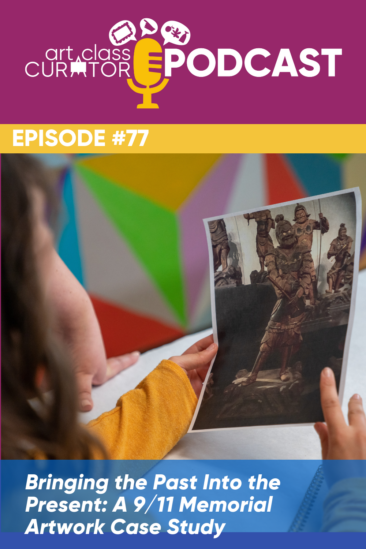
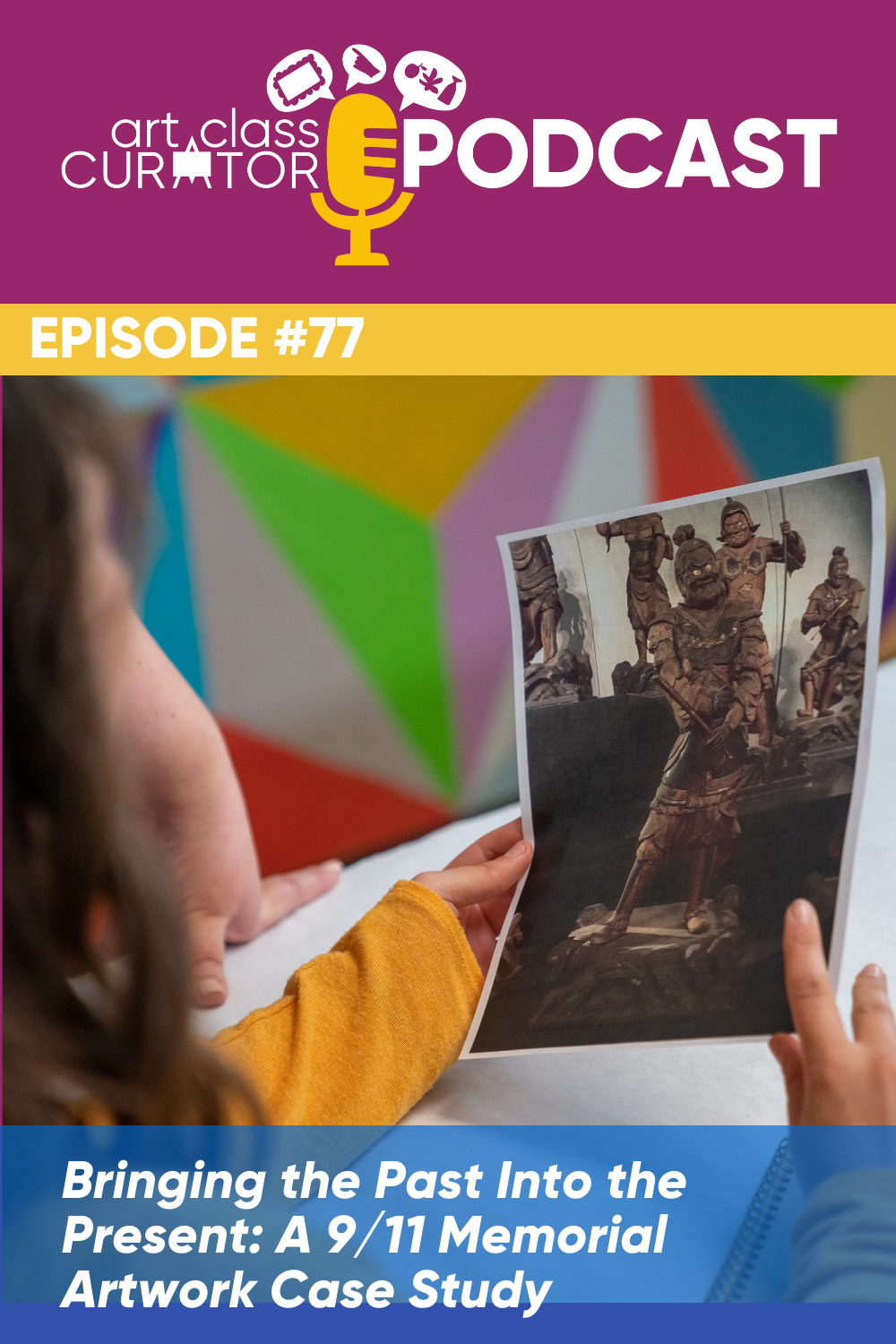
The 20th anniversary of 9/11 is right around the corner. So many people, including your students, weren’t alive when it happened. That’s shocking when you think about it because of how it changed our world practically overnight and still influences current events. So in this episode, I want to use the 9/11 Memorial artwork as a case study for bringing past (and present) events into the classroom and using art to process, reflect, practice empathy, and better understand complex issues.
Bringing the Past Into the Present: A 9/11 Memorial Artwork Case Study

Subscribe in Your Favorite Podcast Listening App

4:57​ – How the 9/11 monument lesson inspired one particularly creative junior high student

8:59 – How art serves as a way for students to experience history, past and present

13:12 – A description of the memorial, who created it, and what it feels like to view it in person

20:10 – One of the lesson activities provided for the monument and other activity ideas

23:01 – Various ways you can apply this lesson (and others available in the Library) to your classroom

26:01 – How incorporating lessons like this can help you in other ways

  • Free Lesson Sample
  • The Curated Connections Library
  • Reflecting Absence: September 11th Lesson Plans for Art Teachers
  • 9/11 Memorial – PWP Landscape Architecture

Be a Podcast Guest: Submit a Voice Memo of Your Art Story (Scroll to the bottom of the page to submit your story.)

Cindy Ingram: Hello and welcome to The Art Class Curator Podcast. I am Cindy Ingram, your host and the founder of Art Class Curator, and The Curated Connections Library. We’re here to talk about teaching art with purpose and inspiration from the daily delights of creativity to the messy mishaps that come with being a teacher. Whether you’re driving home from school or cleaning up your classroom for the 15th time today, take a second, take a deep breath, relax those shoulders, and let’s get started.

Hello everyone, this is Cindy Ingram. I just wanted to give you a little bit of a warning for this episode. I just got word back from my podcast editor that said the sound on this episode is weird. It was recorded a little bit too loud. I needed to have changed some settings on my microphone but it’s not too bad. I listen to it. I think that it is still listenable. I think it won’t bother you too much but I just wanted to apologize for that. It happens to the best of us. I hope you still enjoy this content and this lesson. Thanks so much. On to the episode.

Hello everybody and welcome back to The Art Class Curator Podcast. This is Cindy Ingram. Today, we’re going to talk about how to bring current events into your classroom, how to use art as a way to talk about the things that are going on in the world, and also, the things that have gone on in the past and using art as a tool to process, to reflect, to practice empathy, to better understand complex issues, and all of that can happen in these art lessons. The artwork that I want to talk about as the case study for this topic is the 9/11 Memorial. You know probably by now that 9/11 is around the corner. It is on Saturday this week. It is actually the 20th anniversary of September 11th. What is so shocking about this to me and so many other people is that our students weren’t alive. It was such a big thing in our lives. As time passes, more and more of the population wasn’t there, wasn’t alive, didn’t feel that impact, didn’t see what happened, how it changed, how our world went from one way to another way, almost overnight.

We’re seeing that now with current events now, like that mass trigger catalyst event is happening as we speak but with September 11th, our students just weren’t there. To start out this conversation, I am going to play a clip of a conversation that I had with Robyn Smith. Robyn is an art teacher in California. She has taught pre-K through eighth grade for the past 24 years. She, at the beginning of the 2020-2021 school year, purchased our SPARK Hybrid Learning Curriculum. The SPARK Hybrid Learning Curriculum, as you probably know by now, is actually a part of The Curated Connections Library. We merged the two programs together because it didn’t feel like it made sense to sell them separately anymore. Everything that you found in the SPARK Hybrid Learning Curriculum is also now in The Curated Connections Library.

The Curated Connections Library includes over 175 works of art. A wide variety of works of art that include a lot of activities that you can use in a hybrid setting. The art projects are idea centered and open-ended. They’re not media specific. There are videos and worksheets that are available in Google Classroom format so that you can easily send them to your remote student. For those of you who are experiencing the highs and lows of remote teaching right now or quarantining, the SPARK Hybrid Learning Curriculum inside The Curated Connections Library is a great place for you to find lessons.

Anyway, if you’re interested in checking it out, head over to artclasscurator.com/join. The doors are open and are remaining open. You can head over there to check it out. But in my conversation with Robyn, she shared one of the lessons that she used from the curriculum and how it impacted her students. I love this story that she tells about her student and how he took this lesson, and created something really fun and grand out of it. I’m going to go ahead and play that clip of my conversation with Robyn right now.

Robyn Smith: I bought your SPARK curriculum and used that. That was great. I really enjoyed using that. It worked so well for the online learners and in-class learners. Actually, it worked better for the online learners because they were at home and they could find things versus what I had available in the art room. 

Cindy Ingram: Things as in like supplies or as in like more information about the artwork?

Robyn Smith: I think supplies. I’ll give you an example. One of the lessons I did during 9/11 with the junior high kids was you had a lesson there. I felt like I was cheating using those lessons. It was so easy. With everything there, I put it on canvas and I was good to go. But there was a lesson about monuments and you talked about the 9/11 monument. I think that was cool because the kids didn’t know much about it unless they’d been to New York. Of course, they weren’t around at the time of 9/11. I had them interviewing their parents, “Where were you? What happened? Ask your grandparents what happened.” It was neat that they were able to come back and say, “Everybody remembers where they were when 9/11 happened.” Isn’t that crazy?

Then they had to choose a monument that they wanted to make. I had this one really creative—they were all creative—but one especially creative student who had just moved house. In the middle of doing online learning, his family moved to a new house, to a whole different area. He had a bunch of boxes around the house, so all of his projects involved moving boxes. He took a moving box and he said, “This is the monument to 2020.” One side of the box had a paper mask on it and some plastic gloves, like surgical gloves or whatever. In California, we had a lot of fires in the fall at that time. You’ve probably heard that in the news. He had flames and on one side of it was sticking out flames. Another sign, he had a big giant closed sign that flopped down because everything’s closed because of COVID. I think the third side, the riots that were happening during the fall. He had riots, he had grenades, he had all kinds of things probably you shouldn’t have had at school there. But anyway, it was very creative. I was really impressed with what he’d done.

Cindy Ingram: What I love about that story that you just said is that you’re teaching them history. In the last 20 years it was history, then they’re comparing that event to what they’re going through now because they’re also living through a big historical moment. You’re connecting it that way. He’s able to express his personal feelings about what happened and process that at the same time, and be creative and have this design challenge that was really open-ended. He was able to create something really grand out of that. You’re also having them engaged with the work of art and the 9/11 Memorial monument, and explore all of this through art. I’m just like, “Oh, that’s a beautiful teaching moment.” 

Thank you so much to Robyn Smith for sharing that lesson with you guys. Like I said in the clip, I really love how layered this lesson really is. On the surface, they’re looking at our artwork. They’re talking about it. They’re making an artwork in response but there is so much more happening beneath the surface. I love how she was talking about how she had them interview their parents, so they’re getting a little oral history, a moment. They’re having a connection moment between them and their family. They are really understanding the gravity of the experience, of what that experience was like and stepping into the shoes of people who lived through that. Those experiences when you really look at the past through the lens of art and through the lens of human experience, it really connects you to other people. It helps you develop empathy. It helps you really better understand how people react, respond, and live through big things.

Artists throughout time have used art as a way to process their feelings, to make a statement about something that happened, to change someone’s mind or to influence. I’m just thinking about Guernica, which I talked about with Jenn on the podcast just recently. How Picasso wasn’t a political artist and that bombing of the town of Guernica caused him to create that work of art in response. The same thing is true of Fernando Botero who creates those really joyful paintings. He’s from Colombia. He paints pictures of fat people. Apparently, it’s supposed to be like a cubism takeoff, we’re looking at a person from different points of view, but those paintings are just so happy and joyful. There’s music. There’s dancing. There’s family things. It’s very much not political on the surface anyway but then he created an entire series of artworks about the Abu Ghraib torture scandal back in the 2000s.

Whether it is making art or whether it is looking at art, we can use art as a way to help ourselves through big things. I think that is an amazing lesson for our students. I really encourage you to bring in artwork about things that are happening in the world and about things that happened in the past. On anniversaries of things, on Veterans Day, those holidays where you’re looking back at the past and you’re remembering, it’s a really great opportunity for you as the teacher to help create a full experience for the student because chances are in their English class, they’re going to be writing about it. In their history class, they’re going to be watching a video or talking about it. Throughout their experience of the school day on September 11th or well, it’s a Saturday but this week, they’re going to be hearing about September 11th from a variety of different places. I think that curriculum is best when it is cohesive and when it is integrated, when what’s happening in social studies feeds into what happens in art. What happens in art feeds into what happens in English. What happens in English feeds into what happens in other classes.

That is giving students such an amazing connected world view because the way we do education right now in our country, in most places, we divide everything by subject, then those subject teachers don’t ever really communicate too much with the other subject teachers. I guess at the state level, we have standards. The writers of the standards, in many cases, aligned the curriculum to where English and social studies are related, and that sort of thing. But it doesn’t really happen all that intentionally, I’ve seen in my experience. I think that using contemporary events as a way to connect is really important.

In The Curated Connections Library, we do have this lesson on the September 11th Memorial. Let me tell you a little bit about the Memorial. If you want to include it in your classroom this week, we will give you some information. We do have a blog post about this lesson as well, which I will include both a link to the blog post, which is free content and a link to the membership lesson. If you’re a member, you can visit the show notes today to find this lesson.

The September 11th Memorial was designed by architects Michael Arad and Peter Walker. In the footprint of the Twin Towers, they put bottomless reflecting pools. The title of the artwork is called Reflecting Absence. It’s like a big hole, then it has waterfalls that come from the side down into a lower level. Then inside that lower level, there is a hole, another hole, a square hole that the water continues to go down into. From the side, you cannot see the bottom of that second hole. It’s just like this abyss, then it’s just this dark thing and you can’t see it. The waterfalls descend 30 feet into the basin, then the smaller one goes down another 20 feet. It’s huge.

Another thing about the experience is the waterfall creates a really loud sound. It completely drowns out the noise of the city. When I visited, it was in 2014, they were still building the Freedom Tower. There was a ton of construction in the area and you couldn’t even really hear it. In New York, you’re always hearing the cabs and the people. There’s just the cars, the honking, and all of those things but the sound of that waterfall just completely drowned out the noise. I found that to be really powerful because it allowed me to really focus on what happened and where I am. It added to the solemnity of the experience. It helped me not be distracted. It helped me go into myself and not look around, and see what everyone else was doing.

Then along the side, there are bronze plaques that have the names of everyone who died in the attacks on 9/11 and also the World Trade Center bombing from 1993. They’re all along the edge engraved into the bronze. These reflecting pools are the exact same size and shape of the actual Twin Towers. When you’re standing there in front of them, you really realize how massive the buildings were, then it also helps you imagine the devastation that took place on September 11th.

The conversations that you can have with your students about this, I think it’s really important to show video of the Memorial pictures, just don’t do it justice because of the sound, because of the scale and the size. It’s important to look at it from multiple different angles. It’s important to see and hear the full experience because it is really a beautiful experience. When discussing this with your students, you want to really ask them questions about how all of the artist’s choices contribute to the feeling that it gives the person visiting. That’s one of my favorite questions to ask about an artwork is what did the artist do to make us feel this way? Yes, you can talk about how it makes you feel and explore that. I love talking about that but it’s really fun to pick that apart and get meta with it, then be like, “Okay, well, I’m feeling really anxious because the artist did this” or “I’m feeling really sad because the artist used this color, which really impacted the emotions.”

Like I said, Peter Walker and Michael Arad were the architects in charge of the Memorial. Michael Arad is the one who created the actual Memorial, the monument. When they wanted to create the Memorial, they opened it up for submissions of designs. There were at least five thousand entries for the Memorial during this international contest that was held in 2003. Michael Arad is Israeli-American. He was actually an eyewitness to the second plane, hitting the South Tower of the World Trade Center from the roof of his building that same day. This young architect, Michael Arad, then became a partner of Handle Architects who created the Memorial. He has won several awards for his work on the Memorial and has since been selected to design other Memorials.

In addition to the main Memorial design, Michael Arad partnered with Peter Walker who was a landscape architect. He designed the unique landscaping for the Memorial. His idea was to add a forest of oak trees to create a peaceful place for reflection and contemplation. He wanted those trees to mimic the arches that were located at the base of the original towers, which were designed by architect Minoru Yamasaki. You can visit his website. It’s PWP Landscape Architecture. We’re going to link to it in the show notes. But on that site, you can see the design process, you can see the symbolism for each part of the landscape, and everything like that. It’s pretty fun to see the problem solving that went into this Memorial and the symbolism as well.

The sound of the water washes out the sounds of the city but then the trees hide the sights of the city. They create this canopy over you as you’re walking up and prepare you to enter this sacred space. You see that happen in Japanese temples and things like that where the lead up to the event, to the actual full experience is there to help prepare you. You hear the sound of water. You hear the sound of the little tinkering chimes—I’m still talking about Japan—you hear all of that. It prepares you to enter. These trees do the same thing for you. If you visit the website of PWP Landscape Architecture, you can see pictures of the trees next to pictures of the arch design that I mentioned earlier. It’s really subtle but it’s a really beautiful detail.

The types of trees that they used were white oaks, which are symbols of strength, longevity and the symbolic weight that the architects were trying to convey in the design. One of the activities in this lesson is to explore the monument through the five senses. We have a 5 Senses worksheet where the kids go through the five senses and talk about how each one of them was represented in the artwork, what would it be like to be here, what would it feel like to be here, and also exploring what 9/11 was and talking about what they already know, then sharing with them your experience of it and inviting them to interview their family, which I thought was a really great touch added by Robyn in her clip there. Then talking about what is a Memorial and why we have them. If I were teaching this in my classroom, I would then have students do independent research on different Memorials or monuments. Maybe I would have a group work together to research a monument. I would give them one or have them research one to discover on their own or give them a list of ones that they might find interesting, then they choose from that list, then give them some questions to answer about their memorial, then they present those to the class.

I always love doing activities like that because it allows you to get in extra art. If you’re doing an artwork about a particular theme, you can always then bring in other artworks, have the kids work together to analyze them, then they get to share that with their classmates, what they learned. It gives them a little more ownership over the information, over the content provided in the class. It makes them a little bit more personally connected to it because you’ve got that element of choosing the one that they want to talk about, then it makes them motivated to learn about it because they’re going to have to do a presentation about it. I think there is a lot of good in that type of activity.

Then from there, that’s when I would have the students design and create a Memorial to remember an impactful historical event. It can be something right now, like what Robyn’s student did, or it can be something meaningful to the student. Maybe it’s a Holocaust Memorial. Maybe it is a Memorial of an individual person or an event in their family, or maybe it is another big event. They get to choose, then design a monument. One of my favorite things about these SPARK Works Lessons in The Curated Connections Library is that we give you the art project ideas that are meaningful to the art project but you really get to decide how that plays out in your classroom. That’s why these projects work really well for your remote students if you’re still teaching a hybrid or remote class because you can use any supplies, you can use that Memorial project, the student that Robyn talked about, created his out of boxes. Another student could get on their iPad and do Procreate. Another student could get some grid and graph paper, and make a plan, a blueprint. There’s so many different options. These experiences, we really feel like they are a great bridge between your choice-based classrooms and your more traditional classrooms where everyone’s doing the same thing. This is a really nice combination.

But obviously, you can take these lessons, then make them more or less structured. If you want to do memorial and everybody does it this one certain way, and everybody does it with these certain materials, say you’re teaching a graphic art class and you want to introduce them to architecture software or something like that, you could do that or if you’re teaching a 3D class, you could have them make a sculpture. If you’re teaching a painting class, you can have them do a painting. You can see how they’re really highly flexible. That’s really important to me as a teacher because I never follow a lesson plan 100%. I love to add my own spin to it. I love to take in my expertise and mold that into the lesson. We love to make these lessons really flexible.

That’s the full lesson available in The Curated Connections Library. There’s a lesson plan. There are the Powerpoints you need with images, the videos we’ve curated and watched to know if they’re good or not. We have multiple worksheets. We have multiple worksheets including that 5 Senses worksheet, the What I Already Know and also What I Think worksheet, then there are videos for all of our new SPARK Work lessons. This one is one of those that includes a video. That’s really good for your remote students especially, because they might not have you there to give them some of the information. But I always recommend having them watch the video after they’ve done the activities because you really want them to think for themselves first before you give them any information.

Along these same lines of taking current events, holidays, and things like that and incorporating them into your classroom, it doesn’t have to be this long extended unit. It can just be one day this week, you go in and you talk about that 9/11 Memorial, and do a one day experience. This is really great to add into your curriculum for a lot of reasons, both logistical and for education purposes. We know the  educational value of adding more works of art into your curriculum. We know it’s going to help your student’s critical thinking skills, their empathy, their connection, their tolerance, their communication skills, their self-awareness, their emotional fluency, all those things I talk about all the time but also, it’s going to help you with your lessons because when you’re planning out your lessons for a week, say one day of every week is an art connection experience that you grab from The Curated Connections Library, that is one day of every month or every week that you’ve got plans for, that you don’t have to worry about creating a lesson plan for. It’s ready to go. Even if you’re doing a completely different style of curriculum the rest of the week where you’re maybe really focused on studio or maybe there’s all sorts of other things that you could be doing in art class, this gives them that one time a week where they’re truly connecting with the works of art and doing these activities, then your lessons are done for that day.

It also is really helpful I found, you know that when you’re teaching multiple classes and if you’re doing the same project with them, there’s always one class that gets behind or one class that gets ahead or one class that half the kids were absent because they were taking a makeup test or the other half of the kids were gone the other time, they’re pull outs for something else. There are always kids being pulled out for different things and getting kids behind. That day, I always used to, as a buffer day. If one class was really far behind, we would do the art connection experience at the beginning, then give them more time to get caught up on their assignments. It was a really good way to balance out the work and fill those times.

Adding in a weekly art connection experience that’s outside of your normal curriculum also will allow you to show more works of art and create more diversity in your experiences. Say you’re doing a really comprehensive project that’s going to take multiple weeks—three, four weeks, five weeks and you’re still working on this project—that’s five weeks that they are only working on that project. They’re not getting to explore a lot of other art content as they’re doing it. Throwing in these art connection days will allow you to show your students work from around the world, from across times and really allow them to experience all that art has to offer. It’s like bonus art throughout their lives.

That’s my episode for today. I hope it encourages you to bring this artwork into your curriculum this week or if you’re watching this after September 11th, you still can bring it in or save it for next year. If you want to download this lesson, you can get it in The Curated Connections Library. If you are not a member, you can head over to artclasscurator.com/join. As a bonus for listening to this episode, I am going to offer you $10 off of your first month. If you are not a member and you want to come in, and check it out, just enter the coupon code “Memorial”. That will give you $10 off your first month’s membership. That is for the Museum Level membership. We have two levels. If you get the Gallery Level membership, this artwork is from a past month, so it won’t be in your membership. Make sure you get the Museum Level membership to access this lesson. Thank you so much for listening today. I will be back next week. Have a wonderful day, bye.

When you’re a teacher, one thing is certain, the lesson planning never ends. The Curated Connections Library is here to help with hundreds of art connection lessons and activities. Our signature SPARK Works lessons include everything you need to teach an artwork every single week. Each lesson features one diverse and captivating work of art and is complete with discussion questions, engaging activities to create deeper art connections, and related art project ideas. With unique worksheets and PowerPoint presentations, every lesson is classroom-ready. Get your free SPARK Works lesson and take a break from lesson planning by going to artclasscurator.com/freelesson.

Thank you so much for listening to The Art Class Curator Podcast. If you like what you hear, please subscribe and give us an honest rating on iTunes to help other teachers find us, and hear these amazing art conversations and art teacher insights. Be sure to tune in next week for more art inspiration and curated conversations.
Free Lesson!

Get a Free Lesson Sample

Get a free lesson download!

Members of the Curated Connections Library get nearly 200 SPARKworks lessons that include everything you need to implement an artwork a week experience in your classroom! Click the button below to get a sample SPARKworks lesson–it includes a lesson plan, PowerPoint, and supplemental worksheets/handouts.

Download

Free Lesson!

Get a Free Lesson Sample

Get a free lesson download!

Members of the Curated Connections Library get nearly 200 SPARKworks lessons that include everything you need to implement an artwork a week experience in your classroom! Click the button below to get a sample SPARKworks lesson–it includes a lesson plan, PowerPoint, and supplemental worksheets/handouts.

Subscribe and Review in iTunes

Have you subscribed to the podcast? I don’t want you to miss an episode and we have a lot of good topics and guests coming up! Click here to subscribe on iTunes!

If you are feeling extra kind, I would LOVE it if you left us a review on iTunes too! These reviews help others find the podcast and I truly love reading your feedback. You can click here to review and select “Write a Review” and let me know what you love best about the podcast!
View in iTunes

Filed Under: Podcast


Pretty In Pictures: The Art and Business of Photography with Beryl Young

Pretty In Pictures: The Art and Business of Photography with Beryl Young

Imagine that you’ve never experienced a whole lot of grief before. Then something devastating happens to you and leads to something beautiful. It happened to my guest today, Beryl Young. I’ve known her for several years, ever since I first started Art Class Curator at a blogger conference. Before working with teachers and schools on photography curriculum, she taught kindergarteners and 1st graders for 10 years. Listen as she shares the powerful story of how she started her photography business and how it’s evolved.

Subscribe in Your Favorite Podcast Listening App

2:54​ – The painful incident that triggered Beryl’s transition from photography hobbyist to entrepreneur

9:29 – How Beryl taught herself photography and what inspired her to create her first class

13:21 – How the pandemic served as a huge catalyst for Beryl to shift her business

21:04 – An overview of Beryl’s approach to the teentography curriculum

26:16 – Why Beryl focuses on making photography as accessible as possible

31:37 – Beryl discusses her teentography and kidtography kits

36:01 – The platform that changed Beryl’s life

Beryl Young is the Founder & CEO of Be Young Creative and creator of the Momtography, Teentography, and Kidtography programs. She was never that person who carried a camera wherever she went. But she fell in love with photography in 2009 as a way to document the exciting time of becoming a mom. After an unexpected loss in 2011 she used a camera to heal from the difficult emotions that followed  – leading her down the path of becoming an “accidental business owner”.

As a former elementary school teacher, Beryl’s true calling is education. Through a range of curriculum and programs for ANY type of skill level or camera, Momtography and Teentography is on a mission to show families how to unlock their creative potential and capture a bit of joy in each and every day. 

  • Teentography Club
  • Art Class Curator Curricula at Nasco

Be a Podcast Guest: Submit a Voice Memo of Your Art Story (Scroll to the bottom of the page to submit your story.)

Cindy Ingram: Hello and welcome to The Art Class Curator Podcast. I am Cindy Ingram, your host and the founder of Art Class Curator, and The Curated Connections Library. We’re here to talk about teaching art with purpose and inspiration from the daily delights of creativity to the messy mishaps that come with being a teacher. Whether you’re driving home from school or cleaning up your classroom for the 15th time today, take a second, take a deep breath, relax those shoulders, and let’s get started.

Hello and welcome to The Art Class Curator Podcast. This is Cindy Ingram. Today, I have a friend of mine joining me for an interview. Her name is Beryl Young. I met her years ago when I just first started Art Class Curator at a conference for bloggers. It has been so fun to be a spectator in her journey with her business and to see where it has gone and where it has come from. Today on the podcast, she shares her story about how she started her business, and spoiler alert, it is because of art that she started her business. Now she is working with teachers in schools on photography curriculum. I’m happy to share her journey with you, and without further ado, I would love to introduce you to Beryl Young.

I am so pleased to welcome Beryl Young to the podcast. Welcome, Beryl.

Beryl Young: Thank you for having me.

Cindy Ingram: I have known you for several years and you have a really powerful story about how you started your business and how it’s evolved throughout the start of your business. Can you tell the listeners a little bit more about you, your background, and your experiences, and then what inspired you to start your business?

Beryl Young: Sure. My background is in education. I was a teacher for 10 years before starting my business. As I was doing the math, I was like, “Oh gosh, that was 20 years ago?” I taught kindergarten when I started and I was like, “Oh, yeah, my kindergartners are now graduating from college, so that makes sense.” I taught kindergarten and first grade and then I realized I actually enjoyed working with adults and with teachers more so I transitioned into being a technology resource teacher, which is now instructional technology facilitator depending on where you are. I did that for seven years and it was my job to help teachers become comfortable and confident in technology, which paved the way for where my business journey led me because I now have a photography education business now called Be Young Creative, and we have our Momtography program, our Teentography program, and our Kidtography program. But the business primarily came out of my own motherhood journey.

I was always creative growing up but I wouldn’t consider myself an artist. My mom was an artist but I was not an artist. I just liked creative stuff. I was not super interested in photography but I loved my wedding photographers and I loved our pictures. I took lots of pictures on my honeymoon so it’s definitely an interest. On a teacher’s salary, starting to think about becoming a parent and researching newborn photographers, I was like, “Oh, I’m not going to be able to afford the pictures that I really like.” This was in the heyday when DSLR cameras were all the rage, like 2009, 2010. Everyone was buying one and I’m like, “Well, I’ll just teach myself how to take pictures on my own.”

I got a fancy camera. I actually got it during my first pregnancy as an early baby gift. My pictures were horrible and I realized it wasn’t as easy to take pictures as I thought it was going to be. This took a turn from photography just being this interest and this hobby to being something that fueled this new passion because I lost that first pregnancy. I was 20 weeks pregnant and it was devastating to say the least. This was in September of 2009. This camera that I was gifted to take beautiful pictures of my first daughter, I really turned to, to heal. I hadn’t really experienced a whole lot of grief up until this point. I still have my grandparents, we hadn’t really lost any pets, and I was on the couch, I didn’t want to move, I didn’t want to get up, and people were sending us flowers and meals. I took a photo of these beautiful roses that somebody sent us and I found that I felt a little bit better when I did that. Then I was like, “Huh, I wonder if taking pictures may be a tool to help with the grief.”

So I started looking up photography projects and I was struck by this project that somebody listed on a blog called Take 100 Steps. I was like, “All right, I haven’t been outside in like five days. Let me see if I can get off the couch and take 100 steps.” I did that. Basically, the premise of the project, it’s just like it sounds, you choose a starting point, I chose my front door, you take 100 steps, you stop, and you have to frame some photo where you end up. It became this interesting challenge of “What interesting photos can I take of the dumpster down the street?” You started to make beauty from this unexpected stuff. That project that I did 10 years ago has become the flagship for Be Young Creative.

What was surprising to me was Mom started to tell me, “Oh, wow, I feel better when I do this.” It was a project that the moms wanted to do with their families. Anyways, I know we’re going to talk more about the business but that project really started to get me curious about maybe I should start a blog or maybe I should start taking pictures of people. I’ve dabbled in a lot of different things from starting a portrait photography business to then going, “Nope, that’s not what I meant to do,” to really focusing on education and how I can teach others to be inspired by the camera.

Cindy Ingram: That is such a beautiful story. It always amazes me when I hear people’s stories of how they started their business or how they made that one change that completely shifted their life into a different direction. It usually comes from a blogger or some meme you saw on the internet, some podcast episode and it was like that’s the thing that you needed to hear at that moment to send you in the direction you’re supposed to go.

Beryl Young: Yeah. It almost feels like it was this divinely led thing because I never expected to leave education, I really enjoyed my job as a technology facilitator, but about three years after starting down that photography journey, I was like, “I will not forgive myself if I don’t try to make this a full-time thing for a little while.” It’s been so fun to see the twists and turns and where that creative journey has led.

Cindy Ingram: Yes. Because when I first met you, we were at a conference together and you were taking photos of the participants at the conference. That must have been during your portrait photographer phase?

Beryl Young: Sort of, yeah. I agree to take portraits here and there. When it’s a project that inspires me or makes me feel good, I was like, “No, I’m not going to do weddings or newborns or families,” but sometimes, I will show up and take pictures of other people.

Cindy Ingram: I love it. Another thing I want to mention about your story was how powerful it was that art is what helped get you out of such a tough time in your life. We talk about that a lot here on the podcast in Art Class Curator is how we can use art as a way to better know ourselves, better get through life. I just think that’s a really beautiful story so thank you so much for sharing that.

Beryl Young: Not a problem. It’s funny because, like I said, I never considered myself an artist. Seeing a blank canvas is really daunting for me. My mom is a painter, my mom is a mixed media artist, and I’m always like, “How do you do that, Mom? I can’t do that.” But with photography, I’m like, “Well, the canvas is right there, I just have to make something out of it.” I think it’s why I gravitated to photography because it felt like an easier medium for me to create out of.

Cindy Ingram: How did you teach yourself to be a good photographer? Or is that even a goal?

Beryl Young: Yeah, because I was self-taught for a while. I was like, “Oh, I’m just going to follow blogs,” and there really wasn’t a whole lot on YouTube back when I was learning either. There probably was something but I was like on the photo website Flickr and in communities and I took one little local class near me about my DSLR camera but they didn’t actually tell you what any of the terminology meant, it was just like, “This is how you find the buttons on your camera.” The first class that I built was actually based out of all of this frustration I had in trying to teach myself about the camera because I found it very frustrating that professional photographers would say, “Well, you need to learn manual mode. You need to be able to shoot in manual mode,” and I’m like, “I don’t know how to do that.” I don’t know how all the aperture and ISO and shutter speed, how all of those things work together and so then I put my teacher hat on and I went, “Okay, how do I think through this process?”

Once I did learn it and I learned how to hone in the light and use what was in front of me—that was a two to three year process of even just feeling confident and comfortable there—then I went, “Okay, how can I bring this down to a super, super, super beginner level?” Because it definitely was not easy. But I pride myself on the fact that I’m like, “I think I take a very different approach to how we teach these things than a lot of the other education that’s out there in photography.”

Cindy Ingram: I love that because I tried to teach myself photography one time, it did not go well. It must have been in the 2009, 2010 boom because that’s probably about when my husband showed up home with a DSLR camera. I was like, “I don’t know how to work that.” He kept trying to teach me and I was like, “I just can’t do it. I don’t want to. I can’t.” Then I would try and I got so frustrated.

Beryl Young: A lot of it is practice. The more we practice, the better we get but it’s also easier to practice when you have a framework and a system that is simple to grasp onto and use. So many of the moms that I initially started teaching went on, kept learning, and built their own photography businesses. They got passionate about photography and they were confident when they put that work in. It was fun to see all of these moms get inspired about what was possible for their life when I was like, “Oh, I have this hobby that I can do with my kids and it serves my family and I’m making memories and I learn something new.” Those beginning years of the business were a lot of fun to see this thing, this curriculum that we had created actually come to life and help other people.

Cindy Ingram: Your main target of a person you were helping at that time were moms who wanted to learn photography?

Beryl Young: Yes.

Cindy Ingram: Okay. That was when it was Momtography…

Beryl Young: That’s when it was Momtography and I taught local classes when I started. I’m in Northern Virginia and so all the classes started there. Then I was like, “Okay, I’m going to tackle teaching this in a virtual capacity.” It went from camera education to now I’m going to teach moms how to edit their pictures and now we’re going to tackle the digital overwhelm in printing our photos. Once a teacher, forever a teacher. I feel like curriculum is where my heart is and I just kept creating different tools and curriculum resources along that line.

Cindy Ingram: Tell us about how you started to shift your business. I know the pandemic was a huge catalyst for what you’re doing now, can you talk us through that?

Beryl Young: Yeah. The pandemic was definitely interesting on a variety of levels. We had dove in pre-COVID. We were still very much serving moms and taking all of this curriculum that we created and building out a club for moms virtually and keeping that in-person interaction. When my daughter’s school shut down—I’m a mom of one so what I didn’t mention was after we lost our first pregnancy, we went on to have a daughter about a year later, she’s 10 now—as her school shut down and as all these other schools shut down and as I was talking to our mom audience, I was like, “Moms are just stressed right now,” and it was actually the day before my daughter’s school shut down, I went with one of our Momtography facilitators to a middle school because she was really interested in potentially teaching photography to middle schoolers. We did just like a pop-up photo booth with information and we were going to teach a spring class together locally in our community.

I remember sitting there talking with her and being like, “Huh, what are we going to do if everything shuts down? Hopefully that won’t happen, but what are we going to do if we can’t teach this spring class?” Of course, the very next day, everything shut down and I think in those times of trauma—my grief experience taught me this—I am a dive into a project head first for better or for worse, I’m going to get lost in my art and in my work, and so I was like, “What is going to be my best way to show up and serve?” I knew trying to encourage moms to get involved in something was not the right way to go. Moms were really in this place of “I need to show up and serve my families.” Instead, I was like, “I bet I can take what we were going to do this spring in-person class and turn it into a virtual experience for teens,” which is exactly what we did. When I was a teacher, I led a four or six week after-school club for elementary school students at the school that I taught at. I was like, “Huh, I bet I could take all of those activities that we did and run that.”

So I put out just a little post on Facebook “Would your preteen or teen be interested in joining me for a virtual Teentography class?” We had over 99 kids sign up in that first class. In three weeks, I wrote a curriculum and taught it. It wasn’t fully fleshed out then but it was so much fun. We taught one session and then we taught a second session. Then we did a combined virtual summer camp for moms and teens. We’ve spent the last year going, “Okay, what could a curriculum look like that could be utilized by families, by schools, or by educators?” We’ve been tweaking it all and honing it and putting it together into this Teentography/Kidtography curriculum kit.

Cindy Ingram: I love it. That period of the pandemic was so inspiring to me just to see, as a business owner, I have a lot of business owner friends who I’ve met along the way, it was so fun to see how everybody was responding, what everybody started to talk about, it was like everybody I knew jumped into serve mode. We knew this is the time we need to just love on our people, serve our people, and it was so fun to watch everybody take this in so many different ways and serve their audiences. I love it.

Beryl Young: I agree. I think entrepreneurs and artists, we were made for a time like this because our creative brains got to go, “Okay, this is a total left turn from what life was, how can we create something amazing or new or that allows us to serve out of this experience?”

Cindy Ingram: Yeah. It invigorated a lot of businesses, a lot of businesses obviously struggled, but there were so many businesses that it breathed new life into because they just had the opportunity to be more creative. We just dropped everything we were doing and it’s like we started fresh the day it started. It’s crazy. I also did try really hard to get my daughter to sign up for your Teentography class. She would not agree to it and I was like, “Come on.” She just doesn’t want to do classes. She’s more independent than that.

Beryl Young: If it makes you feel any better, my own daughter does not like photography, does not like virtual learning. She was signed up for the first class by me but I think she only came to one or two classes. Her and I did go out because I tested all of the lessons on her but that was more of like, “We’re going to go out for a walk and we’re going to do this thing that’s helping mom figure out her work,” but she’s not a virtual learner either.

Cindy Ingram: That makes me feel better about my daughter. We did a personality test the other day. I was watching her answer it because it was really fascinating but all the questions about art, she just didn’t answer as confidently as I would have. It wasn’t like she didn’t see the value in art but it wasn’t like the art was the top and I’m like, “Your mom is Art Class Curator,” but anyway, side note.

Beryl Young: I love it. I understand this very well. I’m like, “Wait, you don’t like this thing as much as I do?”

Cindy Ingram: The thing that I’ve dedicated my life to? Come on. What I think is really powerful about your program and about your story is that you are coming at teaching photography, not from a place of, “Hey, I’m an expert photographer and I know all the ins and outs on how to make perfect photograph, and now I’m going to show you all these expert tips,” that doesn’t work in the real world. I love your approach. Can you give us an overview of what your approach is in the Teentography curriculum? What are the goals of your curriculum? What are the things you hope the kids get out of the experience?

Beryl Young: That’s a great question and we actually recently changed our tagline to “Helping families capture life creatively”. I’ve always been in this lane of photography education, but I tell everyone it’s so much more than that. For our moms, it’s been about feeling empowered and feeling creative and feeling capable. It’s that self-discovery piece that I think as moms, we start to lose ourselves in motherhood and we lose sight of what our passions are. They shift and change. Along the same lines, we really built our Teentography curriculum to be this creative exploration that I personally feel like has been lacking in education. It’s a big reason why I took a step away to do my own business, really amazing teachers and there are so many amazing teachers that find the ways to integrate all those things and make them happen. I love that you’re doing Art Class Curator because I think if I had to do it all over again, I’d go back to school and be an art teacher because it’s what we need.

I was talking to a group the other day and really saying that in order for our students to do the things that we need them to accomplish academically, they need to know themselves and they need to feel grounded, safe, and comfortable with who they are. At first, when we built Teentography, initially when the pandemic first started, I was like, “We’re just going to give these kids fun and lightness.” One of our lessons is making a meme and so we have like fill in the blank meme creator and then they go take a photograph to round out that meme and what it needs to be. These really fun lessons are on target with what a kid or a teen is going to want to do, but we also saw the teens and kids learn about themselves and get excited about sharing their stories and about their families.

After that initial run, I really started to ask myself, “Okay, I did this for families but how could this really serve teachers in education too?” Then the light bulb went off and I’m like, “Okay, social emotional learning has been something that education has been focusing on but with the pandemic, it’s even more so going to be important in the coming months, years.”

As I took a different lens, no pun intended, on the curriculum, I was like, “All of this connects back to SEL competencies and what kids need to know. All of our mom curriculum has also connected, moms aren’t as focused on SEL but it’s been that self-discovery introspection, who do you want to be, and I feel like that’s really the power that the camera offers. It feels good when you learn a new trick or technique or become that expert photographer, but I’m more interested in what’s underneath that, like what changed about you to get you to that place where you were able to take amazing photos and enjoy doing it.

Cindy Ingram: Oh, I love that. The SEL is so important. You said that moms aren’t necessarily focused on that but I think SEL is something that everybody needs to definitely consider. I was researching SEL sometime over the last few months for something, I don’t remember what but some website was like “Social emotional learning should start with the teacher. Once the teacher is aware of their own needs or their own social emotional learning, then they can better pass it on to their students.”

Beryl Young: Yeah. I think SEL is the buzzword that we get in the education space but for me, it all connects back to mental health, emotional health which I think is becoming more visible. I think the pandemic has also brought to light how important our mental health is. For our mom audience, that sometimes resonates a little bit more than if I show up and I’m like, “SEL.” It’s semantics in how it’s all coming together but with our education program, that’s really where we’re focused on, how can we make SEL something that is fun and integrative for kids and teens to learn.

Cindy Ingram: I love it. I know a lot of teachers, me included when I was in the classroom, don’t teach photography. We just don’t do it because one, we may not have the technology or that’s probably the number one reason why I didn’t do it, although that’s not really true anymore. I think there’s a lot of teachers, myself included, that think that to teach photography, you have to have a DSLR camera, you have to have a lightroom or some fancy photo editing software, there’s all these things you have to have. But it sounds like your curriculum, you don’t need any of that.

Beryl Young: No. That was really important to me because going back to our mom audience, I knew that the DSLR craze wasn’t going to be around forever and so we had the program for them to help them learn that camera, but then I was like if it’s about the feelings and emotions and as we all started to use cell phones more and more, there’s other fun things and teachings between photo editing, apps, and printing that get at the same stuff. I’ve really been focused for the last five years or so at making photography as accessible as possible. I knew in putting the kid and teen curriculum together that they weren’t necessarily going to have DSLR cameras or they’d be picking up their mom’s or dad’s DSLR camera and they’d have no clue and some of it wouldn’t necessarily be developmentally appropriate or there wouldn’t be that readiness there to teach them all of the tips, tricks, and techniques.

Now, 10 years ago when I was in school, the art teacher that I worked with, we would collaborate sometimes. But that was always the struggle, she was like, “Well, I don’t have a classroom set of cameras, how are we going to do something with this?” It wasn’t until we started to get iPads in the school that we were able to really make some of those lessons come to life, and that may be the benefit of having been a technology integration teacher, it was my job to figure out how we can make this work with a group of students even if we don’t have 10 cameras or 20 cameras for every student in the class. Now I tell the students we work with, “You can pick up a tablet. You can pick up a phone. You can pick up a point and shoot.” We try to give them options in “this is the camera you can use”.

Our curriculum is mainly focused on an app-based device because now there are so many apps out there to have fun with your photos. The really fascinating thing has been watching the kids and teens, they don’t care about the quality of the pictures, they’re less perfectionistic than we are as adults. Some of them will go out and really want to look for the light, and I think the older they get, they start to look for some of those things in a different way but they’re just excited to pick up a camera and go take pictures of anything.

Cindy Ingram: Yeah. That’s the same as a choice-based classroom where you just give the kids the supplies and you let them experiment with them. You let them see where it takes them. That’s the same process. Then we hope that through that process, they’re going to want to get better and learn different techniques. It gives them the photography bug which then will take them further.

Beryl Young: Yeah. I think photography is evolving to be so much more than the picture itself and kids want to really have this creative process where they get to layer in text or edit. We’re in the TikTok generation now. Some of the kids and teens were like, “Oh, are we going to do video?” I don’t necessarily consider a video my forte but they’re more interested in what cool apps can I teach them about or what are they going to get to do with their photos when they’re done taking them. There’s a lot of giving them free, or at least, free trial accessible apps to take the lesson and make it more holistic.

But it is interesting, I have noticed what you said about art classrooms as well, I have found that photography is sometimes this whole separate thing that doesn’t really end up in the art classroom as much. I’ve always wondered why that is or even in my research about making Teentography and Kidtography into this arts integration curriculum, there’s not a whole lot of SEL research that deep dives into photography as a medium. It’s been interesting to explore this past year.

Cindy Ingram: Oh, definitely. Every time I hear about photography being taught from teachers, it’s usually a separate photography class that is taught at a high school or they’re doing photographs of their work to turn in, but I rarely see photographs as the project.

Beryl Young: I think it can be this really unique powerful tool because kids get excited about having like, “Oh, we’re using cameras today? This is exciting,” and it doesn’t matter what you’re having them do with it. Now if you use it too much, then they might not be as excited. But if they haven’t used them at all in the school setting, it can be really engaging.

Cindy Ingram: Definitely. You said you have Teentography and Kidtography kits. Tell us what that is, what is the kit, how do they get it, what is it for, who can get it, all that stuff.

Beryl Young: We started to take our curriculum and go, “Okay, how would a school want to integrate this into what they’re doing?” Our kits are divided into four separate lessons and really, those lessons, we offer suggestions on how they can be used. Our vision as a brand is that it’s either integrated into the school day by an art teacher or by a classroom teacher, depending on the school, or, like my beginnings, we used to offer an after school program. If it’s something that doesn’t fit into the normal school day, we wanted to make these kits something that you didn’t need to be an expert, you need to be photography expert to utilize, you could take it and pass it off to a teacher, to a parent, to whoever to then do these fun activities with the kids.

It’s four separate activities. Some of our schools choose to do them as a week-by-week, if it’s an after school club, it’s okay. Each lesson is going to span a week. But you could technically take what’s in a kit and there’s enough there that depending on how often you’re focusing on it or how often you’re meeting, you could spread it out into a month-long lesson too. There’s a lot of options.

The kits also have cross-curricular suggestions. Here’s an example, one of the kits we introduce, our 100 Steps Project, we offer a photography skill that they’re going to be looking for and in that kit, it’s negative space so we’re giving the tools to talk about negative space with the students. The kits come with digital guides too so there’s a slide deck so the teachers automatically have samples of what negative space looks like that they can show their students. Then there’s a couple of worksheets or planning sheets that the teacher can use to develop the lesson and find those cross-curricular integrations to utilize them.

Cindy Ingram: Wonderful. There are multiple kits and each one has a different topic?

Beryl Young: Right now, we have two. We have enough curriculum to work our way up to probably having four or eight kits available but we’re separating them out. Our Kidtography kit is aimed for grades K through five or six, and then the Teentography kit is the higher level like 6 to 12. That’s where we really get into some of the more in-depth, talk about light and about aperture and bokeh and some of those things. We have two main kits right now.

Cindy Ingram: I love that you’re building in the photography skills, you’re building in the SEL, and also it’s fun for the students too. It’s like a beautiful mix of things.

Beryl Young: Yeah, and we know different schools are going to need to utilize it in different ways. Because we’ve seen that happen, we’ve been able to chat with a couple different schools. It’s still really early and how we’re getting it out into education but we have a couple of trial schools that are working with the curriculum right now. Right now, we’re really just learning how it’s going to be utilized and adding and tweaking and making it better and better.

Cindy Ingram: Wonderful. Where can someone get one of these kits if they want them?

Beryl Young: Our website is teentography.com, pretty simple, and we have all the information on the two kits, what’s in there. I have done a bit of professional development as well so there’s a contact form on there where we’re customizing solutions for each group.

Cindy Ingram: Perfect. Is there anything you feel like you didn’t say before I do wrap up questions?

Beryl Young: No, I think I’m good.

Cindy Ingram: Okay, so we will put your links to Teentography in the show notes as well as any social channels that you want to send people to. Then we always ask one final question on the podcast, which I don’t think I warned you about, but that question is which artwork changed your life?

Beryl Young: Oh, you did not warn me about this. This is a tricky question and I’m not having any famous artist strike me off the top of my head, but I’m going to go back to the beginnings of my photography journey because I became a super invested Flickr user. I don’t know if you’re familiar with Flickr but it’s a photo sharing community. It does still exist but it was very popular in the early 2000s. It was pre-Instagram, it was a photo sharing community. I made so many virtual friends through this space and there were all these groups for sharing your project 365 photo a day pictures.

I don’t have one specific artist that inspired me but I feel like Flickr changed my life because it showed me what was possible, it had me following all these really inspiring photographers, and it encouraged me to step out of my creative comfort zone and emulate what I was seeing and actually practice and do the work to hone in my photography skills. That’s an answer/not answer but that was the first thing that popped into my head was just having those guides who were not professional to teach me what I needed to know.

Cindy Ingram: I love that. It makes me really think about how art now changes so fast. When you think about the past, like Ancient Egypt was 3000 years and the Renaissance was 200 years and now it’s like, “Oh, here’s an art movement, it lasted like two weeks,” then we move on to something else. It’s because we’re all just living in this soup of creativity and everybody is responding to everybody else and getting inspired by everything. I think it’s such an exciting time to be in.

Beryl Young: I think it speaks to my values of wanting art and creativity to be accessible to others that you don’t have to be the expert to create or to inspire someone else.

Cindy Ingram: That’s a lovely final sentiment which kind of gave me a little bit of chills so that’s a good ending.

Beryl Young: Yay!

Cindy Ingram: Thank you so much, Beryl, for joining us today.

Beryl Young: I appreciate you having me. Thank you.

Cindy Ingram: It was a pleasure. We will see you next week on The Art Class Curator Podcast.

Art Class Curator and Nasco have come together to create two incredible full art curriculums, World Mosaic for Elementary and Perspectives for High School. These are so much more than just lesson plans. Your students will experience powerful social emotional learning that’s integrated with language, arts, social studies, history, and more. They are totally aligned with National Art Standards. World Mosaic will take your elementary students on a journey around the globe as each unit features an artwork from a different part of the world with art projects that explore various media and activities that will strengthen their critical thinking skills and expand their worldview. Perspectives is a high school course that explores how art connects us with ourselves and one another through 10 idea-centered themes; using diverse artworks, thought-provoking discussions, and engaging activities. Perspectives also gives teachers the option to create a choice-based classroom so it’s perfect for any type of teaching model. We are thrilled to be partnered with Nasco Education. They’ve been working with districts for years and are huge advocates for educators everywhere. You can learn more about these exciting curricula at artclasscurator.com/nasco.

Thank you so much for listening to The Art Class Curator Podcast. If you like what you hear, please subscribe and give us an honest rating on iTunes to help other teachers find us, and hear these amazing art conversations and art teacher insights. Be sure to tune in next week for more art inspiration and curated conversations.

Subscribe and Review in iTunes

Have you subscribed to the podcast? I don’t want you to miss an episode and we have a lot of good topics and guests coming up! Click here to subscribe on iTunes!

If you are feeling extra kind, I would LOVE it if you left us a review on iTunes too! These reviews help others find the podcast and I truly love reading your feedback. You can click here to review and select “Write a Review” and let me know what you love best about the podcast!
View in iTunes

Filed Under: Podcast


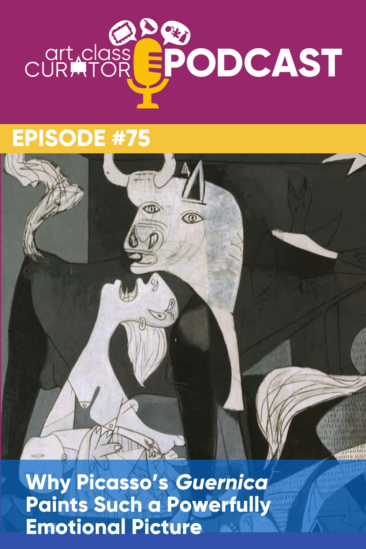
Why Picasso’s Guernica Paints Such a Powerfully Emotional Picture

Why Picasso’s Guernica Paints Such a Powerfully Emotional Picture

Art as a defensive weapon? It seems strange, but Pablo Picasso demonstrated its power in his painting Guernica. I’ve brought Jennifer Easterling back onto the show for another art conversation, and this time we discuss Picasso’s Guernica. Both of us had strong gut reactions to it, so in this episode, we talk about what it’s taught us and its importance in history.

Subscribe in Your Favorite Podcast Listening App

1:47​ – Jenn recalls her reaction when she first laid eyes on Picasso’s Guernica

6:02 – I discuss my unexpected emotional experience seeing it in person 

9:10 – Painting a picture of what this Picasso artwork looks like 

14:20 – The diabolical history behind why Picasso created this painting

18:21 – Why we had such a strong reaction to seeing Guernica in person

21:48 – How the pandemic impacted Jenn’s connection with the artwork

25:18 – Legacy of the Jewish woman who secretly taught art to children in a concentration camp

33:06 – What I kept seeing in my mind when I went to view the painting

37:26 – Picasso’s ultimatum and Guernica’s lengthy journey from Paris to Spain

42:22 – Picasso’s view on symbolism in art

44:51 – Discussing the symbolism we see in his painting

48:08 – A difference I noticed in his drawings versus the final painting

54:08 – Picasso’s experimentation with the drawings

56:40 – How our husbands reacted to Guernica

  • Beyond the Surface: Free Email Course
  • Art Connection Manifesto
  • Pablo Picasso (Pablo Ruiz Picasso) – Guernica
  • Guernica Introduction – Picasso quotes
  • Picasso Comic – Zen Pencils
  • “Art, Horror, and The Sublime: Pablo Picasso’s Guernica” lesson
  • Friedl Dicker-Brandeis
  • Children’s Art from Theresienstadt – Terezin Memorial Ghetto Museum

Helga Weissova, Draw What You See

  • ”Artwork: Child’s Drawing of Transport to Auschwitz”
  • Draw what you see on Google Books

Be a Podcast Guest: Submit a Voice Memo of Your Art Story (Scroll to the bottom of the page to submit your story.)

Cindy Ingram: Hello and welcome to The Art Class Curator Podcast. I am Cindy Ingram, your host and the founder of Art Class Curator, and The Curated Connections Library. We’re here to talk about teaching art with purpose and inspiration from the daily delights of creativity to the messy mishaps that come with being a teacher. Whether you’re driving home from school or cleaning up your classroom for the 15th time today, take a second, take a deep breath, relax those shoulders, and let’s get started. 

Welcome back to The Art Class Curator Podcast, this is Cindy Ingram. Today, I have again with me, Jennifer Easterling. Hi Jenn.

Jennifer Easterling: Hi, glad to be here. 

Cindy Ingram: This is your fourth time on the podcast. Eventually, I’m going to have to stop keeping count for every single episode because you’re becoming a fixture of the podcast. Then for those of you who haven’t met Jenn yet on the podcast, if this is your first time to listen, Jenn works for Art Class Curator as our education manager. She creates most of the resources for our membership, the Curated Connections Library. She’s a brilliant teacher and brilliant creative mind. There you go.

Today, we’re going to do another art conversation. In the past, we did one on Shirin Neshat’s Rebellious Silence. Today, we’re going to talk about Pablo Picasso’s Guernica because both of us had really strong, powerful reactions to it that I feel like we could have a really interesting conversation about this work, what it taught us, and its importance in history as well. Why don’t you tell us about your experience seeing it? 

Jennifer Easterling: Yeah, sure. I took a group of students to Spain in March of 2020. We happened to be there right before everything shut down and as everything was shutting down. It had been a lifelong dream to go see this painting. Whenever I found out that we were going to be in the same city, I made a point to go over there. I actually took another student and teacher with me, and we ditched the group for a little while to make sure we went and saw this painting. It’s funny because we looked all over the museum for it. Here we are, traipsing across Madrid, trying to find the museum in the middle of Europe at night with weird stuff going on around the world. That weird turmoil in the background, that you’re not really sure what all is going on. Now, we all know what was going on and why, and everything else, looking back almost a year and a half later, but I just felt this need that I had to go see it. We finally get to the museum, then we can’t find the painting. It’s really funny. We just go on this whole adventure trying to find this massive, massive painting and for whatever reason, we can’t find it. 

Cindy Ingram: I had the exact same experience. I couldn’t find it either.

Jennifer Easterling: It’s so hilarious, I mean you think we would be front and center right there but no, we had to wind our way. Anyway, we got to see some other cool stuff that we would have missed in there otherwise. But anyway, we come around the corner and of course, it is huge, the whole vibe in the museum, then that room just changed. It’s one of those things that you really can’t explain. It was just a whole vibe change that you feel. There were quite a few people in there, like you could still get up and see it, kind of have your one-on-one experience with it, like the Mona Lisa where there’s people everywhere and you have to find them. You didn’t have to do that but there were quite a few people there.

There were several museum guards in there and they were very adamant that you were not very loud. I kept finding that odd, that they kept shushing everybody. You could have a quiet conversation but if it got too loud, they were shushing everybody and really adamant you didn’t take pictures. Maybe that added to the whole vibe of it but it was very overwhelming, that sense of, “Oh, here it is, wow.” It is huge. I’d always heard that it was a large painting but I didn’t realize just how big it was. I guess I have those emotional reactions the same time I had, like the first real work of art that I saw and recognized was Botticelli’s The Birth of Venus and Primavera. They were huge side by side on these walls and just, “Whoa.” It was that same reaction of, “Oh, this is huge.” You don’t realize it until you’re face to face with it. Man, you got to see all the details. The pictures online just don’t do it justice because there’s so much more depth in it than what you see in a photograph. Even though it is black and white, and all the different values, again, it’s hard to explain until you are seeing something in person versus a small picture online.

Cindy Ingram: Yeah. I looked up the dimensions while you were talking, so I can get them exactly right. But the painting is 11 foot, 6 inches by 25 feet, 6 inches.  

Jennifer Easterling: The only thing in this room.

Cindy Ingram: Massive. When I saw it, there were other things. The sketches leading up to it, the sketches that he did in advance, which were actually devastating. I’ll talk about my experience a little bit too.

Jennifer Easterling: I’ve got to see those when they come to Houston. I thought Guernica was actually in Houston. I was so excited I was going to go see it. I dragged my husband. I was very, very pregnant and didn’t care. I was going to go see it and it wasn’t there. It was just the sketches and everything leaned up. I was like, “Oh, this is cool but where’s the painting?” Then I found out, it doesn’t leave Spain anymore. I was like, “Oh okay, I guess I have to go to Spain.” Well, I finally did.

Cindy Ingram: Yeah, it was always a bucket list item for me too. I went to see it in 2017. In spring break, my husband and I went to Italy. It was the first time my husband went overseas, which was really exciting for me to take him. He was less excited. He’s not as much of a traveler. Anyway, we found these super cheap tickets to Italy. It was a round trip. It was a $400 round trip. We were really excited but the caveat was on the way there. We had a layover in Madrid for 24 hours. I was like, “Well, this is a perfect scenario for me.” because the very top of my bucket list was to see Guernica. We had just flown across the sea, we arrived in Madrid early in the morning. Then our flight was out early morning the next day. We were so tired from being jet lagged. We went straight from the airport to the Reina Sofía museum in Madrid. I don’t know where our bags were. We must have dropped them off somewhere. It doesn’t matter. I’m just like, “What happened to the bags?”

The goal that day was to go to see Guernica first because I knew I needed to be fresh for that, then I wanted to go to the Prado too because the Prado obviously, you have to go there. But we went to see Guernica. I had the same experience. I couldn’t find the painting or just like I kept going to guards going Guernica and pointing, and they would just point me the way. I entered that space. I was expecting it to be emotional. I am prone to emotional experiences in front of paintings. That happens to me. I was expecting that, but I was expecting it more to be the feeling of, “Wow, I can’t believe I get to see this, how cool it is in person and how big it is.” I was expecting all of that but what I did not expect was to be totally devastated by it.

I’m tearing up, just saying that right now because it wasn’t this, “Ah, this beautiful work of art.” It was this, “Wow, this beautiful work of art but look at the death, the devastation, the pain, the horror, and the terror.” The pain of the painting, then all of the sketches around it, I could not even function. It was so painful. I almost couldn’t look at it. I kept having to go and look away, which is really weird because usually, when I’m having a connection with the painting, I can’t look away but this one, I had to look away. It was devastating of a painting. I can tell you, once we get into the conversation, what exactly I was making a lot of connections with. But let’s talk about the painting. Let’s just describe it for people who are listening, who might not have seen it. I’m sure, if you’re an art teacher, you’ve seen this painting 100% but we might have some people who have not. Let’s describe it. Do you want to start? 

Jennifer Easterling: Sure. What we have is like you said, a very large black and white painting. It’s not realistic. It’s kind of what Picasso is known for is abstracting figures. He has added these figures and animals that are in such pain, and devastation. The more you look at them, you see just pain. You just see the pain, the anxiety, the worry, the fear, all of it on each figure. The way he has posed each figure, you feel for a minute, and I find myself putting myself in those figures, kind of persona. I can identify with this figure, then I move over to the next one and I’m like, “Oh, I can identify with that one.” Just going from figure to figure, putting myself in the shoes of each one. I mean six human type figures, one of those looks to be like a baby who’s died and the mother is holding it, just wailing in pain. You’ve got someone else who looks like being stepped on by a horse. That horse also looks like they’re in pain. Actually, I just saw it now, it looks like he might be being stabbed. I’ve never seen that before.

Cindy Ingram: Yeah. He has a stab on his side, then he has a spear or something coming through his top. But there’s something coming out of his mouth too but I always wonder if that’s the tongue or if that’s like another spiky thing. 

Jennifer Easterling: Yeah. But in the way he’s posed, he looks like he’s stepping on what could be this dead body of a figure. 

Cindy Ingram: That figure is decapitated. The arm’s chopped off. There is no body. It’s just two arms and a head.

Jennifer Easterling: Yeah, just the limbs. It’s gripping a broken sword down there at the bottom. Then you have another, looks like a woman rushing in seeing all this. She looks almost bewildered, then right above her, you have this, I keep thinking of a ghost-like figure but it’s not because then, you see the arm reaching through this window, holding the candle, you see the worried expression on their face.

Cindy Ingram: The woman at the bottom, the one that you were talking about who looked bewildered, her leg is swollen. It almost feels to me like it’s trapped. It’s getting swollen. She’s trying to get out but that’s always how I’m reading it. It’s like her leg is super heavy. It’s trapped under something.

Jennifer Easterling: She’s injured. Then if you look back at the shapes and you see this triangle shape that melds into her legs. As soon as you see it, it looks like it’s trapped. I started seeing that. That just changed my whole perspective on it.

Cindy Ingram: Then we have one person who was like I envisioned them in a trash can of flames. They’re in something with flames coming out of it.

Jennifer Easterling: You see their arms reaching up for help or they want to get out or something, then right above it is a house that could be on fire or something with the idea of flames.

Cindy Ingram: We have the horse. We also have a bull. The bull doesn’t have as much painful things happening to it. It just seems to be in shock. Then there’s a bird as well coming in the background.

Jennifer Easterling: The bird is hard to see. I don’t think I ever really saw it until I zoomed in or was sitting there in person, I was like, “Oh.” Because it’s done in a dark gray background with black lines, so it really fades in the back. That’s where I went to zoom in. If you are near a computer, you can go to the Reina Sofía’s website and go to Guernica, and be able to zoom in a lot closer than some other images and see more details. But there’s stuff that I hadn’t seen before until I was able to stand in front of it or zoom in and really see the different details that pop out.

Cindy Ingram: Yeah. I’m going to mention a few other things that are here. The head and arm that are coming through the doorway that looks like a ghost, she/he, they are holding a candle, then there’s also this incandescent light bulb at the top that is lit but also, it has this eyeball shape around it as well. Then there’s the man holding the broken sword. There’s a flower coming out of his hand as well, like just a line drawing of a flower. I think those are the main things. This painting was created in 1939 from the World’s Fair. Picasso was supposed to do a painting for the World’s Fair for the Spanish Pavilion. The theme of the World’s Fair was technology or something like that. New technology, the impact of technology in society.

Jennifer Easterling: Celebrating modern technology.

Cindy Ingram: Yeah, all of that. But then this event happened where Hitler bombed this town of Guernica and basically destroyed it. It was this senseless act. It didn’t make any sense why he would be bombing it. It was part of the Spanish Civil War.

Jennifer Easterling: It was bombing practice for Hitler’s new war machine that he had made. It was the first time that a town and civilians had been bombed like that, and had this aerial blanket bombing, especially over a civilian population. Nothing like this had ever happened before. But basically, Franco, who had been in charge, just picked a town and was like, “You can take that one.”  Hitler came in and just bombed it just for practice. It just caught everybody off guard and destroyed the town, 1600 people were killed or wounded and the whole city burned for three days. He had the blanket bombers come over and bomb it, then these aerial fighters just came in and started shooting down any civilians that were running. Just absolute terror and just a senseless act of death. It just knots in my stomach every time I read about it.

Cindy Ingram: Yeah. You were talking, my whole body covered in chills like, “Oh.”

Jennifer Easterling: I know, same, same. 

Cindy Ingram: It’s funny because Picasso was not a political painter, all of his paintings. This is late in his career. He had been a painter for decades by this point. Everything is women and children, still life, a lot of paintings of women, household scenes, abstraction. His paintings were more about the painting style, the form, and seeing that develop rather than these big political messages but it was a breaking point for him. He realized he couldn’t stay silent. He realized he couldn’t just paint something about technology when this horrible thing had just happened in his homeland. He painted Guernica in response to that event and put that up in the Spanish Exposition instead of what he had been commissioned to do.

Jennifer Easterling: Something interesting too, the World expo, or whatever, was in Paris. Spain had its pavilion. They displayed art and all that stuff, and here’s Guernica that comes in this huge political message. It was also not too far from Germany’s Pavilion. Albert Speer, who was Hitler’s architect. had done something big in response. This is a monolith to Nazi Germany.

Cindy Ingram: Oh.

Jennifer Easterling: Yeah. I know when I read that, I was like, “Oh my goodness.” 

Cindy Ingram: I didn’t know about that.

Jennifer Easterling: Yeah. I didn’t either until I read that. I was like, “Wow.” What a push and pull, and irony and all that. What a message sitting right there in front of him. 

Cindy Ingram: At the beginning, I just looked this up too, I said 1939 earlier, I was wrong. It was 1937. This was July 1937. World War II officially began September 1st, 1939. It was two years before the official beginning of World War II.

Jennifer Easterling: The Spanish Civil War was still going on but Franco and Hitler had partnered up. It was funny because I was reading about the reactions. Russia, who was normally in favor of the Republican against the Spanish Republic and against Franco, and his regime, had such a strong negative reaction. Everybody had negative reactions to this painting like, “What are you doing?” Like, “This is not how you’re supposed to paint. You’re supposed to paint really realistic things,” or whatever. It’s interesting to see how all of his pain and emotions transformed into this. I feel like this, even though it is an abstraction, I have more gut-wrenching feelings toward this than other realistic paintings. Like The Third of May 1808 where it’s much more realistic and Goya has painted the firing squad, and all that. But I have more of a gut reaction, sharp angles and the weird pain. Because you think about pain, if you’ve ever truly been in pain, anguish, whatever, it’s not pretty. Those ugly cries and just the horrors of war. I see that and I feel that in this painting where I don’t so much in other ones. I thought that was really interesting, that even though people were against what was happening, they were still against the painting. It was the message that it was bringing out.

Jennifer Easterling: Yeah. I think it’s true for me. I tend to respond more to abstract art than to realistic art, just in general. But this one in particular, when you look at a reproduction of it, you do see the pain, you see everything in it. But seeing it in person, I noticed for the first time the connection to the artist. I could feel him moving in front of the painting. I could feel him painting. I could see there were drips of paint. There were translucent areas where you could see what he had tried before underneath it. It was thick in some places and thin in the others. You could see the slashing of his movements. You could feel his energy in that room. You could feel his anger. It was just so palpable, the air in front of it. I’m wondering if that’s why the guards made you be quiet because it was sacred. It was like a holy place, just that room. It was bigger than the painting. The painting was so big but it extended beyond the surface.

Jennifer Easterling: Yeah, it really does. You don’t get that in just a photograph.

Cindy Ingram: Yeah. I have it on my monitor as big as I can get it.

Jennifer Easterling: Same. 

Cindy Ingram: It’s not big enough.

Jennifer Easterling: I know. I keep trying to zoom into different places and it doesn’t do it justice.

Cindy Ingram: I wanted to take zoomed in shots while I was there but they wouldn’t let me take pictures.

Jennifer Easterling: I know, same. I’ve been disappointed at that, I’m like, “Oh, I gotta take a picture.”

Cindy Ingram: Yeah. We have this painting and we both have these strong connections to it. One of the things we often talk about at Art Class Curator is the personal connection that you get with the work of art. That it’s not just about history. It’s not just about the artist. It’s not just about what’s in the painting. It’s about what it reminds you of in your own life and what you can learn from it. You said you were seeing this at the very beginning of the pandemic. How did that experience impact your experience of this artwork?

Jennifer Easterling: Whenever I saw it, it had to have been March 10th I believe, everything shifted and changed. We got the message as everything was shutting down, that President Trump at the time had made the announcement that they were closing the borders. We had to be home or everybody had to be back in the United States by midnight. Otherwise, they wouldn’t be able to get back in on March 13th. I saw it right as all that was happening. I kept seeing pandemic stuff, so I knew the story behind it. I researched it before. I knew what the painting was actually created in response to initially. But whenever I was looking at it, I couldn’t help but put all this idea of like pandemic stuff in there. Now, especially after the fact and all that went on in the world, I keep seeing that. Especially like the mother holding her dead baby. I have two girls of my own and they were younger at the time. When I’m standing there in front of it, I keep going back to that. I was like, “If something were to happen to my babies, that would be me.” That’s where my eye just kept going. I kept trying to look at everything else and it just kept going there, and having these gut-wrenching, my heart being ripped out of my chest of like, “Oh, if something were to happen, there I am.”

We saw it there, then like I said, we got this crazy call and we had these huge panics, and here I am in Spain with all these students thinking how we’re supposed to get back safely. Just the panic, the worry, and the stress, I’m like, “Oh, I see all that. Oh my goodness.” I have all these other connections to it but also, one thing that I noticed is everyone was panicking, people back home and people there, “What’s going to happen in the next 24-48 hours? Are we going to get stuck? Can we make flights? Are we going to get sick and die? Are we going to bring all this illness back with us?” All that just kept compounding. While we were in the midst of that panic and just waiting to find out what was going to happen, a couple of my parents who were on the trip, they took the kids aside and they set up these makeshift, just like many art camps and brought out all these art supplies that they’d bought, and used that to help calm the fears of the students. I wanted to participate because I needed it so bad but I was trying to take care of everything else but I appreciated that. I kept going back to this idea of like how many times do we turn to art in times of adversity? Painting in reaction to something or using it as a way to express our fears and our emotions, and calm our mind. I just thought, “Wow, how powerful is this.” Even though I’m looking at this painting in reaction to war or to a bombing, here, we’ve got kids being centered by art. That’s where we kept going back to and I thought, “Oh my goodness, how powerful is that to cross so many generations, cultures, and experiences but we keep going back to creating art?”

In November of 2019, I attended a workshop at the Texas state Art Education conference. The presenter there shared her pretty much career-long research on artist Friedl Dicker-Brandeis. Friedl was an up-and-coming artist from the Bauhaus when she was sent to Theresienstadt, a concentration camp during World War II. The amazing thing about her is that instead of taking food, valuables or money, she filled one of her suitcases with art supplies or I guess her one suitcase because they were only allowed one. She was able to sneak those into the camp. In secret, she taught art to the students or to children who were in the concentration camp or work camp. She used that to help keep them calm or keep them occupied, so they weren’t so focused on all the terrible things that were going around. I thought, “What a brave, powerful statement.” This one woman used her talents and what she had to give hope to the children stuck in this horrible situation. She helped them express their emotions and fears through art. I just thought it was really cool how she turned to art in times of great adversity.

I actually got to go to Theresienstadt several years ago whenever I was in the Czech Republic. We heard about her. It didn’t quite make the full connection at the time but there was a museum of children’s art there in the town. If you don’t know anything about this concentration camp, it was actually set up as this ideal town that they basically talked to Jews. It was going to be this arts cultural center, this model city for everything that the Nazis were doing. “Give up everything you have and come to this wonderful cultural place that has all the best musicians and artists.”

Cindy Ingram: Did you see those pictures from Nazi Germany of kids playing soccer at the concentration camps or people dancing and having a good time? It was all just public relations. They were trying to convince the Jews that, “Oh, we’re not doing anything wrong here. Look how happy everyone is.”

Jennifer Easterling: Yeah, exactly. That’s what this settlement village town, whatever you want to call it was, but it was all fake. Just right down the road was an actual concentration camp but it was like the model one. Anytime someone would come into this place or whoever would come in, they made sure that the Nazis were doing all that they said they’re doing. They would go to this one place and they’d be like, “Oh see, how wonderful it is. There’s a swimming pool, trees, theater, and all this stuff.” But it was all lies. It’s all propaganda and everything. You can drive through the town that’s still there, then you can walk through the concentration camp. But in the town, there is a children’s museum of art that children created while they were there. One little lady, she was a child, whenever she was in the camp, she was drawing and documenting—not on purpose documenting but she was just drawing everything that she saw as the time passed—she somehow was able to hide all of her drawings and you see the progression of the health of the people that were put in that camp. You see the health go down and deteriorate. You see the guards doing different things and all that.

She’s just drawing, just drawing, drawing, drawing. Somehow, she was able to hide all of her drawings through the course of being at this camp. She survived and she took the drawings with her. Long after she took all these drawings, she actually hid them under her mattress in her bedroom and would never show anybody because she was too scared that something would happen to her if anybody saw them, I guess that the Nazis would still come back, just those fears. Finally, her children, grandchildren were able to convince her to bring them out and show people. They published them in a book. I bought the book. It’s incredible to see all the atrocities that were happening through a child’s eyes. They’re just these honest drawings, yet she was still turning to art with whatever she had. She’s kept that art in times of adversity. She kept going back to that. I find that very powerful. That people, no matter what’s going on, still find a way to create and take all these emotions that they’re feeling, everything they’re experiencing and put it on paper, on canvas. Something like that.

Cindy Ingram: Yeah. You think about it through all of time. There was art before there was language. There was art before there was written language. There was art before any of it because we just have this human desire to create. I think about Picasso at that moment. He’s super problematic. I have mixed feelings about him now, especially with the womanizing and all of the wrong things with Picasso. There’s so many things wrong with Picasso. I always have this intellectual/moral/thing happen anytime I talk about his work because to me, I don’t ever really fully focus on who made the artwork that I’m responding to. I never, when I’m looking at a work of art, wonder or think about who this artist was as a person. That’s not something that I’m particularly interested in. I know a lot of people are but that’s just not something that I particularly am that interested in because I do believe that art is the thing that I love. The actual thing. It’s so tricky. I’m sure that there could be someone listening to this episode who’s like, “But Picasso.” I know Picasso. I know I should probably cancel Picasso but it’s also like his work is so powerful to me. I’ve had such powerful moments with it that it’s just this really sticky place.

Anyway, all that aside, I do, in this case, like to think about what he was going through and that desire that he had in that moment. Did it come from a place of wanting to express his feelings or did it come from a place of wanting to make sure the world knew about that? Like not to sweep such atrocities under the rug. It was just all of these things building up in him once or he just couldn’t take it. He finished that painting in like a month. It took him 35 days to create that massive painting. I think that’s astonishing too. A big painting like that feels like it should take a lot longer. But just that moment of anger, that moment of needing to do something, needing to act where your anger finally has reached a moment where it’s like, “I have to do something.”

I think that’s a really interesting moment to consider in myself because when I looked at this painting, it was in 2017 and the wars, and stuff in Syria have been going on for many years before this but there was some embalming in the town of Aleppo that happened in February or March right before I went because I went in March as well as spring break. I had been seeing on Facebook a bunch of videos of Syrian refugees walking away from this bombing. In one case, there was a video, and I never went to look for it again because I honestly don’t want to see it again, but I want to know, so I can fill the story to know exactly what I saw but I just don’t want to see it again, but it was a woman who was holding her child. I think the child was dead. I’m not 100% sure. She was just wailing, just like in the picture. She was covered in ash. There was not a lot of color, even though it wasn’t a black and white picture but she was in the video but she was covered in ash. That had just happened. I’d just seen that.

Then I went to see Guernica. All I could see were these videos that I had just seen, then I also kept seeing in it the 9/11. I guess because of the ash and all the pictures from the World Trade Center are all black and white because it’s just all ash. I kept seeing that in there too. I was feeling the pain of those things over and over again because I tend to stuff down new stuff because I get too emotionally connected to it, then I’m not functional. I tend to shut down those feelings, which is not healthy. But at that moment, it was just like they all were there flooding in. 

Jennifer Easterling: I think it’s amazing that you keep finding new connections to different things that go on. Picasso aside and Guernica aside or whatever, like the town, just the raw imagery in the emotion film, I just see the connection between different things in my life or in things that’s going on in the world over and over, and over again. I love that it doesn’t get old. Not specifically necessarily about this one but so many pieces in general. Whatever is going on in my life or the world, somehow, I start to see those connections. It’s like I’m seeing it with fresh eyes every time, which is cool. That’s what I love about it. I just find that fascinating. I found this cool quote by Picasso as I was looking more at this and it says, “A picture is not thought out and settled beforehand. While it is being done it changes as one’s thoughts change. And when it is finished, it still goes on changing, according to the state of mind of whoever is looking at it.” I thought, “How perfect is that?”

Cindy Ingram: Picasso? He said that? I did not know that he said that.

Jennifer Easterling: I didn’t either. I found it on a website. 

Cindy Ingram: I’m thrilled because I say that all the time. It’s now in our manifesto, which I said to the podcast a few weeks ago. But we have a line in there that says that art belongs to the viewer as much as it belongs to artists. Art changes when we change. Art expands when we expand. I always wonder if artists take offense to that. Every time I say that, I’m like, “Does an artist really think that? Would they agree with me?” But Picasso is saying that. He’s saying once the art leaves his hands, it’s not done. It keeps changing.

Jennifer Easterling: I see that. I truly see that. I feel that, I’m like, “Oh, okay good.” It’s some validation I guess for my emotions.

Cindy Ingram: Yeah. If you go back and see it again, you’re going to have a whole new experience. You’re going to remember the past experience. You’re going to remember this conversation, every other thought you’ve had about it since. Then there’s going to be other things that have gone on in the world too that you’re going to make. Every time you come to a painting, you’re a different person, so you’re going to have a different experience. The painting also has had a life of its own there too.

Jennifer Easterling: Yeah, for sure. As I was reading more about it, after it was painted, it started touring the world to make everybody aware of what was happening, like the atrocities that were happening in Spain. It traveled for 19, 20 years, something like that. But Picasso always intended for it to go back to Spain, to stay there, and be a part of its culture but he also specified that it couldn’t go back until Spain was at peace. Like a republic was set up or a democratic society, whatever it was. It didn’t get to go back. It went to New York and stayed in New York from the beginning of World War I until 1981. It was there at The Museum of Modern Art in New York until they petitioned and they were able to bring home to a peaceful state in Spain. I thought that’s quite a powerful statement too, just within itself.

Cindy Ingram: Yeah, that’s really interesting. Also, that’s the year I was born. I feel like that’s relevant. It was me. It was me. Is it June 1st that they made this decision?

Jennifer Easterling: It’s close, October 25th.

Cindy Ingram: I don’t know. I had to give myself time. I hadn’t fully developed my art connections.

Jennifer Easterling: There you go.

Cindy Ingram: Wow, that’s fascinating. That really is.

Jennifer Easterling: Yeah. Because he wanted it to be owned by the Spanish people but he refused to let it come back. I thought that was really fascinating .

Cindy Ingram: That is. There’s another quote by Picasso that I really love. You can find this in a comic on Zen Pencils. It’s really good but the last part I’m going to feature, which says, “Painting is not done to decorate apartments. It is an instrument of war for attack and defense against the enemy.” He knew, when he was painting this, that this was him taking a stand. This was him doing what he could do as an artist. I think that’s a really important message if you think about just for people in general, that I know I get to a place where something terrible is going on in the world and I feel really helpless. I want to be able to help but I don’t know what I can do. But I think it’s a really good message that you do what is best for you to do. You think about what your realm of influence is.

In my case, my realm of influence is Art Class Curator. I can use Art Class Curator in ways that can help me in certain ways. He was a painter, so his way of addressing this issue and his way of making change was to make a painting about it because he knew that this was the way he could use his voice. I think that’s really interesting to think about for every person like, “What is your thing that you can do, that you can control where you can make your difference?” It makes you feel a little less hopeless, helpless, and a little bit more rooted in and grounded in what you can do. You can’t do everything.

Jennifer Easterling: Yeah. We’re not completely helpless. I pulled up that comic to look at it. I love how it’s called Weapon of Choice. Interesting. What is your weapon of choice, is it words? Is it painting? Is it photography or filmmaking? How many people use their amazing creativity to create or to be that weapon or that voice, that outlet to share messages with the world? 

Cindy Ingram: Yeah. Now that I’m looking at this comic again too, it’s so good. The images are so good. You see him slashing with his paintbrush, like it’s a sword. His mouth is wide open. He’s sweating. Every other panel is the bombing, then every other panel is him painting the picture. It’s really good.

Jennifer Easterling: Whenever you’re talking about that, like I’m standing in front of it and you see the drips, and you see the drawing, the redrawing, and all this stuff. Seeing this comic, I’m like, “Oh, that’s exactly what I was envisioning as I’m imagining him doing this painting.”

Cindy Ingram: I don’t imagine him doing this we’re very calm, methodical, paint his brush here or paint his brush here. No. He’s just attacking that canvas. You could feel that energy.

Jennifer Easterling: For sure. Like I said before, the energy around this painting is just so different than other paintings that I’ve stood in front of and looked at. Those things you can’t quite put into words and be like, “Oh, this is cool.” I don’t know how to talk about it but it’s cool.

Cindy Ingram: Yeah, indeed. We talked about our personal connections to this and how it’s going to change, and the history behind it. Let’s talk about the symbolism and stuff that we see in it because we have a lesson on this somewhere. I think it’s on the blog that I did with my students. They analyzed the symbols and they thought about what the symbols could represent. I like to preface this too by saying that Picasso, his quotes about the painting, say he didn’t intentionally put symbolism in there. I can pull the exact quote.

Jennifer Easterling: I found a quote about it too, about the symbolism.

Cindy Ingram: There’s probably the one that I’m thinking of, so maybe read that.

Jennifer Easterling: When asked to explain his symbolism, Picasso remarked, “It isn’t up to the painter to define the symbols. Otherwise it would be better if he wrote them out in so many words. The public who look at the picture must interpret the symbols as they understand them.” 

Cindy Ingram: That wasn’t the exact quote that I was saying but it’s the exact same message. He says, “I’m not intentionally putting symbols in here, it’s not something that I’m like intellectually thinking of,” but that their present, they just are borne of him I think, the idea that he said. It’s up to us to analyze what they are about. I really like this because I do think the art belongs to the viewer. If he just outright said everything, then I think it takes away the fun for us of exploring the artwork.

Jennifer Easterling: Yeah. I think it would take away some of that connection too because as we see it, we put our own interpretation and our own meaning, then I guess I am disappointed if I go back and I read stuff, and I’m like, “Oh, that’s what that was supposed to mean? Because that’s not what I got.” I had this whole other story and invention going on in my mind, and I’m like, “Oh, okay. I’ll go back to mine. I like mine better.”

Cindy Ingram: Yeah, exactly. That’s an important message for students too because you’ll have a whole conversation with students about something, then they’ll be like, “Okay, what’s the real answer?” I’m like, “Well, we don’t know the real answer.” or “Your answer is better.” Or I’ll tell them and I’m like, “But remember that the ‘real answer’” (in air quotes because it’s not real), there are multiple right answers. There are multiple real answers. There’s no one right answer. I think that is really important to help your students understand.

Let’s talk about the animals because I was doing some research on this. I’m writing a book. I think I might have mentioned that on the podcast before, I’m not sure if I did but anyway, one of the chapters is actually about Guernica. I’m fresh on my research about it. That’s why I can pull off this random information about it. But one of the things I read was a theory that I hadn’t noticed before in my looking at it, was that the horse could potentially not be a good guy. I thought the horse was just having trauma. Like everybody else, it got hurt by the bombing. But I started to realize that in this, there’s the broken sword and the decapitated guy, and right above the broken sword is a piece of a sword stuck into the horse. It made me think that perhaps, the horse is a representation of the bombers.

Jennifer Easterling: Hmm. Yeah.

Cindy Ingram: Then also, on the horse is the only place that has that hash marked texture. When I first learned about this painting, I guess it was a teacher that told me this, it’s just one of those things that have stuck in my head until the end of time but the way they say, it lives rent-free. Someone told me once that it symbolized how Picasso learned about the attack through the newspaper. That’s supposed to represent the newspaper. That could be part of it too. Maybe the horse could represent the media or it could be somebody else.

Jennifer Easterling: Interesting. It does stand out but it’s not the entire horse though either. It’s just like the body. Three of the four legs have that hash mark. I definitely see the newspaper connection. If you look farther down on the far left leg, there’s some other little lines and stuff. I almost see them as headlines now. My mind is totally shifting and changing to this newspaper idea.

Cindy Ingram: Yeah. Then what is that black and white thing in the middle? Because that has plagued me since the end of time.

Jennifer Easterling: It could be a gash on the horse’s side but then at the same time, with the lines coming through on the light, I almost see like fingers.

Cindy Ingram: Yeah. In my head, it is a portal to somewhere else. It is a hand pulling it open. It’s something behind the painting.

Jennifer Easterling: That’s awesome.

Cindy Ingram: I stare at that spot probably the most of any spot of this painting, maybe because it’s right in the center of my eye line too.

Jennifer Easterling: It’s true. Then you’ve got that eye shaped light bulb right above it or you think about people who’ve gone through serious trauma, they need that escape. Are you escaping in your mind or maybe this is the escape portal to another realm to escape the horrors. I don’t know. We could go into all kinds of things.

Cindy Ingram: Yeah, I like that. 

Jennifer Easterling: It looks like a ghost. Is it the ghostly figure coming out to other realms? I don’t know.

Cindy Ingram: Yeah, I don’t know.

Jennifer Easterling: We can see all kinds of possibilities.

Cindy Ingram: It’s interesting too, there are some signs of hope, like the flower and the light but I noticed, when I was looking at the artwork and I know this because I wrote about it, right after I got home, I wrote a blog post about it, so I know what was fresh in my mind, is I talked about how I noticed in the drawings versus the painting and also, there are spots in the painting, when you see it in person, you can see what was going on underneath, like what he had attempted, then he changed. You can’t see it at all in the picture. I know it exists because I just remember it but I can’t have specifics. But I did notice that there were more explicit signs of hope in the painting. There was more of those little bits of positiveness but they didn’t make it into the final version. Even that flower is gray. You can barely tell it’s there. He had more of that in there but then he took it away. I can see he probably did not see any signs of hope there. The bombing of the whole town, destruction of the whole town.

Jennifer Easterling: That flower, you don’t see it at first but when you do, it seems so different from the rest of the painting, you’re like, “How would he include this little ghosted flower in the midst of all this other horror and devastation?” 

Cindy Ingram: Yeah. It’s not an outdoor space. It’s not like it was a flower that was being grown and that one just happened to not get destroyed. I always view them as in a basement or something because there’s tiled ground, then there are walls and there’s the incandescent light bulb that always reminds me of a basement. But then there’s this door with light coming in, then the ghost coming from up high. I’ve always viewed this as a basement.

Jennifer Easterling: You definitely get that feel that tight space that goes into the composition of pulling. I guess that helps with the tension of the whole piece. You just feel cramped with all of this going on.

Cindy Ingram: Yeah. You think about this size of a room because we do see the corners of the room, all of this devastation and drama is happening in a small space. That cycle, subconsciously, probably really adds to the intensity of the person. You don’t necessarily know that’s part of it but it’s like you can’t escape this. There’s no getting out of this room.

Jennifer Easterling: Just like you think to the people, there was no escape for those people. It just happened and caught them off guard. There was no warning. Even though we don’t really put emphasis on elements and principles, you can see them really at play in this and how an artist is taking them, and using them to his advantage. Whether he’s intending to or not, there’s a whole lot of that going on in the stark contrast of the black and the white, and you’re shifting and changing constantly. At one moment, you see this. The next moment, you see something else and see how all that plays off of each other. 

Cindy Ingram: Yeah. The elements of principles work in this. This is just a really good one for analyzing. But what makes me think, I was about to start doing that, I’m about to start thinking, “Oh, this is leading to the emphasis here.” But then I realized, like me doing that is me doing that on this small scale on this computer screen. That I can see the whole image. I can see it. But if I was here standing in front of it, all of these people would be larger than me.

Jennifer Easterling: Yeah, they are.

Cindy Ingram: If it’s 11 feet wide, that’s like two of me laying side to side across the painting. My head is probably as big as that decapitated guy’s head. This is life size.

Jennifer Easterling: Yeah. You’re confronted more with these figures. They become a lot more real whenever you’re seeing them face to face in life-size.

Cindy Ingram: It’s pretty amazing, thinking of him making this such a cohesive thing when it was that big.

Jennifer Easterling: It’s shifting and changing so much, like the horse’s face has a lot more of the shading where other shapes are really flat, then you’ve got the one texture but yet it all works. It all goes together somehow. Maybe that’s part of the chaos of it that plays into your subconscious. You’ve got so much chaos. You’ve got the cramped space. The shifting and changing, I think it really plays on you psychologically.

Cindy Ingram: You know what would be a really good exercise with students is to look at all of Picasso’s styles before this one. Look at his Cubist work, like the mademoiselle painting all the different types of styles he did and see how every single one of them is represented here. You can see the progression. It is like the best summary of all of his work up until now but then infused with this extra actual meaning, story, and emotion. It’s like he’s taking everything he did before and he’s taking his emotions all together to create this masterpiece. It’s like he was born to create this painting. Every moment of his life was building up to this.

Jennifer Easterling: What a statement.

Cindy Ingram: I think I just discounted all of his work up until this point but it was good work. I’ve had very powerful experiences with his early work too but it’s amazing. I feel like we have been a little bit all over the place but I think that’s okay because this painting is all over the place. I just want to mention again, I talked about the drawings around it but for every character in this painting, he did multiple sketches and drawings of them at various stages of agony. He was experimenting with what is the most agony, which you can do, seeing all of the sketches, especially the woman with the baby. I think I also connect to her the most too because I’m a mother. I bet most mothers are probably going to be like, that’s who you’re going to be looking at, probably fathers too but it’s like she is just the most intense. But in the drawings leading up, I would want to look away from the painting and I’d turn around, and the other wall behind me would be just her in five other states of agony. It was pretty intense.

Jennifer Easterling: And it’s crazy to think that a painting could have that much effect on someone. That gut-wrenching, it’s crazy.

Cindy Ingram: You said you were with a student and another adult, how did they respond? Do you remember?

Jennifer Easterling: Yes. They were both in awe. She teaches history. She was having the history side. She’s also taught a lot of art and it was her daughter. She, of course, grew up with art. We talked about it afterwards but honestly, I didn’t even look at them. Once I went into the room, I zoned everybody else out. It was just like me in the painting and the guards pushing me of course. It’s crazy. Going back and putting myself in that room, I remember we chatted about it. I don’t remember what we said but it captivated my attention so much that I lost everything else that was going on around me and it drew me in. I always have that happen. Every once in a while, it does but specifically, that one. Then I’ve gone back because I’m trying to like, “Where were they? I know they were there. I’m pretty sure they were there.” It’d be interesting to go back and talk to her now, especially being a history teacher and get her take on it, and stuff because I’m fascinated with any art connected with World War II somehow, whether it was painted around that time or it was stolen or whatever. I’m just fascinated by it all for some reason. I guess that’s part of why I’ve been drawn to this because it’s painted into a reaction of what was going on.

Cindy Ingram: I went with my husband, like I said earlier and his response was, “Meh.” He said, “It doesn’t do anything for me.” I’m like, “Are you kidding me?” I was sobbing. I stopped trying to wipe the tears at this point. They just were flowing. I was just like, “How is that even possible for you to be in this room and say meh. It doesn’t do anything for me.” I was just devastated. I couldn’t believe it. But also, he is good at looking at art. He will go to look at art with me. He’ll go to museums with me. He does enjoy it. He does recognize artists. Especially when I worked in art museums, I would be talking about this one artist for however long the exhibit was open. He learned a lot but he didn’t like this one.

Jennifer Easterling: I was trying to remember my husband’s reaction when we went to the show in Houston that had all the drawings and stuff. I think he was the same as like, “Picasso’s weird.” 

Cindy Ingram: That same day too, we were supposed to go to the Prado right after this but I couldn’t. I was full. I think the jet lag mixed with just how emotional of an experience it was, I was like, “I need to do something.” I’m not even going to see it if I go. We did actually go to the Prado but I was like, “I just need to see a couple things.” I ran through, just to see a couple things. It was devastating that I didn’t really get to fully experience it. That’s the bucket list to go back to but we ended up going to some castle.

Jennifer Easterling: Was it lovely?

Cindy Ingram: It was. I just could not do anything emotional.

Jennifer Easterling: We had come to the Prado but it was again, that same quick experience because we didn’t have a lot of time. We were supposed to have a great time at the Prado and our guide had made up this whole scavenger hunt to send the kids through to do all these fun things. We get there and the guards won’t let anybody take any pictures of anything. I don’t know what it was with Spain. They wouldn’t let us talk and they wouldn’t let us take pictures, and we’re like, “We just want to enjoy the art. You’re not letting us.” 

Cindy Ingram: Was the scavenger hunt activity involved taking pictures?

Jennifer Easterling: Yeah. You stand beside a sculpture or something and take a picture, and send it. They yelled at me for taking a picture out the window. Not even at the art. I was like, “I’m taking a picture of something cool outside.” “No.” I was like, “Okay.”

Cindy Ingram: Oh, museums, I swear.

Jennifer Easterling: Apparently, that was something that had just changed because when the guide went there, a couple weeks before, there was no issue. They could take pictures. I don’t know what changed. Maybe it was pandemic stuff. Who knows? Or they didn’t want us there. Who knows?

Cindy Ingram: I feel like the photo thing was a thing when I went because I just ran through because I wanted to see The Third of May and I wanted to see The Garden of Earthly Delights specifically, then there were some El Greco’s I wanted to see. I knew what I was looking for, then there were a hundred other things I had to stop and glance at on my way but I do remember sneakily taking pictures of The Garden of Earthly Delights. 

Jennifer Easterling: I may or may not have done the same.

Cindy Ingram: I do have a very, very fast selfie in front of it that I just did as quickly as I could when no one was watching.

Jennifer Easterling: Same with Las Meninas.

Cindy Ingram: Yeah, that was the other one I wanted to see.

Jennifer Easterling: I got to walk around with some people and tell them about it. I felt happy. I came up and I was like, “You all stand guard, I’m going to snap some pictures. Don’t tell anybody.”

Cindy Ingram: Yeah, we just admitted it. They’re going to come after us.

Jennifer Easterling: They probably will.

Cindy Ingram: I think that this painting is amazing. We had a good conversation about it. It might have been a little bit all over the place but that’s okay too. For those of you listening, two things. If you want to travel and have these powerful art experiences, we do take trips at Art Class Curator. If you go to artclasscurator.com/travel, our next trip is to Vietnam, Cambodia, and Thailand in June of 2022. 

Jennifer Easterling: I’m so excited to go.

Cindy Ingram: We’re both going. If you want to very least hang out with us.

Jennifer Easterling: You totally want to hang out with us.

Cindy Ingram: They’re listening, so they obviously do. 

Jennifer Easterling: We got a whole bunch of random stuff in art.

Cindy Ingram: Then also, that manifesto I mentioned, if you want to download that, you can go to artclasscurator.com/manifesto. Is there anything else? Anything we talked about like the show notes, the comics, the blog post I wrote about this, I will put links to all of that in the show notes. Also, this book I’m writing, if you want to get on the waitlist to get that, you can go to artclasscurator.com/book and you can get on our email list and be notified when that comes out. It’s still a ways away. Don’t expect that anytime soon I’ve got another year in it. 

Jennifer Easterling: It’s going to be amazing.

Cindy Ingram: It’ll be good. I’m enjoying writing it. Sure I am. Thank you so much for listening. I will see you again next week.

What’s keeping you from showing more artwork to your students? Do you get stuck trying to choose a work of art or do you fear your students will ask a question that you don’t know the answer to? Have you tried to start a classroom art discussion but didn’t know what to say or how to get your students talking? Are you worried you’re going to spend a ton of time researching and planning a lesson that none of your students are interested in? That’s why we created Beyond the Surface, a free professional development email series, all about how to teach works of art through memorable activities and thoughtful classroom discussions. With Beyond the Surface, you’ll discover how to choose artworks your students will connect with and learn exactly what to say, and do to spark engagement and create a lasting impact. Plus you’ll get everything you need to curate these powerful learning experiences without spending all of your time planning. Sign up to receive this free professional development email course at artclasscurator.com/surface.

Thank you so much for listening to The Art Class Curator Podcast. If you like what you hear, please subscribe and give us an honest rating on iTunes to help other teachers find us, and hear these amazing art conversations and art teacher insights. Be sure to tune in next week for more art inspiration and curated conversations.

Free PD Email Series!

Beyond the Surface

Teach Students How to Dive Deeper into an Artwork to Make Connections and Meaning

Sign up and receive this FREE professional development series about how to engage students when teaching works of art by using memorable activities and leading thoughtful discussions.

Get Inspired

Free PD Email Series!

Beyond the Surface

Teach Students How to Dive Deeper into an Artwork to Make Connections and Meaning

Sign up and receive this FREE professional development series about how to engage students when teaching works of art by using memorable activities and leading thoughtful discussions.

Subscribe and Review in iTunes

Have you subscribed to the podcast? I don’t want you to miss an episode and we have a lot of good topics and guests coming up! Click here to subscribe on iTunes!

If you are feeling extra kind, I would LOVE it if you left us a review on iTunes too! These reviews help others find the podcast and I truly love reading your feedback. You can click here to review and select “Write a Review” and let me know what you love best about the podcast!
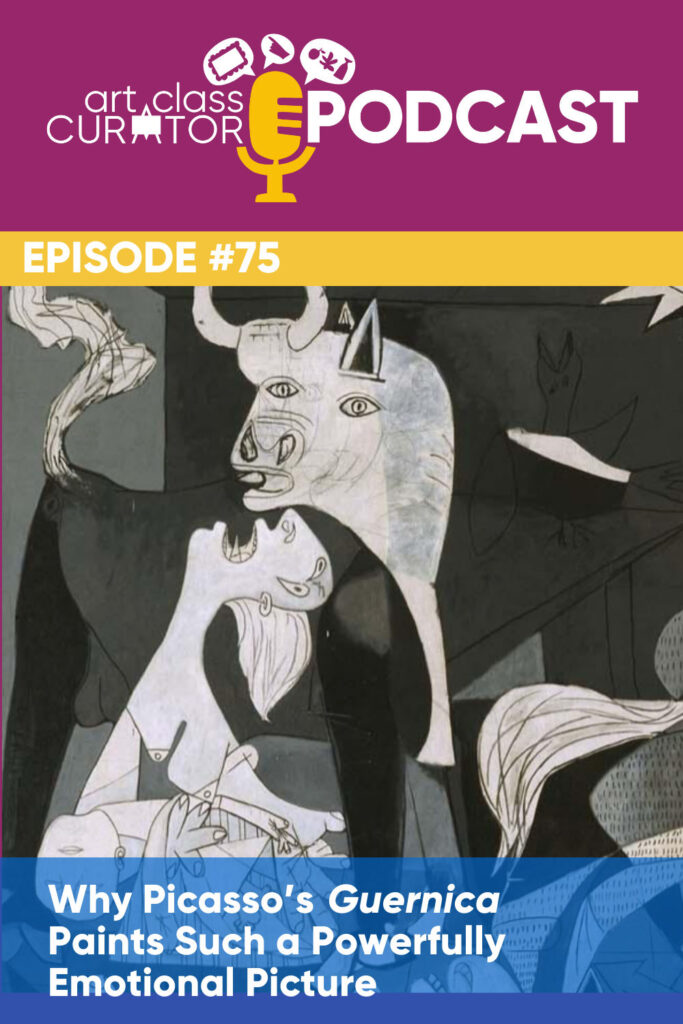
View in iTunes

Filed Under: Podcast


Getting Great at Grant Proposal Writing with Barbara Lardner

Grant Proposal Writing

Does the idea of writing a grant proposal intimidate you? Barbara Lardner is an art teacher who’s taught in multiple grade levels throughout elementary, middle, and high school for over 25 years. She also happens to be an expert at grant writing for the classroom. So in this episode, I’ve invited her on to share her experiences, tips, and best practices for how you can write a great grant proposal.

Subscribe in Your Favorite Podcast Listening App

2:56​ – How Barbara was granted a trip to Paris

5:14 – Different types of grants offered and where to begin your search

8:54 – Crucial tips, steps, and goals to begin the grant writing proposal process

14:49 – One thing you might need (and shouldn’t put off) when writing your proposal

18:47 – Examples of vagueness, specificity, and clarity in proposal writing

22:49 – Why Barbara missed out on receiving an extra $2,000 for her school this year

24:39 – The kind of assessment requirements you need to follow after you get a grant

28:06 – Advice for making the grant writing process easier and less scary

31:11 – What to do before you finally submit your application

35:50 – Recap and more tips and best practices for writing your grant proposal

38:49 – Biggest piece of advice that gave Barbara the grant to attend graduate school

41:44 – What sparked Barbara’s interest in art as a 4-year-old

  • Free Lesson Sample
  • The Curated Connections Library
  • Reflecting Absence: September 11th Lesson Plans for Art Teachers
  • 9/11 Memorial – PWP Landscape Architecture

Be a Podcast Guest: Submit a Voice Memo of Your Art Story (Scroll to the bottom of the page to submit your story.)

Cindy Ingram: Hello and welcome to The Art Class Curator Podcast. I am Cindy Ingram, your host and the founder of Art Class Curator, and The Curated Connections Library. We’re here to talk about teaching art with purpose and inspiration from the daily delights of creativity to the messy mishaps that come with being a teacher. Whether you’re driving home from school or cleaning up your classroom for the 15th time today, take a second, take a deep breath, relax those shoulders, and let’s get started.

Hello everyone, this is Cindy Ingram. I just wanted to give you a little bit of a warning for this episode. I just got word back from my podcast editor that said the sound on this episode is weird. It was recorded a little bit too loud. I needed to have changed some settings on my microphone but it’s not too bad. I listen to it. I think that it is still listenable. I think it won’t bother you too much but I just wanted to apologize for that. It happens to the best of us. I hope you still enjoy this content and this lesson. Thanks so much. On to the episode.

Hello everybody and welcome back to The Art Class Curator Podcast. This is Cindy Ingram. Today, we’re going to talk about how to bring current events into your classroom, how to use art as a way to talk about the things that are going on in the world, and also, the things that have gone on in the past and using art as a tool to process, to reflect, to practice empathy, to better understand complex issues, and all of that can happen in these art lessons. The artwork that I want to talk about as the case study for this topic is the 9/11 Memorial. You know probably by now that 9/11 is around the corner. It is on Saturday this week. It is actually the 20th anniversary of September 11th. What is so shocking about this to me and so many other people is that our students weren’t alive. It was such a big thing in our lives. As time passes, more and more of the population wasn’t there, wasn’t alive, didn’t feel that impact, didn’t see what happened, how it changed, how our world went from one way to another way, almost overnight.

We’re seeing that now with current events now, like that mass trigger catalyst event is happening as we speak but with September 11th, our students just weren’t there. To start out this conversation, I am going to play a clip of a conversation that I had with Robyn Smith. Robyn is an art teacher in California. She has taught pre-K through eighth grade for the past 24 years. She, at the beginning of the 2020-2021 school year, purchased our SPARK Hybrid Learning Curriculum. The SPARK Hybrid Learning Curriculum, as you probably know by now, is actually a part of The Curated Connections Library. We merged the two programs together because it didn’t feel like it made sense to sell them separately anymore. Everything that you found in the SPARK Hybrid Learning Curriculum is also now in The Curated Connections Library.

The Curated Connections Library includes over 175 works of art. A wide variety of works of art that include a lot of activities that you can use in a hybrid setting. The art projects are idea centered and open-ended. They’re not media specific. There are videos and worksheets that are available in Google Classroom format so that you can easily send them to your remote student. For those of you who are experiencing the highs and lows of remote teaching right now or quarantining, the SPARK Hybrid Learning Curriculum inside The Curated Connections Library is a great place for you to find lessons.

Anyway, if you’re interested in checking it out, head over to artclasscurator.com/join. The doors are open and are remaining open. You can head over there to check it out. But in my conversation with Robyn, she shared one of the lessons that she used from the curriculum and how it impacted her students. I love this story that she tells about her student and how he took this lesson, and created something really fun and grand out of it. I’m going to go ahead and play that clip of my conversation with Robyn right now.

Robyn Smith: I bought your SPARK curriculum and used that. That was great. I really enjoyed using that. It worked so well for the online learners and in-class learners. Actually, it worked better for the online learners because they were at home and they could find things versus what I had available in the art room. 

Cindy Ingram: Things as in like supplies or as in like more information about the artwork?

Robyn Smith: I think supplies. I’ll give you an example. One of the lessons I did during 9/11 with the junior high kids was you had a lesson there. I felt like I was cheating using those lessons. It was so easy. With everything there, I put it on canvas and I was good to go. But there was a lesson about monuments and you talked about the 9/11 monument. I think that was cool because the kids didn’t know much about it unless they’d been to New York. Of course, they weren’t around at the time of 9/11. I had them interviewing their parents, “Where were you? What happened? Ask your grandparents what happened.” It was neat that they were able to come back and say, “Everybody remembers where they were when 9/11 happened.” Isn’t that crazy?

Then they had to choose a monument that they wanted to make. I had this one really creative—they were all creative—but one especially creative student who had just moved house. In the middle of doing online learning, his family moved to a new house, to a whole different area. He had a bunch of boxes around the house, so all of his projects involved moving boxes. He took a moving box and he said, “This is the monument to 2020.” One side of the box had a paper mask on it and some plastic gloves, like surgical gloves or whatever. In California, we had a lot of fires in the fall at that time. You’ve probably heard that in the news. He had flames and on one side of it was sticking out flames. Another sign, he had a big giant closed sign that flopped down because everything’s closed because of COVID. I think the third side, the riots that were happening during the fall. He had riots, he had grenades, he had all kinds of things probably you shouldn’t have had at school there. But anyway, it was very creative. I was really impressed with what he’d done.

Cindy Ingram: What I love about that story that you just said is that you’re teaching them history. In the last 20 years it was history, then they’re comparing that event to what they’re going through now because they’re also living through a big historical moment. You’re connecting it that way. He’s able to express his personal feelings about what happened and process that at the same time, and be creative and have this design challenge that was really open-ended. He was able to create something really grand out of that. You’re also having them engaged with the work of art and the 9/11 Memorial monument, and explore all of this through art. I’m just like, “Oh, that’s a beautiful teaching moment.” 

Thank you so much to Robyn Smith for sharing that lesson with you guys. Like I said in the clip, I really love how layered this lesson really is. On the surface, they’re looking at our artwork. They’re talking about it. They’re making an artwork in response but there is so much more happening beneath the surface. I love how she was talking about how she had them interview their parents, so they’re getting a little oral history, a moment. They’re having a connection moment between them and their family. They are really understanding the gravity of the experience, of what that experience was like and stepping into the shoes of people who lived through that. Those experiences when you really look at the past through the lens of art and through the lens of human experience, it really connects you to other people. It helps you develop empathy. It helps you really better understand how people react, respond, and live through big things.

Artists throughout time have used art as a way to process their feelings, to make a statement about something that happened, to change someone’s mind or to influence. I’m just thinking about Guernica, which I talked about with Jenn on the podcast just recently. How Picasso wasn’t a political artist and that bombing of the town of Guernica caused him to create that work of art in response. The same thing is true of Fernando Botero who creates those really joyful paintings. He’s from Colombia. He paints pictures of fat people. Apparently, it’s supposed to be like a cubism takeoff, we’re looking at a person from different points of view, but those paintings are just so happy and joyful. There’s music. There’s dancing. There’s family things. It’s very much not political on the surface anyway but then he created an entire series of artworks about the Abu Ghraib torture scandal back in the 2000s.

Whether it is making art or whether it is looking at art, we can use art as a way to help ourselves through big things. I think that is an amazing lesson for our students. I really encourage you to bring in artwork about things that are happening in the world and about things that happened in the past. On anniversaries of things, on Veterans Day, those holidays where you’re looking back at the past and you’re remembering, it’s a really great opportunity for you as the teacher to help create a full experience for the student because chances are in their English class, they’re going to be writing about it. In their history class, they’re going to be watching a video or talking about it. Throughout their experience of the school day on September 11th or well, it’s a Saturday but this week, they’re going to be hearing about September 11th from a variety of different places. I think that curriculum is best when it is cohesive and when it is integrated, when what’s happening in social studies feeds into what happens in art. What happens in art feeds into what happens in English. What happens in English feeds into what happens in other classes.

That is giving students such an amazing connected world view because the way we do education right now in our country, in most places, we divide everything by subject, then those subject teachers don’t ever really communicate too much with the other subject teachers. I guess at the state level, we have standards. The writers of the standards, in many cases, aligned the curriculum to where English and social studies are related, and that sort of thing. But it doesn’t really happen all that intentionally, I’ve seen in my experience. I think that using contemporary events as a way to connect is really important.

In The Curated Connections Library, we do have this lesson on the September 11th Memorial. Let me tell you a little bit about the Memorial. If you want to include it in your classroom this week, we will give you some information. We do have a blog post about this lesson as well, which I will include both a link to the blog post, which is free content and a link to the membership lesson. If you’re a member, you can visit the show notes today to find this lesson.

The September 11th Memorial was designed by architects Michael Arad and Peter Walker. In the footprint of the Twin Towers, they put bottomless reflecting pools. The title of the artwork is called Reflecting Absence. It’s like a big hole, then it has waterfalls that come from the side down into a lower level. Then inside that lower level, there is a hole, another hole, a square hole that the water continues to go down into. From the side, you cannot see the bottom of that second hole. It’s just like this abyss, then it’s just this dark thing and you can’t see it. The waterfalls descend 30 feet into the basin, then the smaller one goes down another 20 feet. It’s huge.

Another thing about the experience is the waterfall creates a really loud sound. It completely drowns out the noise of the city. When I visited, it was in 2014, they were still building the Freedom Tower. There was a ton of construction in the area and you couldn’t even really hear it. In New York, you’re always hearing the cabs and the people. There’s just the cars, the honking, and all of those things but the sound of that waterfall just completely drowned out the noise. I found that to be really powerful because it allowed me to really focus on what happened and where I am. It added to the solemnity of the experience. It helped me not be distracted. It helped me go into myself and not look around, and see what everyone else was doing.

Then along the side, there are bronze plaques that have the names of everyone who died in the attacks on 9/11 and also the World Trade Center bombing from 1993. They’re all along the edge engraved into the bronze. These reflecting pools are the exact same size and shape of the actual Twin Towers. When you’re standing there in front of them, you really realize how massive the buildings were, then it also helps you imagine the devastation that took place on September 11th.

The conversations that you can have with your students about this, I think it’s really important to show video of the Memorial pictures, just don’t do it justice because of the sound, because of the scale and the size. It’s important to look at it from multiple different angles. It’s important to see and hear the full experience because it is really a beautiful experience. When discussing this with your students, you want to really ask them questions about how all of the artist’s choices contribute to the feeling that it gives the person visiting. That’s one of my favorite questions to ask about an artwork is what did the artist do to make us feel this way? Yes, you can talk about how it makes you feel and explore that. I love talking about that but it’s really fun to pick that apart and get meta with it, then be like, “Okay, well, I’m feeling really anxious because the artist did this” or “I’m feeling really sad because the artist used this color, which really impacted the emotions.”

Like I said, Peter Walker and Michael Arad were the architects in charge of the Memorial. Michael Arad is the one who created the actual Memorial, the monument. When they wanted to create the Memorial, they opened it up for submissions of designs. There were at least five thousand entries for the Memorial during this international contest that was held in 2003. Michael Arad is Israeli-American. He was actually an eyewitness to the second plane, hitting the South Tower of the World Trade Center from the roof of his building that same day. This young architect, Michael Arad, then became a partner of Handle Architects who created the Memorial. He has won several awards for his work on the Memorial and has since been selected to design other Memorials.

In addition to the main Memorial design, Michael Arad partnered with Peter Walker who was a landscape architect. He designed the unique landscaping for the Memorial. His idea was to add a forest of oak trees to create a peaceful place for reflection and contemplation. He wanted those trees to mimic the arches that were located at the base of the original towers, which were designed by architect Minoru Yamasaki. You can visit his website. It’s PWP Landscape Architecture. We’re going to link to it in the show notes. But on that site, you can see the design process, you can see the symbolism for each part of the landscape, and everything like that. It’s pretty fun to see the problem solving that went into this Memorial and the symbolism as well.

The sound of the water washes out the sounds of the city but then the trees hide the sights of the city. They create this canopy over you as you’re walking up and prepare you to enter this sacred space. You see that happen in Japanese temples and things like that where the lead up to the event, to the actual full experience is there to help prepare you. You hear the sound of water. You hear the sound of the little tinkering chimes—I’m still talking about Japan—you hear all of that. It prepares you to enter. These trees do the same thing for you. If you visit the website of PWP Landscape Architecture, you can see pictures of the trees next to pictures of the arch design that I mentioned earlier. It’s really subtle but it’s a really beautiful detail.

The types of trees that they used were white oaks, which are symbols of strength, longevity and the symbolic weight that the architects were trying to convey in the design. One of the activities in this lesson is to explore the monument through the five senses. We have a 5 Senses worksheet where the kids go through the five senses and talk about how each one of them was represented in the artwork, what would it be like to be here, what would it feel like to be here, and also exploring what 9/11 was and talking about what they already know, then sharing with them your experience of it and inviting them to interview their family, which I thought was a really great touch added by Robyn in her clip there. Then talking about what is a Memorial and why we have them. If I were teaching this in my classroom, I would then have students do independent research on different Memorials or monuments. Maybe I would have a group work together to research a monument. I would give them one or have them research one to discover on their own or give them a list of ones that they might find interesting, then they choose from that list, then give them some questions to answer about their memorial, then they present those to the class.

I always love doing activities like that because it allows you to get in extra art. If you’re doing an artwork about a particular theme, you can always then bring in other artworks, have the kids work together to analyze them, then they get to share that with their classmates, what they learned. It gives them a little more ownership over the information, over the content provided in the class. It makes them a little bit more personally connected to it because you’ve got that element of choosing the one that they want to talk about, then it makes them motivated to learn about it because they’re going to have to do a presentation about it. I think there is a lot of good in that type of activity.

Then from there, that’s when I would have the students design and create a Memorial to remember an impactful historical event. It can be something right now, like what Robyn’s student did, or it can be something meaningful to the student. Maybe it’s a Holocaust Memorial. Maybe it is a Memorial of an individual person or an event in their family, or maybe it is another big event. They get to choose, then design a monument. One of my favorite things about these SPARK Works Lessons in The Curated Connections Library is that we give you the art project ideas that are meaningful to the art project but you really get to decide how that plays out in your classroom. That’s why these projects work really well for your remote students if you’re still teaching a hybrid or remote class because you can use any supplies, you can use that Memorial project, the student that Robyn talked about, created his out of boxes. Another student could get on their iPad and do Procreate. Another student could get some grid and graph paper, and make a plan, a blueprint. There’s so many different options. These experiences, we really feel like they are a great bridge between your choice-based classrooms and your more traditional classrooms where everyone’s doing the same thing. This is a really nice combination.

But obviously, you can take these lessons, then make them more or less structured. If you want to do memorial and everybody does it this one certain way, and everybody does it with these certain materials, say you’re teaching a graphic art class and you want to introduce them to architecture software or something like that, you could do that or if you’re teaching a 3D class, you could have them make a sculpture. If you’re teaching a painting class, you can have them do a painting. You can see how they’re really highly flexible. That’s really important to me as a teacher because I never follow a lesson plan 100%. I love to add my own spin to it. I love to take in my expertise and mold that into the lesson. We love to make these lessons really flexible.

That’s the full lesson available in The Curated Connections Library. There’s a lesson plan. There are the Powerpoints you need with images, the videos we’ve curated and watched to know if they’re good or not. We have multiple worksheets. We have multiple worksheets including that 5 Senses worksheet, the What I Already Know and also What I Think worksheet, then there are videos for all of our new SPARK Work lessons. This one is one of those that includes a video. That’s really good for your remote students especially, because they might not have you there to give them some of the information. But I always recommend having them watch the video after they’ve done the activities because you really want them to think for themselves first before you give them any information.

Along these same lines of taking current events, holidays, and things like that and incorporating them into your classroom, it doesn’t have to be this long extended unit. It can just be one day this week, you go in and you talk about that 9/11 Memorial, and do a one day experience. This is really great to add into your curriculum for a lot of reasons, both logistical and for education purposes. We know the  educational value of adding more works of art into your curriculum. We know it’s going to help your student’s critical thinking skills, their empathy, their connection, their tolerance, their communication skills, their self-awareness, their emotional fluency, all those things I talk about all the time but also, it’s going to help you with your lessons because when you’re planning out your lessons for a week, say one day of every week is an art connection experience that you grab from The Curated Connections Library, that is one day of every month or every week that you’ve got plans for, that you don’t have to worry about creating a lesson plan for. It’s ready to go. Even if you’re doing a completely different style of curriculum the rest of the week where you’re maybe really focused on studio or maybe there’s all sorts of other things that you could be doing in art class, this gives them that one time a week where they’re truly connecting with the works of art and doing these activities, then your lessons are done for that day.

It also is really helpful I found, you know that when you’re teaching multiple classes and if you’re doing the same project with them, there’s always one class that gets behind or one class that gets ahead or one class that half the kids were absent because they were taking a makeup test or the other half of the kids were gone the other time, they’re pull outs for something else. There are always kids being pulled out for different things and getting kids behind. That day, I always used to, as a buffer day. If one class was really far behind, we would do the art connection experience at the beginning, then give them more time to get caught up on their assignments. It was a really good way to balance out the work and fill those times.

Adding in a weekly art connection experience that’s outside of your normal curriculum also will allow you to show more works of art and create more diversity in your experiences. Say you’re doing a really comprehensive project that’s going to take multiple weeks—three, four weeks, five weeks and you’re still working on this project—that’s five weeks that they are only working on that project. They’re not getting to explore a lot of other art content as they’re doing it. Throwing in these art connection days will allow you to show your students work from around the world, from across times and really allow them to experience all that art has to offer. It’s like bonus art throughout their lives.

That’s my episode for today. I hope it encourages you to bring this artwork into your curriculum this week or if you’re watching this after September 11th, you still can bring it in or save it for next year. If you want to download this lesson, you can get it in The Curated Connections Library. If you are not a member, you can head over to artclasscurator.com/join. As a bonus for listening to this episode, I am going to offer you $10 off of your first month. If you are not a member and you want to come in, and check it out, just enter the coupon code “Memorial”. That will give you $10 off your first month’s membership. That is for the Museum Level membership. We have two levels. If you get the Gallery Level membership, this artwork is from a past month, so it won’t be in your membership. Make sure you get the Museum Level membership to access this lesson. Thank you so much for listening today. I will be back next week. Have a wonderful day, bye.

When you’re a teacher, one thing is certain, the lesson planning never ends. The Curated Connections Library is here to help with hundreds of art connection lessons and activities. Our signature SPARK Works lessons include everything you need to teach an artwork every single week. Each lesson features one diverse and captivating work of art and is complete with discussion questions, engaging activities to create deeper art connections, and related art project ideas. With unique worksheets and PowerPoint presentations, every lesson is classroom-ready. Get your free SPARK Works lesson and take a break from lesson planning by going to artclasscurator.com/freelesson.

Thank you so much for listening to The Art Class Curator Podcast. If you like what you hear, please subscribe and give us an honest rating on iTunes to help other teachers find us, and hear these amazing art conversations and art teacher insights. Be sure to tune in next week for more art inspiration and curated conversations.

Free Resource!

82 Questions About Art

82 questions you can use to start and extend conversations about works of art with your classroom. Free download includes a list plus individual question cards perfect for laminating!

Download

Free Resource!

82 Questions About Art

82 questions you can use to start and extend conversations about works of art with your classroom. Free download includes a list plus individual question cards perfect for laminating!

Subscribe and Review in iTunes

Have you subscribed to the podcast? I don’t want you to miss an episode and we have a lot of good topics and guests coming up! Click here to subscribe on iTunes!

If you are feeling extra kind, I would LOVE it if you left us a review on iTunes too! These reviews help others find the podcast and I truly love reading your feedback. You can click here to review and select “Write a Review” and let me know what you love best about the podcast!
View in iTunes

Filed Under: Podcast


What is a SPARKwork? Using SPARKworks to Light Up Your Art Lessons

What is a SPARKwork? Using SPARKworks to Light Up Your Art Lessons

What in the world is a SPARKworks? At Art Class Curator, we love to do things differently than what you’ll find anywhere else. Recently, I relaunched The Curated Connections Library with SPARKworks, a new name with new features for an established framework. In this episode, I walk you through what a SPARKwork lesson is, how to follow one step-by-step, and offer tips on how to use these sorts of lessons in your classroom.

Subscribe in Your Favorite Podcast Listening App

3:21​ – Why The Curated Connections Library became more than just about art history

5:21 – Goals of the membership for teachers and their students

10:22 – What a SPARKwork is and where the name comes from

14:22 – SPARKwork step #1 and the 4 Cs to curate a good work of art for your lessons

19:48 – Leading your lesson with art discussion and the goal you should aim for

25:25 – How SPARKworks encourage student engagement and impress your administration

29:29 – Discussing ways to complete the 4th step in the framework

33:07 – New details and benefits of joining the recently relaunched membership

39:28 – Why becoming a member is a preventative self-care gift to yourself

  • Free Lesson Sample
  • The Curated Connections Library
  • Reflecting Absence: September 11th Lesson Plans for Art Teachers
  • 9/11 Memorial – PWP Landscape Architecture

Be a Podcast Guest: Submit a Voice Memo of Your Art Story (Scroll to the bottom of the page to submit your story.)

Cindy Ingram: Hello and welcome to The Art Class Curator Podcast. I am Cindy Ingram, your host and the founder of Art Class Curator, and The Curated Connections Library. We’re here to talk about teaching art with purpose and inspiration from the daily delights of creativity to the messy mishaps that come with being a teacher. Whether you’re driving home from school or cleaning up your classroom for the 15th time today, take a second, take a deep breath, relax those shoulders, and let’s get started.

Hello everyone, this is Cindy Ingram. I just wanted to give you a little bit of a warning for this episode. I just got word back from my podcast editor that said the sound on this episode is weird. It was recorded a little bit too loud. I needed to have changed some settings on my microphone but it’s not too bad. I listen to it. I think that it is still listenable. I think it won’t bother you too much but I just wanted to apologize for that. It happens to the best of us. I hope you still enjoy this content and this lesson. Thanks so much. On to the episode.

Hello everybody and welcome back to The Art Class Curator Podcast. This is Cindy Ingram. Today, we’re going to talk about how to bring current events into your classroom, how to use art as a way to talk about the things that are going on in the world, and also, the things that have gone on in the past and using art as a tool to process, to reflect, to practice empathy, to better understand complex issues, and all of that can happen in these art lessons. The artwork that I want to talk about as the case study for this topic is the 9/11 Memorial. You know probably by now that 9/11 is around the corner. It is on Saturday this week. It is actually the 20th anniversary of September 11th. What is so shocking about this to me and so many other people is that our students weren’t alive. It was such a big thing in our lives. As time passes, more and more of the population wasn’t there, wasn’t alive, didn’t feel that impact, didn’t see what happened, how it changed, how our world went from one way to another way, almost overnight.

We’re seeing that now with current events now, like that mass trigger catalyst event is happening as we speak but with September 11th, our students just weren’t there. To start out this conversation, I am going to play a clip of a conversation that I had with Robyn Smith. Robyn is an art teacher in California. She has taught pre-K through eighth grade for the past 24 years. She, at the beginning of the 2020-2021 school year, purchased our SPARK Hybrid Learning Curriculum. The SPARK Hybrid Learning Curriculum, as you probably know by now, is actually a part of The Curated Connections Library. We merged the two programs together because it didn’t feel like it made sense to sell them separately anymore. Everything that you found in the SPARK Hybrid Learning Curriculum is also now in The Curated Connections Library.

The Curated Connections Library includes over 175 works of art. A wide variety of works of art that include a lot of activities that you can use in a hybrid setting. The art projects are idea centered and open-ended. They’re not media specific. There are videos and worksheets that are available in Google Classroom format so that you can easily send them to your remote student. For those of you who are experiencing the highs and lows of remote teaching right now or quarantining, the SPARK Hybrid Learning Curriculum inside The Curated Connections Library is a great place for you to find lessons.

Anyway, if you’re interested in checking it out, head over to artclasscurator.com/join. The doors are open and are remaining open. You can head over there to check it out. But in my conversation with Robyn, she shared one of the lessons that she used from the curriculum and how it impacted her students. I love this story that she tells about her student and how he took this lesson, and created something really fun and grand out of it. I’m going to go ahead and play that clip of my conversation with Robyn right now.

Robyn Smith: I bought your SPARK curriculum and used that. That was great. I really enjoyed using that. It worked so well for the online learners and in-class learners. Actually, it worked better for the online learners because they were at home and they could find things versus what I had available in the art room. 

Cindy Ingram: Things as in like supplies or as in like more information about the artwork?

Robyn Smith: I think supplies. I’ll give you an example. One of the lessons I did during 9/11 with the junior high kids was you had a lesson there. I felt like I was cheating using those lessons. It was so easy. With everything there, I put it on canvas and I was good to go. But there was a lesson about monuments and you talked about the 9/11 monument. I think that was cool because the kids didn’t know much about it unless they’d been to New York. Of course, they weren’t around at the time of 9/11. I had them interviewing their parents, “Where were you? What happened? Ask your grandparents what happened.” It was neat that they were able to come back and say, “Everybody remembers where they were when 9/11 happened.” Isn’t that crazy?

Then they had to choose a monument that they wanted to make. I had this one really creative—they were all creative—but one especially creative student who had just moved house. In the middle of doing online learning, his family moved to a new house, to a whole different area. He had a bunch of boxes around the house, so all of his projects involved moving boxes. He took a moving box and he said, “This is the monument to 2020.” One side of the box had a paper mask on it and some plastic gloves, like surgical gloves or whatever. In California, we had a lot of fires in the fall at that time. You’ve probably heard that in the news. He had flames and on one side of it was sticking out flames. Another sign, he had a big giant closed sign that flopped down because everything’s closed because of COVID. I think the third side, the riots that were happening during the fall. He had riots, he had grenades, he had all kinds of things probably you shouldn’t have had at school there. But anyway, it was very creative. I was really impressed with what he’d done.

Cindy Ingram: What I love about that story that you just said is that you’re teaching them history. In the last 20 years it was history, then they’re comparing that event to what they’re going through now because they’re also living through a big historical moment. You’re connecting it that way. He’s able to express his personal feelings about what happened and process that at the same time, and be creative and have this design challenge that was really open-ended. He was able to create something really grand out of that. You’re also having them engaged with the work of art and the 9/11 Memorial monument, and explore all of this through art. I’m just like, “Oh, that’s a beautiful teaching moment.” 

Thank you so much to Robyn Smith for sharing that lesson with you guys. Like I said in the clip, I really love how layered this lesson really is. On the surface, they’re looking at our artwork. They’re talking about it. They’re making an artwork in response but there is so much more happening beneath the surface. I love how she was talking about how she had them interview their parents, so they’re getting a little oral history, a moment. They’re having a connection moment between them and their family. They are really understanding the gravity of the experience, of what that experience was like and stepping into the shoes of people who lived through that. Those experiences when you really look at the past through the lens of art and through the lens of human experience, it really connects you to other people. It helps you develop empathy. It helps you really better understand how people react, respond, and live through big things.

Artists throughout time have used art as a way to process their feelings, to make a statement about something that happened, to change someone’s mind or to influence. I’m just thinking about Guernica, which I talked about with Jenn on the podcast just recently. How Picasso wasn’t a political artist and that bombing of the town of Guernica caused him to create that work of art in response. The same thing is true of Fernando Botero who creates those really joyful paintings. He’s from Colombia. He paints pictures of fat people. Apparently, it’s supposed to be like a cubism takeoff, we’re looking at a person from different points of view, but those paintings are just so happy and joyful. There’s music. There’s dancing. There’s family things. It’s very much not political on the surface anyway but then he created an entire series of artworks about the Abu Ghraib torture scandal back in the 2000s.

Whether it is making art or whether it is looking at art, we can use art as a way to help ourselves through big things. I think that is an amazing lesson for our students. I really encourage you to bring in artwork about things that are happening in the world and about things that happened in the past. On anniversaries of things, on Veterans Day, those holidays where you’re looking back at the past and you’re remembering, it’s a really great opportunity for you as the teacher to help create a full experience for the student because chances are in their English class, they’re going to be writing about it. In their history class, they’re going to be watching a video or talking about it. Throughout their experience of the school day on September 11th or well, it’s a Saturday but this week, they’re going to be hearing about September 11th from a variety of different places. I think that curriculum is best when it is cohesive and when it is integrated, when what’s happening in social studies feeds into what happens in art. What happens in art feeds into what happens in English. What happens in English feeds into what happens in other classes.

That is giving students such an amazing connected world view because the way we do education right now in our country, in most places, we divide everything by subject, then those subject teachers don’t ever really communicate too much with the other subject teachers. I guess at the state level, we have standards. The writers of the standards, in many cases, aligned the curriculum to where English and social studies are related, and that sort of thing. But it doesn’t really happen all that intentionally, I’ve seen in my experience. I think that using contemporary events as a way to connect is really important.

In The Curated Connections Library, we do have this lesson on the September 11th Memorial. Let me tell you a little bit about the Memorial. If you want to include it in your classroom this week, we will give you some information. We do have a blog post about this lesson as well, which I will include both a link to the blog post, which is free content and a link to the membership lesson. If you’re a member, you can visit the show notes today to find this lesson.

The September 11th Memorial was designed by architects Michael Arad and Peter Walker. In the footprint of the Twin Towers, they put bottomless reflecting pools. The title of the artwork is called Reflecting Absence. It’s like a big hole, then it has waterfalls that come from the side down into a lower level. Then inside that lower level, there is a hole, another hole, a square hole that the water continues to go down into. From the side, you cannot see the bottom of that second hole. It’s just like this abyss, then it’s just this dark thing and you can’t see it. The waterfalls descend 30 feet into the basin, then the smaller one goes down another 20 feet. It’s huge.

Another thing about the experience is the waterfall creates a really loud sound. It completely drowns out the noise of the city. When I visited, it was in 2014, they were still building the Freedom Tower. There was a ton of construction in the area and you couldn’t even really hear it. In New York, you’re always hearing the cabs and the people. There’s just the cars, the honking, and all of those things but the sound of that waterfall just completely drowned out the noise. I found that to be really powerful because it allowed me to really focus on what happened and where I am. It added to the solemnity of the experience. It helped me not be distracted. It helped me go into myself and not look around, and see what everyone else was doing.

Then along the side, there are bronze plaques that have the names of everyone who died in the attacks on 9/11 and also the World Trade Center bombing from 1993. They’re all along the edge engraved into the bronze. These reflecting pools are the exact same size and shape of the actual Twin Towers. When you’re standing there in front of them, you really realize how massive the buildings were, then it also helps you imagine the devastation that took place on September 11th.

The conversations that you can have with your students about this, I think it’s really important to show video of the Memorial pictures, just don’t do it justice because of the sound, because of the scale and the size. It’s important to look at it from multiple different angles. It’s important to see and hear the full experience because it is really a beautiful experience. When discussing this with your students, you want to really ask them questions about how all of the artist’s choices contribute to the feeling that it gives the person visiting. That’s one of my favorite questions to ask about an artwork is what did the artist do to make us feel this way? Yes, you can talk about how it makes you feel and explore that. I love talking about that but it’s really fun to pick that apart and get meta with it, then be like, “Okay, well, I’m feeling really anxious because the artist did this” or “I’m feeling really sad because the artist used this color, which really impacted the emotions.”

Like I said, Peter Walker and Michael Arad were the architects in charge of the Memorial. Michael Arad is the one who created the actual Memorial, the monument. When they wanted to create the Memorial, they opened it up for submissions of designs. There were at least five thousand entries for the Memorial during this international contest that was held in 2003. Michael Arad is Israeli-American. He was actually an eyewitness to the second plane, hitting the South Tower of the World Trade Center from the roof of his building that same day. This young architect, Michael Arad, then became a partner of Handle Architects who created the Memorial. He has won several awards for his work on the Memorial and has since been selected to design other Memorials.

In addition to the main Memorial design, Michael Arad partnered with Peter Walker who was a landscape architect. He designed the unique landscaping for the Memorial. His idea was to add a forest of oak trees to create a peaceful place for reflection and contemplation. He wanted those trees to mimic the arches that were located at the base of the original towers, which were designed by architect Minoru Yamasaki. You can visit his website. It’s PWP Landscape Architecture. We’re going to link to it in the show notes. But on that site, you can see the design process, you can see the symbolism for each part of the landscape, and everything like that. It’s pretty fun to see the problem solving that went into this Memorial and the symbolism as well.

The sound of the water washes out the sounds of the city but then the trees hide the sights of the city. They create this canopy over you as you’re walking up and prepare you to enter this sacred space. You see that happen in Japanese temples and things like that where the lead up to the event, to the actual full experience is there to help prepare you. You hear the sound of water. You hear the sound of the little tinkering chimes—I’m still talking about Japan—you hear all of that. It prepares you to enter. These trees do the same thing for you. If you visit the website of PWP Landscape Architecture, you can see pictures of the trees next to pictures of the arch design that I mentioned earlier. It’s really subtle but it’s a really beautiful detail.

The types of trees that they used were white oaks, which are symbols of strength, longevity and the symbolic weight that the architects were trying to convey in the design. One of the activities in this lesson is to explore the monument through the five senses. We have a 5 Senses worksheet where the kids go through the five senses and talk about how each one of them was represented in the artwork, what would it be like to be here, what would it feel like to be here, and also exploring what 9/11 was and talking about what they already know, then sharing with them your experience of it and inviting them to interview their family, which I thought was a really great touch added by Robyn in her clip there. Then talking about what is a Memorial and why we have them. If I were teaching this in my classroom, I would then have students do independent research on different Memorials or monuments. Maybe I would have a group work together to research a monument. I would give them one or have them research one to discover on their own or give them a list of ones that they might find interesting, then they choose from that list, then give them some questions to answer about their memorial, then they present those to the class.

I always love doing activities like that because it allows you to get in extra art. If you’re doing an artwork about a particular theme, you can always then bring in other artworks, have the kids work together to analyze them, then they get to share that with their classmates, what they learned. It gives them a little more ownership over the information, over the content provided in the class. It makes them a little bit more personally connected to it because you’ve got that element of choosing the one that they want to talk about, then it makes them motivated to learn about it because they’re going to have to do a presentation about it. I think there is a lot of good in that type of activity.

Then from there, that’s when I would have the students design and create a Memorial to remember an impactful historical event. It can be something right now, like what Robyn’s student did, or it can be something meaningful to the student. Maybe it’s a Holocaust Memorial. Maybe it is a Memorial of an individual person or an event in their family, or maybe it is another big event. They get to choose, then design a monument. One of my favorite things about these SPARK Works Lessons in The Curated Connections Library is that we give you the art project ideas that are meaningful to the art project but you really get to decide how that plays out in your classroom. That’s why these projects work really well for your remote students if you’re still teaching a hybrid or remote class because you can use any supplies, you can use that Memorial project, the student that Robyn talked about, created his out of boxes. Another student could get on their iPad and do Procreate. Another student could get some grid and graph paper, and make a plan, a blueprint. There’s so many different options. These experiences, we really feel like they are a great bridge between your choice-based classrooms and your more traditional classrooms where everyone’s doing the same thing. This is a really nice combination.

But obviously, you can take these lessons, then make them more or less structured. If you want to do memorial and everybody does it this one certain way, and everybody does it with these certain materials, say you’re teaching a graphic art class and you want to introduce them to architecture software or something like that, you could do that or if you’re teaching a 3D class, you could have them make a sculpture. If you’re teaching a painting class, you can have them do a painting. You can see how they’re really highly flexible. That’s really important to me as a teacher because I never follow a lesson plan 100%. I love to add my own spin to it. I love to take in my expertise and mold that into the lesson. We love to make these lessons really flexible.

That’s the full lesson available in The Curated Connections Library. There’s a lesson plan. There are the Powerpoints you need with images, the videos we’ve curated and watched to know if they’re good or not. We have multiple worksheets. We have multiple worksheets including that 5 Senses worksheet, the What I Already Know and also What I Think worksheet, then there are videos for all of our new SPARK Work lessons. This one is one of those that includes a video. That’s really good for your remote students especially, because they might not have you there to give them some of the information. But I always recommend having them watch the video after they’ve done the activities because you really want them to think for themselves first before you give them any information.

Along these same lines of taking current events, holidays, and things like that and incorporating them into your classroom, it doesn’t have to be this long extended unit. It can just be one day this week, you go in and you talk about that 9/11 Memorial, and do a one day experience. This is really great to add into your curriculum for a lot of reasons, both logistical and for education purposes. We know the  educational value of adding more works of art into your curriculum. We know it’s going to help your student’s critical thinking skills, their empathy, their connection, their tolerance, their communication skills, their self-awareness, their emotional fluency, all those things I talk about all the time but also, it’s going to help you with your lessons because when you’re planning out your lessons for a week, say one day of every week is an art connection experience that you grab from The Curated Connections Library, that is one day of every month or every week that you’ve got plans for, that you don’t have to worry about creating a lesson plan for. It’s ready to go. Even if you’re doing a completely different style of curriculum the rest of the week where you’re maybe really focused on studio or maybe there’s all sorts of other things that you could be doing in art class, this gives them that one time a week where they’re truly connecting with the works of art and doing these activities, then your lessons are done for that day.

It also is really helpful I found, you know that when you’re teaching multiple classes and if you’re doing the same project with them, there’s always one class that gets behind or one class that gets ahead or one class that half the kids were absent because they were taking a makeup test or the other half of the kids were gone the other time, they’re pull outs for something else. There are always kids being pulled out for different things and getting kids behind. That day, I always used to, as a buffer day. If one class was really far behind, we would do the art connection experience at the beginning, then give them more time to get caught up on their assignments. It was a really good way to balance out the work and fill those times.

Adding in a weekly art connection experience that’s outside of your normal curriculum also will allow you to show more works of art and create more diversity in your experiences. Say you’re doing a really comprehensive project that’s going to take multiple weeks—three, four weeks, five weeks and you’re still working on this project—that’s five weeks that they are only working on that project. They’re not getting to explore a lot of other art content as they’re doing it. Throwing in these art connection days will allow you to show your students work from around the world, from across times and really allow them to experience all that art has to offer. It’s like bonus art throughout their lives.

That’s my episode for today. I hope it encourages you to bring this artwork into your curriculum this week or if you’re watching this after September 11th, you still can bring it in or save it for next year. If you want to download this lesson, you can get it in The Curated Connections Library. If you are not a member, you can head over to artclasscurator.com/join. As a bonus for listening to this episode, I am going to offer you $10 off of your first month. If you are not a member and you want to come in, and check it out, just enter the coupon code “Memorial”. That will give you $10 off your first month’s membership. That is for the Museum Level membership. We have two levels. If you get the Gallery Level membership, this artwork is from a past month, so it won’t be in your membership. Make sure you get the Museum Level membership to access this lesson. Thank you so much for listening today. I will be back next week. Have a wonderful day, bye.

When you’re a teacher, one thing is certain, the lesson planning never ends. The Curated Connections Library is here to help with hundreds of art connection lessons and activities. Our signature SPARK Works lessons include everything you need to teach an artwork every single week. Each lesson features one diverse and captivating work of art and is complete with discussion questions, engaging activities to create deeper art connections, and related art project ideas. With unique worksheets and PowerPoint presentations, every lesson is classroom-ready. Get your free SPARK Works lesson and take a break from lesson planning by going to artclasscurator.com/freelesson.

Thank you so much for listening to The Art Class Curator Podcast. If you like what you hear, please subscribe and give us an honest rating on iTunes to help other teachers find us, and hear these amazing art conversations and art teacher insights. Be sure to tune in next week for more art inspiration and curated conversations.

Free Resource!

82 Questions About Art

82 questions you can use to start and extend conversations about works of art with your classroom. Free download includes a list plus individual question cards perfect for laminating!

Download

Free Resource!

82 Questions About Art

82 questions you can use to start and extend conversations about works of art with your classroom. Free download includes a list plus individual question cards perfect for laminating!

Subscribe and Review in iTunes

Have you subscribed to the podcast? I don’t want you to miss an episode and we have a lot of good topics and guests coming up! Click here to subscribe on iTunes!

If you are feeling extra kind, I would LOVE it if you left us a review on iTunes too! These reviews help others find the podcast and I truly love reading your feedback. You can click here to review and select “Write a Review” and let me know what you love best about the podcast!
View in iTunes

Filed Under: Podcast


Destroying the Big Myth That Can Cause You to Underestimate Your Art Students

Destroying the Big Myth That Can Cause You to Underestimate Your Art Students

Ever since I started Art Class Curator in 2014, I’ve heard a lot of teachers who haven’t tried our lessons tell me that their students can’t do them. They think the lessons are too high-level or their students won’t connect with the works of art. Oh how wrong they are! So today I want to focus on destroying the big myth that can cause you to underestimate your students and believe that they can’t handle higher level thinking and gain a deeper connection with art in the classroom.

Subscribe in Your Favorite Podcast Listening App

8:18​ – The only difference between age groups during art lessons

9:39 – One of the biggest fears of art teachers and why the worry isn’t necessary

14:32 – Why you shouldn’t underestimate your students’ ability to think critically

16:53 – How haiku and thinking like a math teacher can help you teach art

24:33 – Other ways we can help students engage with art lessons

  • Free Lesson Sample
  • The Curated Connections Library
  • Reflecting Absence: September 11th Lesson Plans for Art Teachers
  • 9/11 Memorial – PWP Landscape Architecture

Be a Podcast Guest: Submit a Voice Memo of Your Art Story (Scroll to the bottom of the page to submit your story.)

Cindy Ingram: Hello and welcome to The Art Class Curator Podcast. I am Cindy Ingram, your host and the founder of Art Class Curator, and The Curated Connections Library. We’re here to talk about teaching art with purpose and inspiration from the daily delights of creativity to the messy mishaps that come with being a teacher. Whether you’re driving home from school or cleaning up your classroom for the 15th time today, take a second, take a deep breath, relax those shoulders, and let’s get started.

Hello everyone, this is Cindy Ingram. I just wanted to give you a little bit of a warning for this episode. I just got word back from my podcast editor that said the sound on this episode is weird. It was recorded a little bit too loud. I needed to have changed some settings on my microphone but it’s not too bad. I listen to it. I think that it is still listenable. I think it won’t bother you too much but I just wanted to apologize for that. It happens to the best of us. I hope you still enjoy this content and this lesson. Thanks so much. On to the episode.

Hello everybody and welcome back to The Art Class Curator Podcast. This is Cindy Ingram. Today, we’re going to talk about how to bring current events into your classroom, how to use art as a way to talk about the things that are going on in the world, and also, the things that have gone on in the past and using art as a tool to process, to reflect, to practice empathy, to better understand complex issues, and all of that can happen in these art lessons. The artwork that I want to talk about as the case study for this topic is the 9/11 Memorial. You know probably by now that 9/11 is around the corner. It is on Saturday this week. It is actually the 20th anniversary of September 11th. What is so shocking about this to me and so many other people is that our students weren’t alive. It was such a big thing in our lives. As time passes, more and more of the population wasn’t there, wasn’t alive, didn’t feel that impact, didn’t see what happened, how it changed, how our world went from one way to another way, almost overnight.

We’re seeing that now with current events now, like that mass trigger catalyst event is happening as we speak but with September 11th, our students just weren’t there. To start out this conversation, I am going to play a clip of a conversation that I had with Robyn Smith. Robyn is an art teacher in California. She has taught pre-K through eighth grade for the past 24 years. She, at the beginning of the 2020-2021 school year, purchased our SPARK Hybrid Learning Curriculum. The SPARK Hybrid Learning Curriculum, as you probably know by now, is actually a part of The Curated Connections Library. We merged the two programs together because it didn’t feel like it made sense to sell them separately anymore. Everything that you found in the SPARK Hybrid Learning Curriculum is also now in The Curated Connections Library.

The Curated Connections Library includes over 175 works of art. A wide variety of works of art that include a lot of activities that you can use in a hybrid setting. The art projects are idea centered and open-ended. They’re not media specific. There are videos and worksheets that are available in Google Classroom format so that you can easily send them to your remote student. For those of you who are experiencing the highs and lows of remote teaching right now or quarantining, the SPARK Hybrid Learning Curriculum inside The Curated Connections Library is a great place for you to find lessons.

Anyway, if you’re interested in checking it out, head over to artclasscurator.com/join. The doors are open and are remaining open. You can head over there to check it out. But in my conversation with Robyn, she shared one of the lessons that she used from the curriculum and how it impacted her students. I love this story that she tells about her student and how he took this lesson, and created something really fun and grand out of it. I’m going to go ahead and play that clip of my conversation with Robyn right now.

Robyn Smith: I bought your SPARK curriculum and used that. That was great. I really enjoyed using that. It worked so well for the online learners and in-class learners. Actually, it worked better for the online learners because they were at home and they could find things versus what I had available in the art room. 

Cindy Ingram: Things as in like supplies or as in like more information about the artwork?

Robyn Smith: I think supplies. I’ll give you an example. One of the lessons I did during 9/11 with the junior high kids was you had a lesson there. I felt like I was cheating using those lessons. It was so easy. With everything there, I put it on canvas and I was good to go. But there was a lesson about monuments and you talked about the 9/11 monument. I think that was cool because the kids didn’t know much about it unless they’d been to New York. Of course, they weren’t around at the time of 9/11. I had them interviewing their parents, “Where were you? What happened? Ask your grandparents what happened.” It was neat that they were able to come back and say, “Everybody remembers where they were when 9/11 happened.” Isn’t that crazy?

Then they had to choose a monument that they wanted to make. I had this one really creative—they were all creative—but one especially creative student who had just moved house. In the middle of doing online learning, his family moved to a new house, to a whole different area. He had a bunch of boxes around the house, so all of his projects involved moving boxes. He took a moving box and he said, “This is the monument to 2020.” One side of the box had a paper mask on it and some plastic gloves, like surgical gloves or whatever. In California, we had a lot of fires in the fall at that time. You’ve probably heard that in the news. He had flames and on one side of it was sticking out flames. Another sign, he had a big giant closed sign that flopped down because everything’s closed because of COVID. I think the third side, the riots that were happening during the fall. He had riots, he had grenades, he had all kinds of things probably you shouldn’t have had at school there. But anyway, it was very creative. I was really impressed with what he’d done.

Cindy Ingram: What I love about that story that you just said is that you’re teaching them history. In the last 20 years it was history, then they’re comparing that event to what they’re going through now because they’re also living through a big historical moment. You’re connecting it that way. He’s able to express his personal feelings about what happened and process that at the same time, and be creative and have this design challenge that was really open-ended. He was able to create something really grand out of that. You’re also having them engaged with the work of art and the 9/11 Memorial monument, and explore all of this through art. I’m just like, “Oh, that’s a beautiful teaching moment.” 

Thank you so much to Robyn Smith for sharing that lesson with you guys. Like I said in the clip, I really love how layered this lesson really is. On the surface, they’re looking at our artwork. They’re talking about it. They’re making an artwork in response but there is so much more happening beneath the surface. I love how she was talking about how she had them interview their parents, so they’re getting a little oral history, a moment. They’re having a connection moment between them and their family. They are really understanding the gravity of the experience, of what that experience was like and stepping into the shoes of people who lived through that. Those experiences when you really look at the past through the lens of art and through the lens of human experience, it really connects you to other people. It helps you develop empathy. It helps you really better understand how people react, respond, and live through big things.

Artists throughout time have used art as a way to process their feelings, to make a statement about something that happened, to change someone’s mind or to influence. I’m just thinking about Guernica, which I talked about with Jenn on the podcast just recently. How Picasso wasn’t a political artist and that bombing of the town of Guernica caused him to create that work of art in response. The same thing is true of Fernando Botero who creates those really joyful paintings. He’s from Colombia. He paints pictures of fat people. Apparently, it’s supposed to be like a cubism takeoff, we’re looking at a person from different points of view, but those paintings are just so happy and joyful. There’s music. There’s dancing. There’s family things. It’s very much not political on the surface anyway but then he created an entire series of artworks about the Abu Ghraib torture scandal back in the 2000s.

Whether it is making art or whether it is looking at art, we can use art as a way to help ourselves through big things. I think that is an amazing lesson for our students. I really encourage you to bring in artwork about things that are happening in the world and about things that happened in the past. On anniversaries of things, on Veterans Day, those holidays where you’re looking back at the past and you’re remembering, it’s a really great opportunity for you as the teacher to help create a full experience for the student because chances are in their English class, they’re going to be writing about it. In their history class, they’re going to be watching a video or talking about it. Throughout their experience of the school day on September 11th or well, it’s a Saturday but this week, they’re going to be hearing about September 11th from a variety of different places. I think that curriculum is best when it is cohesive and when it is integrated, when what’s happening in social studies feeds into what happens in art. What happens in art feeds into what happens in English. What happens in English feeds into what happens in other classes.

That is giving students such an amazing connected world view because the way we do education right now in our country, in most places, we divide everything by subject, then those subject teachers don’t ever really communicate too much with the other subject teachers. I guess at the state level, we have standards. The writers of the standards, in many cases, aligned the curriculum to where English and social studies are related, and that sort of thing. But it doesn’t really happen all that intentionally, I’ve seen in my experience. I think that using contemporary events as a way to connect is really important.

In The Curated Connections Library, we do have this lesson on the September 11th Memorial. Let me tell you a little bit about the Memorial. If you want to include it in your classroom this week, we will give you some information. We do have a blog post about this lesson as well, which I will include both a link to the blog post, which is free content and a link to the membership lesson. If you’re a member, you can visit the show notes today to find this lesson.

The September 11th Memorial was designed by architects Michael Arad and Peter Walker. In the footprint of the Twin Towers, they put bottomless reflecting pools. The title of the artwork is called Reflecting Absence. It’s like a big hole, then it has waterfalls that come from the side down into a lower level. Then inside that lower level, there is a hole, another hole, a square hole that the water continues to go down into. From the side, you cannot see the bottom of that second hole. It’s just like this abyss, then it’s just this dark thing and you can’t see it. The waterfalls descend 30 feet into the basin, then the smaller one goes down another 20 feet. It’s huge.

Another thing about the experience is the waterfall creates a really loud sound. It completely drowns out the noise of the city. When I visited, it was in 2014, they were still building the Freedom Tower. There was a ton of construction in the area and you couldn’t even really hear it. In New York, you’re always hearing the cabs and the people. There’s just the cars, the honking, and all of those things but the sound of that waterfall just completely drowned out the noise. I found that to be really powerful because it allowed me to really focus on what happened and where I am. It added to the solemnity of the experience. It helped me not be distracted. It helped me go into myself and not look around, and see what everyone else was doing.

Then along the side, there are bronze plaques that have the names of everyone who died in the attacks on 9/11 and also the World Trade Center bombing from 1993. They’re all along the edge engraved into the bronze. These reflecting pools are the exact same size and shape of the actual Twin Towers. When you’re standing there in front of them, you really realize how massive the buildings were, then it also helps you imagine the devastation that took place on September 11th.

The conversations that you can have with your students about this, I think it’s really important to show video of the Memorial pictures, just don’t do it justice because of the sound, because of the scale and the size. It’s important to look at it from multiple different angles. It’s important to see and hear the full experience because it is really a beautiful experience. When discussing this with your students, you want to really ask them questions about how all of the artist’s choices contribute to the feeling that it gives the person visiting. That’s one of my favorite questions to ask about an artwork is what did the artist do to make us feel this way? Yes, you can talk about how it makes you feel and explore that. I love talking about that but it’s really fun to pick that apart and get meta with it, then be like, “Okay, well, I’m feeling really anxious because the artist did this” or “I’m feeling really sad because the artist used this color, which really impacted the emotions.”

Like I said, Peter Walker and Michael Arad were the architects in charge of the Memorial. Michael Arad is the one who created the actual Memorial, the monument. When they wanted to create the Memorial, they opened it up for submissions of designs. There were at least five thousand entries for the Memorial during this international contest that was held in 2003. Michael Arad is Israeli-American. He was actually an eyewitness to the second plane, hitting the South Tower of the World Trade Center from the roof of his building that same day. This young architect, Michael Arad, then became a partner of Handle Architects who created the Memorial. He has won several awards for his work on the Memorial and has since been selected to design other Memorials.

In addition to the main Memorial design, Michael Arad partnered with Peter Walker who was a landscape architect. He designed the unique landscaping for the Memorial. His idea was to add a forest of oak trees to create a peaceful place for reflection and contemplation. He wanted those trees to mimic the arches that were located at the base of the original towers, which were designed by architect Minoru Yamasaki. You can visit his website. It’s PWP Landscape Architecture. We’re going to link to it in the show notes. But on that site, you can see the design process, you can see the symbolism for each part of the landscape, and everything like that. It’s pretty fun to see the problem solving that went into this Memorial and the symbolism as well.

The sound of the water washes out the sounds of the city but then the trees hide the sights of the city. They create this canopy over you as you’re walking up and prepare you to enter this sacred space. You see that happen in Japanese temples and things like that where the lead up to the event, to the actual full experience is there to help prepare you. You hear the sound of water. You hear the sound of the little tinkering chimes—I’m still talking about Japan—you hear all of that. It prepares you to enter. These trees do the same thing for you. If you visit the website of PWP Landscape Architecture, you can see pictures of the trees next to pictures of the arch design that I mentioned earlier. It’s really subtle but it’s a really beautiful detail.

The types of trees that they used were white oaks, which are symbols of strength, longevity and the symbolic weight that the architects were trying to convey in the design. One of the activities in this lesson is to explore the monument through the five senses. We have a 5 Senses worksheet where the kids go through the five senses and talk about how each one of them was represented in the artwork, what would it be like to be here, what would it feel like to be here, and also exploring what 9/11 was and talking about what they already know, then sharing with them your experience of it and inviting them to interview their family, which I thought was a really great touch added by Robyn in her clip there. Then talking about what is a Memorial and why we have them. If I were teaching this in my classroom, I would then have students do independent research on different Memorials or monuments. Maybe I would have a group work together to research a monument. I would give them one or have them research one to discover on their own or give them a list of ones that they might find interesting, then they choose from that list, then give them some questions to answer about their memorial, then they present those to the class.

I always love doing activities like that because it allows you to get in extra art. If you’re doing an artwork about a particular theme, you can always then bring in other artworks, have the kids work together to analyze them, then they get to share that with their classmates, what they learned. It gives them a little more ownership over the information, over the content provided in the class. It makes them a little bit more personally connected to it because you’ve got that element of choosing the one that they want to talk about, then it makes them motivated to learn about it because they’re going to have to do a presentation about it. I think there is a lot of good in that type of activity.

Then from there, that’s when I would have the students design and create a Memorial to remember an impactful historical event. It can be something right now, like what Robyn’s student did, or it can be something meaningful to the student. Maybe it’s a Holocaust Memorial. Maybe it is a Memorial of an individual person or an event in their family, or maybe it is another big event. They get to choose, then design a monument. One of my favorite things about these SPARK Works Lessons in The Curated Connections Library is that we give you the art project ideas that are meaningful to the art project but you really get to decide how that plays out in your classroom. That’s why these projects work really well for your remote students if you’re still teaching a hybrid or remote class because you can use any supplies, you can use that Memorial project, the student that Robyn talked about, created his out of boxes. Another student could get on their iPad and do Procreate. Another student could get some grid and graph paper, and make a plan, a blueprint. There’s so many different options. These experiences, we really feel like they are a great bridge between your choice-based classrooms and your more traditional classrooms where everyone’s doing the same thing. This is a really nice combination.

But obviously, you can take these lessons, then make them more or less structured. If you want to do memorial and everybody does it this one certain way, and everybody does it with these certain materials, say you’re teaching a graphic art class and you want to introduce them to architecture software or something like that, you could do that or if you’re teaching a 3D class, you could have them make a sculpture. If you’re teaching a painting class, you can have them do a painting. You can see how they’re really highly flexible. That’s really important to me as a teacher because I never follow a lesson plan 100%. I love to add my own spin to it. I love to take in my expertise and mold that into the lesson. We love to make these lessons really flexible.

That’s the full lesson available in The Curated Connections Library. There’s a lesson plan. There are the Powerpoints you need with images, the videos we’ve curated and watched to know if they’re good or not. We have multiple worksheets. We have multiple worksheets including that 5 Senses worksheet, the What I Already Know and also What I Think worksheet, then there are videos for all of our new SPARK Work lessons. This one is one of those that includes a video. That’s really good for your remote students especially, because they might not have you there to give them some of the information. But I always recommend having them watch the video after they’ve done the activities because you really want them to think for themselves first before you give them any information.

Along these same lines of taking current events, holidays, and things like that and incorporating them into your classroom, it doesn’t have to be this long extended unit. It can just be one day this week, you go in and you talk about that 9/11 Memorial, and do a one day experience. This is really great to add into your curriculum for a lot of reasons, both logistical and for education purposes. We know the  educational value of adding more works of art into your curriculum. We know it’s going to help your student’s critical thinking skills, their empathy, their connection, their tolerance, their communication skills, their self-awareness, their emotional fluency, all those things I talk about all the time but also, it’s going to help you with your lessons because when you’re planning out your lessons for a week, say one day of every week is an art connection experience that you grab from The Curated Connections Library, that is one day of every month or every week that you’ve got plans for, that you don’t have to worry about creating a lesson plan for. It’s ready to go. Even if you’re doing a completely different style of curriculum the rest of the week where you’re maybe really focused on studio or maybe there’s all sorts of other things that you could be doing in art class, this gives them that one time a week where they’re truly connecting with the works of art and doing these activities, then your lessons are done for that day.

It also is really helpful I found, you know that when you’re teaching multiple classes and if you’re doing the same project with them, there’s always one class that gets behind or one class that gets ahead or one class that half the kids were absent because they were taking a makeup test or the other half of the kids were gone the other time, they’re pull outs for something else. There are always kids being pulled out for different things and getting kids behind. That day, I always used to, as a buffer day. If one class was really far behind, we would do the art connection experience at the beginning, then give them more time to get caught up on their assignments. It was a really good way to balance out the work and fill those times.

Adding in a weekly art connection experience that’s outside of your normal curriculum also will allow you to show more works of art and create more diversity in your experiences. Say you’re doing a really comprehensive project that’s going to take multiple weeks—three, four weeks, five weeks and you’re still working on this project—that’s five weeks that they are only working on that project. They’re not getting to explore a lot of other art content as they’re doing it. Throwing in these art connection days will allow you to show your students work from around the world, from across times and really allow them to experience all that art has to offer. It’s like bonus art throughout their lives.

That’s my episode for today. I hope it encourages you to bring this artwork into your curriculum this week or if you’re watching this after September 11th, you still can bring it in or save it for next year. If you want to download this lesson, you can get it in The Curated Connections Library. If you are not a member, you can head over to artclasscurator.com/join. As a bonus for listening to this episode, I am going to offer you $10 off of your first month. If you are not a member and you want to come in, and check it out, just enter the coupon code “Memorial”. That will give you $10 off your first month’s membership. That is for the Museum Level membership. We have two levels. If you get the Gallery Level membership, this artwork is from a past month, so it won’t be in your membership. Make sure you get the Museum Level membership to access this lesson. Thank you so much for listening today. I will be back next week. Have a wonderful day, bye.

When you’re a teacher, one thing is certain, the lesson planning never ends. The Curated Connections Library is here to help with hundreds of art connection lessons and activities. Our signature SPARK Works lessons include everything you need to teach an artwork every single week. Each lesson features one diverse and captivating work of art and is complete with discussion questions, engaging activities to create deeper art connections, and related art project ideas. With unique worksheets and PowerPoint presentations, every lesson is classroom-ready. Get your free SPARK Works lesson and take a break from lesson planning by going to artclasscurator.com/freelesson.

Thank you so much for listening to The Art Class Curator Podcast. If you like what you hear, please subscribe and give us an honest rating on iTunes to help other teachers find us, and hear these amazing art conversations and art teacher insights. Be sure to tune in next week for more art inspiration and curated conversations.

Free Resource!

82 Questions About Art

82 questions you can use to start and extend conversations about works of art with your classroom. Free download includes a list plus individual question cards perfect for laminating!

Download

Free Resource!

82 Questions About Art

82 questions you can use to start and extend conversations about works of art with your classroom. Free download includes a list plus individual question cards perfect for laminating!

Subscribe and Review in iTunes

Have you subscribed to the podcast? I don’t want you to miss an episode and we have a lot of good topics and guests coming up! Click here to subscribe on iTunes!

If you are feeling extra kind, I would LOVE it if you left us a review on iTunes too! These reviews help others find the podcast and I truly love reading your feedback. You can click here to review and select “Write a Review” and let me know what you love best about the podcast!
View in iTunes

Filed Under: Podcast


Reclaim Your Classroom and Teaching Spark With Intention, Joy, and Purpose

Reclaim Your Classroom and Teaching Spark With Intention, Joy, and Purpose

This year was one of, if not the hardest, for teachers in their entire career. Many reached a breaking point and decided to leave the classroom or retire early. And while it might be better going forward, everything isn’t fixed. The pandemic goes on, and teachers will still face many of the same worries as last year.

The question to ask yourself in preparing for this year is, “How do I get the spark back and re-take power in my classroom?” So I decided to create an empowering program using our SPARK framework to help you do just that. Today the Reclaim Your Classroom free course begins, and in this episode I go through the program, giving you an overview of what you can expect after you join.

Subscribe in Your Favorite Podcast Listening App

2:14​ – A quick overview of the 5 steps in the SPARK framework

5:32 – What to expect when you first sign up for the program

6:59 – How to take inventory of what’s going on with you right now

10:57 – The emotional exercise to expect on Day 2 and the tool that can help

14:52 – The simple, cool tool and method you’ll use for completing step 3

18:41 – Taking the A in SPARK and using it twice

20:39 – Bringing it all together for step 4 to start moving toward where you want to go

22:48 – What the K stands for this time and how to create your battle cry for this year

24:27 – Reading the manifesto I wrote for Art Class Curator

  • Free Lesson Sample
  • The Curated Connections Library
  • Reflecting Absence: September 11th Lesson Plans for Art Teachers
  • 9/11 Memorial – PWP Landscape Architecture

Be a Podcast Guest: Submit a Voice Memo of Your Art Story (Scroll to the bottom of the page to submit your story.)

Cindy Ingram: Hello and welcome to The Art Class Curator Podcast. I am Cindy Ingram, your host and the founder of Art Class Curator, and The Curated Connections Library. We’re here to talk about teaching art with purpose and inspiration from the daily delights of creativity to the messy mishaps that come with being a teacher. Whether you’re driving home from school or cleaning up your classroom for the 15th time today, take a second, take a deep breath, relax those shoulders, and let’s get started.

Hello everyone, this is Cindy Ingram. I just wanted to give you a little bit of a warning for this episode. I just got word back from my podcast editor that said the sound on this episode is weird. It was recorded a little bit too loud. I needed to have changed some settings on my microphone but it’s not too bad. I listen to it. I think that it is still listenable. I think it won’t bother you too much but I just wanted to apologize for that. It happens to the best of us. I hope you still enjoy this content and this lesson. Thanks so much. On to the episode.

Hello everybody and welcome back to The Art Class Curator Podcast. This is Cindy Ingram. Today, we’re going to talk about how to bring current events into your classroom, how to use art as a way to talk about the things that are going on in the world, and also, the things that have gone on in the past and using art as a tool to process, to reflect, to practice empathy, to better understand complex issues, and all of that can happen in these art lessons. The artwork that I want to talk about as the case study for this topic is the 9/11 Memorial. You know probably by now that 9/11 is around the corner. It is on Saturday this week. It is actually the 20th anniversary of September 11th. What is so shocking about this to me and so many other people is that our students weren’t alive. It was such a big thing in our lives. As time passes, more and more of the population wasn’t there, wasn’t alive, didn’t feel that impact, didn’t see what happened, how it changed, how our world went from one way to another way, almost overnight.

We’re seeing that now with current events now, like that mass trigger catalyst event is happening as we speak but with September 11th, our students just weren’t there. To start out this conversation, I am going to play a clip of a conversation that I had with Robyn Smith. Robyn is an art teacher in California. She has taught pre-K through eighth grade for the past 24 years. She, at the beginning of the 2020-2021 school year, purchased our SPARK Hybrid Learning Curriculum. The SPARK Hybrid Learning Curriculum, as you probably know by now, is actually a part of The Curated Connections Library. We merged the two programs together because it didn’t feel like it made sense to sell them separately anymore. Everything that you found in the SPARK Hybrid Learning Curriculum is also now in The Curated Connections Library.

The Curated Connections Library includes over 175 works of art. A wide variety of works of art that include a lot of activities that you can use in a hybrid setting. The art projects are idea centered and open-ended. They’re not media specific. There are videos and worksheets that are available in Google Classroom format so that you can easily send them to your remote student. For those of you who are experiencing the highs and lows of remote teaching right now or quarantining, the SPARK Hybrid Learning Curriculum inside The Curated Connections Library is a great place for you to find lessons.

Anyway, if you’re interested in checking it out, head over to artclasscurator.com/join. The doors are open and are remaining open. You can head over there to check it out. But in my conversation with Robyn, she shared one of the lessons that she used from the curriculum and how it impacted her students. I love this story that she tells about her student and how he took this lesson, and created something really fun and grand out of it. I’m going to go ahead and play that clip of my conversation with Robyn right now.

Robyn Smith: I bought your SPARK curriculum and used that. That was great. I really enjoyed using that. It worked so well for the online learners and in-class learners. Actually, it worked better for the online learners because they were at home and they could find things versus what I had available in the art room. 

Cindy Ingram: Things as in like supplies or as in like more information about the artwork?

Robyn Smith: I think supplies. I’ll give you an example. One of the lessons I did during 9/11 with the junior high kids was you had a lesson there. I felt like I was cheating using those lessons. It was so easy. With everything there, I put it on canvas and I was good to go. But there was a lesson about monuments and you talked about the 9/11 monument. I think that was cool because the kids didn’t know much about it unless they’d been to New York. Of course, they weren’t around at the time of 9/11. I had them interviewing their parents, “Where were you? What happened? Ask your grandparents what happened.” It was neat that they were able to come back and say, “Everybody remembers where they were when 9/11 happened.” Isn’t that crazy?

Then they had to choose a monument that they wanted to make. I had this one really creative—they were all creative—but one especially creative student who had just moved house. In the middle of doing online learning, his family moved to a new house, to a whole different area. He had a bunch of boxes around the house, so all of his projects involved moving boxes. He took a moving box and he said, “This is the monument to 2020.” One side of the box had a paper mask on it and some plastic gloves, like surgical gloves or whatever. In California, we had a lot of fires in the fall at that time. You’ve probably heard that in the news. He had flames and on one side of it was sticking out flames. Another sign, he had a big giant closed sign that flopped down because everything’s closed because of COVID. I think the third side, the riots that were happening during the fall. He had riots, he had grenades, he had all kinds of things probably you shouldn’t have had at school there. But anyway, it was very creative. I was really impressed with what he’d done.

Cindy Ingram: What I love about that story that you just said is that you’re teaching them history. In the last 20 years it was history, then they’re comparing that event to what they’re going through now because they’re also living through a big historical moment. You’re connecting it that way. He’s able to express his personal feelings about what happened and process that at the same time, and be creative and have this design challenge that was really open-ended. He was able to create something really grand out of that. You’re also having them engaged with the work of art and the 9/11 Memorial monument, and explore all of this through art. I’m just like, “Oh, that’s a beautiful teaching moment.” 

Thank you so much to Robyn Smith for sharing that lesson with you guys. Like I said in the clip, I really love how layered this lesson really is. On the surface, they’re looking at our artwork. They’re talking about it. They’re making an artwork in response but there is so much more happening beneath the surface. I love how she was talking about how she had them interview their parents, so they’re getting a little oral history, a moment. They’re having a connection moment between them and their family. They are really understanding the gravity of the experience, of what that experience was like and stepping into the shoes of people who lived through that. Those experiences when you really look at the past through the lens of art and through the lens of human experience, it really connects you to other people. It helps you develop empathy. It helps you really better understand how people react, respond, and live through big things.

Artists throughout time have used art as a way to process their feelings, to make a statement about something that happened, to change someone’s mind or to influence. I’m just thinking about Guernica, which I talked about with Jenn on the podcast just recently. How Picasso wasn’t a political artist and that bombing of the town of Guernica caused him to create that work of art in response. The same thing is true of Fernando Botero who creates those really joyful paintings. He’s from Colombia. He paints pictures of fat people. Apparently, it’s supposed to be like a cubism takeoff, we’re looking at a person from different points of view, but those paintings are just so happy and joyful. There’s music. There’s dancing. There’s family things. It’s very much not political on the surface anyway but then he created an entire series of artworks about the Abu Ghraib torture scandal back in the 2000s.

Whether it is making art or whether it is looking at art, we can use art as a way to help ourselves through big things. I think that is an amazing lesson for our students. I really encourage you to bring in artwork about things that are happening in the world and about things that happened in the past. On anniversaries of things, on Veterans Day, those holidays where you’re looking back at the past and you’re remembering, it’s a really great opportunity for you as the teacher to help create a full experience for the student because chances are in their English class, they’re going to be writing about it. In their history class, they’re going to be watching a video or talking about it. Throughout their experience of the school day on September 11th or well, it’s a Saturday but this week, they’re going to be hearing about September 11th from a variety of different places. I think that curriculum is best when it is cohesive and when it is integrated, when what’s happening in social studies feeds into what happens in art. What happens in art feeds into what happens in English. What happens in English feeds into what happens in other classes.

That is giving students such an amazing connected world view because the way we do education right now in our country, in most places, we divide everything by subject, then those subject teachers don’t ever really communicate too much with the other subject teachers. I guess at the state level, we have standards. The writers of the standards, in many cases, aligned the curriculum to where English and social studies are related, and that sort of thing. But it doesn’t really happen all that intentionally, I’ve seen in my experience. I think that using contemporary events as a way to connect is really important.

In The Curated Connections Library, we do have this lesson on the September 11th Memorial. Let me tell you a little bit about the Memorial. If you want to include it in your classroom this week, we will give you some information. We do have a blog post about this lesson as well, which I will include both a link to the blog post, which is free content and a link to the membership lesson. If you’re a member, you can visit the show notes today to find this lesson.

The September 11th Memorial was designed by architects Michael Arad and Peter Walker. In the footprint of the Twin Towers, they put bottomless reflecting pools. The title of the artwork is called Reflecting Absence. It’s like a big hole, then it has waterfalls that come from the side down into a lower level. Then inside that lower level, there is a hole, another hole, a square hole that the water continues to go down into. From the side, you cannot see the bottom of that second hole. It’s just like this abyss, then it’s just this dark thing and you can’t see it. The waterfalls descend 30 feet into the basin, then the smaller one goes down another 20 feet. It’s huge.

Another thing about the experience is the waterfall creates a really loud sound. It completely drowns out the noise of the city. When I visited, it was in 2014, they were still building the Freedom Tower. There was a ton of construction in the area and you couldn’t even really hear it. In New York, you’re always hearing the cabs and the people. There’s just the cars, the honking, and all of those things but the sound of that waterfall just completely drowned out the noise. I found that to be really powerful because it allowed me to really focus on what happened and where I am. It added to the solemnity of the experience. It helped me not be distracted. It helped me go into myself and not look around, and see what everyone else was doing.

Then along the side, there are bronze plaques that have the names of everyone who died in the attacks on 9/11 and also the World Trade Center bombing from 1993. They’re all along the edge engraved into the bronze. These reflecting pools are the exact same size and shape of the actual Twin Towers. When you’re standing there in front of them, you really realize how massive the buildings were, then it also helps you imagine the devastation that took place on September 11th.

The conversations that you can have with your students about this, I think it’s really important to show video of the Memorial pictures, just don’t do it justice because of the sound, because of the scale and the size. It’s important to look at it from multiple different angles. It’s important to see and hear the full experience because it is really a beautiful experience. When discussing this with your students, you want to really ask them questions about how all of the artist’s choices contribute to the feeling that it gives the person visiting. That’s one of my favorite questions to ask about an artwork is what did the artist do to make us feel this way? Yes, you can talk about how it makes you feel and explore that. I love talking about that but it’s really fun to pick that apart and get meta with it, then be like, “Okay, well, I’m feeling really anxious because the artist did this” or “I’m feeling really sad because the artist used this color, which really impacted the emotions.”

Like I said, Peter Walker and Michael Arad were the architects in charge of the Memorial. Michael Arad is the one who created the actual Memorial, the monument. When they wanted to create the Memorial, they opened it up for submissions of designs. There were at least five thousand entries for the Memorial during this international contest that was held in 2003. Michael Arad is Israeli-American. He was actually an eyewitness to the second plane, hitting the South Tower of the World Trade Center from the roof of his building that same day. This young architect, Michael Arad, then became a partner of Handle Architects who created the Memorial. He has won several awards for his work on the Memorial and has since been selected to design other Memorials.

In addition to the main Memorial design, Michael Arad partnered with Peter Walker who was a landscape architect. He designed the unique landscaping for the Memorial. His idea was to add a forest of oak trees to create a peaceful place for reflection and contemplation. He wanted those trees to mimic the arches that were located at the base of the original towers, which were designed by architect Minoru Yamasaki. You can visit his website. It’s PWP Landscape Architecture. We’re going to link to it in the show notes. But on that site, you can see the design process, you can see the symbolism for each part of the landscape, and everything like that. It’s pretty fun to see the problem solving that went into this Memorial and the symbolism as well.

The sound of the water washes out the sounds of the city but then the trees hide the sights of the city. They create this canopy over you as you’re walking up and prepare you to enter this sacred space. You see that happen in Japanese temples and things like that where the lead up to the event, to the actual full experience is there to help prepare you. You hear the sound of water. You hear the sound of the little tinkering chimes—I’m still talking about Japan—you hear all of that. It prepares you to enter. These trees do the same thing for you. If you visit the website of PWP Landscape Architecture, you can see pictures of the trees next to pictures of the arch design that I mentioned earlier. It’s really subtle but it’s a really beautiful detail.

The types of trees that they used were white oaks, which are symbols of strength, longevity and the symbolic weight that the architects were trying to convey in the design. One of the activities in this lesson is to explore the monument through the five senses. We have a 5 Senses worksheet where the kids go through the five senses and talk about how each one of them was represented in the artwork, what would it be like to be here, what would it feel like to be here, and also exploring what 9/11 was and talking about what they already know, then sharing with them your experience of it and inviting them to interview their family, which I thought was a really great touch added by Robyn in her clip there. Then talking about what is a Memorial and why we have them. If I were teaching this in my classroom, I would then have students do independent research on different Memorials or monuments. Maybe I would have a group work together to research a monument. I would give them one or have them research one to discover on their own or give them a list of ones that they might find interesting, then they choose from that list, then give them some questions to answer about their memorial, then they present those to the class.

I always love doing activities like that because it allows you to get in extra art. If you’re doing an artwork about a particular theme, you can always then bring in other artworks, have the kids work together to analyze them, then they get to share that with their classmates, what they learned. It gives them a little more ownership over the information, over the content provided in the class. It makes them a little bit more personally connected to it because you’ve got that element of choosing the one that they want to talk about, then it makes them motivated to learn about it because they’re going to have to do a presentation about it. I think there is a lot of good in that type of activity.

Then from there, that’s when I would have the students design and create a Memorial to remember an impactful historical event. It can be something right now, like what Robyn’s student did, or it can be something meaningful to the student. Maybe it’s a Holocaust Memorial. Maybe it is a Memorial of an individual person or an event in their family, or maybe it is another big event. They get to choose, then design a monument. One of my favorite things about these SPARK Works Lessons in The Curated Connections Library is that we give you the art project ideas that are meaningful to the art project but you really get to decide how that plays out in your classroom. That’s why these projects work really well for your remote students if you’re still teaching a hybrid or remote class because you can use any supplies, you can use that Memorial project, the student that Robyn talked about, created his out of boxes. Another student could get on their iPad and do Procreate. Another student could get some grid and graph paper, and make a plan, a blueprint. There’s so many different options. These experiences, we really feel like they are a great bridge between your choice-based classrooms and your more traditional classrooms where everyone’s doing the same thing. This is a really nice combination.

But obviously, you can take these lessons, then make them more or less structured. If you want to do memorial and everybody does it this one certain way, and everybody does it with these certain materials, say you’re teaching a graphic art class and you want to introduce them to architecture software or something like that, you could do that or if you’re teaching a 3D class, you could have them make a sculpture. If you’re teaching a painting class, you can have them do a painting. You can see how they’re really highly flexible. That’s really important to me as a teacher because I never follow a lesson plan 100%. I love to add my own spin to it. I love to take in my expertise and mold that into the lesson. We love to make these lessons really flexible.

That’s the full lesson available in The Curated Connections Library. There’s a lesson plan. There are the Powerpoints you need with images, the videos we’ve curated and watched to know if they’re good or not. We have multiple worksheets. We have multiple worksheets including that 5 Senses worksheet, the What I Already Know and also What I Think worksheet, then there are videos for all of our new SPARK Work lessons. This one is one of those that includes a video. That’s really good for your remote students especially, because they might not have you there to give them some of the information. But I always recommend having them watch the video after they’ve done the activities because you really want them to think for themselves first before you give them any information.

Along these same lines of taking current events, holidays, and things like that and incorporating them into your classroom, it doesn’t have to be this long extended unit. It can just be one day this week, you go in and you talk about that 9/11 Memorial, and do a one day experience. This is really great to add into your curriculum for a lot of reasons, both logistical and for education purposes. We know the  educational value of adding more works of art into your curriculum. We know it’s going to help your student’s critical thinking skills, their empathy, their connection, their tolerance, their communication skills, their self-awareness, their emotional fluency, all those things I talk about all the time but also, it’s going to help you with your lessons because when you’re planning out your lessons for a week, say one day of every week is an art connection experience that you grab from The Curated Connections Library, that is one day of every month or every week that you’ve got plans for, that you don’t have to worry about creating a lesson plan for. It’s ready to go. Even if you’re doing a completely different style of curriculum the rest of the week where you’re maybe really focused on studio or maybe there’s all sorts of other things that you could be doing in art class, this gives them that one time a week where they’re truly connecting with the works of art and doing these activities, then your lessons are done for that day.

It also is really helpful I found, you know that when you’re teaching multiple classes and if you’re doing the same project with them, there’s always one class that gets behind or one class that gets ahead or one class that half the kids were absent because they were taking a makeup test or the other half of the kids were gone the other time, they’re pull outs for something else. There are always kids being pulled out for different things and getting kids behind. That day, I always used to, as a buffer day. If one class was really far behind, we would do the art connection experience at the beginning, then give them more time to get caught up on their assignments. It was a really good way to balance out the work and fill those times.

Adding in a weekly art connection experience that’s outside of your normal curriculum also will allow you to show more works of art and create more diversity in your experiences. Say you’re doing a really comprehensive project that’s going to take multiple weeks—three, four weeks, five weeks and you’re still working on this project—that’s five weeks that they are only working on that project. They’re not getting to explore a lot of other art content as they’re doing it. Throwing in these art connection days will allow you to show your students work from around the world, from across times and really allow them to experience all that art has to offer. It’s like bonus art throughout their lives.

That’s my episode for today. I hope it encourages you to bring this artwork into your curriculum this week or if you’re watching this after September 11th, you still can bring it in or save it for next year. If you want to download this lesson, you can get it in The Curated Connections Library. If you are not a member, you can head over to artclasscurator.com/join. As a bonus for listening to this episode, I am going to offer you $10 off of your first month. If you are not a member and you want to come in, and check it out, just enter the coupon code “Memorial”. That will give you $10 off your first month’s membership. That is for the Museum Level membership. We have two levels. If you get the Gallery Level membership, this artwork is from a past month, so it won’t be in your membership. Make sure you get the Museum Level membership to access this lesson. Thank you so much for listening today. I will be back next week. Have a wonderful day, bye.

When you’re a teacher, one thing is certain, the lesson planning never ends. The Curated Connections Library is here to help with hundreds of art connection lessons and activities. Our signature SPARK Works lessons include everything you need to teach an artwork every single week. Each lesson features one diverse and captivating work of art and is complete with discussion questions, engaging activities to create deeper art connections, and related art project ideas. With unique worksheets and PowerPoint presentations, every lesson is classroom-ready. Get your free SPARK Works lesson and take a break from lesson planning by going to artclasscurator.com/freelesson.

Thank you so much for listening to The Art Class Curator Podcast. If you like what you hear, please subscribe and give us an honest rating on iTunes to help other teachers find us, and hear these amazing art conversations and art teacher insights. Be sure to tune in next week for more art inspiration and curated conversations.

Free Resource!

82 Questions About Art

82 questions you can use to start and extend conversations about works of art with your classroom. Free download includes a list plus individual question cards perfect for laminating!

Download

Free Resource!

82 Questions About Art

82 questions you can use to start and extend conversations about works of art with your classroom. Free download includes a list plus individual question cards perfect for laminating!

Subscribe and Review in iTunes

Have you subscribed to the podcast? I don’t want you to miss an episode and we have a lot of good topics and guests coming up! Click here to subscribe on iTunes!

If you are feeling extra kind, I would LOVE it if you left us a review on iTunes too! These reviews help others find the podcast and I truly love reading your feedback. You can click here to review and select “Write a Review” and let me know what you love best about the podcast!

View in iTunes

Filed Under: Podcast


The Countless Ways Art Can Change You and the World Through You

Art Can Change You

* This page contains affiliate links. As an Amazon Associate, I earn from qualifying purchases and will be awarded a small commission at no extra cost to you in the event of a sale. *

The personal connection you have with works of arts–what it does for you and how you use it in your life–rubs off on your students too and impacts their lives and those around them. Author John Butler once said, “Art changes people and people change the world.” How? I did some research to discover what looking at art does for us as people and the countless ways art can change you.

In this episode, I discuss how it benefits the broader spectrum of humanity physically, mentally, emotionally, and more.

Subscribe in Your Favorite Podcast Listening App

5:38 – Hormonal and other health effects that just 30 minutes of art gazing has on your body

9:16 – How art rescued me during an emotionally vulnerable time on a week-long retreat

10:55 – How art alleviates feelings of isolation and increases empathy, tolerance, and compassion

18:56 – Why engaging with works of art makes you more insightful and creative

24:22 – Ways in which looking at art can transform and improve your thinking skills

29:32 – The impact of art connection on your relationships, communication, and emotion

31:46 – How seeing Picasso’s Guernica reflected in a real life event shifted my inner kaleidoscope

35:06 – Why yawns are contagious and what they have in common with looking at art

  • 82 Questions About Art
  • Free E-Mail Course: Reclaim Your Classroom
  • The Galaxy, and the Ground Within by Becky Chambers
  • Between Two Kingdoms: A Memoir of a Life Interrupted by Suleika Jaouad
  • The Untethered Soul: The Journey Beyond Yourself by Michael Singer
  • “Art and Health: The Real-World Benefits of Viewing Art”
  • “How Engaging With Art Affects the Human Brain” by Kat Zambon
  • “Brain scans reveal the power of art” (subscription/registration required)
  • “Art does heal: scientists say appreciating creative works can fight off disease” (subscription/registration required)
  • Be a Podcast Guest: Submit a Voice Memo of Your Art Story (Scroll to the bottom of the page to submit your story.)

Cindy Ingram: Hello and welcome to The Art Class Curator Podcast. I am Cindy Ingram, your host and the founder of Art Class Curator, and The Curated Connections Library. We’re here to talk about teaching art with purpose and inspiration from the daily delights of creativity to the messy mishaps that come with being a teacher. Whether you’re driving home from school or cleaning up your classroom for the 15th time today, take a second, take a deep breath, relax those shoulders, and let’s get started.

Did this year take everything you had to give and then some? This year it was traumatic. Too much was expected of us and there was just not enough to go around. This year it was a wake-up call, but so many are ready to hit the snooze button and ignore all the lessons we learned. At Art Class Curator, we’re saying enough. We’ve had enough of teachers being under-appreciated, enough of the stress and overwhelm, enough of being told that art isn’t important, enough of being treated like a supplies closet, enough of being exhausted. This year, it’s going to be different because we know it can be, we believe it can be, because teachers deserve better. This year, we are taking back our creativity. We’re taking back our time. We’re taking back our worth. This year, we’re taking back our teaching.

Join us this summer for Reclaim Your Classroom: Take Back Your Teaching Spark with Intention, Joy, and Purpose. We’re going to reflect on last year and figure out how to make this year better by getting in touch with our purpose and our passion. Come together with the community, rediscover your spark, and learn what you need to do to make this your best year yet. Sign up for Reclaim Your Classroom at artclasscurator.com/takeback.

Hello, everybody. This is Cindy Ingram. I am excited to welcome you to The Art Class Curator Podcast. Before we get started, I want to tell you a little bit about this upcoming program that we have that starts on July 26th. This summer, we’ve been talking a lot about this school year, how it went, and ways to reclaim your joy of teaching in this next year. One of those ways to do that is to reconnect with your why, with why you are an art teacher to begin with, and why you’ve chosen to do this job. You know it makes such an important impact but it is just such a hard job to do.

My favorite quote is the quote by John Butler where he says, “Art changes people, people change the world.” I put it in the bottom of my emails. I include it in presentations. It’s one of those drivers for me. I started to think, “How does art change people and how does art change the world?” I thought I would go through the research to talk about what looking at art does for us as people, not just for your students—I’ve done episodes before where I talk about what students learn—but really I am talking today about the broader spectrum, not just students but you, too, and what looking at art does for you. All of the research that I found today is about looking at art rather than making art. There’s a whole slew of other research about that. We all know the crazy good benefits of making art, but you know that at Art Class Curator, we’re dedicated to art connection experiences and really deeply connecting with works of art. That’s what we’ll be focusing on today.

I have this structured in a way that I was thinking about the sentence prompt “Art transforms” and so I have art transforms your perspective, your connections, your satisfaction, your wellness, your thinking, your relationships, your connection with the past, your self-actualization, your emotions, your outlook. Art does so much for us. With that in mind, we’re going to go through some of those things that I just mentioned and talk about what art does for you. I really want you to think about how you’re using art in your own personal life because I think I’ve said it before on the podcast, and I’m sure I’ll say it again, but that connection that you personally have with works of art is so important because that is going to rub off on your students. Not only is it fulfilling for you, it’s satisfying your personal needs, but it also then will rub off on your students, your passion and your connection to it, the energy that you approach it. All of that will benefit your students too.

It’s the same thing with social-emotional learning. They say that one of the best ways to improve the social-emotional learning of your students is to first improve it in yourself. I have found that to be so true. For me as a parent especially, the more I work on myself, the better it is for my kids. They benefit from all the work that I do on myself. The same is true for your students.

One of the most fascinating bits of research that I could find was that people who participated in cultural activities and people who participated in museum gallery visits—there were a couple different studies that I’m combining into this one section. All of my notes that are sources that I found will be in the show notes so you can check that out if you’re interested in doing a little bit more digging and research on these topics—so studies have found that looking at art, even for 30 minutes at your lunch break in an art gallery will lower your stress levels. It decreases your cortisol levels, which is that hormone in your body that controls the stress. It also increases your dopamine, which is your hormones that promote happiness. They say that dopamine response actually mimics the feeling of falling in love, that there is increased blood flow in the pleasure centers of your brain, and the more you like the artwork, the more blood flow you find in those areas too, which I think is really fascinating to me.

There’s also some research on lower inflammation. There was something called cytokines which are proteins, I guess, they’re released in your bloodstream that are markers of inflammation and that looking at art actually lowers levels of inflammatory cytokines. It could boost your immune system and make you healthier. The feeling of awe or wonder that we experience when looking at art—I talk about that a lot with the feeling of the sublime—I also have that same feeling when I teach a really amazing lesson with a work of art and have a really powerful art discussion. Jenn and I last week on the podcast tried to explain what that felt like. It’s just one of those feelings that just fills you up, and that feeling of awe, the people who had more feelings of awe or other positive emotions, had the lowest level of these inflammatory cytokines.

Along these same lines, looking at art has also shown to increase the satisfaction in your own life and also to lower your anxiety and your depression. This research, like I said, one of them, they spent 30 minutes in an art gallery, so you can imagine if you’re experiencing regular works of art, your regular trips to a museum, looking through art books, or perusing art online, that you’re doing yourself such a great benefit. Imagine if you’re doing that for your students, every week you show them a new work of art, how that will improve their lives as well. I found showing artworks to students, they really do dive head in to the artwork, they look at it full force, they’re really engaged in it, they’re connecting with it. I know that they’re experiencing some of those same positive benefits that these studies show.

We know as teachers, from things like Maslow’s hierarchy of needs and just from the experience of being a teacher, that students who are not feeling safe, who are not feeling well, and aren’t getting their needs met are not going to learn as well when you’re in an active stress state. When you’re feeling anxious, you are less likely to have positive learning outcomes because your nervous system is too busy worrying about keeping you safe and learning is something not as important.

I have a personal story about this, which I’m not going to tell you in the full effects of it on a podcast because it’s probably embarrassing, but I know I’ve told this story on a podcast before as how I was at a retreat for a week. It was really this emotionally vulnerable place. I was really tired too because the sleeping situation wasn’t ideal. I was staying in a house with 12 other people. As a person who is highly sensitive and easily overwhelmed to sensory input and also an introvert, it was really a lot for my nervous system to handle. We had an afternoon break, a lot of people stayed back and chatted back in the house, but I knew I needed to reset and so I went to the art museum, it was the High Museum in Atlanta, and it was almost instantaneous, walking in those doors and into that space, I just immediately felt more relaxed. I had been having some digestion issues and just other things that were going on and the art museum solved all of my problems. I think when you have a safe space like that, a place to turn to, it can bring a lot of peace into your life.

Along the same lines of impacting your mental health, I think that connection to art actually helps you feel less alone in the world. We live in these silos in our brains. Every person has just a world of complex thoughts, ideas, dreams, aspirations, struggles, and circumstances that they’re dealing with and it can feel really isolating, especially if you have a harder time talking about those bigger things and sharing your struggles with other people. When you see art made by other people that is dealing with issues that you yourself also deal with, it helps you see yourself in the art. When you can see yourself in the art, you’re seeing yourself in another person because a person made that art. Seeing yourself in another person allows you to see yourself in a new light. It helps you maybe not take yourself so seriously and it helps you realize that your problems and your circumstances are manageable and also you feel seen in new ways that you hadn’t before.

Experiencing artwork and connecting with it in deep ways is transformational. This whole episode is about how art is transformational and there are so many ways that it is transformational. But that better understanding of self, mixed with the better understanding of others at the same time, connects us to that human spirit. It makes you realize that we are all so similar and we all deal with such same things. It makes our differences feel more surmountable, easier to tackle. Seeing yourself in art with another person also helps you transform your perspectives—your perspective on life, your perspective on the world, on other people, on art, all of that is challenged, questioned, and reinforced through experiences with works of art. When we see ourselves in art, we see ourselves in other people. We’re seeing new thoughts, ideas, and perspectives on different topics, and that is allowing us to better understand them, to better understand the complexities of the situation.

This is true for art, for literature, for music, any version of the arts, we can do this. The example that pops to mind right away is that I just finished reading a book recently, it’s called The Galaxy, and the Ground Within by Becky Chambers. In the book, there are a group of aliens—I don’t normally read this genre of book but Madalyn had recommended it to me, Madalyn from our past episodes about Death and Life by Gustav Klimt, which if you haven’t listened to, you really need to listen to because they’re probably my favorite couple of episodes I’ve ever done—but anyway, it’s this sci-fi type of book that has a group of aliens and they’re all stranded on this in-between place island, it’s almost like a truck stop type of island, not island, planet. In it, they’re having all these conversations about their way of life, how they do things. There are conversations about gender, about all this stuff.

But throughout the whole book, it was so fun to listen to these conversations because they were, very clearly, metaphors about things happening on earth. It was pretty unapologetic in that way. But it was fascinating to be able to experience these really complex things that happen on earth in an art form. It made me understand them better. Looking at art and experiencing art allows us to stand in another person’s shoes, to see it from their perspective, and to experience their struggles from their individual voice. That’s going to help us with empathy, compassion, understanding which, above all else, art changes people, people change the world. When you have art that transforms how someone views something, there’s so much power in that.

That has been shown in research as well. There was a study done in conjunction with the Crystal Bridges Museum of American Art, which is in Bentonville, Arkansas. The study, which was published by the University of Arkansas in 2014 determined that the students that partook in this field trip program at the museum showed improvements in both tolerance and historical empathy. I had never heard about historical empathy specifically before until I read this study. The definition of historical empathy is the process of understanding people in the past by contextualizing their actions. Not only are we creating students who are understanding issues from more perspectives, they’re understanding how to use those in their personal lives. That, in itself, is super beneficial, but we’re also using art to understand the past in more substantial ways. We’re seeing patterns in the past, we’re seeing how things have changed through time, and we are looking at people in a really authentic way and not judging the past, not judging other groups of people, but we’re learning about them and we’re learning to understand them and to do it kindly.

Connecting with art from the past and connecting with art across time and across cultures will allow us to better understand where we’ve been as people, we understand where we’re going, we’re going to better understand history, culture, geography, time, place, it broadens your worldview, broadens your understanding of your place in time, your place in history, your physical place. Looking at art and experiencing art is allowing you to break out of the silo that we live in our brains and see the world more clearly, more kindly, and with less judgment.

At Art Class Curator, we use the word connections a lot. We have The Curated Connections Library. We’ve stopped using the term art appreciation or even art history, we call it art connection because one of the things that we’ve noticed in ourselves is the more art that you look at, the more that you read, the more music that you listen to, the more conversations that you have about the world, the more you engage in the news and world views. All of this stuff is going to feed your natural curiosity but it also is going to feed your ability to make connections between ideas. That’s not only going to make you just a more educated person and give you more to talk about, but it also will improve your creativity because basically what creativity is, is taking what you know and solving problems with it. You can’t be creative without being curious. Curiosity is all about the pursuit of new knowledge and new experiences. It’s about connecting disparate ideas. The more you experience out in the world, the more experiences you have to fuel your creativity and to fuel your new ideas.

I know that often if I get stuck in something, say I’m going to do a podcast episode, write an email, a blog post, or something and I can’t quite figure out what I want to say, often the best way to do that is to go out and have some experiences. I can sit and I can try to force my brain to come up with something or I can go read an article about something related, I can go read a fiction book, I can take a walk and listen to a podcast or even just listen to silence. Those things often will give me insight into whatever I’m trying to write about, think about, or teach about. You’ll find that a lot of my examples sometimes, or even things that sparked ideas for emails or podcast episodes, came from random sources like the book The Galaxy, and the Ground Within, that has nothing to do with teaching art but I’m pulling these connections from all sorts of places and they’re helping me develop my ideas and understand them better.

Even today, right before I was going to record this episode, I was listening to an audiobook while I was eating lunch. The book I’m currently reading is Between Two Kingdoms by Suleika Jaouad, it’s a memoir of her experience with cancer. She said something so beautiful and I was like, “Oh, I’m going to use that as an example in this podcast I’m about to record.” It’s actually not about the current topic so I’ll tell you the example later. But there are always ways to find these new connections and it adds complexity to what you’re doing. Even when Jenn and I were recording our episode last week, we talked about student art connections and we were talking about how, every time we teach about a work of art and talk about it with our students, it adds new layers of connection and meaning that we didn’t necessarily have before because students are always going to have new ideas that we’ve never thought of, so the more art we experience is going to transform that for ourselves.

You know when you are shopping for a car and you’re considering a certain car, how all of a sudden, all you do is notice types of cars when you never notice what people drove before. Last week, I was tree shopping for my backyard and we have this new house that is new construction and we don’t have any trees and so I was trying to learn about trees. Now suddenly, when I’m out driving around, all I do is notice trees and I’m looking at all the different types of trees and studying which ones I like. Never before have I noticed what types of trees are around. You think about it, showing a work of art to a student, the things that they notice in the works of art are going to make them more aware of those things in their normal life, they’re going to start to make those connections. Maybe they see a work of art where they had a strong feeling of empathy for the character or the figure in the work of art, and then maybe they see an artwork with a homeless person and then they see a homeless person out and about in their town, they’re going to then experience the interaction with that homeless person in a different way because they had had that experience. Those connections are subtle but they also can be really overt. It’s really powerful.

Art also transforms your thinking. Along the same lines of making the connections, our brains are constantly firing, they’re constantly trying to make sense of the world. One example of this is how our brains are trained to look for faces. You can look at an electrical outlet and you naturally just see the face sometimes in it. Our brains are constantly just trying to figure it out; they’re trying to piece this puzzle together based on our sensory input. Our brains are naturally doing this already. Our brains are looking for connections, they’re looking for things that remind us of things we already know, they’re connecting back with our experiences, and they’re integrating these new awarenesses, new conversations, and new experiences into what you already know. It’s just building and building and building. When you introduce new works of art, when you introduce new experiences, your brain is already functioning to make sense of that and to connect it to other things.

Studies have shown that experience looking at works of art and participating in conversations and discussions around works of art have improved students’ critical thinking skills. Those are things like asking questions, finding links and connections between things, evaluating arguments, evaluating points, using evidence, being creative, taking things apart and restructuring them in different ways, making decisions, solving problems. All of these things that we use in our lives, day-to-day, can be improved through looking at and discussing works of art.

Art also transforms your thinking in that it allows you to slow down and focus. Studies have shown that mindfulness and meditation improves your mental health, your overall stress levels, your compassion even. But one of the things that meditation does is that it sharpens your attention. I think that looking at art is, in the same vein, if you think about the activity in our brains and how they’re constantly thinking, constantly narrating, constantly preparing for future conversations, reliving past conversations, reliving past experiences, preparing you for new ones, I read a book once about meditation, it was Michael Singer’s The Untethered Soul which I highly recommend, but he, in one of the chapters, was talking about who’s in your head and he was talking about imagining that the person narrating your thoughts in your head was actually in the room with you and someone was acting the way your brain acts, that was hilarious because every now and then, when I’m sitting there, lost in thought, I hear my brain ping from one thing to another, to another, to another, and they were so random and it might be something I hadn’t thought of in a long time, it’s suddenly popping up and then it’s interrupted by something else. It’s just nutso. That’s going on in our head all the time.

We’re also used to constantly entertaining ourselves. A lot of people are not able to sit still and are constantly—if you have a few moments of silence, even at the stoplight—picking up your phone, checking your email, reading an article, checking out—mine is checking Apple News or Facebook—we’re constantly trying to feed that beast in our brain that wants to keep churning, keep processing.

The whole goal of meditation is to shut that part out of your brain, not to shut it out, but to calm that and learn to manage it and learn to quiet it. Looking at art does the same thing when you are sitting, looking at a work of art, focused on it, you’re thinking about it, you’re experiencing it, you’re feeling it, you’re noticing all of the details in it, you’re connecting with it. It is a moment where you’re paused, you’re focusing, you’re slowing down, you are not living in that constant scatteredness that so many of us live in every minute, every second of the day. I think for our students too, who probably have less training on this than we do, slowing down and spending 30 minutes looking at a work of art allows us to live in that place of wonder and curiosity.

Art can also transform your relationships and your communication. You think about having conversations—and we had an episode recently about big talk versus small talk—but the more experiences you have in the world, the more thoughts you engage in, the more art you engage in, the more travel, the more books, you’re going to have more to say and you’re going to have more to think about. That will impact your enjoyment in your relationships, your enjoyment in your conversations, your enjoyment in your own self too. Not only are you just going to have more to talk about, but talking about works of art with people allows you to have conversations that are hard and scary.

I think back to my episode I did with Jenn Easterling back on June 14th where we talked about the artwork of Shirin Neshat, and even the two episodes with Madalyn about the Gustav Klimt artwork, we’ve talked about some really hard things in those episodes. Having conversations that are challenging where you could say something and put your foot in the mouth that are about big topics, having conversations focused on an artwork that is about that topic creates a safe space for us to explore our thoughts, our relationships, and our connections in really powerful ways. Not only is that going to transform your relationship with other people but your relationship with yourself as well. Of course, art is going to transform your connection to your emotions. It’s going to help you become more emotionally literate, help you understand emotions and the language of emotions better, and it will help you process your feelings as well.

I mentioned the book that I was reading today earlier, Between Two Kingdoms by Suleika Jaouad. In it, she gave an example of something that she heard or a conversation she had. I wish I had the exact quote but I was listening on Audible and it would take me a while to go back and figure out exactly what she said, but she called it her inner kaleidoscope, and that’s something that she said shifted her inner kaleidoscope. You think about a kaleidoscope and as you turn it, the beads or whatever it is inside, shift and restructure themselves into a new image. I feel like that is what happens when we explore the emotions in works of art.

It makes me think about my experience when I saw Picasso’s Guernica in person for the first and only time I’ve seen it. I saw it back in, I think it was 2017, spring break. My husband and I were going to Italy for spring break which was really exciting, but I got tickets to Italy on the app Hopper, which is an amazing app. It gives you really cheap airfare, but to get this really, really cheap airfare, we had to do a 24-hour layover in Madrid. I wasn’t mad at all about that because I had been dying to go to Spain to see mainly—I want to go to the Prado—but my main reason to go to Madrid was to see Guernica. We arrived in Madrid, super jet lagged, and basically went straight to the museum.

At the time, there was some bombing of Aleppo in Syria. In the news, there were videos of women and families covered in ash and there was one particular video I saw where a woman was holding her child. I believe the child had passed, I don’t remember and I’m not going to go look for it because I don’t want to watch that video again, but it was fresh on my memory of seeing all of this stuff, and then when I saw Guernica for the first time, I couldn’t separate that image of the woman that I saw in the video, the real life had happened in this world within a month of me visiting, and seeing this reflected onto the canvas, I was distraught. It was such a wrenching experience for me. It also made me think of 9/11, but the pain in that painting was so big, raw, and real. You could feel Picasso’s pain about that experience. My inner kaleidoscope that day was shifted.

All of these experiences connect you to the world, connect you to yourself, connect you to other people in such amazing ways. One other point about emotional literacy and how we experience art is that our brain, when we look at works of art, does something called embodied cognition. This is fascinating to me—and here’s another connection moment—just recently, last week, my daughter and I were curious about yawns and so we were like, “How are yawns so contagious? What is the yawn anyway? What’s its function? But also why are they contagious?” We’re watching some YouTube videos on it and in it, it talks about something called mirror neurons in your brain. When you see somebody doing something, your brain is like, “Oh, okay, that’s what we’re doing now. Oh, I’ll mirror that.” That’s why you yawn because your mirror neurons are firing.

That same thing is happening when you look at art. You see something and then your brain tries to recreate that and mirror that and so when you look at a work of art, your brain is making your body feel the same way as if it happened to you, as if it was happening to you. That’s why we are so prone to these profound emotional experiences when looking at art, when watching movies, when reading books is because our brain is putting us there. We’re practicing real-life, actual empathy because of these mirror neurons. Of course, I’m not a brain scientist, I don’t know, I just know what I understand based on the reading and research I’ve done and the connections that I have personally explored and made.

But all this to say, from all of these perspectives, art is transforming us on every level—in our brain, in our hearts, in our guts, with our relationships, with ourselves, with history—all of this is making such a profound impact on you. I hope this inspires you a little bit to go out and look at some more art, visit a museum this summer, explore some of the art we have at Art Class Curator on our website, and really reconnect with the beauty that is art. This joy that we get to do as art teachers, it’s such a privilege to explore. But even though we do have it as part of our jobs, I think it’s really important to be intentional about feeding that aspect of ourselves too.

Coming up on July 26th, we have a new program at Art Class Curator, and it’s called the Take Back Teaching Project where we are going to spend some time reflecting on our year, preparing ourselves for the coming year, and reconnecting with the things that matter to us. I hope that you consider joining us for that, you can go over to artclasscurator.com/takeback and sign up for that. If you’re already on our email list, you don’t necessarily need to go do that, you’re already going to get the program. But it’s going to be a really powerful time to get ourselves grounded, get ourselves centered for the new school year, and reconnect with our passion and our joy in our jobs.

Thank you so much for listening today and I will see you again next week on The Art Class Curator Podcast. Thanks for listening. Bye.

If your art appreciation classes were anything like mine, they happen in dark rooms with endless slides and boring lectures. Art in the dark. But art appreciation doesn’t have to turn into nap time for your students. Start connecting your students to art with powerful class discussions. It can be intimidating to start talking about art with students, so teachers always want to know what they should say. The real question is what you should ask. You can get 82 questions to ask about almost any work of art for free on the Art Class Curator Blog. The free download includes the list of questions plus cards that you can cut out and laminate to use, again and again. These versatile questions can be used in everything from bell ringers to group activities to critiques. Just go to artclasscurator.com/questions to get your free copy today. 

Thank you so much for listening to The Art Class Curator Podcast. If you like what you hear, please subscribe and give us an honest rating on iTunes to help other teachers find us, and hear these amazing art conversations and art teacher insights. Be sure to tune in next week for more art inspiration and curated conversations.

Free Resource!

82 Questions About Art

82 questions you can use to start and extend conversations about works of art with your classroom. Free download includes a list plus individual question cards perfect for laminating!

Download

Free Resource!

82 Questions About Art

82 questions you can use to start and extend conversations about works of art with your classroom. Free download includes a list plus individual question cards perfect for laminating!

Subscribe and Review in iTunes

Have you subscribed to the podcast? I don’t want you to miss an episode and we have a lot of good topics and guests coming up! Click here to subscribe on iTunes!

If you are feeling extra kind, I would LOVE it if you left us a review on iTunes too! These reviews help others find the podcast and I truly love reading your feedback. You can click here to review and select “Write a Review” and let me know what you love best about the podcast!
View in iTunes

Filed Under: Podcast


How Learning and Teaching Art Powers Personal Connection with Jenn Easterling

How Learning and Teaching Art Powers Personal Connection

Jenn Easterling is back on the show today! She’s been in the classroom for 11 years teaching grades K-12 and has taught drawing, painting, and a little art history in her studio. Jenn joins me to talk about how learning and teaching art powers personal connection

We also talk about some of the lessons offered at Art Class Curator as well as the fun, impactful insights and conversations those lessons sparked in our students and ourselves personally.

Subscribe in Your Favorite Podcast Listening App

7:01​ – Jenn’s emotional perspective on teaching Art Class Curator lessons

10:23 – How teaching works of art fuels your personal connection

15:20 – Why using the same art work lessons for multiple grade levels still works

20:52 – How looking at artwork impacts students’ art creation in the classroom

24:52 – A lesson that bridged the gap between the art and the personal for Jenn’s students

34:58 – Why you don’t need to worry about bringing any works of art to your students

38:34 – What you’re not doing when you’re looking at and talking about a piece of art

40:22 – How students often have way more interesting interpretations of art than the official story

44:13 – Examples of fun lessons for Jenn’s students that also encouraged art connections across campus

49:19 – Ways that teaching art can instigate outside-the-box thinking

  • Free Lesson Sample
  • The Curated Connections Library
  • Reflecting Absence: September 11th Lesson Plans for Art Teachers
  • 9/11 Memorial – PWP Landscape Architecture

Be a Podcast Guest: Submit a Voice Memo of Your Art Story (Scroll to the bottom of the page to submit your story.)

Cindy Ingram: Hello and welcome to The Art Class Curator Podcast. I am Cindy Ingram, your host and the founder of Art Class Curator, and The Curated Connections Library. We’re here to talk about teaching art with purpose and inspiration from the daily delights of creativity to the messy mishaps that come with being a teacher. Whether you’re driving home from school or cleaning up your classroom for the 15th time today, take a second, take a deep breath, relax those shoulders, and let’s get started.

Hello everyone, this is Cindy Ingram. I just wanted to give you a little bit of a warning for this episode. I just got word back from my podcast editor that said the sound on this episode is weird. It was recorded a little bit too loud. I needed to have changed some settings on my microphone but it’s not too bad. I listen to it. I think that it is still listenable. I think it won’t bother you too much but I just wanted to apologize for that. It happens to the best of us. I hope you still enjoy this content and this lesson. Thanks so much. On to the episode.

Hello everybody and welcome back to The Art Class Curator Podcast. This is Cindy Ingram. Today, we’re going to talk about how to bring current events into your classroom, how to use art as a way to talk about the things that are going on in the world, and also, the things that have gone on in the past and using art as a tool to process, to reflect, to practice empathy, to better understand complex issues, and all of that can happen in these art lessons. The artwork that I want to talk about as the case study for this topic is the 9/11 Memorial. You know probably by now that 9/11 is around the corner. It is on Saturday this week. It is actually the 20th anniversary of September 11th. What is so shocking about this to me and so many other people is that our students weren’t alive. It was such a big thing in our lives. As time passes, more and more of the population wasn’t there, wasn’t alive, didn’t feel that impact, didn’t see what happened, how it changed, how our world went from one way to another way, almost overnight.

We’re seeing that now with current events now, like that mass trigger catalyst event is happening as we speak but with September 11th, our students just weren’t there. To start out this conversation, I am going to play a clip of a conversation that I had with Robyn Smith. Robyn is an art teacher in California. She has taught pre-K through eighth grade for the past 24 years. She, at the beginning of the 2020-2021 school year, purchased our SPARK Hybrid Learning Curriculum. The SPARK Hybrid Learning Curriculum, as you probably know by now, is actually a part of The Curated Connections Library. We merged the two programs together because it didn’t feel like it made sense to sell them separately anymore. Everything that you found in the SPARK Hybrid Learning Curriculum is also now in The Curated Connections Library.

The Curated Connections Library includes over 175 works of art. A wide variety of works of art that include a lot of activities that you can use in a hybrid setting. The art projects are idea centered and open-ended. They’re not media specific. There are videos and worksheets that are available in Google Classroom format so that you can easily send them to your remote student. For those of you who are experiencing the highs and lows of remote teaching right now or quarantining, the SPARK Hybrid Learning Curriculum inside The Curated Connections Library is a great place for you to find lessons.

Anyway, if you’re interested in checking it out, head over to artclasscurator.com/join. The doors are open and are remaining open. You can head over there to check it out. But in my conversation with Robyn, she shared one of the lessons that she used from the curriculum and how it impacted her students. I love this story that she tells about her student and how he took this lesson, and created something really fun and grand out of it. I’m going to go ahead and play that clip of my conversation with Robyn right now.

Robyn Smith: I bought your SPARK curriculum and used that. That was great. I really enjoyed using that. It worked so well for the online learners and in-class learners. Actually, it worked better for the online learners because they were at home and they could find things versus what I had available in the art room. 

Cindy Ingram: Things as in like supplies or as in like more information about the artwork?

Robyn Smith: I think supplies. I’ll give you an example. One of the lessons I did during 9/11 with the junior high kids was you had a lesson there. I felt like I was cheating using those lessons. It was so easy. With everything there, I put it on canvas and I was good to go. But there was a lesson about monuments and you talked about the 9/11 monument. I think that was cool because the kids didn’t know much about it unless they’d been to New York. Of course, they weren’t around at the time of 9/11. I had them interviewing their parents, “Where were you? What happened? Ask your grandparents what happened.” It was neat that they were able to come back and say, “Everybody remembers where they were when 9/11 happened.” Isn’t that crazy?

Then they had to choose a monument that they wanted to make. I had this one really creative—they were all creative—but one especially creative student who had just moved house. In the middle of doing online learning, his family moved to a new house, to a whole different area. He had a bunch of boxes around the house, so all of his projects involved moving boxes. He took a moving box and he said, “This is the monument to 2020.” One side of the box had a paper mask on it and some plastic gloves, like surgical gloves or whatever. In California, we had a lot of fires in the fall at that time. You’ve probably heard that in the news. He had flames and on one side of it was sticking out flames. Another sign, he had a big giant closed sign that flopped down because everything’s closed because of COVID. I think the third side, the riots that were happening during the fall. He had riots, he had grenades, he had all kinds of things probably you shouldn’t have had at school there. But anyway, it was very creative. I was really impressed with what he’d done.

Cindy Ingram: What I love about that story that you just said is that you’re teaching them history. In the last 20 years it was history, then they’re comparing that event to what they’re going through now because they’re also living through a big historical moment. You’re connecting it that way. He’s able to express his personal feelings about what happened and process that at the same time, and be creative and have this design challenge that was really open-ended. He was able to create something really grand out of that. You’re also having them engaged with the work of art and the 9/11 Memorial monument, and explore all of this through art. I’m just like, “Oh, that’s a beautiful teaching moment.” 

Thank you so much to Robyn Smith for sharing that lesson with you guys. Like I said in the clip, I really love how layered this lesson really is. On the surface, they’re looking at our artwork. They’re talking about it. They’re making an artwork in response but there is so much more happening beneath the surface. I love how she was talking about how she had them interview their parents, so they’re getting a little oral history, a moment. They’re having a connection moment between them and their family. They are really understanding the gravity of the experience, of what that experience was like and stepping into the shoes of people who lived through that. Those experiences when you really look at the past through the lens of art and through the lens of human experience, it really connects you to other people. It helps you develop empathy. It helps you really better understand how people react, respond, and live through big things.

Artists throughout time have used art as a way to process their feelings, to make a statement about something that happened, to change someone’s mind or to influence. I’m just thinking about Guernica, which I talked about with Jenn on the podcast just recently. How Picasso wasn’t a political artist and that bombing of the town of Guernica caused him to create that work of art in response. The same thing is true of Fernando Botero who creates those really joyful paintings. He’s from Colombia. He paints pictures of fat people. Apparently, it’s supposed to be like a cubism takeoff, we’re looking at a person from different points of view, but those paintings are just so happy and joyful. There’s music. There’s dancing. There’s family things. It’s very much not political on the surface anyway but then he created an entire series of artworks about the Abu Ghraib torture scandal back in the 2000s.

Whether it is making art or whether it is looking at art, we can use art as a way to help ourselves through big things. I think that is an amazing lesson for our students. I really encourage you to bring in artwork about things that are happening in the world and about things that happened in the past. On anniversaries of things, on Veterans Day, those holidays where you’re looking back at the past and you’re remembering, it’s a really great opportunity for you as the teacher to help create a full experience for the student because chances are in their English class, they’re going to be writing about it. In their history class, they’re going to be watching a video or talking about it. Throughout their experience of the school day on September 11th or well, it’s a Saturday but this week, they’re going to be hearing about September 11th from a variety of different places. I think that curriculum is best when it is cohesive and when it is integrated, when what’s happening in social studies feeds into what happens in art. What happens in art feeds into what happens in English. What happens in English feeds into what happens in other classes.

That is giving students such an amazing connected world view because the way we do education right now in our country, in most places, we divide everything by subject, then those subject teachers don’t ever really communicate too much with the other subject teachers. I guess at the state level, we have standards. The writers of the standards, in many cases, aligned the curriculum to where English and social studies are related, and that sort of thing. But it doesn’t really happen all that intentionally, I’ve seen in my experience. I think that using contemporary events as a way to connect is really important.

In The Curated Connections Library, we do have this lesson on the September 11th Memorial. Let me tell you a little bit about the Memorial. If you want to include it in your classroom this week, we will give you some information. We do have a blog post about this lesson as well, which I will include both a link to the blog post, which is free content and a link to the membership lesson. If you’re a member, you can visit the show notes today to find this lesson.

The September 11th Memorial was designed by architects Michael Arad and Peter Walker. In the footprint of the Twin Towers, they put bottomless reflecting pools. The title of the artwork is called Reflecting Absence. It’s like a big hole, then it has waterfalls that come from the side down into a lower level. Then inside that lower level, there is a hole, another hole, a square hole that the water continues to go down into. From the side, you cannot see the bottom of that second hole. It’s just like this abyss, then it’s just this dark thing and you can’t see it. The waterfalls descend 30 feet into the basin, then the smaller one goes down another 20 feet. It’s huge.

Another thing about the experience is the waterfall creates a really loud sound. It completely drowns out the noise of the city. When I visited, it was in 2014, they were still building the Freedom Tower. There was a ton of construction in the area and you couldn’t even really hear it. In New York, you’re always hearing the cabs and the people. There’s just the cars, the honking, and all of those things but the sound of that waterfall just completely drowned out the noise. I found that to be really powerful because it allowed me to really focus on what happened and where I am. It added to the solemnity of the experience. It helped me not be distracted. It helped me go into myself and not look around, and see what everyone else was doing.

Then along the side, there are bronze plaques that have the names of everyone who died in the attacks on 9/11 and also the World Trade Center bombing from 1993. They’re all along the edge engraved into the bronze. These reflecting pools are the exact same size and shape of the actual Twin Towers. When you’re standing there in front of them, you really realize how massive the buildings were, then it also helps you imagine the devastation that took place on September 11th.

The conversations that you can have with your students about this, I think it’s really important to show video of the Memorial pictures, just don’t do it justice because of the sound, because of the scale and the size. It’s important to look at it from multiple different angles. It’s important to see and hear the full experience because it is really a beautiful experience. When discussing this with your students, you want to really ask them questions about how all of the artist’s choices contribute to the feeling that it gives the person visiting. That’s one of my favorite questions to ask about an artwork is what did the artist do to make us feel this way? Yes, you can talk about how it makes you feel and explore that. I love talking about that but it’s really fun to pick that apart and get meta with it, then be like, “Okay, well, I’m feeling really anxious because the artist did this” or “I’m feeling really sad because the artist used this color, which really impacted the emotions.”

Like I said, Peter Walker and Michael Arad were the architects in charge of the Memorial. Michael Arad is the one who created the actual Memorial, the monument. When they wanted to create the Memorial, they opened it up for submissions of designs. There were at least five thousand entries for the Memorial during this international contest that was held in 2003. Michael Arad is Israeli-American. He was actually an eyewitness to the second plane, hitting the South Tower of the World Trade Center from the roof of his building that same day. This young architect, Michael Arad, then became a partner of Handle Architects who created the Memorial. He has won several awards for his work on the Memorial and has since been selected to design other Memorials.

In addition to the main Memorial design, Michael Arad partnered with Peter Walker who was a landscape architect. He designed the unique landscaping for the Memorial. His idea was to add a forest of oak trees to create a peaceful place for reflection and contemplation. He wanted those trees to mimic the arches that were located at the base of the original towers, which were designed by architect Minoru Yamasaki. You can visit his website. It’s PWP Landscape Architecture. We’re going to link to it in the show notes. But on that site, you can see the design process, you can see the symbolism for each part of the landscape, and everything like that. It’s pretty fun to see the problem solving that went into this Memorial and the symbolism as well.

The sound of the water washes out the sounds of the city but then the trees hide the sights of the city. They create this canopy over you as you’re walking up and prepare you to enter this sacred space. You see that happen in Japanese temples and things like that where the lead up to the event, to the actual full experience is there to help prepare you. You hear the sound of water. You hear the sound of the little tinkering chimes—I’m still talking about Japan—you hear all of that. It prepares you to enter. These trees do the same thing for you. If you visit the website of PWP Landscape Architecture, you can see pictures of the trees next to pictures of the arch design that I mentioned earlier. It’s really subtle but it’s a really beautiful detail.

The types of trees that they used were white oaks, which are symbols of strength, longevity and the symbolic weight that the architects were trying to convey in the design. One of the activities in this lesson is to explore the monument through the five senses. We have a 5 Senses worksheet where the kids go through the five senses and talk about how each one of them was represented in the artwork, what would it be like to be here, what would it feel like to be here, and also exploring what 9/11 was and talking about what they already know, then sharing with them your experience of it and inviting them to interview their family, which I thought was a really great touch added by Robyn in her clip there. Then talking about what is a Memorial and why we have them. If I were teaching this in my classroom, I would then have students do independent research on different Memorials or monuments. Maybe I would have a group work together to research a monument. I would give them one or have them research one to discover on their own or give them a list of ones that they might find interesting, then they choose from that list, then give them some questions to answer about their memorial, then they present those to the class.

I always love doing activities like that because it allows you to get in extra art. If you’re doing an artwork about a particular theme, you can always then bring in other artworks, have the kids work together to analyze them, then they get to share that with their classmates, what they learned. It gives them a little more ownership over the information, over the content provided in the class. It makes them a little bit more personally connected to it because you’ve got that element of choosing the one that they want to talk about, then it makes them motivated to learn about it because they’re going to have to do a presentation about it. I think there is a lot of good in that type of activity.

Then from there, that’s when I would have the students design and create a Memorial to remember an impactful historical event. It can be something right now, like what Robyn’s student did, or it can be something meaningful to the student. Maybe it’s a Holocaust Memorial. Maybe it is a Memorial of an individual person or an event in their family, or maybe it is another big event. They get to choose, then design a monument. One of my favorite things about these SPARK Works Lessons in The Curated Connections Library is that we give you the art project ideas that are meaningful to the art project but you really get to decide how that plays out in your classroom. That’s why these projects work really well for your remote students if you’re still teaching a hybrid or remote class because you can use any supplies, you can use that Memorial project, the student that Robyn talked about, created his out of boxes. Another student could get on their iPad and do Procreate. Another student could get some grid and graph paper, and make a plan, a blueprint. There’s so many different options. These experiences, we really feel like they are a great bridge between your choice-based classrooms and your more traditional classrooms where everyone’s doing the same thing. This is a really nice combination.

But obviously, you can take these lessons, then make them more or less structured. If you want to do memorial and everybody does it this one certain way, and everybody does it with these certain materials, say you’re teaching a graphic art class and you want to introduce them to architecture software or something like that, you could do that or if you’re teaching a 3D class, you could have them make a sculpture. If you’re teaching a painting class, you can have them do a painting. You can see how they’re really highly flexible. That’s really important to me as a teacher because I never follow a lesson plan 100%. I love to add my own spin to it. I love to take in my expertise and mold that into the lesson. We love to make these lessons really flexible.

That’s the full lesson available in The Curated Connections Library. There’s a lesson plan. There are the Powerpoints you need with images, the videos we’ve curated and watched to know if they’re good or not. We have multiple worksheets. We have multiple worksheets including that 5 Senses worksheet, the What I Already Know and also What I Think worksheet, then there are videos for all of our new SPARK Work lessons. This one is one of those that includes a video. That’s really good for your remote students especially, because they might not have you there to give them some of the information. But I always recommend having them watch the video after they’ve done the activities because you really want them to think for themselves first before you give them any information.

Along these same lines of taking current events, holidays, and things like that and incorporating them into your classroom, it doesn’t have to be this long extended unit. It can just be one day this week, you go in and you talk about that 9/11 Memorial, and do a one day experience. This is really great to add into your curriculum for a lot of reasons, both logistical and for education purposes. We know the  educational value of adding more works of art into your curriculum. We know it’s going to help your student’s critical thinking skills, their empathy, their connection, their tolerance, their communication skills, their self-awareness, their emotional fluency, all those things I talk about all the time but also, it’s going to help you with your lessons because when you’re planning out your lessons for a week, say one day of every week is an art connection experience that you grab from The Curated Connections Library, that is one day of every month or every week that you’ve got plans for, that you don’t have to worry about creating a lesson plan for. It’s ready to go. Even if you’re doing a completely different style of curriculum the rest of the week where you’re maybe really focused on studio or maybe there’s all sorts of other things that you could be doing in art class, this gives them that one time a week where they’re truly connecting with the works of art and doing these activities, then your lessons are done for that day.

It also is really helpful I found, you know that when you’re teaching multiple classes and if you’re doing the same project with them, there’s always one class that gets behind or one class that gets ahead or one class that half the kids were absent because they were taking a makeup test or the other half of the kids were gone the other time, they’re pull outs for something else. There are always kids being pulled out for different things and getting kids behind. That day, I always used to, as a buffer day. If one class was really far behind, we would do the art connection experience at the beginning, then give them more time to get caught up on their assignments. It was a really good way to balance out the work and fill those times.

Adding in a weekly art connection experience that’s outside of your normal curriculum also will allow you to show more works of art and create more diversity in your experiences. Say you’re doing a really comprehensive project that’s going to take multiple weeks—three, four weeks, five weeks and you’re still working on this project—that’s five weeks that they are only working on that project. They’re not getting to explore a lot of other art content as they’re doing it. Throwing in these art connection days will allow you to show your students work from around the world, from across times and really allow them to experience all that art has to offer. It’s like bonus art throughout their lives.

That’s my episode for today. I hope it encourages you to bring this artwork into your curriculum this week or if you’re watching this after September 11th, you still can bring it in or save it for next year. If you want to download this lesson, you can get it in The Curated Connections Library. If you are not a member, you can head over to artclasscurator.com/join. As a bonus for listening to this episode, I am going to offer you $10 off of your first month. If you are not a member and you want to come in, and check it out, just enter the coupon code “Memorial”. That will give you $10 off your first month’s membership. That is for the Museum Level membership. We have two levels. If you get the Gallery Level membership, this artwork is from a past month, so it won’t be in your membership. Make sure you get the Museum Level membership to access this lesson. Thank you so much for listening today. I will be back next week. Have a wonderful day, bye.

When you’re a teacher, one thing is certain, the lesson planning never ends. The Curated Connections Library is here to help with hundreds of art connection lessons and activities. Our signature SPARK Works lessons include everything you need to teach an artwork every single week. Each lesson features one diverse and captivating work of art and is complete with discussion questions, engaging activities to create deeper art connections, and related art project ideas. With unique worksheets and PowerPoint presentations, every lesson is classroom-ready. Get your free SPARK Works lesson and take a break from lesson planning by going to artclasscurator.com/freelesson.

Thank you so much for listening to The Art Class Curator Podcast. If you like what you hear, please subscribe and give us an honest rating on iTunes to help other teachers find us, and hear these amazing art conversations and art teacher insights. Be sure to tune in next week for more art inspiration and curated conversations.

Free Resource!

82 Questions About Art

82 questions you can use to start and extend conversations about works of art with your classroom. Free download includes a list plus individual question cards perfect for laminating!

Download

Free Resource!

82 Questions About Art

82 questions you can use to start and extend conversations about works of art with your classroom. Free download includes a list plus individual question cards perfect for laminating!

Subscribe and Review in iTunes

Have you subscribed to the podcast? I don’t want you to miss an episode and we have a lot of good topics and guests coming up! Click here to subscribe on iTunes!

If you are feeling extra kind, I would LOVE it if you left us a review on iTunes too! These reviews help others find the podcast and I truly love reading your feedback. You can click here to review and select “Write a Review” and let me know what you love best about the podcast!
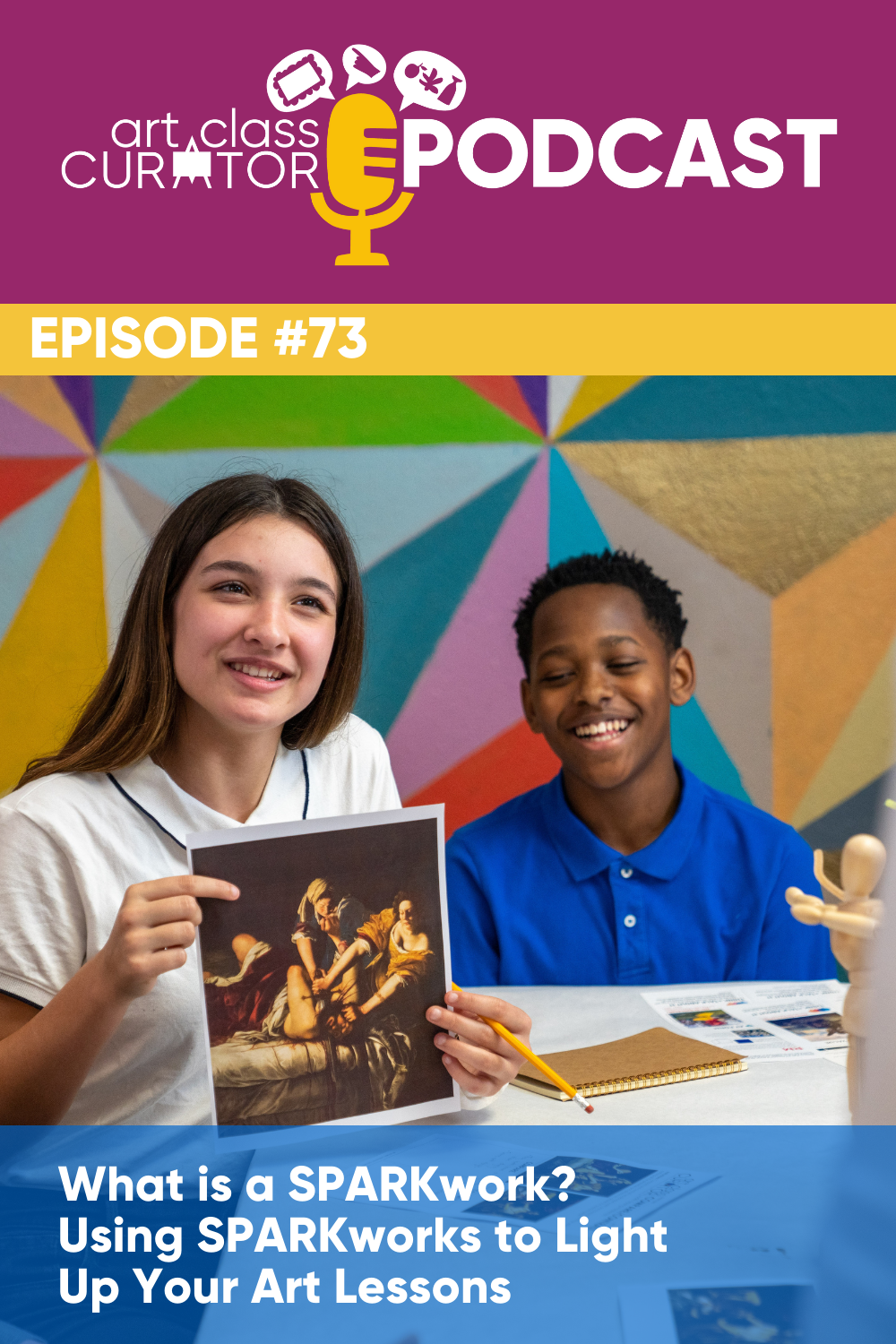
View in iTunes

Filed Under: Podcast


SPARKing Interest in Your Art Students with Teacher Staci Sterenberg

SPARKing Interest in Your Art Students

Believe it or not, the pandemic had its bright side. During this tumultuous year, we’ve had so many teachers across the nation successfully use our SPARK Hybrid curriculum. They’re sharing amazing stories about how they are SPARKing interest with art students and connecting with works of art. Today, I interviewed one of those teachers, Staci Sterenberg, who’s taught grades K-8 at a Chicago parochial school for 19 years.

Staci Sterenberg is a teaching artist living in Chicago. Her work as an art educator has brought her into classrooms and learning spaces for all ages and her art practice ranges in media from mosaic to sculpture to crochet. Her mission as an educator is to promote and value the creative experience while facilitating exploration in a variety of media. Her perfect world is a place where curiosity and creativity are free to discover and where mistakes are detours and not dead ends. Staci holds a Bachelor’s in Studio Art from Michigan State University and a Master’s of Art Education from the School of the Art Institute of Chicago.

In this episode, she and I discuss her feelings about being an artist, how the Coronavirus impacted her classroom, and the unexpected gifts she received from the pandemic. We also dive into some of the amazing lessons from SPARK that her kids participated in and greatly enjoyed this past school year.

Subscribe in Your Favorite Podcast Listening App

4:18​ – How Staci’s history lead her to teach art

6:19 – How SPARK influenced Staci’s education philosophy in the classroom

8:27 – Why Staci felt with her district and administration at the start of the school year

13:09 – A SPARK lesson that went particularly well with Staci’s 4th graders

17:24 – What made the lesson Staci found for her 7th and 8th grade classes so timely

23:01 – The art piece that proved to be a misstep for Staci’s e-learning students

30:23 – How the art teacher community online came together at the start of lockdown

32:16 – Staci’s big, one-word takeaway from this year to use in future years

35:54 – A false belief many people have about being a good artist

38:29 – How art got Staci through the pandemic and her identity crisis as COVID hit

44:42 – The blanket decision that prompted Staci to leave her school district

47:13 – A life philosophy that Staci learned from an old boss and wants to pass down

  • Free Lesson Sample
  • The Curated Connections Library
  • Reflecting Absence: September 11th Lesson Plans for Art Teachers
  • 9/11 Memorial – PWP Landscape Architecture

Be a Podcast Guest: Submit a Voice Memo of Your Art Story (Scroll to the bottom of the page to submit your story.)

Cindy Ingram: Hello and welcome to The Art Class Curator Podcast. I am Cindy Ingram, your host and the founder of Art Class Curator, and The Curated Connections Library. We’re here to talk about teaching art with purpose and inspiration from the daily delights of creativity to the messy mishaps that come with being a teacher. Whether you’re driving home from school or cleaning up your classroom for the 15th time today, take a second, take a deep breath, relax those shoulders, and let’s get started.

Hello everyone, this is Cindy Ingram. I just wanted to give you a little bit of a warning for this episode. I just got word back from my podcast editor that said the sound on this episode is weird. It was recorded a little bit too loud. I needed to have changed some settings on my microphone but it’s not too bad. I listen to it. I think that it is still listenable. I think it won’t bother you too much but I just wanted to apologize for that. It happens to the best of us. I hope you still enjoy this content and this lesson. Thanks so much. On to the episode.

Hello everybody and welcome back to The Art Class Curator Podcast. This is Cindy Ingram. Today, we’re going to talk about how to bring current events into your classroom, how to use art as a way to talk about the things that are going on in the world, and also, the things that have gone on in the past and using art as a tool to process, to reflect, to practice empathy, to better understand complex issues, and all of that can happen in these art lessons. The artwork that I want to talk about as the case study for this topic is the 9/11 Memorial. You know probably by now that 9/11 is around the corner. It is on Saturday this week. It is actually the 20th anniversary of September 11th. What is so shocking about this to me and so many other people is that our students weren’t alive. It was such a big thing in our lives. As time passes, more and more of the population wasn’t there, wasn’t alive, didn’t feel that impact, didn’t see what happened, how it changed, how our world went from one way to another way, almost overnight.

We’re seeing that now with current events now, like that mass trigger catalyst event is happening as we speak but with September 11th, our students just weren’t there. To start out this conversation, I am going to play a clip of a conversation that I had with Robyn Smith. Robyn is an art teacher in California. She has taught pre-K through eighth grade for the past 24 years. She, at the beginning of the 2020-2021 school year, purchased our SPARK Hybrid Learning Curriculum. The SPARK Hybrid Learning Curriculum, as you probably know by now, is actually a part of The Curated Connections Library. We merged the two programs together because it didn’t feel like it made sense to sell them separately anymore. Everything that you found in the SPARK Hybrid Learning Curriculum is also now in The Curated Connections Library.

The Curated Connections Library includes over 175 works of art. A wide variety of works of art that include a lot of activities that you can use in a hybrid setting. The art projects are idea centered and open-ended. They’re not media specific. There are videos and worksheets that are available in Google Classroom format so that you can easily send them to your remote student. For those of you who are experiencing the highs and lows of remote teaching right now or quarantining, the SPARK Hybrid Learning Curriculum inside The Curated Connections Library is a great place for you to find lessons.

Anyway, if you’re interested in checking it out, head over to artclasscurator.com/join. The doors are open and are remaining open. You can head over there to check it out. But in my conversation with Robyn, she shared one of the lessons that she used from the curriculum and how it impacted her students. I love this story that she tells about her student and how he took this lesson, and created something really fun and grand out of it. I’m going to go ahead and play that clip of my conversation with Robyn right now.

Robyn Smith: I bought your SPARK curriculum and used that. That was great. I really enjoyed using that. It worked so well for the online learners and in-class learners. Actually, it worked better for the online learners because they were at home and they could find things versus what I had available in the art room. 

Cindy Ingram: Things as in like supplies or as in like more information about the artwork?

Robyn Smith: I think supplies. I’ll give you an example. One of the lessons I did during 9/11 with the junior high kids was you had a lesson there. I felt like I was cheating using those lessons. It was so easy. With everything there, I put it on canvas and I was good to go. But there was a lesson about monuments and you talked about the 9/11 monument. I think that was cool because the kids didn’t know much about it unless they’d been to New York. Of course, they weren’t around at the time of 9/11. I had them interviewing their parents, “Where were you? What happened? Ask your grandparents what happened.” It was neat that they were able to come back and say, “Everybody remembers where they were when 9/11 happened.” Isn’t that crazy?

Then they had to choose a monument that they wanted to make. I had this one really creative—they were all creative—but one especially creative student who had just moved house. In the middle of doing online learning, his family moved to a new house, to a whole different area. He had a bunch of boxes around the house, so all of his projects involved moving boxes. He took a moving box and he said, “This is the monument to 2020.” One side of the box had a paper mask on it and some plastic gloves, like surgical gloves or whatever. In California, we had a lot of fires in the fall at that time. You’ve probably heard that in the news. He had flames and on one side of it was sticking out flames. Another sign, he had a big giant closed sign that flopped down because everything’s closed because of COVID. I think the third side, the riots that were happening during the fall. He had riots, he had grenades, he had all kinds of things probably you shouldn’t have had at school there. But anyway, it was very creative. I was really impressed with what he’d done.

Cindy Ingram: What I love about that story that you just said is that you’re teaching them history. In the last 20 years it was history, then they’re comparing that event to what they’re going through now because they’re also living through a big historical moment. You’re connecting it that way. He’s able to express his personal feelings about what happened and process that at the same time, and be creative and have this design challenge that was really open-ended. He was able to create something really grand out of that. You’re also having them engaged with the work of art and the 9/11 Memorial monument, and explore all of this through art. I’m just like, “Oh, that’s a beautiful teaching moment.” 

Thank you so much to Robyn Smith for sharing that lesson with you guys. Like I said in the clip, I really love how layered this lesson really is. On the surface, they’re looking at our artwork. They’re talking about it. They’re making an artwork in response but there is so much more happening beneath the surface. I love how she was talking about how she had them interview their parents, so they’re getting a little oral history, a moment. They’re having a connection moment between them and their family. They are really understanding the gravity of the experience, of what that experience was like and stepping into the shoes of people who lived through that. Those experiences when you really look at the past through the lens of art and through the lens of human experience, it really connects you to other people. It helps you develop empathy. It helps you really better understand how people react, respond, and live through big things.

Artists throughout time have used art as a way to process their feelings, to make a statement about something that happened, to change someone’s mind or to influence. I’m just thinking about Guernica, which I talked about with Jenn on the podcast just recently. How Picasso wasn’t a political artist and that bombing of the town of Guernica caused him to create that work of art in response. The same thing is true of Fernando Botero who creates those really joyful paintings. He’s from Colombia. He paints pictures of fat people. Apparently, it’s supposed to be like a cubism takeoff, we’re looking at a person from different points of view, but those paintings are just so happy and joyful. There’s music. There’s dancing. There’s family things. It’s very much not political on the surface anyway but then he created an entire series of artworks about the Abu Ghraib torture scandal back in the 2000s.

Whether it is making art or whether it is looking at art, we can use art as a way to help ourselves through big things. I think that is an amazing lesson for our students. I really encourage you to bring in artwork about things that are happening in the world and about things that happened in the past. On anniversaries of things, on Veterans Day, those holidays where you’re looking back at the past and you’re remembering, it’s a really great opportunity for you as the teacher to help create a full experience for the student because chances are in their English class, they’re going to be writing about it. In their history class, they’re going to be watching a video or talking about it. Throughout their experience of the school day on September 11th or well, it’s a Saturday but this week, they’re going to be hearing about September 11th from a variety of different places. I think that curriculum is best when it is cohesive and when it is integrated, when what’s happening in social studies feeds into what happens in art. What happens in art feeds into what happens in English. What happens in English feeds into what happens in other classes.

That is giving students such an amazing connected world view because the way we do education right now in our country, in most places, we divide everything by subject, then those subject teachers don’t ever really communicate too much with the other subject teachers. I guess at the state level, we have standards. The writers of the standards, in many cases, aligned the curriculum to where English and social studies are related, and that sort of thing. But it doesn’t really happen all that intentionally, I’ve seen in my experience. I think that using contemporary events as a way to connect is really important.

In The Curated Connections Library, we do have this lesson on the September 11th Memorial. Let me tell you a little bit about the Memorial. If you want to include it in your classroom this week, we will give you some information. We do have a blog post about this lesson as well, which I will include both a link to the blog post, which is free content and a link to the membership lesson. If you’re a member, you can visit the show notes today to find this lesson.

The September 11th Memorial was designed by architects Michael Arad and Peter Walker. In the footprint of the Twin Towers, they put bottomless reflecting pools. The title of the artwork is called Reflecting Absence. It’s like a big hole, then it has waterfalls that come from the side down into a lower level. Then inside that lower level, there is a hole, another hole, a square hole that the water continues to go down into. From the side, you cannot see the bottom of that second hole. It’s just like this abyss, then it’s just this dark thing and you can’t see it. The waterfalls descend 30 feet into the basin, then the smaller one goes down another 20 feet. It’s huge.

Another thing about the experience is the waterfall creates a really loud sound. It completely drowns out the noise of the city. When I visited, it was in 2014, they were still building the Freedom Tower. There was a ton of construction in the area and you couldn’t even really hear it. In New York, you’re always hearing the cabs and the people. There’s just the cars, the honking, and all of those things but the sound of that waterfall just completely drowned out the noise. I found that to be really powerful because it allowed me to really focus on what happened and where I am. It added to the solemnity of the experience. It helped me not be distracted. It helped me go into myself and not look around, and see what everyone else was doing.

Then along the side, there are bronze plaques that have the names of everyone who died in the attacks on 9/11 and also the World Trade Center bombing from 1993. They’re all along the edge engraved into the bronze. These reflecting pools are the exact same size and shape of the actual Twin Towers. When you’re standing there in front of them, you really realize how massive the buildings were, then it also helps you imagine the devastation that took place on September 11th.

The conversations that you can have with your students about this, I think it’s really important to show video of the Memorial pictures, just don’t do it justice because of the sound, because of the scale and the size. It’s important to look at it from multiple different angles. It’s important to see and hear the full experience because it is really a beautiful experience. When discussing this with your students, you want to really ask them questions about how all of the artist’s choices contribute to the feeling that it gives the person visiting. That’s one of my favorite questions to ask about an artwork is what did the artist do to make us feel this way? Yes, you can talk about how it makes you feel and explore that. I love talking about that but it’s really fun to pick that apart and get meta with it, then be like, “Okay, well, I’m feeling really anxious because the artist did this” or “I’m feeling really sad because the artist used this color, which really impacted the emotions.”

Like I said, Peter Walker and Michael Arad were the architects in charge of the Memorial. Michael Arad is the one who created the actual Memorial, the monument. When they wanted to create the Memorial, they opened it up for submissions of designs. There were at least five thousand entries for the Memorial during this international contest that was held in 2003. Michael Arad is Israeli-American. He was actually an eyewitness to the second plane, hitting the South Tower of the World Trade Center from the roof of his building that same day. This young architect, Michael Arad, then became a partner of Handle Architects who created the Memorial. He has won several awards for his work on the Memorial and has since been selected to design other Memorials.

In addition to the main Memorial design, Michael Arad partnered with Peter Walker who was a landscape architect. He designed the unique landscaping for the Memorial. His idea was to add a forest of oak trees to create a peaceful place for reflection and contemplation. He wanted those trees to mimic the arches that were located at the base of the original towers, which were designed by architect Minoru Yamasaki. You can visit his website. It’s PWP Landscape Architecture. We’re going to link to it in the show notes. But on that site, you can see the design process, you can see the symbolism for each part of the landscape, and everything like that. It’s pretty fun to see the problem solving that went into this Memorial and the symbolism as well.

The sound of the water washes out the sounds of the city but then the trees hide the sights of the city. They create this canopy over you as you’re walking up and prepare you to enter this sacred space. You see that happen in Japanese temples and things like that where the lead up to the event, to the actual full experience is there to help prepare you. You hear the sound of water. You hear the sound of the little tinkering chimes—I’m still talking about Japan—you hear all of that. It prepares you to enter. These trees do the same thing for you. If you visit the website of PWP Landscape Architecture, you can see pictures of the trees next to pictures of the arch design that I mentioned earlier. It’s really subtle but it’s a really beautiful detail.

The types of trees that they used were white oaks, which are symbols of strength, longevity and the symbolic weight that the architects were trying to convey in the design. One of the activities in this lesson is to explore the monument through the five senses. We have a 5 Senses worksheet where the kids go through the five senses and talk about how each one of them was represented in the artwork, what would it be like to be here, what would it feel like to be here, and also exploring what 9/11 was and talking about what they already know, then sharing with them your experience of it and inviting them to interview their family, which I thought was a really great touch added by Robyn in her clip there. Then talking about what is a Memorial and why we have them. If I were teaching this in my classroom, I would then have students do independent research on different Memorials or monuments. Maybe I would have a group work together to research a monument. I would give them one or have them research one to discover on their own or give them a list of ones that they might find interesting, then they choose from that list, then give them some questions to answer about their memorial, then they present those to the class.

I always love doing activities like that because it allows you to get in extra art. If you’re doing an artwork about a particular theme, you can always then bring in other artworks, have the kids work together to analyze them, then they get to share that with their classmates, what they learned. It gives them a little more ownership over the information, over the content provided in the class. It makes them a little bit more personally connected to it because you’ve got that element of choosing the one that they want to talk about, then it makes them motivated to learn about it because they’re going to have to do a presentation about it. I think there is a lot of good in that type of activity.

Then from there, that’s when I would have the students design and create a Memorial to remember an impactful historical event. It can be something right now, like what Robyn’s student did, or it can be something meaningful to the student. Maybe it’s a Holocaust Memorial. Maybe it is a Memorial of an individual person or an event in their family, or maybe it is another big event. They get to choose, then design a monument. One of my favorite things about these SPARK Works Lessons in The Curated Connections Library is that we give you the art project ideas that are meaningful to the art project but you really get to decide how that plays out in your classroom. That’s why these projects work really well for your remote students if you’re still teaching a hybrid or remote class because you can use any supplies, you can use that Memorial project, the student that Robyn talked about, created his out of boxes. Another student could get on their iPad and do Procreate. Another student could get some grid and graph paper, and make a plan, a blueprint. There’s so many different options. These experiences, we really feel like they are a great bridge between your choice-based classrooms and your more traditional classrooms where everyone’s doing the same thing. This is a really nice combination.

But obviously, you can take these lessons, then make them more or less structured. If you want to do memorial and everybody does it this one certain way, and everybody does it with these certain materials, say you’re teaching a graphic art class and you want to introduce them to architecture software or something like that, you could do that or if you’re teaching a 3D class, you could have them make a sculpture. If you’re teaching a painting class, you can have them do a painting. You can see how they’re really highly flexible. That’s really important to me as a teacher because I never follow a lesson plan 100%. I love to add my own spin to it. I love to take in my expertise and mold that into the lesson. We love to make these lessons really flexible.

That’s the full lesson available in The Curated Connections Library. There’s a lesson plan. There are the Powerpoints you need with images, the videos we’ve curated and watched to know if they’re good or not. We have multiple worksheets. We have multiple worksheets including that 5 Senses worksheet, the What I Already Know and also What I Think worksheet, then there are videos for all of our new SPARK Work lessons. This one is one of those that includes a video. That’s really good for your remote students especially, because they might not have you there to give them some of the information. But I always recommend having them watch the video after they’ve done the activities because you really want them to think for themselves first before you give them any information.

Along these same lines of taking current events, holidays, and things like that and incorporating them into your classroom, it doesn’t have to be this long extended unit. It can just be one day this week, you go in and you talk about that 9/11 Memorial, and do a one day experience. This is really great to add into your curriculum for a lot of reasons, both logistical and for education purposes. We know the  educational value of adding more works of art into your curriculum. We know it’s going to help your student’s critical thinking skills, their empathy, their connection, their tolerance, their communication skills, their self-awareness, their emotional fluency, all those things I talk about all the time but also, it’s going to help you with your lessons because when you’re planning out your lessons for a week, say one day of every week is an art connection experience that you grab from The Curated Connections Library, that is one day of every month or every week that you’ve got plans for, that you don’t have to worry about creating a lesson plan for. It’s ready to go. Even if you’re doing a completely different style of curriculum the rest of the week where you’re maybe really focused on studio or maybe there’s all sorts of other things that you could be doing in art class, this gives them that one time a week where they’re truly connecting with the works of art and doing these activities, then your lessons are done for that day.

It also is really helpful I found, you know that when you’re teaching multiple classes and if you’re doing the same project with them, there’s always one class that gets behind or one class that gets ahead or one class that half the kids were absent because they were taking a makeup test or the other half of the kids were gone the other time, they’re pull outs for something else. There are always kids being pulled out for different things and getting kids behind. That day, I always used to, as a buffer day. If one class was really far behind, we would do the art connection experience at the beginning, then give them more time to get caught up on their assignments. It was a really good way to balance out the work and fill those times.

Adding in a weekly art connection experience that’s outside of your normal curriculum also will allow you to show more works of art and create more diversity in your experiences. Say you’re doing a really comprehensive project that’s going to take multiple weeks—three, four weeks, five weeks and you’re still working on this project—that’s five weeks that they are only working on that project. They’re not getting to explore a lot of other art content as they’re doing it. Throwing in these art connection days will allow you to show your students work from around the world, from across times and really allow them to experience all that art has to offer. It’s like bonus art throughout their lives.

That’s my episode for today. I hope it encourages you to bring this artwork into your curriculum this week or if you’re watching this after September 11th, you still can bring it in or save it for next year. If you want to download this lesson, you can get it in The Curated Connections Library. If you are not a member, you can head over to artclasscurator.com/join. As a bonus for listening to this episode, I am going to offer you $10 off of your first month. If you are not a member and you want to come in, and check it out, just enter the coupon code “Memorial”. That will give you $10 off your first month’s membership. That is for the Museum Level membership. We have two levels. If you get the Gallery Level membership, this artwork is from a past month, so it won’t be in your membership. Make sure you get the Museum Level membership to access this lesson. Thank you so much for listening today. I will be back next week. Have a wonderful day, bye.

When you’re a teacher, one thing is certain, the lesson planning never ends. The Curated Connections Library is here to help with hundreds of art connection lessons and activities. Our signature SPARK Works lessons include everything you need to teach an artwork every single week. Each lesson features one diverse and captivating work of art and is complete with discussion questions, engaging activities to create deeper art connections, and related art project ideas. With unique worksheets and PowerPoint presentations, every lesson is classroom-ready. Get your free SPARK Works lesson and take a break from lesson planning by going to artclasscurator.com/freelesson.

Thank you so much for listening to The Art Class Curator Podcast. If you like what you hear, please subscribe and give us an honest rating on iTunes to help other teachers find us, and hear these amazing art conversations and art teacher insights. Be sure to tune in next week for more art inspiration and curated conversations.

Free Resource!

82 Questions About Art

82 questions you can use to start and extend conversations about works of art with your classroom. Free download includes a list plus individual question cards perfect for laminating!

Download

Free Resource!

82 Questions About Art

82 questions you can use to start and extend conversations about works of art with your classroom. Free download includes a list plus individual question cards perfect for laminating!

Subscribe and Review in iTunes

Have you subscribed to the podcast? I don’t want you to miss an episode and we have a lot of good topics and guests coming up! Click here to subscribe on iTunes!

If you are feeling extra kind, I would LOVE it if you left us a review on iTunes too! These reviews help others find the podcast and I truly love reading your feedback. You can click here to review and select “Write a Review” and let me know what you love best about the podcast!
View in iTunes

Filed Under: Podcast


  • Previous Page
  • Page 1
  • Page 2
  • Page 3
  • Page 4
  • Page 5
  • Page 6
  • Interim pages omitted …
  • Page 38
  • Next Page

Primary Sidebar

Hi! I’m Cindy Ingram, the creator of Art Class Curator and The Curated Connections Library

I’m on a mission to revolutionize education with the power of life-changing art connections. Art is not “extra”. Art is essential. We are empowering teachers to bridge the gap between art making and art connection, kindling a passion for art that will transform generations.

More About Me

Free Worksheets!

-Free Bundle of Art Appreciation Worksheets-

In this free bundle of art worksheets, you receive six ready-to-use art worksheets with looking activities designed to work with almost any work of art.

Download

Free Worksheets!

-Free Bundle of Art Appreciation Worksheets-

In this free bundle of art worksheets, you receive six ready-to-use art worksheets with looking activities designed to work with almost any work of art.

Enrollment in Curated Connections Library is currently open. Click here to join. Join our list to get more information and to get a free lesson from the vault! If you are purchasing for a school or school district, head over here for more information.

Check Out What’s New In The Shop

Experience Art: Engaging Art Criticism Discussions and Activities for Teachers and Students of All Ages
Call to Art: An Un-Conference for Art Educators
Curated Connections Library Membership
Perspectives High School Curriculum

More Products

Have You Listened to the Latest Podcast Episode?

Falling for Naudline Pierre’s Evocative Art: A Conversation with Madalyn (Part 2)

More Episodes

Testimonials

I like how this program, unlike other art class resource membership programs, feels authentic. It's like art matters more here, and not fancy flash-in-the-pan trendiness. The goal of Art Class Curator seemed to be helping kids develop a lifelong love and art appreciation versus "Hey, look. I painted this fish."
Erin A.
Your questions are helping me to delve into much deeper learning, and my students are getting better at discussion-and then, making connections in their own work. Art Class Curator is awesome!
Denise W.
Interestingly, my lower performing classes really get engaged in these [lessons] and come away with some profound thoughts!
Melissa G.
I had the most amazing 6th grade class today. They were jumping out of their seats with hands raised just to respond and give input. It was as if I was waving candy in front of them! They saw more and more and the ideas and interpretations unfolded. So cool!!! This is what makes teaching art so wonderful – thank you!!
Caroline G.
I just wanted to thank you for the invaluable resource you have through Art Class Curator. Not only do you have thought provoking activities and discussion prompts, but it saves me so much time in preparing things for myself! I feel like I’ve only scratched the surface with your site.
Maryjane F.

Get Art Inspiration To Your Inbox!

Enter your email address to get regular art inspiration to your inbox
plus a BUNDLE OF 6 FREE WORKSHEETS!
We hate SPAM and promise to keep your email address safe.
Download

Free Worksheets!

*Free Bundle of Art Appreciation Worksheets*

In this free bundle of art worksheets, you receive six ready-to-use art worksheets with looking activities designed to work with almost any work of art.

Copyright © 2026 Ignite Art, LLC DBA Art Class Curator •  All rights reserved  •  Privacy Policy  •  Terms of Service  •  Site Design by Emily White Designs